5
#000000
#FFFFFF
To donate by check, phone, or other method, see our More Ways to Give page.
Daily news & progressive opinion—funded by the people, not the corporations—delivered straight to your inbox.

Writers Guild of America (WGA) East members walk a picket line at the Paramount+ Summit outside the Paramount Building in Times Square on May 17, 2023 in New York City.
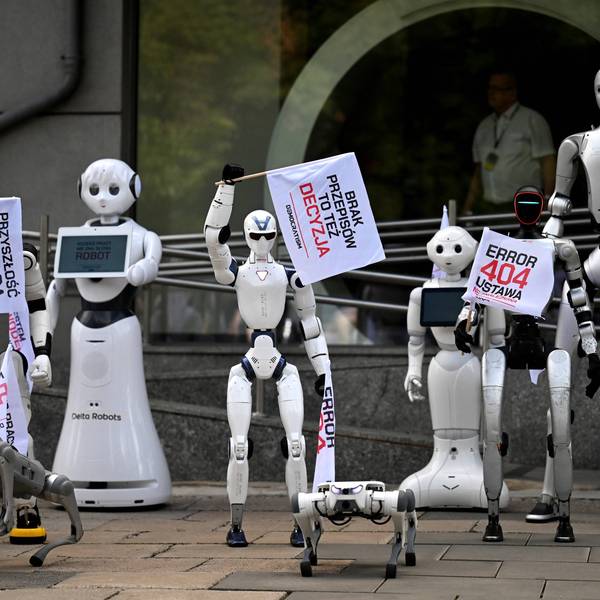
There is broad and deep recognition that AI technology will reshape the future of work, and unions have decided to roll up their sleeves (and dust off their picket signs) to bargain how AI will be implemented, to do what, and to what effect.
For many pundits and policymakers, there is little doubt that Artificial Intelligence will devour the jobs of millions of people, including professionals formerly presumed immune to technological replacement. The only question is how many jobs will be lost, how quickly. In fact, there is nothing inevitable about AI—not its development, its deployment, or its impact. Massive job losses are not inherent in the algorithm, preordained by the laws of nature and physics. Rather than remaining struck by awe, we can reassert human agency over this technology. We can not only save jobs, but perhaps even make them better.
AI is not an abstract force that operates solely at the macroeconomic level. AI systems and agents are developed and implemented in ways specific to each sector, each workplace, each type of job. Although employers might focus myopically on cutting their wage bill, their employees know firsthand how the work actually gets done. They know what disclosures to request about how the technology would be used. They know how AI might affect the content and flow of their work, what training would be most helpful, and which implementations would be most likely to devalue their labor versus those most likely to enhance it. Thus, the most effective way to ensure that AI makes work life better and not worse is to empower workers to bargain about it.
By “workers” I mean people who rely on their own labor to earn a living—which is to say, most of us, whether we write reports, treat patients, teach kids, manufacture products, or stock warehouses. AI is not something that’s going to happen only to other people; it will affect all of us.
Workers need the authority and the power to bargain about the implementation of AI in the workplace, not just the effects. “Effects bargaining” is the traditional approach: After a technology has wiped out jobs, people negotiate a little severance pay to tide them over, and maybe some training for completely different jobs, if any such jobs exist. By contrast, our goal should be to make sure workers can negotiate for technology that makes their jobs better, more productive, more valuable. To avoid the car crash in the first place, if you will, and not just to apportion damages afterward.
AI will not destroy or devalue our jobs by itself, unless we let it.
One can imagine some objections to this approach. Some people might insist that AI is in irresistible force, that large-scale job destruction is inevitable, and that our task is to figure out other things for people to do to earn a living—or, if that’s not possible, to pay them a small stipend so they don’t starve. This defeatism is a short step away from the more nihilistic vision of the pure doomers, who think it might already be too late to save humanity from machine-led destruction. I love science fiction myself—but it is fiction, not history.
Another objection might be that placing restraints of any kind on AI companies in the United States will keep the industry from winning the global race for dominance. This is the Trump administration’s view. This logic is inverted. Nations should be governed for the benefit of their people, not just their Big Tech companies. Both the Republican and Democratic parties proclaim themselves to be the champions of the American worker. If so, the real triumph for the nation would be to ensure that technology enhances work and makes working people’s lives better, not to create havoc and economic devastation across the labor market.
Some might object that it is unrealistic to think that working people have the interest or ability to intervene effectively, to exercise their right to bargain about AI technology. But that is exactly what has been happening in the entertainment industry. One of the central issues in the 2023 strike by the Writers Guild of America against the Hollywood studios and producers was the use of AI in writers’ workplaces. The Guild represents the professionals who create scripts for TV and streaming series and for feature films. In late 2022 Open AI revealed that ChatGPT could write—coherently and at some length. Although the union did not conclude that robots had suddenly become capable of crafting award-winning scripts, Guild members recognized that their employers could use AI to do just enough to degrade and devalue their work.
During contract talks in 2023 the Guild proposed—and won, after a five-month strike—language that puts meaningful guardrails on the use of AI. These guardrails reflect the process writers and studios actually use to create characters and stories and full-length projects. They ensure that AI cannot be used to deprive writers of the opportunity to do the full range of writing work, and they deprive employers of the economic incentive to replace professional writers with algorithms. Guild members knew how to defend their careers, and they fought for meaningful protections.
The Guild members’ willingness to take on the AI issue, rather than passively accept that the technology would hollow out their careers, resonated with working people everywhere. The actors’ union (SAG AFTRA) also struck and won contract protections on AI, and the following year the other entertainment industry unions did the same. The entire labor movement has made workplace AI a top priority. There is broad and deep recognition that AI technology will reshape the future of work, and unions have decided to roll up their sleeves (and dust off their picket signs) to bargain how AI will be implemented, to do what, to what effect.
AI systems do not develop themselves; AI companies do. AI does not implement itself in the workplace; employers do. AI will not destroy or devalue our jobs by itself, unless we let it. Working people can and must protect their livelihoods by bargaining over AI implementation. Nothing less than the future of work is at stake.
Dear Common Dreams reader, It’s been nearly 30 years since I co-founded Common Dreams with my late wife, Lina Newhouser. We had the radical notion that journalism should serve the public good, not corporate profits. It was clear to us from the outset what it would take to build such a project. No paid advertisements. No corporate sponsors. No millionaire publisher telling us what to think or do. Many people said we wouldn't last a year, but we proved those doubters wrong. Together with a tremendous team of journalists and dedicated staff, we built an independent media outlet free from the constraints of profits and corporate control. Our mission has always been simple: To inform. To inspire. To ignite change for the common good. Building Common Dreams was not easy. Our survival was never guaranteed. When you take on the most powerful forces—Wall Street greed, fossil fuel industry destruction, Big Tech lobbyists, and uber-rich oligarchs who have spent billions upon billions rigging the economy and democracy in their favor—the only bulwark you have is supporters who believe in your work. But here’s the urgent message from me today. It's never been this bad out there. And it's never been this hard to keep us going. At the very moment Common Dreams is most needed, the threats we face are intensifying. We need your support now more than ever. We don't accept corporate advertising and never will. We don't have a paywall because we don't think people should be blocked from critical news based on their ability to pay. Everything we do is funded by the donations of readers like you. When everyone does the little they can afford, we are strong. But if that support retreats or dries up, so do we. Will you donate now to make sure Common Dreams not only survives but thrives? —Craig Brown, Co-founder |
For many pundits and policymakers, there is little doubt that Artificial Intelligence will devour the jobs of millions of people, including professionals formerly presumed immune to technological replacement. The only question is how many jobs will be lost, how quickly. In fact, there is nothing inevitable about AI—not its development, its deployment, or its impact. Massive job losses are not inherent in the algorithm, preordained by the laws of nature and physics. Rather than remaining struck by awe, we can reassert human agency over this technology. We can not only save jobs, but perhaps even make them better.
AI is not an abstract force that operates solely at the macroeconomic level. AI systems and agents are developed and implemented in ways specific to each sector, each workplace, each type of job. Although employers might focus myopically on cutting their wage bill, their employees know firsthand how the work actually gets done. They know what disclosures to request about how the technology would be used. They know how AI might affect the content and flow of their work, what training would be most helpful, and which implementations would be most likely to devalue their labor versus those most likely to enhance it. Thus, the most effective way to ensure that AI makes work life better and not worse is to empower workers to bargain about it.
By “workers” I mean people who rely on their own labor to earn a living—which is to say, most of us, whether we write reports, treat patients, teach kids, manufacture products, or stock warehouses. AI is not something that’s going to happen only to other people; it will affect all of us.
Workers need the authority and the power to bargain about the implementation of AI in the workplace, not just the effects. “Effects bargaining” is the traditional approach: After a technology has wiped out jobs, people negotiate a little severance pay to tide them over, and maybe some training for completely different jobs, if any such jobs exist. By contrast, our goal should be to make sure workers can negotiate for technology that makes their jobs better, more productive, more valuable. To avoid the car crash in the first place, if you will, and not just to apportion damages afterward.
AI will not destroy or devalue our jobs by itself, unless we let it.
One can imagine some objections to this approach. Some people might insist that AI is in irresistible force, that large-scale job destruction is inevitable, and that our task is to figure out other things for people to do to earn a living—or, if that’s not possible, to pay them a small stipend so they don’t starve. This defeatism is a short step away from the more nihilistic vision of the pure doomers, who think it might already be too late to save humanity from machine-led destruction. I love science fiction myself—but it is fiction, not history.
Another objection might be that placing restraints of any kind on AI companies in the United States will keep the industry from winning the global race for dominance. This is the Trump administration’s view. This logic is inverted. Nations should be governed for the benefit of their people, not just their Big Tech companies. Both the Republican and Democratic parties proclaim themselves to be the champions of the American worker. If so, the real triumph for the nation would be to ensure that technology enhances work and makes working people’s lives better, not to create havoc and economic devastation across the labor market.
Some might object that it is unrealistic to think that working people have the interest or ability to intervene effectively, to exercise their right to bargain about AI technology. But that is exactly what has been happening in the entertainment industry. One of the central issues in the 2023 strike by the Writers Guild of America against the Hollywood studios and producers was the use of AI in writers’ workplaces. The Guild represents the professionals who create scripts for TV and streaming series and for feature films. In late 2022 Open AI revealed that ChatGPT could write—coherently and at some length. Although the union did not conclude that robots had suddenly become capable of crafting award-winning scripts, Guild members recognized that their employers could use AI to do just enough to degrade and devalue their work.
During contract talks in 2023 the Guild proposed—and won, after a five-month strike—language that puts meaningful guardrails on the use of AI. These guardrails reflect the process writers and studios actually use to create characters and stories and full-length projects. They ensure that AI cannot be used to deprive writers of the opportunity to do the full range of writing work, and they deprive employers of the economic incentive to replace professional writers with algorithms. Guild members knew how to defend their careers, and they fought for meaningful protections.
The Guild members’ willingness to take on the AI issue, rather than passively accept that the technology would hollow out their careers, resonated with working people everywhere. The actors’ union (SAG AFTRA) also struck and won contract protections on AI, and the following year the other entertainment industry unions did the same. The entire labor movement has made workplace AI a top priority. There is broad and deep recognition that AI technology will reshape the future of work, and unions have decided to roll up their sleeves (and dust off their picket signs) to bargain how AI will be implemented, to do what, to what effect.
AI systems do not develop themselves; AI companies do. AI does not implement itself in the workplace; employers do. AI will not destroy or devalue our jobs by itself, unless we let it. Working people can and must protect their livelihoods by bargaining over AI implementation. Nothing less than the future of work is at stake.
For many pundits and policymakers, there is little doubt that Artificial Intelligence will devour the jobs of millions of people, including professionals formerly presumed immune to technological replacement. The only question is how many jobs will be lost, how quickly. In fact, there is nothing inevitable about AI—not its development, its deployment, or its impact. Massive job losses are not inherent in the algorithm, preordained by the laws of nature and physics. Rather than remaining struck by awe, we can reassert human agency over this technology. We can not only save jobs, but perhaps even make them better.
AI is not an abstract force that operates solely at the macroeconomic level. AI systems and agents are developed and implemented in ways specific to each sector, each workplace, each type of job. Although employers might focus myopically on cutting their wage bill, their employees know firsthand how the work actually gets done. They know what disclosures to request about how the technology would be used. They know how AI might affect the content and flow of their work, what training would be most helpful, and which implementations would be most likely to devalue their labor versus those most likely to enhance it. Thus, the most effective way to ensure that AI makes work life better and not worse is to empower workers to bargain about it.
By “workers” I mean people who rely on their own labor to earn a living—which is to say, most of us, whether we write reports, treat patients, teach kids, manufacture products, or stock warehouses. AI is not something that’s going to happen only to other people; it will affect all of us.
Workers need the authority and the power to bargain about the implementation of AI in the workplace, not just the effects. “Effects bargaining” is the traditional approach: After a technology has wiped out jobs, people negotiate a little severance pay to tide them over, and maybe some training for completely different jobs, if any such jobs exist. By contrast, our goal should be to make sure workers can negotiate for technology that makes their jobs better, more productive, more valuable. To avoid the car crash in the first place, if you will, and not just to apportion damages afterward.
AI will not destroy or devalue our jobs by itself, unless we let it.
One can imagine some objections to this approach. Some people might insist that AI is in irresistible force, that large-scale job destruction is inevitable, and that our task is to figure out other things for people to do to earn a living—or, if that’s not possible, to pay them a small stipend so they don’t starve. This defeatism is a short step away from the more nihilistic vision of the pure doomers, who think it might already be too late to save humanity from machine-led destruction. I love science fiction myself—but it is fiction, not history.
Another objection might be that placing restraints of any kind on AI companies in the United States will keep the industry from winning the global race for dominance. This is the Trump administration’s view. This logic is inverted. Nations should be governed for the benefit of their people, not just their Big Tech companies. Both the Republican and Democratic parties proclaim themselves to be the champions of the American worker. If so, the real triumph for the nation would be to ensure that technology enhances work and makes working people’s lives better, not to create havoc and economic devastation across the labor market.
Some might object that it is unrealistic to think that working people have the interest or ability to intervene effectively, to exercise their right to bargain about AI technology. But that is exactly what has been happening in the entertainment industry. One of the central issues in the 2023 strike by the Writers Guild of America against the Hollywood studios and producers was the use of AI in writers’ workplaces. The Guild represents the professionals who create scripts for TV and streaming series and for feature films. In late 2022 Open AI revealed that ChatGPT could write—coherently and at some length. Although the union did not conclude that robots had suddenly become capable of crafting award-winning scripts, Guild members recognized that their employers could use AI to do just enough to degrade and devalue their work.
During contract talks in 2023 the Guild proposed—and won, after a five-month strike—language that puts meaningful guardrails on the use of AI. These guardrails reflect the process writers and studios actually use to create characters and stories and full-length projects. They ensure that AI cannot be used to deprive writers of the opportunity to do the full range of writing work, and they deprive employers of the economic incentive to replace professional writers with algorithms. Guild members knew how to defend their careers, and they fought for meaningful protections.
The Guild members’ willingness to take on the AI issue, rather than passively accept that the technology would hollow out their careers, resonated with working people everywhere. The actors’ union (SAG AFTRA) also struck and won contract protections on AI, and the following year the other entertainment industry unions did the same. The entire labor movement has made workplace AI a top priority. There is broad and deep recognition that AI technology will reshape the future of work, and unions have decided to roll up their sleeves (and dust off their picket signs) to bargain how AI will be implemented, to do what, to what effect.
AI systems do not develop themselves; AI companies do. AI does not implement itself in the workplace; employers do. AI will not destroy or devalue our jobs by itself, unless we let it. Working people can and must protect their livelihoods by bargaining over AI implementation. Nothing less than the future of work is at stake.