

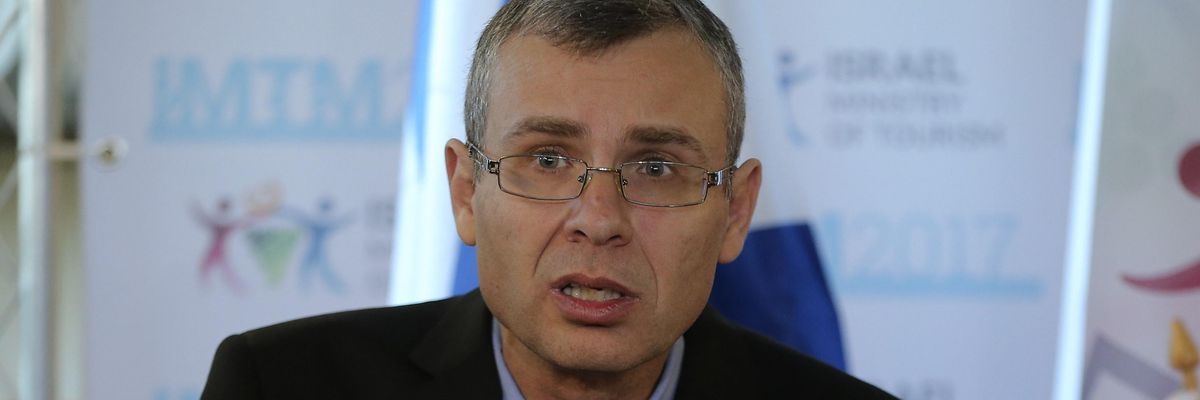
Israeli Justice Minister Yariv Levin, seen here in 2017, has proposed sweeping judiciary reforms widely condemned in his country and beyond.
Israeli Government Accused of 'Assassinating Democracy' With Proposed Judiciary Overhaul
"It is not necessary to send the Proud Boys to storm the Capitol to attempt a coup," said one former Israeli ambassador. "Abusing a tiny legislative majority to crush the judiciary and the nature of Israel's democracy is also a coup."
Israeli liberals and critics around the world sounded the alarm Thursday over a plan by Israel's new far-right government to dramatically limit the power of the country's judiciary, in part by allowing a simple parliamentary majority to overturn Supreme Court rulings.
On Wednesday, Israeli Justice Minister Yariv Levin—a member of Prime Minister Benjamin Netanyahu's Likud party—released a set of proposals he said were aimed at "strengthening democracy, rehabilitating governance, restoring faith in the judicial system, and rebalancing the three branches of government."
"Judicial review? Gone. Separation of powers? Dead. Checks and balances? Kiss it goodbye."
However, opponents of the plan condemned it as a "political coup" and a "dagger in the rule of law."
"The night of January 4, 2023 will go down in history as the beginning of the regime coup in Israel, on its way to becoming a clone of Hungary/Poland/Russia/Turkey," journalist Yossi Verter wrote for the liberal Israeli newspaper Haaretz.
"A democratically elected government is assassinating democracy, for the glory of so-called democracy... on the way to the next step, the annulment of Netanyahu's trial," he added, referring to the prime minister's ongoing corruption case.
U.S.-based Partners for a Progressive Israel tweeted: "Judicial review? Gone. Separation of powers? Dead. Checks and balances? Kiss it goodbye."
The most contentious part of Levin's plan is an "override clause" that would allow a 50%+1 parliamentary majority to override rulings issued by the Supreme Court, which also sits as the High Court of Justice and has been accused by human rights groups of giving legal cover to war crimes and crimes against humanity including apartheid and the illegal occupation of Palestine.
As Haaretz's Amir Tibon noted: "Israel does not have a constitution, and the separation between the legislative and executive branches is very weak as the government almost always holds a majority in the Knesset [parliament]. This makes the Supreme Court the only institution with the power to limit government actions and legislation passed by a parliamentary majority. Now Levin wants to take that power away."
"For instance," he added, " if the government passed a law that clearly favored ultra-Orthodox citizens and hurt the rights of secular Israelis, and the Supreme Court then struck it down, all it would take to reinstate the discriminatory law is 61 votes in the Knesset."
Levin's proposal would also change how Israel's judges are selected.
"Today, the Judicial Appointments Committee includes politicians from both the government and the opposition, judges, and representatives of the Israel Bar Association," Tibon explained. "Levin wants to increase the power of the politicians and decrease that of judges and lawyers, effectively giving the government the power to appoint judges and, critically, Supreme Court justices."
The Israel Bar Association opposes Levin's proposal.
"Another change he wants to promote is to make it more difficult for the Supreme Court to annul legislation by requiring a larger majority of justices, and not just a regular majority, for any such decision to take effect," Tibon added. When this idea is combined with increasing the government's control over judicial appointments and the override clause, it becomes clear that Levin, in essence, wants the Supreme Court's ability to conduct judicial reviews to become a dead letter."
Furthermore, Levin's proposal would turn legal advisers who serve government ministries from professional appointees accountable to the attorney general into political appointments controlled by Cabinet ministers.
Finally, Levin is seeking to rescind the "reasonableness" standard used by the Supreme Court to overrule egregious government decisions like then-Prime Minister Yitzhak Rabin's refusal to fire Cabinet Minister Aryeh Deri, leader of the ultra-Orthodox Shas party, after a 1993 fraud and bribery indictment.
Levin's proposal came a day before the High Court of Justice heard arguments for and against the so-called Deri Law, legislation recently passed by the Knesset to allow Deri to serve as minister of both health and the interior despite his prior conviction and imprisonment for bribery, tax fraud, and breach of trust.
Levin's predecessor, Gideon Sa'ar, likened the proposed judiciary overhaul to "regime change," while Benny Gantz, leader of the opposition National Unity Party, called the plan "a major danger to the private citizen."
"We don't have a balanced system. We don't have a constitution to protect us. We don't have two houses [of parliament]," Gantz told Haaretz. "We have a government that with its majority controls the Knesset, and now together they will control the court."
Yair Lapid, who stepped down as Israel's prime minister last week and now leads the opposition, wrote: "Like a gang of criminals, the day before the High Court hearing on the Deri law, the government placed a loaded gun on the table. What Yariv Levin presented today is not legal reform, but rather a threatening letter. They are threatening to destroy the entire constitutional structure of Israel."
"A country that removes basic democratic checks and balances and eviscerates the independence of the judiciary can no longer be referred to seriously as a full democracy."
Daniel Sokatch, CEO of the liberal, U.S.-based New Israel Fund, said in a statement that "a country that removes basic democratic checks and balances and eviscerates the independence of the judiciary can no longer be referred to seriously as a full democracy."
"If Israel's new ruling coalition approves this legislation, it would strip power from the High Court of Justice, one of the few remaining institutions willing to protect human rights, individual freedoms, and democratic values," he continued.
"The international community, including the United States government, should see this move for what it is," Sokatch added, "a lurch towards autocracy, weakening Israel's legal system and democracy, and paving the way towards an attempt to further marginalize the most vulnerable in Israel and under Israel's control, including Palestinians, Arab citizens of Israel, members of the LGBTQ+ community, and migrants."
We are at a crossroads
This country and this world are at a monumental crossroads. In a few short weeks, US voters will have an opportunity to beat back the forces of fascism and confront the billionaires who are rigging the economy, our media system, and our democracy, making it increasingly impossible for ordinary people to get by. We’re not just talking about the election. We’re talking about what must be done once these fascist elements are vanquished from power. We need a bolder set of solutions than what either major party has so far been willing to offer and a working-class movement ready to fight like hell for it. Trump didn't emerge from nowhere. The conditions that fueled MAGA authoritarianism were created by decades of radical neoliberal economic policies and a corrupt political system dominated by corporate interests. They slashed taxes on the super-rich, promising that the benefits would trickle down. They said giveaways to the corporate titans would make life more affordable for the rest of us. It was all bullshit. And when a bitter, betrayed populace searches for someone to blame, right-wing demagogues have little trouble finding scapegoats. People know when they're being lied to, but you won't hear any of this from the corporate media. Only independent journalism—powered and funded by people who believe in building a better world—can deliver truly trustworthy daily news. Our Fall Campaign is underway, and we need your help. To power our newsroom through the rest of the year, we need to raise $125,000 by midnight on October 31. So if you share our vision, please contribute whatever you can to sustain our work. |
Israeli liberals and critics around the world sounded the alarm Thursday over a plan by Israel's new far-right government to dramatically limit the power of the country's judiciary, in part by allowing a simple parliamentary majority to overturn Supreme Court rulings.
On Wednesday, Israeli Justice Minister Yariv Levin—a member of Prime Minister Benjamin Netanyahu's Likud party—released a set of proposals he said were aimed at "strengthening democracy, rehabilitating governance, restoring faith in the judicial system, and rebalancing the three branches of government."
"Judicial review? Gone. Separation of powers? Dead. Checks and balances? Kiss it goodbye."
However, opponents of the plan condemned it as a "political coup" and a "dagger in the rule of law."
"The night of January 4, 2023 will go down in history as the beginning of the regime coup in Israel, on its way to becoming a clone of Hungary/Poland/Russia/Turkey," journalist Yossi Verter wrote for the liberal Israeli newspaper Haaretz.
"A democratically elected government is assassinating democracy, for the glory of so-called democracy... on the way to the next step, the annulment of Netanyahu's trial," he added, referring to the prime minister's ongoing corruption case.
U.S.-based Partners for a Progressive Israel tweeted: "Judicial review? Gone. Separation of powers? Dead. Checks and balances? Kiss it goodbye."
The most contentious part of Levin's plan is an "override clause" that would allow a 50%+1 parliamentary majority to override rulings issued by the Supreme Court, which also sits as the High Court of Justice and has been accused by human rights groups of giving legal cover to war crimes and crimes against humanity including apartheid and the illegal occupation of Palestine.
As Haaretz's Amir Tibon noted: "Israel does not have a constitution, and the separation between the legislative and executive branches is very weak as the government almost always holds a majority in the Knesset [parliament]. This makes the Supreme Court the only institution with the power to limit government actions and legislation passed by a parliamentary majority. Now Levin wants to take that power away."
"For instance," he added, " if the government passed a law that clearly favored ultra-Orthodox citizens and hurt the rights of secular Israelis, and the Supreme Court then struck it down, all it would take to reinstate the discriminatory law is 61 votes in the Knesset."
Levin's proposal would also change how Israel's judges are selected.
"Today, the Judicial Appointments Committee includes politicians from both the government and the opposition, judges, and representatives of the Israel Bar Association," Tibon explained. "Levin wants to increase the power of the politicians and decrease that of judges and lawyers, effectively giving the government the power to appoint judges and, critically, Supreme Court justices."
The Israel Bar Association opposes Levin's proposal.
"Another change he wants to promote is to make it more difficult for the Supreme Court to annul legislation by requiring a larger majority of justices, and not just a regular majority, for any such decision to take effect," Tibon added. When this idea is combined with increasing the government's control over judicial appointments and the override clause, it becomes clear that Levin, in essence, wants the Supreme Court's ability to conduct judicial reviews to become a dead letter."
Furthermore, Levin's proposal would turn legal advisers who serve government ministries from professional appointees accountable to the attorney general into political appointments controlled by Cabinet ministers.
Finally, Levin is seeking to rescind the "reasonableness" standard used by the Supreme Court to overrule egregious government decisions like then-Prime Minister Yitzhak Rabin's refusal to fire Cabinet Minister Aryeh Deri, leader of the ultra-Orthodox Shas party, after a 1993 fraud and bribery indictment.
Levin's proposal came a day before the High Court of Justice heard arguments for and against the so-called Deri Law, legislation recently passed by the Knesset to allow Deri to serve as minister of both health and the interior despite his prior conviction and imprisonment for bribery, tax fraud, and breach of trust.
Levin's predecessor, Gideon Sa'ar, likened the proposed judiciary overhaul to "regime change," while Benny Gantz, leader of the opposition National Unity Party, called the plan "a major danger to the private citizen."
"We don't have a balanced system. We don't have a constitution to protect us. We don't have two houses [of parliament]," Gantz told Haaretz. "We have a government that with its majority controls the Knesset, and now together they will control the court."
Yair Lapid, who stepped down as Israel's prime minister last week and now leads the opposition, wrote: "Like a gang of criminals, the day before the High Court hearing on the Deri law, the government placed a loaded gun on the table. What Yariv Levin presented today is not legal reform, but rather a threatening letter. They are threatening to destroy the entire constitutional structure of Israel."
"A country that removes basic democratic checks and balances and eviscerates the independence of the judiciary can no longer be referred to seriously as a full democracy."
Daniel Sokatch, CEO of the liberal, U.S.-based New Israel Fund, said in a statement that "a country that removes basic democratic checks and balances and eviscerates the independence of the judiciary can no longer be referred to seriously as a full democracy."
"If Israel's new ruling coalition approves this legislation, it would strip power from the High Court of Justice, one of the few remaining institutions willing to protect human rights, individual freedoms, and democratic values," he continued.
"The international community, including the United States government, should see this move for what it is," Sokatch added, "a lurch towards autocracy, weakening Israel's legal system and democracy, and paving the way towards an attempt to further marginalize the most vulnerable in Israel and under Israel's control, including Palestinians, Arab citizens of Israel, members of the LGBTQ+ community, and migrants."
- Israel's New Far-Right Government to Lift Ban on Parliamentary Candidates Inciting Racism ›
- Rights Advocates Alarmed Over Israel's New 'Fascist, Racist, and Settler' Government ›
- Netanyahu Picks Self-Described 'Racist' May Golan as Top Israeli Diplomat in NY ›
- Opinion | With Part of Judicial Overhaul Passed, Israel Is Now an Elective Dictatorship | Common Dreams ›