5
#000000
#FFFFFF
To donate by check, phone, or other method, see our More Ways to Give page.
Daily news & progressive opinion—funded by the people, not the corporations—delivered straight to your inbox.
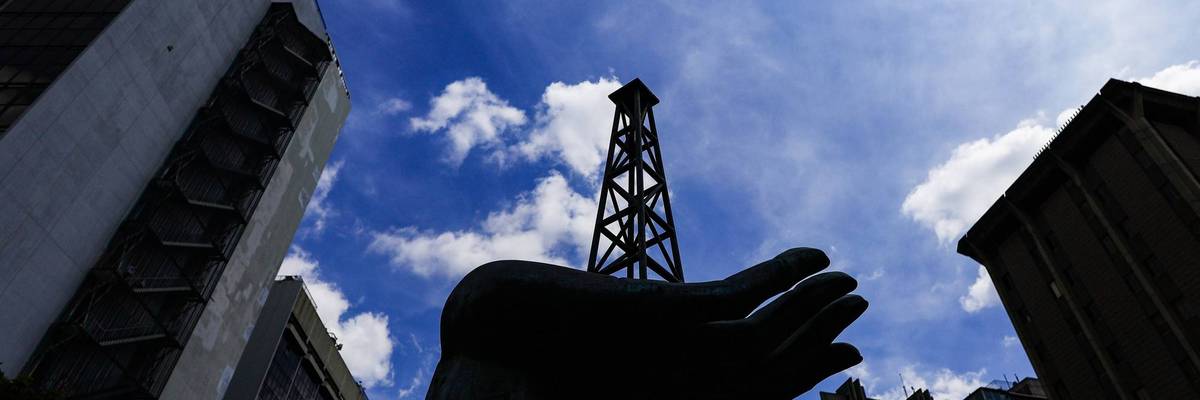
A detail of a statue on the subject of oil is seen in Caracas, Venezuela.
If climate change isn’t reason enough to break the political power of this industry, its role in incentivizing war and conflict is another.
Is the illegal US invasion of Venezuela, and kidnapping of its president, a “war for oil”?
To some extent, this is a reductionist debate. There are often multiple motivations for war, and there clearly are several here. Some in the administration are stuck in Cold War ideology and will use any pretext to undermine and even overthrow governments they perceive as left-leaning, as seen from President Donald Trump’s threats against Colombia, Cuba, and Mexico.
Beyond those governments, the latest Trump National Security Strategy proclaims a desire to “reassert and enforce the Monroe Doctrine to restore American preeminence in the Western Hemisphere.”
Still, it’s hard to ignore the role of oil. Venezuela likely has the world’s largest proven oil reserves, and Trump has repeatedly declared his intention to seize Venezuela’s oil, partly for the benefit of the United States and US oil companies.
We may eventually see US oil companies grab some of the largest oil reserves in the world, with huge direct public subsidies in the form of investment reimbursements, and indirect subsidies in the form of the US military acting as their free private security force.
There are reasonable doubts about whether US oil companies would be willing to invest in Venezuela. The poor state of the country’s oil infrastructure would necessitate major investments to upgrade it. It’s estimated to cost $110 billion to restore production to mid-2010s levels, and there’s a high likelihood of political instability in the country over the next few years.
Reportedly, many US oil companies are reluctant to invest in Venezuela despite pressure from the US government. Either way, the web of business interests that benefit, directly or indirectly, from the oil and gas industry still stand to come out ahead—and in some ways are already benefiting—from Trump’s aggression.
Stock prices for US refiners (such as Chevron and Valero Energy) and oilfield services companies (such as Halliburton) have soared in response to the US attack, with an immediate spike on the first trading day after the attack. While prices have decreased since, they remain at their highest levels in recent weeks.
Oil companies can benefit directly, even if they don’t invest in Venezuela. Crude oil prices have been on a downward trajectory over the last year due to oversupply.
This is one of the reasons the industry is skeptical about entering Venezuela—and, indeed, their short-term objectives appear to be at odds with those of the Trump administration, which claims to want more production and lower pump prices.
There’s always the possibility that Trump could use US control of Venezuela to reduce its oil production.
After all, the administration has always been friendly to the interests of the fossil fuel industry, whose leaders were among Trump’s major backers. If the US clamps down on oil production in Venezuela, that would at least somewhat alleviate the downward pressure on oil prices, benefiting the industry.
The Trump regime has openly stated its intent to “run” Venezuela, with “boots on the ground” if needed. This gives them the power to enforce further cuts in Venezuelan oil production, if they choose to do so.
Finally, we shouldn’t discount the possibility that the administration will offer enough sweeteners to make investment in Venezuela lucrative for the industry. The administration has already signaled that it may be willing to reimburse oil companies for their investment and escalate US military intervention to provide security for the US oil and gas industry. That essentially kicks the cost of production to US taxpayers.
This may not be enough to persuade the industry to invest in Venezuela. If it is, we may eventually see US oil companies grab some of the largest oil reserves in the world, with huge direct public subsidies in the form of investment reimbursements, and indirect subsidies in the form of the US military acting as their free private security force.
Setting aside the limiting debate about whether this is a “war for oil,” it’s clear that fossil fuel capitalism is already profiting from the attack on Venezuela—and may profit more in the future. If climate change isn’t reason enough to break the political power of this industry, its role in incentivizing war and conflict is another.
Dear Common Dreams reader, It’s been nearly 30 years since I co-founded Common Dreams with my late wife, Lina Newhouser. We had the radical notion that journalism should serve the public good, not corporate profits. It was clear to us from the outset what it would take to build such a project. No paid advertisements. No corporate sponsors. No millionaire publisher telling us what to think or do. Many people said we wouldn't last a year, but we proved those doubters wrong. Together with a tremendous team of journalists and dedicated staff, we built an independent media outlet free from the constraints of profits and corporate control. Our mission has always been simple: To inform. To inspire. To ignite change for the common good. Building Common Dreams was not easy. Our survival was never guaranteed. When you take on the most powerful forces—Wall Street greed, fossil fuel industry destruction, Big Tech lobbyists, and uber-rich oligarchs who have spent billions upon billions rigging the economy and democracy in their favor—the only bulwark you have is supporters who believe in your work. But here’s the urgent message from me today. It's never been this bad out there. And it's never been this hard to keep us going. At the very moment Common Dreams is most needed, the threats we face are intensifying. We need your support now more than ever. We don't accept corporate advertising and never will. We don't have a paywall because we don't think people should be blocked from critical news based on their ability to pay. Everything we do is funded by the donations of readers like you. When everyone does the little they can afford, we are strong. But if that support retreats or dries up, so do we. Will you donate now to make sure Common Dreams not only survives but thrives? —Craig Brown, Co-founder |
Is the illegal US invasion of Venezuela, and kidnapping of its president, a “war for oil”?
To some extent, this is a reductionist debate. There are often multiple motivations for war, and there clearly are several here. Some in the administration are stuck in Cold War ideology and will use any pretext to undermine and even overthrow governments they perceive as left-leaning, as seen from President Donald Trump’s threats against Colombia, Cuba, and Mexico.
Beyond those governments, the latest Trump National Security Strategy proclaims a desire to “reassert and enforce the Monroe Doctrine to restore American preeminence in the Western Hemisphere.”
Still, it’s hard to ignore the role of oil. Venezuela likely has the world’s largest proven oil reserves, and Trump has repeatedly declared his intention to seize Venezuela’s oil, partly for the benefit of the United States and US oil companies.
We may eventually see US oil companies grab some of the largest oil reserves in the world, with huge direct public subsidies in the form of investment reimbursements, and indirect subsidies in the form of the US military acting as their free private security force.
There are reasonable doubts about whether US oil companies would be willing to invest in Venezuela. The poor state of the country’s oil infrastructure would necessitate major investments to upgrade it. It’s estimated to cost $110 billion to restore production to mid-2010s levels, and there’s a high likelihood of political instability in the country over the next few years.
Reportedly, many US oil companies are reluctant to invest in Venezuela despite pressure from the US government. Either way, the web of business interests that benefit, directly or indirectly, from the oil and gas industry still stand to come out ahead—and in some ways are already benefiting—from Trump’s aggression.
Stock prices for US refiners (such as Chevron and Valero Energy) and oilfield services companies (such as Halliburton) have soared in response to the US attack, with an immediate spike on the first trading day after the attack. While prices have decreased since, they remain at their highest levels in recent weeks.
Oil companies can benefit directly, even if they don’t invest in Venezuela. Crude oil prices have been on a downward trajectory over the last year due to oversupply.
This is one of the reasons the industry is skeptical about entering Venezuela—and, indeed, their short-term objectives appear to be at odds with those of the Trump administration, which claims to want more production and lower pump prices.
There’s always the possibility that Trump could use US control of Venezuela to reduce its oil production.
After all, the administration has always been friendly to the interests of the fossil fuel industry, whose leaders were among Trump’s major backers. If the US clamps down on oil production in Venezuela, that would at least somewhat alleviate the downward pressure on oil prices, benefiting the industry.
The Trump regime has openly stated its intent to “run” Venezuela, with “boots on the ground” if needed. This gives them the power to enforce further cuts in Venezuelan oil production, if they choose to do so.
Finally, we shouldn’t discount the possibility that the administration will offer enough sweeteners to make investment in Venezuela lucrative for the industry. The administration has already signaled that it may be willing to reimburse oil companies for their investment and escalate US military intervention to provide security for the US oil and gas industry. That essentially kicks the cost of production to US taxpayers.
This may not be enough to persuade the industry to invest in Venezuela. If it is, we may eventually see US oil companies grab some of the largest oil reserves in the world, with huge direct public subsidies in the form of investment reimbursements, and indirect subsidies in the form of the US military acting as their free private security force.
Setting aside the limiting debate about whether this is a “war for oil,” it’s clear that fossil fuel capitalism is already profiting from the attack on Venezuela—and may profit more in the future. If climate change isn’t reason enough to break the political power of this industry, its role in incentivizing war and conflict is another.
Is the illegal US invasion of Venezuela, and kidnapping of its president, a “war for oil”?
To some extent, this is a reductionist debate. There are often multiple motivations for war, and there clearly are several here. Some in the administration are stuck in Cold War ideology and will use any pretext to undermine and even overthrow governments they perceive as left-leaning, as seen from President Donald Trump’s threats against Colombia, Cuba, and Mexico.
Beyond those governments, the latest Trump National Security Strategy proclaims a desire to “reassert and enforce the Monroe Doctrine to restore American preeminence in the Western Hemisphere.”
Still, it’s hard to ignore the role of oil. Venezuela likely has the world’s largest proven oil reserves, and Trump has repeatedly declared his intention to seize Venezuela’s oil, partly for the benefit of the United States and US oil companies.
We may eventually see US oil companies grab some of the largest oil reserves in the world, with huge direct public subsidies in the form of investment reimbursements, and indirect subsidies in the form of the US military acting as their free private security force.
There are reasonable doubts about whether US oil companies would be willing to invest in Venezuela. The poor state of the country’s oil infrastructure would necessitate major investments to upgrade it. It’s estimated to cost $110 billion to restore production to mid-2010s levels, and there’s a high likelihood of political instability in the country over the next few years.
Reportedly, many US oil companies are reluctant to invest in Venezuela despite pressure from the US government. Either way, the web of business interests that benefit, directly or indirectly, from the oil and gas industry still stand to come out ahead—and in some ways are already benefiting—from Trump’s aggression.
Stock prices for US refiners (such as Chevron and Valero Energy) and oilfield services companies (such as Halliburton) have soared in response to the US attack, with an immediate spike on the first trading day after the attack. While prices have decreased since, they remain at their highest levels in recent weeks.
Oil companies can benefit directly, even if they don’t invest in Venezuela. Crude oil prices have been on a downward trajectory over the last year due to oversupply.
This is one of the reasons the industry is skeptical about entering Venezuela—and, indeed, their short-term objectives appear to be at odds with those of the Trump administration, which claims to want more production and lower pump prices.
There’s always the possibility that Trump could use US control of Venezuela to reduce its oil production.
After all, the administration has always been friendly to the interests of the fossil fuel industry, whose leaders were among Trump’s major backers. If the US clamps down on oil production in Venezuela, that would at least somewhat alleviate the downward pressure on oil prices, benefiting the industry.
The Trump regime has openly stated its intent to “run” Venezuela, with “boots on the ground” if needed. This gives them the power to enforce further cuts in Venezuelan oil production, if they choose to do so.
Finally, we shouldn’t discount the possibility that the administration will offer enough sweeteners to make investment in Venezuela lucrative for the industry. The administration has already signaled that it may be willing to reimburse oil companies for their investment and escalate US military intervention to provide security for the US oil and gas industry. That essentially kicks the cost of production to US taxpayers.
This may not be enough to persuade the industry to invest in Venezuela. If it is, we may eventually see US oil companies grab some of the largest oil reserves in the world, with huge direct public subsidies in the form of investment reimbursements, and indirect subsidies in the form of the US military acting as their free private security force.
Setting aside the limiting debate about whether this is a “war for oil,” it’s clear that fossil fuel capitalism is already profiting from the attack on Venezuela—and may profit more in the future. If climate change isn’t reason enough to break the political power of this industry, its role in incentivizing war and conflict is another.