

SUBSCRIBE TO OUR FREE NEWSLETTER
Daily news & progressive opinion—funded by the people, not the corporations—delivered straight to your inbox.
5
#000000
#FFFFFF
To donate by check, phone, or other method, see our More Ways to Give page.
Daily news & progressive opinion—funded by the people, not the corporations—delivered straight to your inbox.
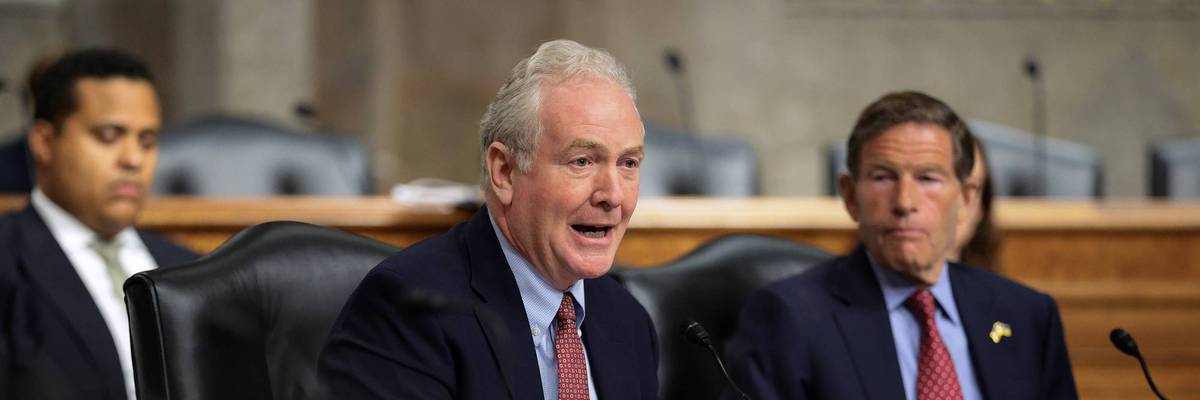
Sen. Chris Van Hollen (D-Md.) speaks during an event on Capitol Hill on July 27, 2026 in Washington, DC.
"Should these provisions be enacted, it would further increase Israel’s leverage over the United States through some of the most sensitive technologies in warfare."
Sen. Chris Van Hollen, who is considering a bid for Senate majority leader against Sen. Chuck Schumer, led a group of Democratic lawmakers on Tuesday in demanding that congressional leaders scrap a bipartisan effort to more closely integrate the American and Israeli militaries, warning the initiative would threaten US national security and risk further complicity in Israeli atrocities.
In a letter to Democratic and Republican congressional leaders, Van Hollen (D-Md.) and 11 other members of the Senate Democratic caucus demanded exclusion of three specific provisions from the Fiscal Year 2027 National Defense Authorization Act (NDAA), warning they would "constrain the administration’s ability to independently determine how best to protect US national security and would lock in long-term commitments despite our serious concerns with the Israeli government’s actions in Gaza, the West Bank, and other parts of the region." Schumer did not sign the new letter.
Two of the provisions raised in the letter—Section 1217 of the Senate-passed NDAA and Section 219 of the House version of the bill—would establish a "United States-Israel Defense Technology Cooperation Initiative" aimed at accelerating "bilateral defense technology research, development, testing, evaluation, coordination, and industrial cooperation."
Lawmakers from both chambers must reconcile the differences between the House and Senate NDAAs before final passage, creating another opportunity for opponents of US-Israel military integration to strip out the provisions.
The senators warned in their Tuesday letter that the "agreements and projects these provisions envision threaten U.S. national security interests by handing Israel leverage over American weapons systems and military technology."
"Should these provisions be enacted, it would further increase Israel’s leverage over the United States through some of the most sensitive technologies in warfare. That is not in the US interest," the lawmakers wrote. "If enacted, these agreements would create long-term dependencies by embedding Israeli technology into the US defense industrial base that could make future policy changes costly or difficult to implement."
"We do not share, let alone co-produce, many of these sensitive technologies even with our closest partners, including NATO or other treaty allies," they added. "To do so in this instance would be unwise, especially as the government of Israel continues to pursue policies in Gaza, the West Bank, and other parts of the region that are inconsistent with US interests and values."
The lawmakers also warned against passage of Section 618 of the Fiscal Year 2027 Intelligence Authorization Act (IAA), which would require the executive branch to "expand and enhance intelligence sharing with the government of Israel." The IAA is usually included in the NDAA.
"The provision would tie the president’s hands from limiting intelligence sharing with Israel, even when doing so may be necessary to protect US national security," the senators wrote. "That would be irresponsible and especially troubling given public reports that the Defense Intelligence Agency recently raised the counterintelligence threat from Israel to its highest level."
"I am pushing every Democrat and our leadership to get Section 219 out of our defense bill."
The senators' letter came a week after President Donald Trump declared on the day of the midterm elections that he and Israeli Prime Minister Benjamin Netanyahu reached an agreement to end the roughly $4 billion in military assistance that the US provides to Israel each year.
"This is where Section 219 of the NDAA comes in," Drop Site reporter Julian Andreone wrote in response to the president's announcement, referring to the military integration provision. "They’re going to transfer all of the aid behind closed doors and cut it from the appropriations process."
Rep. Ro Khanna (D-Calif.) argued in a social media post earlier this week that removal of the military integration language from the NDAA "needs to be a top priority" in the lame-duck session of Congress.
"I am pushing every Democrat and our leadership to get Section 219 out of our defense bill," Khanna said.
This country and this world are at a monumental crossroads. US voters have an opportunity to beat back the forces of fascism and confront the billionaires who are rigging the economy, our media system, and our democracy, making it increasingly impossible for ordinary people to get by. We’re not just talking about the election. We’re talking about what must be done once these fascist elements are vanquished from power. We need a bolder set of solutions than what either major party has so far been willing to offer and a working-class movement ready to fight like hell for it. Trump didn't emerge from nowhere. The conditions that fueled MAGA authoritarianism were created by decades of radical neoliberal economic policies and a corrupt political system dominated by corporate interests. They slashed taxes on the super-rich, promising that the benefits would trickle down. They said giveaways to the corporate titans would make life more affordable for the rest of us. It was all bullshit. And when a bitter, betrayed populace searches for someone to blame, right-wing demagogues have little trouble finding scapegoats. People know when they're being lied to, but you won't hear any of this from the corporate media. Only independent journalism—powered and funded by people who believe in building a better world—can deliver truly trustworthy daily news. If you share our vision, please contribute whatever you can to sustain our work. |
Sen. Chris Van Hollen, who is considering a bid for Senate majority leader against Sen. Chuck Schumer, led a group of Democratic lawmakers on Tuesday in demanding that congressional leaders scrap a bipartisan effort to more closely integrate the American and Israeli militaries, warning the initiative would threaten US national security and risk further complicity in Israeli atrocities.
In a letter to Democratic and Republican congressional leaders, Van Hollen (D-Md.) and 11 other members of the Senate Democratic caucus demanded exclusion of three specific provisions from the Fiscal Year 2027 National Defense Authorization Act (NDAA), warning they would "constrain the administration’s ability to independently determine how best to protect US national security and would lock in long-term commitments despite our serious concerns with the Israeli government’s actions in Gaza, the West Bank, and other parts of the region." Schumer did not sign the new letter.
Two of the provisions raised in the letter—Section 1217 of the Senate-passed NDAA and Section 219 of the House version of the bill—would establish a "United States-Israel Defense Technology Cooperation Initiative" aimed at accelerating "bilateral defense technology research, development, testing, evaluation, coordination, and industrial cooperation."
Lawmakers from both chambers must reconcile the differences between the House and Senate NDAAs before final passage, creating another opportunity for opponents of US-Israel military integration to strip out the provisions.
The senators warned in their Tuesday letter that the "agreements and projects these provisions envision threaten U.S. national security interests by handing Israel leverage over American weapons systems and military technology."
"Should these provisions be enacted, it would further increase Israel’s leverage over the United States through some of the most sensitive technologies in warfare. That is not in the US interest," the lawmakers wrote. "If enacted, these agreements would create long-term dependencies by embedding Israeli technology into the US defense industrial base that could make future policy changes costly or difficult to implement."
"We do not share, let alone co-produce, many of these sensitive technologies even with our closest partners, including NATO or other treaty allies," they added. "To do so in this instance would be unwise, especially as the government of Israel continues to pursue policies in Gaza, the West Bank, and other parts of the region that are inconsistent with US interests and values."
The lawmakers also warned against passage of Section 618 of the Fiscal Year 2027 Intelligence Authorization Act (IAA), which would require the executive branch to "expand and enhance intelligence sharing with the government of Israel." The IAA is usually included in the NDAA.
"The provision would tie the president’s hands from limiting intelligence sharing with Israel, even when doing so may be necessary to protect US national security," the senators wrote. "That would be irresponsible and especially troubling given public reports that the Defense Intelligence Agency recently raised the counterintelligence threat from Israel to its highest level."
"I am pushing every Democrat and our leadership to get Section 219 out of our defense bill."
The senators' letter came a week after President Donald Trump declared on the day of the midterm elections that he and Israeli Prime Minister Benjamin Netanyahu reached an agreement to end the roughly $4 billion in military assistance that the US provides to Israel each year.
"This is where Section 219 of the NDAA comes in," Drop Site reporter Julian Andreone wrote in response to the president's announcement, referring to the military integration provision. "They’re going to transfer all of the aid behind closed doors and cut it from the appropriations process."
Rep. Ro Khanna (D-Calif.) argued in a social media post earlier this week that removal of the military integration language from the NDAA "needs to be a top priority" in the lame-duck session of Congress.
"I am pushing every Democrat and our leadership to get Section 219 out of our defense bill," Khanna said.

