SUBSCRIBE TO OUR FREE NEWSLETTER
Daily news & progressive opinion—funded by the people, not the corporations—delivered straight to your inbox.
5
#000000
#FFFFFF
To donate by check, phone, or other method, see our More Ways to Give page.
Daily news & progressive opinion—funded by the people, not the corporations—delivered straight to your inbox.
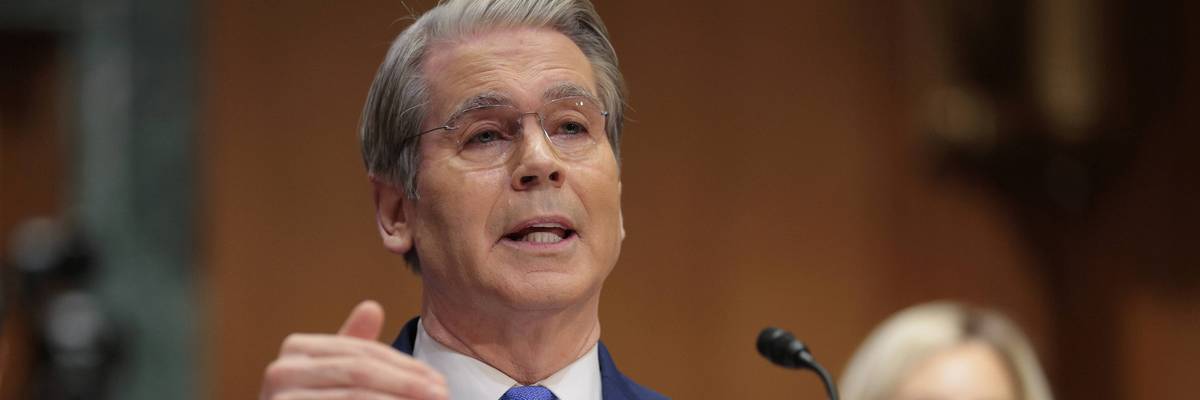
US Treasury Secretary Scott Bessent testifies during a Senate Committee on Finance hearing in the Dirksen Senate Office Building on Capitol Hill on June 3, 2026 in Washington, DC.
"Trump is going to pump billions of dollars into the bond market to push down interest rates through the election, then let everything fall apart again," said one critic.
The Trump administration on Wednesday unveiled a plan to ease upward pressure on the cost of US debt by doubling its bond buybacks through November.
In announcing that it will buy back "at least" $4 billion worth of bonds over a two-month period, the US Department of Treasury said it was seeking "to provide greater liquidity support in longer-dated nominal sectors where there is consistent strong sponsorship from market participants."
While the announcement did result in interest rates for US treasuries dropping, economists and other political observers are warning that Treasury Secretary Scott Bessent's scheme to stop spiking yields will prove ineffective over the long term.
In a Wednesday interview with NOTUS, Joseph Brusuelas, principal and chief economist for RSM US LLP, said that Bessent was making decisions based solely on the political fortunes of the Republican Party.
"Bessent is a political actor," Brusuelas said. "His interest is purely short-term and is organized around the upcoming election and not a return to price stability. This is what fiscal dominance looks like as the fiscal authority leans on the central bank to subordinate its goal of price stability to the government’s borrowing and political needs."
The economist's analysis was echoed by Drop Site News reporter Ryan Grim, who argued in a social media post that President Donald Trump's administration was scrambling to save its endangered GOP congressional majority.
"Trump is going to pump billions of dollars into the bond market to push down interest rates through the election, then let everything fall apart again," Grim wrote. "Not sure I’ve seen a more nakedly electoral use of this amount of money before, for such a targeted amount of time."
Krishna Guha, head of global policy and central bank strategy at Evercore ISI, argued in a Wednesday research note flagged by CNBC that the bond buyback scheme "changes almost nothing in terms of the fundamentals in particular the unchanged need to finance the tidal wave of hyperscaler debt in addition to very large government deficits."
Adam Josephson, founder of Sakonnet Research, also expressed skepticism of the buyback plan's effectiveness in a Wednesday interview with Politico.
“They’re trying everything possible to limit upward pressure on long-term yields,” Josephson said. “Nothing has worked. And why would this work? It’s too small to matter.”
Experts say that bond yields have been spiking to highs not seen since the start of the Great Recession due to investor anxiety over a number of factors, including inflation, the size of the US government's debt, and Trump's illegal war with Iran.
Dear Common Dreams reader, It’s been nearly 30 years since I co-founded Common Dreams with my late wife, Lina Newhouser. We had the radical notion that journalism should serve the public good, not corporate profits. It was clear to us from the outset what it would take to build such a project. No paid advertisements. No corporate sponsors. No millionaire publisher telling us what to think or do. Many people said we wouldn't last a year, but we proved those doubters wrong. Together with a tremendous team of journalists and dedicated staff, we built an independent media outlet free from the constraints of profits and corporate control. Our mission has always been simple: To inform. To inspire. To ignite change for the common good. Building Common Dreams was not easy. Our survival was never guaranteed. When you take on the most powerful forces—Wall Street greed, fossil fuel industry destruction, Big Tech lobbyists, and uber-rich oligarchs who have spent billions upon billions rigging the economy and democracy in their favor—the only bulwark you have is supporters who believe in your work. But here’s the urgent message from me today. It's never been this bad out there. And it's never been this hard to keep us going. At the very moment Common Dreams is most needed, the threats we face are intensifying. We need your support now more than ever. We don't accept corporate advertising and never will. We don't have a paywall because we don't think people should be blocked from critical news based on their ability to pay. Everything we do is funded by the donations of readers like you. When everyone does the little they can afford, we are strong. But if that support retreats or dries up, so do we. Will you donate now to make sure Common Dreams not only survives but thrives? —Craig Brown, Co-founder |
The Trump administration on Wednesday unveiled a plan to ease upward pressure on the cost of US debt by doubling its bond buybacks through November.
In announcing that it will buy back "at least" $4 billion worth of bonds over a two-month period, the US Department of Treasury said it was seeking "to provide greater liquidity support in longer-dated nominal sectors where there is consistent strong sponsorship from market participants."
While the announcement did result in interest rates for US treasuries dropping, economists and other political observers are warning that Treasury Secretary Scott Bessent's scheme to stop spiking yields will prove ineffective over the long term.
In a Wednesday interview with NOTUS, Joseph Brusuelas, principal and chief economist for RSM US LLP, said that Bessent was making decisions based solely on the political fortunes of the Republican Party.
"Bessent is a political actor," Brusuelas said. "His interest is purely short-term and is organized around the upcoming election and not a return to price stability. This is what fiscal dominance looks like as the fiscal authority leans on the central bank to subordinate its goal of price stability to the government’s borrowing and political needs."
The economist's analysis was echoed by Drop Site News reporter Ryan Grim, who argued in a social media post that President Donald Trump's administration was scrambling to save its endangered GOP congressional majority.
"Trump is going to pump billions of dollars into the bond market to push down interest rates through the election, then let everything fall apart again," Grim wrote. "Not sure I’ve seen a more nakedly electoral use of this amount of money before, for such a targeted amount of time."
Krishna Guha, head of global policy and central bank strategy at Evercore ISI, argued in a Wednesday research note flagged by CNBC that the bond buyback scheme "changes almost nothing in terms of the fundamentals in particular the unchanged need to finance the tidal wave of hyperscaler debt in addition to very large government deficits."
Adam Josephson, founder of Sakonnet Research, also expressed skepticism of the buyback plan's effectiveness in a Wednesday interview with Politico.
“They’re trying everything possible to limit upward pressure on long-term yields,” Josephson said. “Nothing has worked. And why would this work? It’s too small to matter.”
Experts say that bond yields have been spiking to highs not seen since the start of the Great Recession due to investor anxiety over a number of factors, including inflation, the size of the US government's debt, and Trump's illegal war with Iran.
The Trump administration on Wednesday unveiled a plan to ease upward pressure on the cost of US debt by doubling its bond buybacks through November.
In announcing that it will buy back "at least" $4 billion worth of bonds over a two-month period, the US Department of Treasury said it was seeking "to provide greater liquidity support in longer-dated nominal sectors where there is consistent strong sponsorship from market participants."
While the announcement did result in interest rates for US treasuries dropping, economists and other political observers are warning that Treasury Secretary Scott Bessent's scheme to stop spiking yields will prove ineffective over the long term.
In a Wednesday interview with NOTUS, Joseph Brusuelas, principal and chief economist for RSM US LLP, said that Bessent was making decisions based solely on the political fortunes of the Republican Party.
"Bessent is a political actor," Brusuelas said. "His interest is purely short-term and is organized around the upcoming election and not a return to price stability. This is what fiscal dominance looks like as the fiscal authority leans on the central bank to subordinate its goal of price stability to the government’s borrowing and political needs."
The economist's analysis was echoed by Drop Site News reporter Ryan Grim, who argued in a social media post that President Donald Trump's administration was scrambling to save its endangered GOP congressional majority.
"Trump is going to pump billions of dollars into the bond market to push down interest rates through the election, then let everything fall apart again," Grim wrote. "Not sure I’ve seen a more nakedly electoral use of this amount of money before, for such a targeted amount of time."
Krishna Guha, head of global policy and central bank strategy at Evercore ISI, argued in a Wednesday research note flagged by CNBC that the bond buyback scheme "changes almost nothing in terms of the fundamentals in particular the unchanged need to finance the tidal wave of hyperscaler debt in addition to very large government deficits."
Adam Josephson, founder of Sakonnet Research, also expressed skepticism of the buyback plan's effectiveness in a Wednesday interview with Politico.
“They’re trying everything possible to limit upward pressure on long-term yields,” Josephson said. “Nothing has worked. And why would this work? It’s too small to matter.”
Experts say that bond yields have been spiking to highs not seen since the start of the Great Recession due to investor anxiety over a number of factors, including inflation, the size of the US government's debt, and Trump's illegal war with Iran.