5
#000000
#FFFFFF
To donate by check, phone, or other method, see our More Ways to Give page.
Daily news & progressive opinion—funded by the people, not the corporations—delivered straight to your inbox.
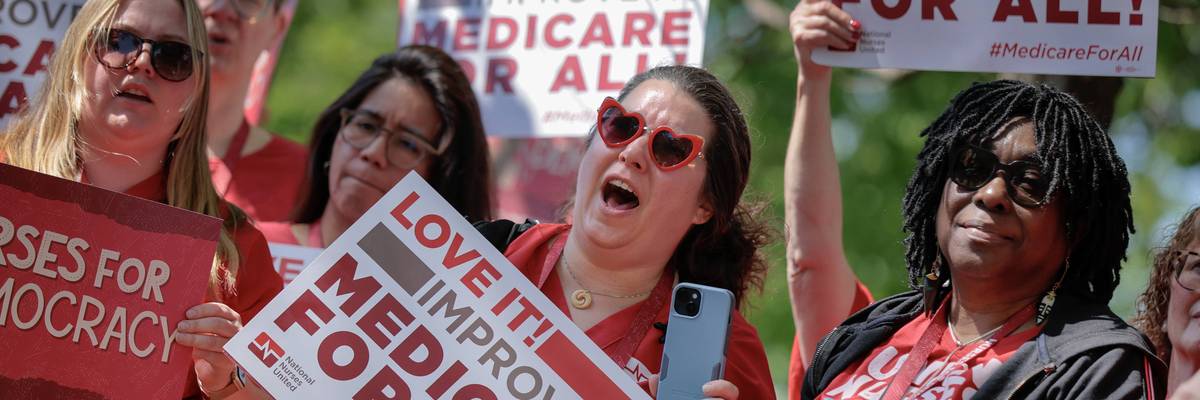
Members of National Nurses United rally with lawmakers to show their support for the Medicare For All Act in Upper Senate Park on Capitol Hill on April 29, 2025 in Washington, DC.
"We know what high-performing health systems look like—other countries have them and are building them. It’s high time the US did better.”
An annual analysis that examines healthcare systems across nearly two dozen wealthy countries around the world once again highlighted the United States' "uniquely poor performance relative to its peers," with this year's US Health Care from a Global Perspective report focusing on "insurance coverage and access to care, affordability of care, delivery of care, and equity of health outcomes."
As advocates for expanding the US Medicare system to the entire population have long warned, the country's for-profit healthcare system—which ties the ability to get care to one's employment and allows insurance companies to boost profits by denying care to patients—"The US, on average, has the poorest health outcomes of any high-income country," the Commonwealth Fund's report reads.
The report examines the US system compared with other countries in the Organization for Economic Cooperation and Development (OECD), including the United Kingdom, France, New Zealand, Japan, and Mexico.
It finds that the US spent 18% of its gross domestic product on healthcare in 2024—nearly twice the OECD average.
Life expectancy in the US reached an all-time high in 2024, but was still among the shortest when compared to the 19 other countries, nearly five years shorter than Japan, Spain, and Switzerland, and longer than the average lifespan in Turkey and Mexico.
While the US and Mexico also both rank high on the list in terms of preventable deaths, the latter nation announced last month that it would soon be joining every other country included in the analysis by shifting to a universal, government-run healthcare system.
In the United States, the for-profit health sector—which spent a record $877.69 million on lobbying last year—contributes to the high number of avoidable deaths, which stands at 312 per 100,000 people. About 27 million Americans are still uninsured, more than 16 years after the passage of the Affordable Care Act, and the Republican Party's refusal to continue ACA subsidies last year as well as its $1 trillion in Medicaid cuts over the next decade, according to Thursday's report, are "projected to increase the number of uninsured Americans by an additional 17 million by 2034, potentially leading to more than 50,000 additional preventable deaths annually."
"By contrast, Mexico’s recently established Universal Health Service will provide all residents with access to free care at any public health institute, starting in 2027," the report states. "The US is one of the only countries to have enacted policies that reduce coverage."
High out-of-pocket costs may also contribute to poor outcomes and the high number of preventable deaths in the US, the Commonwealth Fund suggests. Americans spend $400 per person, per year, on out-of-pocket costs for prescription drugs, while people in France spend $100.
"The US is one of the only countries to have enacted policies that reduce coverage."
"In the US, where approximately 8% of the population is uninsured and one-quarter has coverage that comes with high out-of-pocket costs or deductibles, people are far more likely to forgo needed care because of costs than people in peer countries," reads the report. "This can mean not filling prescriptions, not obtaining diagnostic tests, treatment, or follow-up care, or being unable to adhere to clinician-recommended care plans."
The report also identifies the US as a country that lags behind its peers in producing new doctors, contributing to a crisis in primary care, with the US having the fewest number of primary care providers per 1,000 people. The country also has the "highest medical tuition fees of any country in our analysis," said the Commonwealth Fund.
The organization also found that in 2023, the US had nearly 19 maternal deaths for every 100,000 live births, representing a decline for the country that has long had "among the highest rates of maternal deaths related to complications of pregnancy and childbirth."
"By contrast, in 11 of the 18 countries we studied there were less than five maternal deaths per 100,000 live births," reads the report, which also notes that in the US, maternal mortality is "exceptionally high" among Black women, at 50 deaths per 100,000 live births.
"This far exceeds national maternal mortality in any of the other countries," the report states. "Inequities in access to care and patients’ care experiences—often rooted in discrimination and clinician bias—may be prime contributing factors."
Dr. Joseph Betancourt, president of the Commonwealth Fund, noted that "the US has long prided itself on having the best healthcare in the world, but the population benefits from this excellence unevenly, and it remains largely out of reach for many Americans."
"We spend more than any other nation on healthcare, so our poorer health outcomes aren’t due to a lack of resources—it is about how we choose to use them," said Betancourt. "We know what high-performing health systems look like—other countries have them and are building them. It’s high time the US did better."
"Other countries have shown that alternatives work. What’s striking isn’t the absence of solutions; it’s our reluctance to implement them."
The report does not explicitly call on the US to shift to a universal, government-funded healthcare system, but studies have shown that expanding Medicare to the entire US population, as lawmakers including Sen. Bernie Sanders (I-Vt.) and Reps. Pramila Jayapal (D-Wash.) and Alexandria Ocasio-Cortez (D-NY) have consistently demanded, would address many of the problems listed in the report.
Studies by the Congressional Budget Office and Yale University have shown that Medicare for All would save an estimated $650 billion and prevent 68,000 avoidable deaths each year.
The policy, which has been proposed in Congress numerous times, is also broadly popular; 65% of US voters—including 78% of Democrats, 71% of Independents, and 49% of Republicans—support creating a national, government-run healthcare program, according to a Data for Progress poll last year.
Despite this, both Republican and Democratic lawmakers continue to insist the proposal is unpopular and too expensive, with Michigan state Sen. Mallory McMorrow (D-8), who is running against vehement Medicare for All advocate Abdul El-Sayed in the Democratic US Senate primary, insisting recently that "the support for a true single-payer system isn't there yet."
Reginald Williams II, senior vice president at Commonwealth Fund, emphasized that it is "not inevitable" that "Americans pay more for healthcare and get less in return."
"It’s the result of different choices," he said. "Other countries have shown that alternatives work. What’s striking isn’t the absence of solutions; it’s our reluctance to implement them. The failure of the US health system is not a failure of ideas. It’s a failure of will to act on them.”
Dear Common Dreams reader, It’s been nearly 30 years since I co-founded Common Dreams with my late wife, Lina Newhouser. We had the radical notion that journalism should serve the public good, not corporate profits. It was clear to us from the outset what it would take to build such a project. No paid advertisements. No corporate sponsors. No millionaire publisher telling us what to think or do. Many people said we wouldn't last a year, but we proved those doubters wrong. Together with a tremendous team of journalists and dedicated staff, we built an independent media outlet free from the constraints of profits and corporate control. Our mission has always been simple: To inform. To inspire. To ignite change for the common good. Building Common Dreams was not easy. Our survival was never guaranteed. When you take on the most powerful forces—Wall Street greed, fossil fuel industry destruction, Big Tech lobbyists, and uber-rich oligarchs who have spent billions upon billions rigging the economy and democracy in their favor—the only bulwark you have is supporters who believe in your work. But here’s the urgent message from me today. It's never been this bad out there. And it's never been this hard to keep us going. At the very moment Common Dreams is most needed, the threats we face are intensifying. We need your support now more than ever. We don't accept corporate advertising and never will. We don't have a paywall because we don't think people should be blocked from critical news based on their ability to pay. Everything we do is funded by the donations of readers like you. When everyone does the little they can afford, we are strong. But if that support retreats or dries up, so do we. Will you donate now to make sure Common Dreams not only survives but thrives? —Craig Brown, Co-founder |
An annual analysis that examines healthcare systems across nearly two dozen wealthy countries around the world once again highlighted the United States' "uniquely poor performance relative to its peers," with this year's US Health Care from a Global Perspective report focusing on "insurance coverage and access to care, affordability of care, delivery of care, and equity of health outcomes."
As advocates for expanding the US Medicare system to the entire population have long warned, the country's for-profit healthcare system—which ties the ability to get care to one's employment and allows insurance companies to boost profits by denying care to patients—"The US, on average, has the poorest health outcomes of any high-income country," the Commonwealth Fund's report reads.
The report examines the US system compared with other countries in the Organization for Economic Cooperation and Development (OECD), including the United Kingdom, France, New Zealand, Japan, and Mexico.
It finds that the US spent 18% of its gross domestic product on healthcare in 2024—nearly twice the OECD average.
Life expectancy in the US reached an all-time high in 2024, but was still among the shortest when compared to the 19 other countries, nearly five years shorter than Japan, Spain, and Switzerland, and longer than the average lifespan in Turkey and Mexico.
While the US and Mexico also both rank high on the list in terms of preventable deaths, the latter nation announced last month that it would soon be joining every other country included in the analysis by shifting to a universal, government-run healthcare system.
In the United States, the for-profit health sector—which spent a record $877.69 million on lobbying last year—contributes to the high number of avoidable deaths, which stands at 312 per 100,000 people. About 27 million Americans are still uninsured, more than 16 years after the passage of the Affordable Care Act, and the Republican Party's refusal to continue ACA subsidies last year as well as its $1 trillion in Medicaid cuts over the next decade, according to Thursday's report, are "projected to increase the number of uninsured Americans by an additional 17 million by 2034, potentially leading to more than 50,000 additional preventable deaths annually."
"By contrast, Mexico’s recently established Universal Health Service will provide all residents with access to free care at any public health institute, starting in 2027," the report states. "The US is one of the only countries to have enacted policies that reduce coverage."
High out-of-pocket costs may also contribute to poor outcomes and the high number of preventable deaths in the US, the Commonwealth Fund suggests. Americans spend $400 per person, per year, on out-of-pocket costs for prescription drugs, while people in France spend $100.
"The US is one of the only countries to have enacted policies that reduce coverage."
"In the US, where approximately 8% of the population is uninsured and one-quarter has coverage that comes with high out-of-pocket costs or deductibles, people are far more likely to forgo needed care because of costs than people in peer countries," reads the report. "This can mean not filling prescriptions, not obtaining diagnostic tests, treatment, or follow-up care, or being unable to adhere to clinician-recommended care plans."
The report also identifies the US as a country that lags behind its peers in producing new doctors, contributing to a crisis in primary care, with the US having the fewest number of primary care providers per 1,000 people. The country also has the "highest medical tuition fees of any country in our analysis," said the Commonwealth Fund.
The organization also found that in 2023, the US had nearly 19 maternal deaths for every 100,000 live births, representing a decline for the country that has long had "among the highest rates of maternal deaths related to complications of pregnancy and childbirth."
"By contrast, in 11 of the 18 countries we studied there were less than five maternal deaths per 100,000 live births," reads the report, which also notes that in the US, maternal mortality is "exceptionally high" among Black women, at 50 deaths per 100,000 live births.
"This far exceeds national maternal mortality in any of the other countries," the report states. "Inequities in access to care and patients’ care experiences—often rooted in discrimination and clinician bias—may be prime contributing factors."
Dr. Joseph Betancourt, president of the Commonwealth Fund, noted that "the US has long prided itself on having the best healthcare in the world, but the population benefits from this excellence unevenly, and it remains largely out of reach for many Americans."
"We spend more than any other nation on healthcare, so our poorer health outcomes aren’t due to a lack of resources—it is about how we choose to use them," said Betancourt. "We know what high-performing health systems look like—other countries have them and are building them. It’s high time the US did better."
"Other countries have shown that alternatives work. What’s striking isn’t the absence of solutions; it’s our reluctance to implement them."
The report does not explicitly call on the US to shift to a universal, government-funded healthcare system, but studies have shown that expanding Medicare to the entire US population, as lawmakers including Sen. Bernie Sanders (I-Vt.) and Reps. Pramila Jayapal (D-Wash.) and Alexandria Ocasio-Cortez (D-NY) have consistently demanded, would address many of the problems listed in the report.
Studies by the Congressional Budget Office and Yale University have shown that Medicare for All would save an estimated $650 billion and prevent 68,000 avoidable deaths each year.
The policy, which has been proposed in Congress numerous times, is also broadly popular; 65% of US voters—including 78% of Democrats, 71% of Independents, and 49% of Republicans—support creating a national, government-run healthcare program, according to a Data for Progress poll last year.
Despite this, both Republican and Democratic lawmakers continue to insist the proposal is unpopular and too expensive, with Michigan state Sen. Mallory McMorrow (D-8), who is running against vehement Medicare for All advocate Abdul El-Sayed in the Democratic US Senate primary, insisting recently that "the support for a true single-payer system isn't there yet."
Reginald Williams II, senior vice president at Commonwealth Fund, emphasized that it is "not inevitable" that "Americans pay more for healthcare and get less in return."
"It’s the result of different choices," he said. "Other countries have shown that alternatives work. What’s striking isn’t the absence of solutions; it’s our reluctance to implement them. The failure of the US health system is not a failure of ideas. It’s a failure of will to act on them.”
An annual analysis that examines healthcare systems across nearly two dozen wealthy countries around the world once again highlighted the United States' "uniquely poor performance relative to its peers," with this year's US Health Care from a Global Perspective report focusing on "insurance coverage and access to care, affordability of care, delivery of care, and equity of health outcomes."
As advocates for expanding the US Medicare system to the entire population have long warned, the country's for-profit healthcare system—which ties the ability to get care to one's employment and allows insurance companies to boost profits by denying care to patients—"The US, on average, has the poorest health outcomes of any high-income country," the Commonwealth Fund's report reads.
The report examines the US system compared with other countries in the Organization for Economic Cooperation and Development (OECD), including the United Kingdom, France, New Zealand, Japan, and Mexico.
It finds that the US spent 18% of its gross domestic product on healthcare in 2024—nearly twice the OECD average.
Life expectancy in the US reached an all-time high in 2024, but was still among the shortest when compared to the 19 other countries, nearly five years shorter than Japan, Spain, and Switzerland, and longer than the average lifespan in Turkey and Mexico.
While the US and Mexico also both rank high on the list in terms of preventable deaths, the latter nation announced last month that it would soon be joining every other country included in the analysis by shifting to a universal, government-run healthcare system.
In the United States, the for-profit health sector—which spent a record $877.69 million on lobbying last year—contributes to the high number of avoidable deaths, which stands at 312 per 100,000 people. About 27 million Americans are still uninsured, more than 16 years after the passage of the Affordable Care Act, and the Republican Party's refusal to continue ACA subsidies last year as well as its $1 trillion in Medicaid cuts over the next decade, according to Thursday's report, are "projected to increase the number of uninsured Americans by an additional 17 million by 2034, potentially leading to more than 50,000 additional preventable deaths annually."
"By contrast, Mexico’s recently established Universal Health Service will provide all residents with access to free care at any public health institute, starting in 2027," the report states. "The US is one of the only countries to have enacted policies that reduce coverage."
High out-of-pocket costs may also contribute to poor outcomes and the high number of preventable deaths in the US, the Commonwealth Fund suggests. Americans spend $400 per person, per year, on out-of-pocket costs for prescription drugs, while people in France spend $100.
"The US is one of the only countries to have enacted policies that reduce coverage."
"In the US, where approximately 8% of the population is uninsured and one-quarter has coverage that comes with high out-of-pocket costs or deductibles, people are far more likely to forgo needed care because of costs than people in peer countries," reads the report. "This can mean not filling prescriptions, not obtaining diagnostic tests, treatment, or follow-up care, or being unable to adhere to clinician-recommended care plans."
The report also identifies the US as a country that lags behind its peers in producing new doctors, contributing to a crisis in primary care, with the US having the fewest number of primary care providers per 1,000 people. The country also has the "highest medical tuition fees of any country in our analysis," said the Commonwealth Fund.
The organization also found that in 2023, the US had nearly 19 maternal deaths for every 100,000 live births, representing a decline for the country that has long had "among the highest rates of maternal deaths related to complications of pregnancy and childbirth."
"By contrast, in 11 of the 18 countries we studied there were less than five maternal deaths per 100,000 live births," reads the report, which also notes that in the US, maternal mortality is "exceptionally high" among Black women, at 50 deaths per 100,000 live births.
"This far exceeds national maternal mortality in any of the other countries," the report states. "Inequities in access to care and patients’ care experiences—often rooted in discrimination and clinician bias—may be prime contributing factors."
Dr. Joseph Betancourt, president of the Commonwealth Fund, noted that "the US has long prided itself on having the best healthcare in the world, but the population benefits from this excellence unevenly, and it remains largely out of reach for many Americans."
"We spend more than any other nation on healthcare, so our poorer health outcomes aren’t due to a lack of resources—it is about how we choose to use them," said Betancourt. "We know what high-performing health systems look like—other countries have them and are building them. It’s high time the US did better."
"Other countries have shown that alternatives work. What’s striking isn’t the absence of solutions; it’s our reluctance to implement them."
The report does not explicitly call on the US to shift to a universal, government-funded healthcare system, but studies have shown that expanding Medicare to the entire US population, as lawmakers including Sen. Bernie Sanders (I-Vt.) and Reps. Pramila Jayapal (D-Wash.) and Alexandria Ocasio-Cortez (D-NY) have consistently demanded, would address many of the problems listed in the report.
Studies by the Congressional Budget Office and Yale University have shown that Medicare for All would save an estimated $650 billion and prevent 68,000 avoidable deaths each year.
The policy, which has been proposed in Congress numerous times, is also broadly popular; 65% of US voters—including 78% of Democrats, 71% of Independents, and 49% of Republicans—support creating a national, government-run healthcare program, according to a Data for Progress poll last year.
Despite this, both Republican and Democratic lawmakers continue to insist the proposal is unpopular and too expensive, with Michigan state Sen. Mallory McMorrow (D-8), who is running against vehement Medicare for All advocate Abdul El-Sayed in the Democratic US Senate primary, insisting recently that "the support for a true single-payer system isn't there yet."
Reginald Williams II, senior vice president at Commonwealth Fund, emphasized that it is "not inevitable" that "Americans pay more for healthcare and get less in return."
"It’s the result of different choices," he said. "Other countries have shown that alternatives work. What’s striking isn’t the absence of solutions; it’s our reluctance to implement them. The failure of the US health system is not a failure of ideas. It’s a failure of will to act on them.”