SUBSCRIBE TO OUR FREE NEWSLETTER
Daily news & progressive opinion—funded by the people, not the corporations—delivered straight to your inbox.
5
#000000
#FFFFFF
To donate by check, phone, or other method, see our More Ways to Give page.
Daily news & progressive opinion—funded by the people, not the corporations—delivered straight to your inbox.
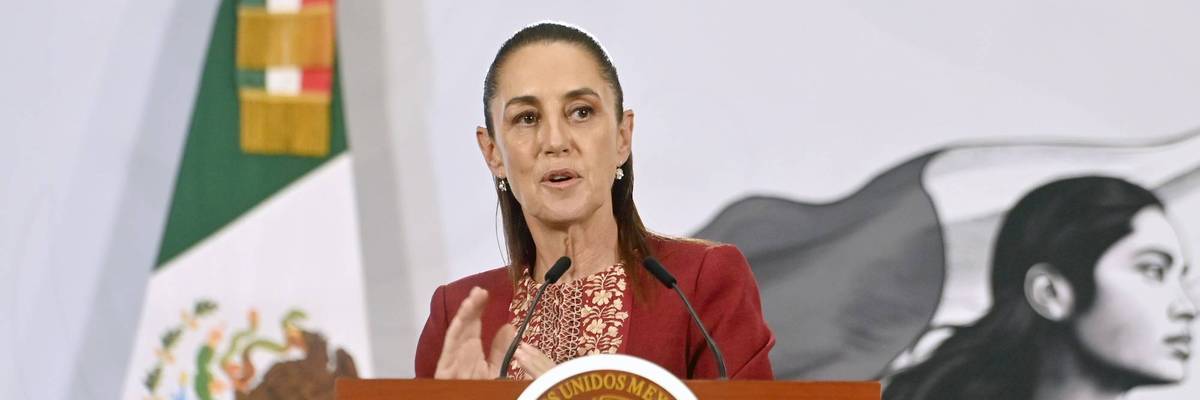
Mexican President Claudia Sheinbaum speaks during the daily morning briefing at Palacio Nacional on April 7, 2026, in Mexico City, Mexico.
Medicare for All advocate Wendell Potter said it's "both inspiring and frustrating" to see other nations advance their public healthcare systems while the US dismantles its own.
As Mexican President Claudia Sheinbaum moves forward with a plan to enact universal healthcare for her country’s more than 130 million people, a longtime advocate for Medicare for All in the US called the development “both inspiring and frustrating.”
"Inspiring because it shows what is possible," Wendell Potter, a former insurance company communications director who has become a leading critic of the industry, told Common Dreams. "Frustrating because here in the US we are going in the opposite direction."
Earlier this week, Sheinbaum announced a decree that she called "a historic step" for Mexico.
Beginning in 2027, her government plans to unify Mexico's public health institutions into a single Universal Health Service, allowing patients across the country to receive care from the Mexican Social Security Institute (IMSS), the Social Security Institute and Social Services of Workers of the State (ISSSTE), and the IMSS‑Bienestar program, which provides free services to those without employer-provided insurance.
According to TeleSur, universal access would be rolled out gradually, with universal emergency care and continuity of treatment, free of financial constraints, beginning in January. Specialized services such as radiotherapy, laboratory tests, and imaging studies would be phased in later that year, and universal prescription fulfillment and hospitalization would also be added to the program in 2028.
"The goal is that when we leave the government [in 2030], any Mexican man or woman can go to any health institution for treatment for any ailment and be received," Sheinbaum said.
Mexico has expanded its annual healthcare budget in recent years, but Sheinbaum's government hopes that consolidating all of Mexico's health services into a single program will eliminate bureaucratic bloat and create a more cost-effective system that saves money over time.
Potter described the plan as “just another example of countries around the world lapping the US when it comes to healthcare policy.”
While tens of millions more previously uninsured Mexicans have become eligible for free care under the healthcare expansion efforts of Sheinbaum and her predecessor, Andrés Manuel López Obrador, the US under President Donald Trump is in the process of shredding public healthcare programs and subsidies.
Following the One Big Beautiful Bill Act, signed into law by Trump last year, 11.8 million Americans are expected to lose Medicaid and other coverage, and more than 20 million are projected to see higher premiums after insurance subsidies under the Affordable Care Act were allowed to expire.
"Due to the stranglehold Big Insurance has on too many politicians in this country, instead of expanding care and lowering costs, we are simply helping Big Insurance make more and more money," Potter said. "It is totally backwards."
"We must continue to keep Medicare for All as our north star here. But also acknowledge the reality that we need to change so much about our current political environment to make it possible," he said. "And that has to start with breaking up Big Insurance's stranglehold on Washington."
Dear Common Dreams reader, It’s been nearly 30 years since I co-founded Common Dreams with my late wife, Lina Newhouser. We had the radical notion that journalism should serve the public good, not corporate profits. It was clear to us from the outset what it would take to build such a project. No paid advertisements. No corporate sponsors. No millionaire publisher telling us what to think or do. Many people said we wouldn't last a year, but we proved those doubters wrong. Together with a tremendous team of journalists and dedicated staff, we built an independent media outlet free from the constraints of profits and corporate control. Our mission has always been simple: To inform. To inspire. To ignite change for the common good. Building Common Dreams was not easy. Our survival was never guaranteed. When you take on the most powerful forces—Wall Street greed, fossil fuel industry destruction, Big Tech lobbyists, and uber-rich oligarchs who have spent billions upon billions rigging the economy and democracy in their favor—the only bulwark you have is supporters who believe in your work. But here’s the urgent message from me today. It's never been this bad out there. And it's never been this hard to keep us going. At the very moment Common Dreams is most needed, the threats we face are intensifying. We need your support now more than ever. We don't accept corporate advertising and never will. We don't have a paywall because we don't think people should be blocked from critical news based on their ability to pay. Everything we do is funded by the donations of readers like you. When everyone does the little they can afford, we are strong. But if that support retreats or dries up, so do we. Will you donate now to make sure Common Dreams not only survives but thrives? —Craig Brown, Co-founder |
As Mexican President Claudia Sheinbaum moves forward with a plan to enact universal healthcare for her country’s more than 130 million people, a longtime advocate for Medicare for All in the US called the development “both inspiring and frustrating.”
"Inspiring because it shows what is possible," Wendell Potter, a former insurance company communications director who has become a leading critic of the industry, told Common Dreams. "Frustrating because here in the US we are going in the opposite direction."
Earlier this week, Sheinbaum announced a decree that she called "a historic step" for Mexico.
Beginning in 2027, her government plans to unify Mexico's public health institutions into a single Universal Health Service, allowing patients across the country to receive care from the Mexican Social Security Institute (IMSS), the Social Security Institute and Social Services of Workers of the State (ISSSTE), and the IMSS‑Bienestar program, which provides free services to those without employer-provided insurance.
According to TeleSur, universal access would be rolled out gradually, with universal emergency care and continuity of treatment, free of financial constraints, beginning in January. Specialized services such as radiotherapy, laboratory tests, and imaging studies would be phased in later that year, and universal prescription fulfillment and hospitalization would also be added to the program in 2028.
"The goal is that when we leave the government [in 2030], any Mexican man or woman can go to any health institution for treatment for any ailment and be received," Sheinbaum said.
Mexico has expanded its annual healthcare budget in recent years, but Sheinbaum's government hopes that consolidating all of Mexico's health services into a single program will eliminate bureaucratic bloat and create a more cost-effective system that saves money over time.
Potter described the plan as “just another example of countries around the world lapping the US when it comes to healthcare policy.”
While tens of millions more previously uninsured Mexicans have become eligible for free care under the healthcare expansion efforts of Sheinbaum and her predecessor, Andrés Manuel López Obrador, the US under President Donald Trump is in the process of shredding public healthcare programs and subsidies.
Following the One Big Beautiful Bill Act, signed into law by Trump last year, 11.8 million Americans are expected to lose Medicaid and other coverage, and more than 20 million are projected to see higher premiums after insurance subsidies under the Affordable Care Act were allowed to expire.
"Due to the stranglehold Big Insurance has on too many politicians in this country, instead of expanding care and lowering costs, we are simply helping Big Insurance make more and more money," Potter said. "It is totally backwards."
"We must continue to keep Medicare for All as our north star here. But also acknowledge the reality that we need to change so much about our current political environment to make it possible," he said. "And that has to start with breaking up Big Insurance's stranglehold on Washington."
As Mexican President Claudia Sheinbaum moves forward with a plan to enact universal healthcare for her country’s more than 130 million people, a longtime advocate for Medicare for All in the US called the development “both inspiring and frustrating.”
"Inspiring because it shows what is possible," Wendell Potter, a former insurance company communications director who has become a leading critic of the industry, told Common Dreams. "Frustrating because here in the US we are going in the opposite direction."
Earlier this week, Sheinbaum announced a decree that she called "a historic step" for Mexico.
Beginning in 2027, her government plans to unify Mexico's public health institutions into a single Universal Health Service, allowing patients across the country to receive care from the Mexican Social Security Institute (IMSS), the Social Security Institute and Social Services of Workers of the State (ISSSTE), and the IMSS‑Bienestar program, which provides free services to those without employer-provided insurance.
According to TeleSur, universal access would be rolled out gradually, with universal emergency care and continuity of treatment, free of financial constraints, beginning in January. Specialized services such as radiotherapy, laboratory tests, and imaging studies would be phased in later that year, and universal prescription fulfillment and hospitalization would also be added to the program in 2028.
"The goal is that when we leave the government [in 2030], any Mexican man or woman can go to any health institution for treatment for any ailment and be received," Sheinbaum said.
Mexico has expanded its annual healthcare budget in recent years, but Sheinbaum's government hopes that consolidating all of Mexico's health services into a single program will eliminate bureaucratic bloat and create a more cost-effective system that saves money over time.
Potter described the plan as “just another example of countries around the world lapping the US when it comes to healthcare policy.”
While tens of millions more previously uninsured Mexicans have become eligible for free care under the healthcare expansion efforts of Sheinbaum and her predecessor, Andrés Manuel López Obrador, the US under President Donald Trump is in the process of shredding public healthcare programs and subsidies.
Following the One Big Beautiful Bill Act, signed into law by Trump last year, 11.8 million Americans are expected to lose Medicaid and other coverage, and more than 20 million are projected to see higher premiums after insurance subsidies under the Affordable Care Act were allowed to expire.
"Due to the stranglehold Big Insurance has on too many politicians in this country, instead of expanding care and lowering costs, we are simply helping Big Insurance make more and more money," Potter said. "It is totally backwards."
"We must continue to keep Medicare for All as our north star here. But also acknowledge the reality that we need to change so much about our current political environment to make it possible," he said. "And that has to start with breaking up Big Insurance's stranglehold on Washington."