

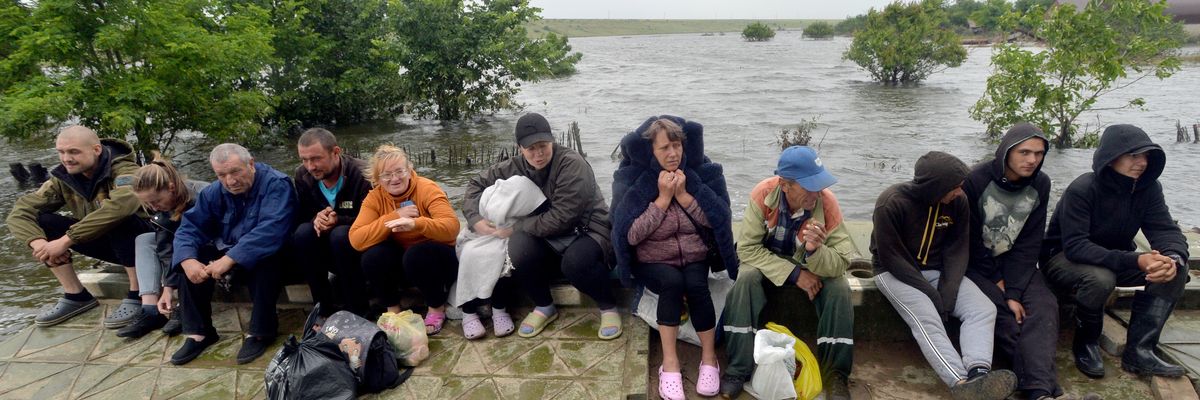
People are pictured in Afanasiyivka, Mykolaiv region on June 12, 2023 after the Kakhovka dam collapse.
UN Accuses Russia of Blocking Aid to Dam Collapse Victims
"Aid cannot be denied to people who need it," said the U.N. humanitarian coordinator for Ukraine.
The United Nations on Sunday accused the Russian government of denying aid workers access to Moscow-controlled areas of southern Ukraine that were impacted by the devastating collapse of the Kakhovka dam earlier this month.
Denise Brown, the U.N. humanitarian coordinator for Ukraine, said in a statement that Russia has "so far declined our request to access the areas under its temporary military control" and implored Moscow officials to "act in accordance with their obligations under international humanitarian law."
"Aid cannot be denied to people who need it," said Brown. "The U.N. will continue to do all it can to reach all people—including those suffering as a result of the recent dam destruction—who urgently need life-saving assistance, no matter where they are."
Dmitry Peskov, a spokesperson for the Kremlin, said it would be unsafe to allow aid workers to access the area due to ongoing fighting.
"There has been constant shelling, constant provocations, civilian facilities, and the civilian population have come under fire, people have died, so it’s really difficult to ensure their security," Peskov told reporters Monday.
The dam's collapse sparked a humanitarian and ecological disaster, forcing thousands to flee their homes, intensifying concerns about the structural integrity of a major nuclear plant, and potentially causing long-term damage to the area's drinking water and agriculture—a crisis with global implications.
More than 50 people have been confirmed dead as a result of the dam's collapse.
Ukraine and Russia have blamed each other for the disaster, while some have suggested the fall of the dam—which was under Russian control at the time of the collapse—was a result of damage accumulated from months of war.
Citing two U.S. engineers, an explosives expert, and a Ukrainian engineer with "extensive experience with the dam's operations," The New York Times reported Friday that "given the satellite and seismic detections of explosions in the area, by far the most likely cause of the collapse was an explosive charge placed in the maintenance passageway, or gallery, that runs through the concrete heart of the structure."
The Associated Press separately reported Sunday that "images taken from above the Kakhovka dam... appear to show an explosive-laden car atop the structure, and two officials said Russian troops were stationed in a crucial area inside the dam where the Ukrainians say the explosion that destroyed it was centered."
Moscow says Ukraine sabotaged the dam with "mass artillery attacks" or missile strikes.
Whatever the cause, the consequences have been profound and will likely be long-lasting.
"I worry a lot about the effect on global food prices and, as much as anything, on global food availability," Martin Griffiths, the U.N.'s under-secretary-general for humanitarian affairs and emergency relief coordinator, told PBS late last week.
"We will see the extent of that damage as the waters recede," Griffiths added. "It is a catastrophe for the world."
We are at a crossroads
This country and this world are at a monumental crossroads. In a few short weeks, US voters will have an opportunity to beat back the forces of fascism and confront the billionaires who are rigging the economy, our media system, and our democracy, making it increasingly impossible for ordinary people to get by. We’re not just talking about the election. We’re talking about what must be done once these fascist elements are vanquished from power. We need a bolder set of solutions than what either major party has so far been willing to offer and a working-class movement ready to fight like hell for it. Trump didn't emerge from nowhere. The conditions that fueled MAGA authoritarianism were created by decades of radical neoliberal economic policies and a corrupt political system dominated by corporate interests. They slashed taxes on the super-rich, promising that the benefits would trickle down. They said giveaways to the corporate titans would make life more affordable for the rest of us. It was all bullshit. And when a bitter, betrayed populace searches for someone to blame, right-wing demagogues have little trouble finding scapegoats. People know when they're being lied to, but you won't hear any of this from the corporate media. Only independent journalism—powered and funded by people who believe in building a better world—can deliver truly trustworthy daily news. Our Fall Campaign is underway, and we need your help. To power our newsroom through the rest of the year, we need to raise $125,000 by midnight on October 31. So if you share our vision, please contribute whatever you can to sustain our work. |
The United Nations on Sunday accused the Russian government of denying aid workers access to Moscow-controlled areas of southern Ukraine that were impacted by the devastating collapse of the Kakhovka dam earlier this month.
Denise Brown, the U.N. humanitarian coordinator for Ukraine, said in a statement that Russia has "so far declined our request to access the areas under its temporary military control" and implored Moscow officials to "act in accordance with their obligations under international humanitarian law."
"Aid cannot be denied to people who need it," said Brown. "The U.N. will continue to do all it can to reach all people—including those suffering as a result of the recent dam destruction—who urgently need life-saving assistance, no matter where they are."
Dmitry Peskov, a spokesperson for the Kremlin, said it would be unsafe to allow aid workers to access the area due to ongoing fighting.
"There has been constant shelling, constant provocations, civilian facilities, and the civilian population have come under fire, people have died, so it’s really difficult to ensure their security," Peskov told reporters Monday.
The dam's collapse sparked a humanitarian and ecological disaster, forcing thousands to flee their homes, intensifying concerns about the structural integrity of a major nuclear plant, and potentially causing long-term damage to the area's drinking water and agriculture—a crisis with global implications.
More than 50 people have been confirmed dead as a result of the dam's collapse.
Ukraine and Russia have blamed each other for the disaster, while some have suggested the fall of the dam—which was under Russian control at the time of the collapse—was a result of damage accumulated from months of war.
Citing two U.S. engineers, an explosives expert, and a Ukrainian engineer with "extensive experience with the dam's operations," The New York Times reported Friday that "given the satellite and seismic detections of explosions in the area, by far the most likely cause of the collapse was an explosive charge placed in the maintenance passageway, or gallery, that runs through the concrete heart of the structure."
The Associated Press separately reported Sunday that "images taken from above the Kakhovka dam... appear to show an explosive-laden car atop the structure, and two officials said Russian troops were stationed in a crucial area inside the dam where the Ukrainians say the explosion that destroyed it was centered."
Moscow says Ukraine sabotaged the dam with "mass artillery attacks" or missile strikes.
Whatever the cause, the consequences have been profound and will likely be long-lasting.
"I worry a lot about the effect on global food prices and, as much as anything, on global food availability," Martin Griffiths, the U.N.'s under-secretary-general for humanitarian affairs and emergency relief coordinator, told PBS late last week.
"We will see the extent of that damage as the waters recede," Griffiths added. "It is a catastrophe for the world."