SUBSCRIBE TO OUR FREE NEWSLETTER
Daily news & progressive opinion—funded by the people, not the corporations—delivered straight to your inbox.
5
#000000
#FFFFFF
To donate by check, phone, or other method, see our More Ways to Give page.
Daily news & progressive opinion—funded by the people, not the corporations—delivered straight to your inbox.
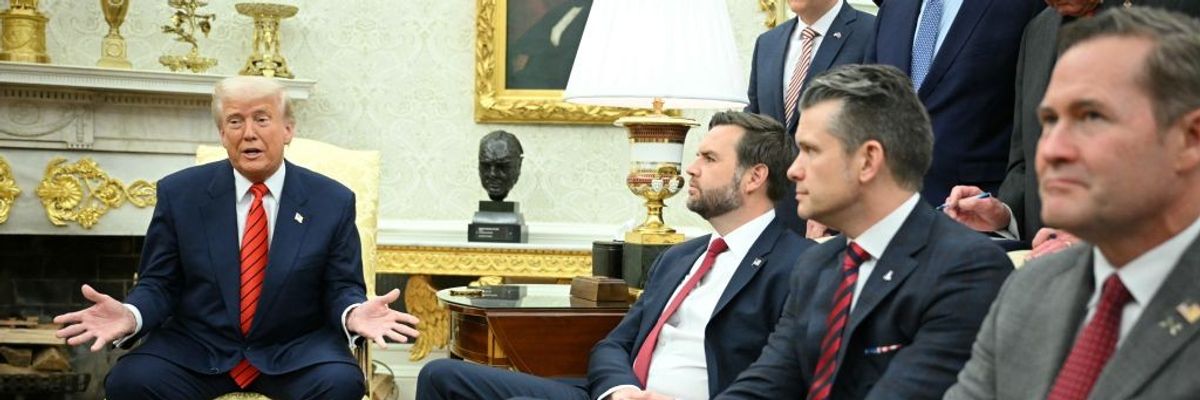
U.S. President Donald Trump speaks to the press at the White House in Washington, D.C. on March 13, 2025, seated beside Vice President JD Vance, Defense Secretary Pete Hegseth, and National Security Adviser Mike Waltz.
Reactions included: "Dangerous." "Gross incompetence." "Unfathomable."
U.S. President Donald Trump's administration came under fire Monday after a journalist revealed that he was added to a group on a commercial messaging application in which top officials discussed secret plans for the recent bombing of Yemen.
"I have never seen a breach quite like this," Jeffrey Goldberg, editor in chief of The Atlantic, wrote of his experience in the group, which began with a March 11 connection request on the app Signal from "Michael Waltz," the name of Trump's national security adviser. The journalist—who has faced public attacks from the president—figured "someone could be masquerading as Waltz in order to somehow entrap me."
However, in the days that followed, Goldberg saw messages from accounts with names or initials of top officials—including Vice President JD Vance, Central Intelligence Agency Director John Ratcliffe, Director of National Intelligence Tulsi Gabbard, Defense Secretary Pete Hegseth, Secretary of State Marco Rubio, and Treasury Secretary Scott Bessent. On March 15, Trump bombed Yemen, citing the Houthis' interference with global shipping over Israel's U.S.-backed assault on the Gaza Strip.
"Jeffrey Goldberg's reporting in The Atlantic calls for a prompt and thorough investigation...There needs to be an oversight hearing and accountability for these actions."
Goldberg published quotes and screenshots from the group but withheld some details due to security risks for U.S. personnel. Noting a March 15 message from the Pentagon chief, he wrote, "What I will say, in order to illustrate the shocking recklessness of this Signal conversation, is that the Hegseth post contained operational details of forthcoming strikes on Yemen, including information about targets."
The journalist also highlighted how—according to lawyers interviewed by his colleague Shane Harris—Waltz "may have violated several provisions of the Espionage Act," as well as federal records laws, given that he set some messages to eventually disappear.
After Goldberg formally inquired about the Signal group on Monday, Brian Hughes, the spokesperson for the National Security Council, told him: "This appears to be an authentic message chain, and we are reviewing how an inadvertent number was added to the chain... The thread is a demonstration of the deep and thoughtful policy coordination between senior officials. The ongoing success of the Houthi operation demonstrates that there were no threats to troops or national security."
Political figures and observers swiftly weighed in and shared the article on social media, with reporters calling it "unfathomable" and "the must-read of the week," and saying that "this story almost seems too wild to be real, but no one involved is disputing it."
CNN's Christiane Amanpour said: "Amateur hour? Is the president, is America, being properly served? Dangerous."
The group VoteVets took aim at the defense secretary—a former Fox News host—saying: "Gross incompetence. The Trump admin accidentally texted a journalist our war plans. This proves what we always knew: Hegseth was never qualified to be SecDef—now his recklessness is putting troops' lives at risk. This is deadly serious."
Democratic Minnesota Gov. Tim Walz—who was former Vice President Kamala Harris' running mate—pointed to the Department of Government Efficiency's attacks on the federal bureaucracy, including the Department of Veterans Affairs: "You know where DOGE should take a closer look? Trump's Cabinet. None of the 83,000 caregivers Trump fired from the VA leaked classified information."
Congressman Joe Neguse (D-Colo.) said: "If you read one article today, make it this one. Total incompetence, yet again. And putting our national security at great risk."
U.S. Senate Select Committee on Intelligence Vice Chair Mark Warner (D-Va.) declared that "this administration is playing fast and loose with our nation's most classified info, and it makes all Americans less safe."
Sen. Chris Coons (D-Del.) said: "Jeffrey Goldberg's reporting in The Atlantic calls for a prompt and thorough investigation. If senior advisers to President Trump in fact used nonsecure, nongovernment systems to discuss and convey detailed war plans, it's a shocking breach of the standards for sharing classified information that could have put American servicemembers at risk. There needs to be an oversight hearing and accountability for these actions."
When asked about the reporting on Monday, Trump—a serial liar—said: "I don't know anything about it. I'm not a big fan of The Atlantic. It's, to me, it's a magazine that's going out of business. I think it's not much of a magazine, but I know nothing about it."
"You're saying that they had what?" Trump asked the inquiring journalist, who explained that top officials were using Signal to coordinate on sensitive materials related to the U.S. attack targeting the Houthis.
Trump then added: "Well, it couldn't have been very effective, because the attack was very effective, I can tell you that. I don't know anything about it. You're telling me about it for the first time."
Responding to a clip of Trump's remarks, David Badash, founder and editor of The New Civil Rights Movement, said: "1. 100% incompetence if his comms staff did not brief him on this before he got in front of a camera. 2. This is the commander-in-chief admitting that he is unaware of what his top NatSec officials are doing. This is bad."
As Common Dreams has reported, Trump has also faced criticism for the assault on Yemen—which killed more than 50 people, mostly women and children, according to the Yemeni Health Ministry. Critics, including U.S. lawmakers, have long argued that airstrikes on the Middle Eastern country are illegal because Congress has not declared war.
Dear Common Dreams reader, It’s been nearly 30 years since I co-founded Common Dreams with my late wife, Lina Newhouser. We had the radical notion that journalism should serve the public good, not corporate profits. It was clear to us from the outset what it would take to build such a project. No paid advertisements. No corporate sponsors. No millionaire publisher telling us what to think or do. Many people said we wouldn't last a year, but we proved those doubters wrong. Together with a tremendous team of journalists and dedicated staff, we built an independent media outlet free from the constraints of profits and corporate control. Our mission has always been simple: To inform. To inspire. To ignite change for the common good. Building Common Dreams was not easy. Our survival was never guaranteed. When you take on the most powerful forces—Wall Street greed, fossil fuel industry destruction, Big Tech lobbyists, and uber-rich oligarchs who have spent billions upon billions rigging the economy and democracy in their favor—the only bulwark you have is supporters who believe in your work. But here’s the urgent message from me today. It's never been this bad out there. And it's never been this hard to keep us going. At the very moment Common Dreams is most needed, the threats we face are intensifying. We need your support now more than ever. We don't accept corporate advertising and never will. We don't have a paywall because we don't think people should be blocked from critical news based on their ability to pay. Everything we do is funded by the donations of readers like you. When everyone does the little they can afford, we are strong. But if that support retreats or dries up, so do we. Will you donate now to make sure Common Dreams not only survives but thrives? —Craig Brown, Co-founder |
U.S. President Donald Trump's administration came under fire Monday after a journalist revealed that he was added to a group on a commercial messaging application in which top officials discussed secret plans for the recent bombing of Yemen.
"I have never seen a breach quite like this," Jeffrey Goldberg, editor in chief of The Atlantic, wrote of his experience in the group, which began with a March 11 connection request on the app Signal from "Michael Waltz," the name of Trump's national security adviser. The journalist—who has faced public attacks from the president—figured "someone could be masquerading as Waltz in order to somehow entrap me."
However, in the days that followed, Goldberg saw messages from accounts with names or initials of top officials—including Vice President JD Vance, Central Intelligence Agency Director John Ratcliffe, Director of National Intelligence Tulsi Gabbard, Defense Secretary Pete Hegseth, Secretary of State Marco Rubio, and Treasury Secretary Scott Bessent. On March 15, Trump bombed Yemen, citing the Houthis' interference with global shipping over Israel's U.S.-backed assault on the Gaza Strip.
"Jeffrey Goldberg's reporting in The Atlantic calls for a prompt and thorough investigation...There needs to be an oversight hearing and accountability for these actions."
Goldberg published quotes and screenshots from the group but withheld some details due to security risks for U.S. personnel. Noting a March 15 message from the Pentagon chief, he wrote, "What I will say, in order to illustrate the shocking recklessness of this Signal conversation, is that the Hegseth post contained operational details of forthcoming strikes on Yemen, including information about targets."
The journalist also highlighted how—according to lawyers interviewed by his colleague Shane Harris—Waltz "may have violated several provisions of the Espionage Act," as well as federal records laws, given that he set some messages to eventually disappear.
After Goldberg formally inquired about the Signal group on Monday, Brian Hughes, the spokesperson for the National Security Council, told him: "This appears to be an authentic message chain, and we are reviewing how an inadvertent number was added to the chain... The thread is a demonstration of the deep and thoughtful policy coordination between senior officials. The ongoing success of the Houthi operation demonstrates that there were no threats to troops or national security."
Political figures and observers swiftly weighed in and shared the article on social media, with reporters calling it "unfathomable" and "the must-read of the week," and saying that "this story almost seems too wild to be real, but no one involved is disputing it."
CNN's Christiane Amanpour said: "Amateur hour? Is the president, is America, being properly served? Dangerous."
The group VoteVets took aim at the defense secretary—a former Fox News host—saying: "Gross incompetence. The Trump admin accidentally texted a journalist our war plans. This proves what we always knew: Hegseth was never qualified to be SecDef—now his recklessness is putting troops' lives at risk. This is deadly serious."
Democratic Minnesota Gov. Tim Walz—who was former Vice President Kamala Harris' running mate—pointed to the Department of Government Efficiency's attacks on the federal bureaucracy, including the Department of Veterans Affairs: "You know where DOGE should take a closer look? Trump's Cabinet. None of the 83,000 caregivers Trump fired from the VA leaked classified information."
Congressman Joe Neguse (D-Colo.) said: "If you read one article today, make it this one. Total incompetence, yet again. And putting our national security at great risk."
U.S. Senate Select Committee on Intelligence Vice Chair Mark Warner (D-Va.) declared that "this administration is playing fast and loose with our nation's most classified info, and it makes all Americans less safe."
Sen. Chris Coons (D-Del.) said: "Jeffrey Goldberg's reporting in The Atlantic calls for a prompt and thorough investigation. If senior advisers to President Trump in fact used nonsecure, nongovernment systems to discuss and convey detailed war plans, it's a shocking breach of the standards for sharing classified information that could have put American servicemembers at risk. There needs to be an oversight hearing and accountability for these actions."
When asked about the reporting on Monday, Trump—a serial liar—said: "I don't know anything about it. I'm not a big fan of The Atlantic. It's, to me, it's a magazine that's going out of business. I think it's not much of a magazine, but I know nothing about it."
"You're saying that they had what?" Trump asked the inquiring journalist, who explained that top officials were using Signal to coordinate on sensitive materials related to the U.S. attack targeting the Houthis.
Trump then added: "Well, it couldn't have been very effective, because the attack was very effective, I can tell you that. I don't know anything about it. You're telling me about it for the first time."
Responding to a clip of Trump's remarks, David Badash, founder and editor of The New Civil Rights Movement, said: "1. 100% incompetence if his comms staff did not brief him on this before he got in front of a camera. 2. This is the commander-in-chief admitting that he is unaware of what his top NatSec officials are doing. This is bad."
As Common Dreams has reported, Trump has also faced criticism for the assault on Yemen—which killed more than 50 people, mostly women and children, according to the Yemeni Health Ministry. Critics, including U.S. lawmakers, have long argued that airstrikes on the Middle Eastern country are illegal because Congress has not declared war.
U.S. President Donald Trump's administration came under fire Monday after a journalist revealed that he was added to a group on a commercial messaging application in which top officials discussed secret plans for the recent bombing of Yemen.
"I have never seen a breach quite like this," Jeffrey Goldberg, editor in chief of The Atlantic, wrote of his experience in the group, which began with a March 11 connection request on the app Signal from "Michael Waltz," the name of Trump's national security adviser. The journalist—who has faced public attacks from the president—figured "someone could be masquerading as Waltz in order to somehow entrap me."
However, in the days that followed, Goldberg saw messages from accounts with names or initials of top officials—including Vice President JD Vance, Central Intelligence Agency Director John Ratcliffe, Director of National Intelligence Tulsi Gabbard, Defense Secretary Pete Hegseth, Secretary of State Marco Rubio, and Treasury Secretary Scott Bessent. On March 15, Trump bombed Yemen, citing the Houthis' interference with global shipping over Israel's U.S.-backed assault on the Gaza Strip.
"Jeffrey Goldberg's reporting in The Atlantic calls for a prompt and thorough investigation...There needs to be an oversight hearing and accountability for these actions."
Goldberg published quotes and screenshots from the group but withheld some details due to security risks for U.S. personnel. Noting a March 15 message from the Pentagon chief, he wrote, "What I will say, in order to illustrate the shocking recklessness of this Signal conversation, is that the Hegseth post contained operational details of forthcoming strikes on Yemen, including information about targets."
The journalist also highlighted how—according to lawyers interviewed by his colleague Shane Harris—Waltz "may have violated several provisions of the Espionage Act," as well as federal records laws, given that he set some messages to eventually disappear.
After Goldberg formally inquired about the Signal group on Monday, Brian Hughes, the spokesperson for the National Security Council, told him: "This appears to be an authentic message chain, and we are reviewing how an inadvertent number was added to the chain... The thread is a demonstration of the deep and thoughtful policy coordination between senior officials. The ongoing success of the Houthi operation demonstrates that there were no threats to troops or national security."
Political figures and observers swiftly weighed in and shared the article on social media, with reporters calling it "unfathomable" and "the must-read of the week," and saying that "this story almost seems too wild to be real, but no one involved is disputing it."
CNN's Christiane Amanpour said: "Amateur hour? Is the president, is America, being properly served? Dangerous."
The group VoteVets took aim at the defense secretary—a former Fox News host—saying: "Gross incompetence. The Trump admin accidentally texted a journalist our war plans. This proves what we always knew: Hegseth was never qualified to be SecDef—now his recklessness is putting troops' lives at risk. This is deadly serious."
Democratic Minnesota Gov. Tim Walz—who was former Vice President Kamala Harris' running mate—pointed to the Department of Government Efficiency's attacks on the federal bureaucracy, including the Department of Veterans Affairs: "You know where DOGE should take a closer look? Trump's Cabinet. None of the 83,000 caregivers Trump fired from the VA leaked classified information."
Congressman Joe Neguse (D-Colo.) said: "If you read one article today, make it this one. Total incompetence, yet again. And putting our national security at great risk."
U.S. Senate Select Committee on Intelligence Vice Chair Mark Warner (D-Va.) declared that "this administration is playing fast and loose with our nation's most classified info, and it makes all Americans less safe."
Sen. Chris Coons (D-Del.) said: "Jeffrey Goldberg's reporting in The Atlantic calls for a prompt and thorough investigation. If senior advisers to President Trump in fact used nonsecure, nongovernment systems to discuss and convey detailed war plans, it's a shocking breach of the standards for sharing classified information that could have put American servicemembers at risk. There needs to be an oversight hearing and accountability for these actions."
When asked about the reporting on Monday, Trump—a serial liar—said: "I don't know anything about it. I'm not a big fan of The Atlantic. It's, to me, it's a magazine that's going out of business. I think it's not much of a magazine, but I know nothing about it."
"You're saying that they had what?" Trump asked the inquiring journalist, who explained that top officials were using Signal to coordinate on sensitive materials related to the U.S. attack targeting the Houthis.
Trump then added: "Well, it couldn't have been very effective, because the attack was very effective, I can tell you that. I don't know anything about it. You're telling me about it for the first time."
Responding to a clip of Trump's remarks, David Badash, founder and editor of The New Civil Rights Movement, said: "1. 100% incompetence if his comms staff did not brief him on this before he got in front of a camera. 2. This is the commander-in-chief admitting that he is unaware of what his top NatSec officials are doing. This is bad."
As Common Dreams has reported, Trump has also faced criticism for the assault on Yemen—which killed more than 50 people, mostly women and children, according to the Yemeni Health Ministry. Critics, including U.S. lawmakers, have long argued that airstrikes on the Middle Eastern country are illegal because Congress has not declared war.