

SUBSCRIBE TO OUR FREE NEWSLETTER
Daily news & progressive opinion—funded by the people, not the corporations—delivered straight to your inbox.
5
#000000
#FFFFFF
To donate by check, phone, or other method, see our More Ways to Give page.
Daily news & progressive opinion—funded by the people, not the corporations—delivered straight to your inbox.
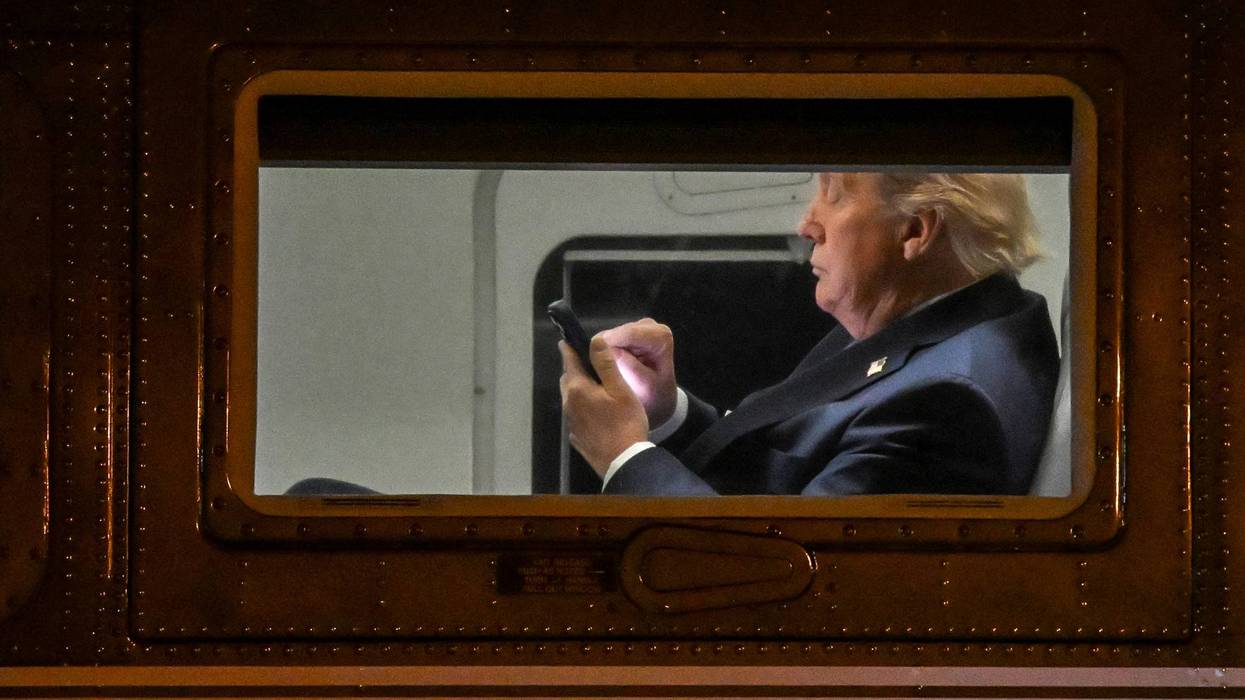
"President Trump has repeatedly made clear his contempt for laws governing presidential transparency and proper recordkeeping."
A watchdog group is raising concerns that President Donald Trump may have violated federal recordkeeping laws by using an auto-deleting message application to text world leaders.
On Tuesday, the group American Oversight sent a letter to White House Counsel David Warrington asking for information about whether the president is taking all the required steps to comply with the Presidential Records Act, which requires the preservation of all presidential records—including digital correspondence—during official duties.
The group highlighted two posts Trump made on Truth Social last Tuesday in which appeared to reveal that he was using Signal or another similar messaging app to discuss world affairs with world leaders.
The first screenshot shows a message from French President Emmanuel Macron, who discussed plans to meet with Trump about his proposal to take over Greenland and meetings with other foreign diplomats.
The second was sent from NATO Secretary General Mark Rutte, who told Trump he'd use his "media engagements" in Davos to "highlight" Trump's work in Ukraine and Gaza, and expressed an interest in "finding a way forward on Greenland."
While some European diplomats found it troubling that any intimate communication they have with Trump could be exposed to the world on a whim, American Oversight said it also raised concerns about the preservation of records.
Trump has a long history of flouting rules surrounding the proper storage of documents. The group pointed out that during his first term, the president would often rip up notes, memos, and documents after reading them and at least twice reportedly attempted to flush them down the toilet.
More recently, he was indicted for improperly stashing away classified documents at his personal residence at Mar-a-Lago after leaving the White House and showing them to people without security clearances.
The second Trump White House has already been involved in a scandal surrounding their use of deleting message apps when a journalist was accidentally invited into a private Signal chat last year, which contained the administration's plans for an imminent strike on Yemen. The messages in that chat were reportedly set to delete after one week, before later being changed to four, which would have also violated the Presidential Records Act.
“President Trump has repeatedly made clear his contempt for laws governing presidential transparency and proper recordkeeping,” said American Oversight executive director Chioma Chukwu. “The Presidential Records Act exists to ensure transparency of presidential decisions and safeguard the historical record for the American people."
"Given President Trump’s well-documented history of mishandling sensitive information and presidential records," he added, "the White House must assure the public that these communications are secure and being preserved and protected in full compliance with the law.”
The group has requested that the White House counsel disclose any other messages Trump may have sent using auto-deleting apps and ensure that any messages sent through mobile messaging programs are properly preserved.

"There must be accountability for this administration's dangerous disregard for our national security," said one Democratic congressman and former military prosecutor.
U.S. National Security Adviser Mike Waltz and members of his staff have created at least 20 group chats on the encrypted messaging app Signal to coordinate official work on sensitive policy issues around the world, four people who were added to such groups told Politico.
Waltz was already under fire for a group chat about the U.S. bombing Yemen when the report broke. Politico's Dasha Burns wrote on Wednesday that "none of the four individuals said they were aware of whether any classified information was shared, but all said that posts in group chats did include sensitive details of national security work."
The anonymous sources told Politico that the group chats involved policy issues involving China, Ukraine, Gaza, the Middle East, Europe, and Africa. One of them said, "It was commonplace to stand up chats on any given national security topic," one of the four sources told the outlet.
The Politico article comes a day after The Washington Post reported that Waltz and other members of President Donald Trump's National Security Council conducted official government business via their personal Gmail accounts, which are far less secure than Signal chats.
The fresh revelations also come as "Signalgate"—in which Waltz, Defense Secretary Pete Hegseth, and other top Trump administration officials added a journalist to a Signal group chat about plans to bomb Yemen—still smolders.
Calls for Waltz's resignation or firing, which were already numerous in the wake of Signalgate, mounted Wednesday.
Resign.
[image or embed]
— Senator Ed Markey ( @markey.senate.gov) April 2, 2025 at 2:26 PM
"Waltz must resign. Hegseth must resign," Rep. Ted Lieu (D-Calif.), a member of the House Foreign Affairs Committee, said on the social media site Bluesky. "There must be accountability for this administration's dangerous disregard for our national security."
Referring to the Signal group chats, Rep. Jimmy Gomez (D-Calif.) asked on the social media site X, "How many more are there?"
"Even Trump allies say this doesn't pass the smell test," he added. "National Security Adviser Waltz and Pete Hegseth need to be fired."
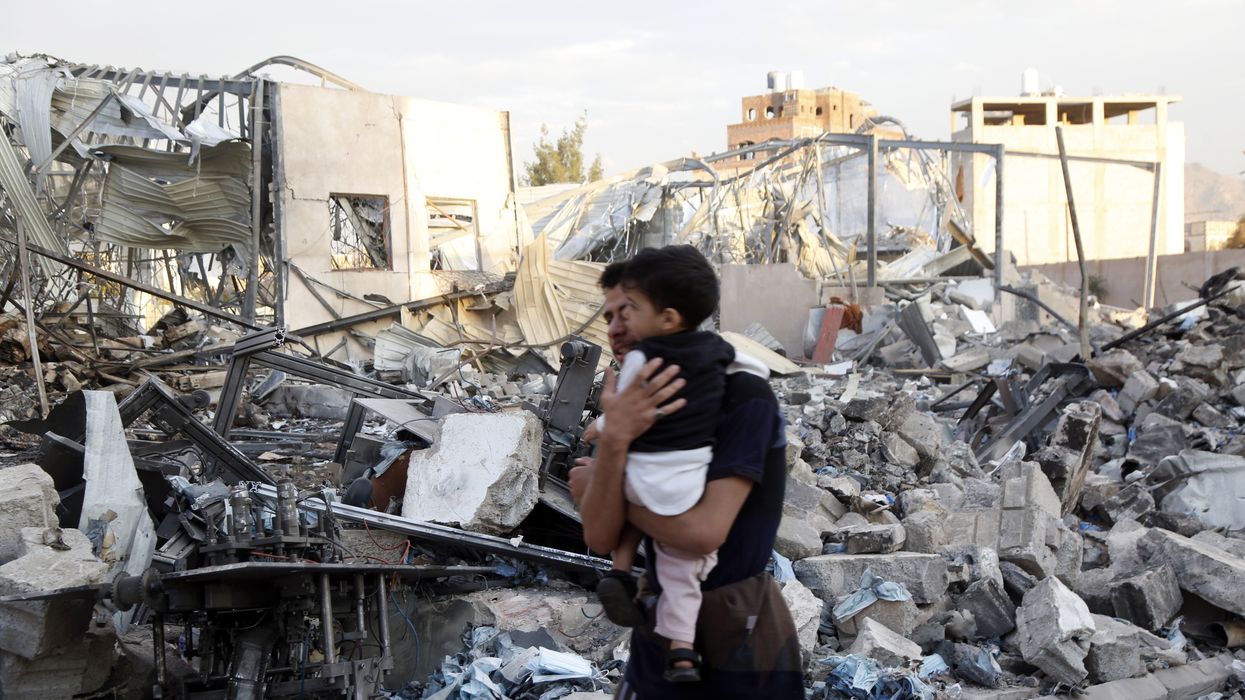
"President Trump has not only launched us into a new military escapade in the Middle East, he's done so in breach of our Constitution," said one advocate.
The leaked messages among top Trump administration officials about U.S. strikes in Yemen earlier this month, which were held via a private sector messaging app in breach of national security protocol and inadvertently included a journalist, sparked considerable discussion among political commentators and social media users—but as the initial shock regarding the Signal conversation faded, advocates and policy experts said lawmakers' attention should turn to the illegality of the attacks on Yemen.
The advocacy groups Just Foreign Policy, DAWN, and Action Corps released a joint statement Thursday calling on Congress to take action to stop U.S. military action in Yemen by upholding "its sole authority to declare war under Article I of the Constitution and the 1973 War Powers Resolution (WPR)."
The chat messages sent between officials including Vice President JD Vance, Defense Secretary Pete Hegseth, and National Security Adviser Michael Waltz stunned the public and Washington insiders this week because they had accidentally also been sent to Atlantic journalist Jeffrey Goldberg, but the three groups pointed out that they also included an admission from Vance that the strikes were not defensive—contrary to claims by President Donald Trump:
I think we are making a mistake… 3 percent of US trade runs through the suez. 40 percent of European trade does. There is a real risk that the public doesn't understand this or why it's necessary. The strongest reason to do this is, as POTUS said, to send a message…
Vance's comments bolster the three groups' position that "the strikes also violate Chapters I and VII of the United Nations Charter, which prohibit states from launching a war unless in self-defense or authorized by the U.N. Security Council."
Even before the chats were leaked, said the groups, it was clear that Trump had not sought congressional authorization for military strikes in Yemen, which have killed at least 53 people since the U.S. launched attacks on March 15.
The War Powers Resolution of 1973, which was introduced after former President Richard Nixon's secretive bombings of Cambodia, requires congressional authorization for "the introduction of the United States armed forces into hostilities, or into situations where imminent involvement in hostilities is clearly indicated by the circumstances," while Article I of the Constitution grants Congress the authority to declare war.
"Congress should demand an end to this reckless, unauthorized war that will both harm U.S. interests and continue to terrorize the Yemeni people who have already suffered years of U.S.-backed violence."
"President Trump has not only launched us into a new military escapade in the Middle East, he's done so in breach of our Constitution," said Isaac Evans-Frantz, director of Action Corps. "Congress should demand an end to this reckless, unauthorized war that will both harm U.S. interests and continue to terrorize the Yemeni people who have already suffered years of U.S.-backed violence."
The groups' comments echoed those of Michigan State University professor and Quincy Institute fellow Shireen Al-Adeimi, who is Yemeni-American.
"With all the noise about the Signal leak, is anyone in Congress or the media concerned that actually bombing Yemeni people and Yemen's infrastructure is unconstitutional?" she asked on Tuesday. "Anyone?"
The Trump administration claimed that the strikes in Yemen were made because the Houthis' blockade on Israeli ships—established in retaliation for Israel's breaking of a cease-fire in Gaza—was an attack on U.S. economic interests and economic security, but the three groups noted that "there is no evidence that Houthi forces attacked any U.S. ships or personnel from the beginning of the Gaza cease-fire in January 2025 through March 15."
The Houthis struck cargo ships they deemed to be tied to Israel starting in November 2023, in response to Israel's relentless assault on Gaza. They stopped the attacks for the duration of the cease-fire, which lasted nearly two months starting in mid-January.
"The cessation of Houthi attacks during the short-lived Gaza truce underscores their primary focus to defend Palestinians from genocide—a reality obscured by Trump's rhetoric to justify unauthorized military action and deepen U.S. aggression in a widening conflict," said Sarah Leah Whitson, executive director of DAWN. "The best way to protect global maritime navigation through the Red Sea is to ensure the Israeli government ends its genocidal violence in Gaza."
Along with Vance's apparent admission that the strikes were not in self-defense, the Signal discussion included what observers called a "confession" to alleged war crimes by Waltz, who said the residential building of the girlfriend of a Houthi leader had "collapsed" after a U.S. strike. As Common Dreams reported Wednesday, Waltz and Vance celebrated the strike.
Etan Mabourakh, a fellow at Action Corps, called on Congress to introduce a Yemen War Powers Resolution. The House and Senate both passed such a resolution in 2019 to bar the U.S. from participating in the Saudi war in Yemen.
"Congress should take the necessary step to stop these illegal, ineffective, and unauthorized airstrikes in Yemen," said Mabourakh. "Rather than debating the Trump administration's violation of security protocols in their Signal chats, they should do their job and challenge another unlawful new war in the region that is making everyone less safe."
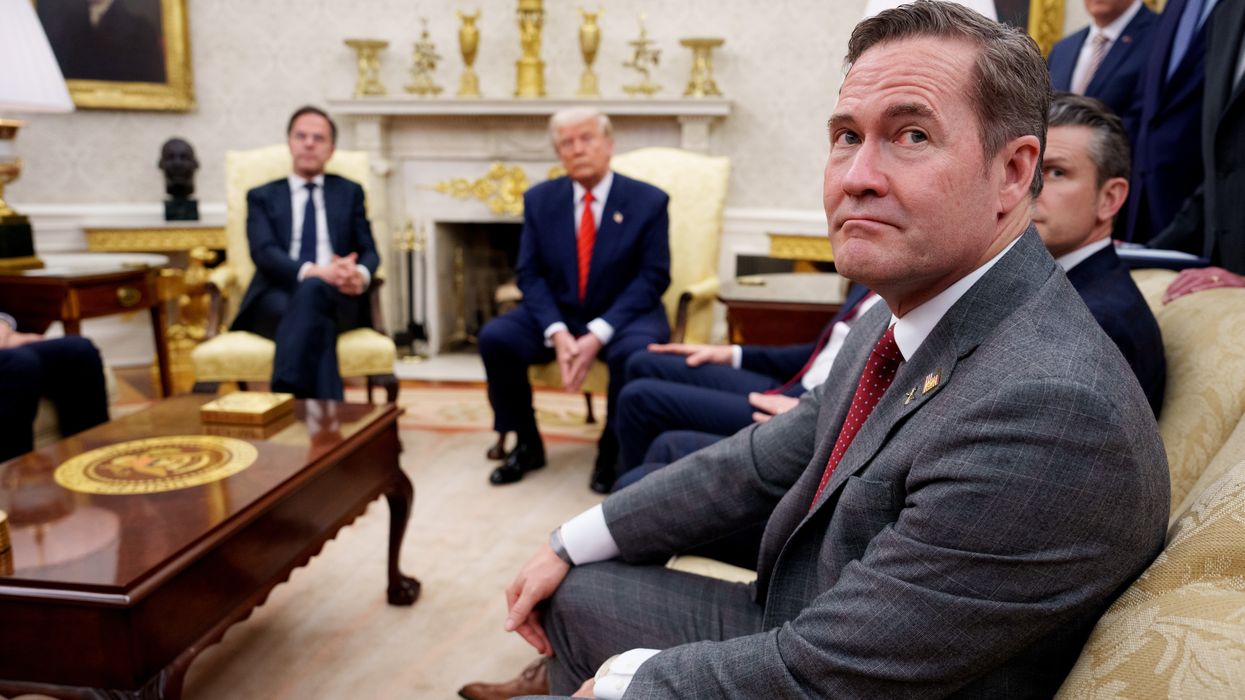
National Security Adviser Michael Waltz and Vice President JD Vance celebrated as a residential building "collapsed" following a U.S. strike.
Along with raising alarm about a massive national security breach—and questions about the competence of top officials in the Trump administration who "inadvertently" added a journalist to a Signal group chat about plans to bomb targets in Yemen—the incident that Atlantic reporter Jeffrey Goldberg publicized this week included an apparent "confession" of at least one alleged war crime.
As
Common Dreams reported Wednesday, Goldberg released the entirety of the group chat that was held via the commercial messaging app Signal, following denials by Defense Secretary Pete Hegseth and White House Press Secretary Karoline Leavitt that any classified information was transmitted in the discussion.
In addition to making clear the detailed plans for attacks on Houthi targets in Yemen using F-18s and drones, the conversation included a brief message from National Security Adviser Michael Waltz in which he appeared to casually describe a strike on a civilian target in Sanaa.
Waltz first praised Hegseth, Central Command leader Gen. Michael Kurilla, and the intelligence community for an "amazing job," saying a "building collapsed" after U.S. intelligence identified a Houthi leader who was targeted for a strike.
He then clarified his message for Vice President JD Vance: "Their first target—their top missile guy—we had positive ID of him walking into his girlfriend's building and it's now collapsed," wrote Waltz.
The vice president replied, "Excellent."
The messages Goldberg disclosed to the public were sent over several days after he received a connection request from "Michael Waltz" via the Signal app. The conversation took place around the Trump administration's March 15 bombing of Yemen, which was carried out after the Houthis renewed a blockade on Israeli ships.
At least 31 civilians were killed in the bombing campaign, and the Houthi media office reported at the time that the U.S. had struck a "residential neighborhood" in Sanaa.
On Wednesday, journalist and author Kim Zetter said Waltz's message suggested top administration officials knew U.S. forces had "targeted [a] residential building," despite President Donald Trump's claims to the contrary.
Dylan Williams, vice president for government affairs at the Center for International Policy, said the messages contain "prima facie evidence of at least one war crime applauded by the people who conspired to commit it."
Matt Duss, executive vice president of the organization, recalled the warning of Foundation for Middle East Peace president Lara Friedman in September 2024 regarding the Biden administration's support for Israel's "rules of war" in Gaza—where "every human being" has been defined "as a legitimate military target—a terrorist, a terrorist supporter or sympathizer, or a 'human shield'... allowing the annihilation of huge numbers of civilians and destruction of entire cities."
"The costs of these new rules of war will be paid with the blood of civilians worldwide for generations to come, and the U.S. responsibility for enabling, defending, and normalizing these new rules—and their horrific, dehumanizing consequences—will not be forgotten,"
said Friedman at the time.
Duss
said Wednesday that "rules of engagement that permit destroying an entire civilian apartment building to kill one alleged terrorist is part of [former President] Joe Biden's legacy."
"It's still a war crime though," he added, "and Waltz's text is a confession."
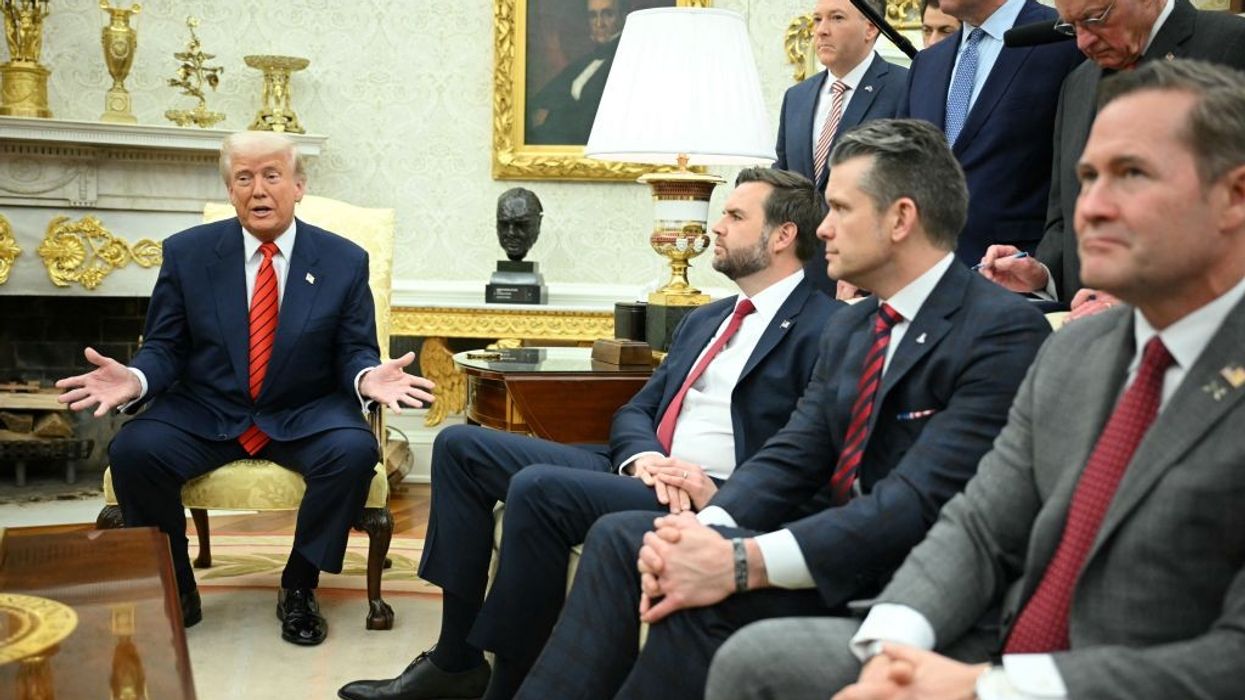
Reactions included: "Dangerous." "Gross incompetence." "Unfathomable."
U.S. President Donald Trump's administration came under fire Monday after a journalist revealed that he was added to a group on a commercial messaging application in which top officials discussed secret plans for the recent bombing of Yemen.
"I have never seen a breach quite like this," Jeffrey Goldberg, editor in chief of The Atlantic, wrote of his experience in the group, which began with a March 11 connection request on the app Signal from "Michael Waltz," the name of Trump's national security adviser. The journalist—who has faced public attacks from the president—figured "someone could be masquerading as Waltz in order to somehow entrap me."
However, in the days that followed, Goldberg saw messages from accounts with names or initials of top officials—including Vice President JD Vance, Central Intelligence Agency Director John Ratcliffe, Director of National Intelligence Tulsi Gabbard, Defense Secretary Pete Hegseth, Secretary of State Marco Rubio, and Treasury Secretary Scott Bessent. On March 15, Trump bombed Yemen, citing the Houthis' interference with global shipping over Israel's U.S.-backed assault on the Gaza Strip.
"Jeffrey Goldberg's reporting in The Atlantic calls for a prompt and thorough investigation...There needs to be an oversight hearing and accountability for these actions."
Goldberg published quotes and screenshots from the group but withheld some details due to security risks for U.S. personnel. Noting a March 15 message from the Pentagon chief, he wrote, "What I will say, in order to illustrate the shocking recklessness of this Signal conversation, is that the Hegseth post contained operational details of forthcoming strikes on Yemen, including information about targets."
The journalist also highlighted how—according to lawyers interviewed by his colleague Shane Harris—Waltz "may have violated several provisions of the Espionage Act," as well as federal records laws, given that he set some messages to eventually disappear.
After Goldberg formally inquired about the Signal group on Monday, Brian Hughes, the spokesperson for the National Security Council, told him: "This appears to be an authentic message chain, and we are reviewing how an inadvertent number was added to the chain... The thread is a demonstration of the deep and thoughtful policy coordination between senior officials. The ongoing success of the Houthi operation demonstrates that there were no threats to troops or national security."
Political figures and observers swiftly weighed in and shared the article on social media, with reporters calling it "unfathomable" and "the must-read of the week," and saying that "this story almost seems too wild to be real, but no one involved is disputing it."
CNN's Christiane Amanpour said: "Amateur hour? Is the president, is America, being properly served? Dangerous."
The group VoteVets took aim at the defense secretary—a former Fox News host—saying: "Gross incompetence. The Trump admin accidentally texted a journalist our war plans. This proves what we always knew: Hegseth was never qualified to be SecDef—now his recklessness is putting troops' lives at risk. This is deadly serious."
Democratic Minnesota Gov. Tim Walz—who was former Vice President Kamala Harris' running mate—pointed to the Department of Government Efficiency's attacks on the federal bureaucracy, including the Department of Veterans Affairs: "You know where DOGE should take a closer look? Trump's Cabinet. None of the 83,000 caregivers Trump fired from the VA leaked classified information."
Congressman Joe Neguse (D-Colo.) said: "If you read one article today, make it this one. Total incompetence, yet again. And putting our national security at great risk."
U.S. Senate Select Committee on Intelligence Vice Chair Mark Warner (D-Va.) declared that "this administration is playing fast and loose with our nation's most classified info, and it makes all Americans less safe."
Sen. Chris Coons (D-Del.) said: "Jeffrey Goldberg's reporting in The Atlantic calls for a prompt and thorough investigation. If senior advisers to President Trump in fact used nonsecure, nongovernment systems to discuss and convey detailed war plans, it's a shocking breach of the standards for sharing classified information that could have put American servicemembers at risk. There needs to be an oversight hearing and accountability for these actions."
When asked about the reporting on Monday, Trump—a serial liar—said: "I don't know anything about it. I'm not a big fan of The Atlantic. It's, to me, it's a magazine that's going out of business. I think it's not much of a magazine, but I know nothing about it."
"You're saying that they had what?" Trump asked the inquiring journalist, who explained that top officials were using Signal to coordinate on sensitive materials related to the U.S. attack targeting the Houthis.
Trump then added: "Well, it couldn't have been very effective, because the attack was very effective, I can tell you that. I don't know anything about it. You're telling me about it for the first time."
Responding to a clip of Trump's remarks, David Badash, founder and editor of The New Civil Rights Movement, said: "1. 100% incompetence if his comms staff did not brief him on this before he got in front of a camera. 2. This is the commander-in-chief admitting that he is unaware of what his top NatSec officials are doing. This is bad."
As Common Dreams has reported, Trump has also faced criticism for the assault on Yemen—which killed more than 50 people, mostly women and children, according to the Yemeni Health Ministry. Critics, including U.S. lawmakers, have long argued that airstrikes on the Middle Eastern country are illegal because Congress has not declared war.