5
#000000
#FFFFFF
To donate by check, phone, or other method, see our More Ways to Give page.
Daily news & progressive opinion—funded by the people, not the corporations—delivered straight to your inbox.
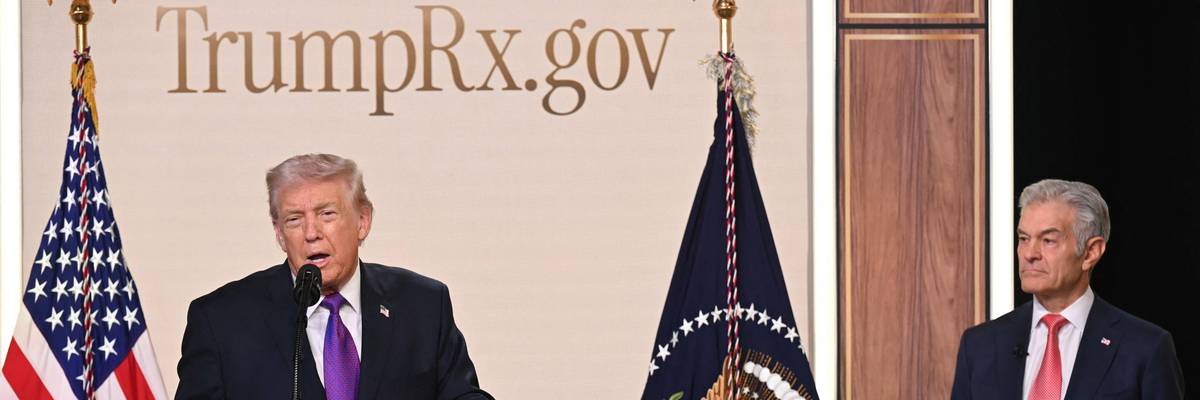
US President Donald Trump speaks in the South Court Auditorium of the White House in Washington, DC on February 5, 2026.
"Trump and congressional Republicans intentionally force seniors to pay more for cancer treatment so that Big Pharma can rake in more money that Trump can personally profit from."
An analysis released Friday by Democrats on the congressional Joint Economic Committee details how US President Donald Trump loaded up on shares of major pharmaceutical companies last year as his administration and Republican allies enacted policies that benefited the industry—at the expense seniors and other patients.
The JEC analysis estimates that Trump increased his stock holdings in the pharmaceutical sector from $1.7 million in 2024 to as much as $56.2 million last year. The committee notes that Trump, who has repeatedly promised to cut drug prices while implementing policies that raised them, "held as much as $39.1 million in stock in the same Big Pharma companies that directly benefited" from a budget package that the president signed into law last summer.
“Trump and congressional Republicans intentionally force seniors to pay more for cancer treatment so that Big Pharma can rake in more money that Trump can personally profit from," said Sen. Maggie Hassan (D-NH), the JEC's ranking member. "It’s outrageous and yet typical from this president, who makes the American people foot the bill again and again for his own gains."
Tucked in the Trump-GOP budget law was a provision exempting some widely used, high-priced prescription drugs from Medicare price negotiations. Merck's cancer medication Keytruda was one of the drugs temporarily shielded by the provision; Merck appears more than 60 times in the president's 2025 financial disclosure.
The JEC analysis notes that "in 2025, Merck reported $18.8 billion in US revenues for Keytruda, which helped the company net $22.5 billion in profits that year, a 16% increase compared to 2024."
The president also made big purchases of stock in Johnson & Johnson, AbbVie, Pfizer, and Amgen last year. The JEC found that each of those companies "had at least one drug that benefited from the carveouts" in the Trump-GOP budget law.
Additionally, the Trump administration has entered friendly agreements with pharmaceutical companies in which the president is invested, including Pfizer and Eli Lilly.
“Trump’s drug pricing deals are a mirage, designed to convince Americans that he’s taken significant action on drug pricing while creating minimal if any downside for Big Pharma,” Peter Maybarduk, access to medicines director for the consumer advocacy group Public Citizen, said last month after his organization obtained heavily redacted texts of the agreements.
"The texts show Trump handing out favors to Big Pharma, undercutting his own models to lower prices, and throwing the support of the US government behind corporate decisions to deny medicines entirely to other countries," said Maybarduk.
Dear Common Dreams reader, It’s been nearly 30 years since I co-founded Common Dreams with my late wife, Lina Newhouser. We had the radical notion that journalism should serve the public good, not corporate profits. It was clear to us from the outset what it would take to build such a project. No paid advertisements. No corporate sponsors. No millionaire publisher telling us what to think or do. Many people said we wouldn't last a year, but we proved those doubters wrong. Together with a tremendous team of journalists and dedicated staff, we built an independent media outlet free from the constraints of profits and corporate control. Our mission has always been simple: To inform. To inspire. To ignite change for the common good. Building Common Dreams was not easy. Our survival was never guaranteed. When you take on the most powerful forces—Wall Street greed, fossil fuel industry destruction, Big Tech lobbyists, and uber-rich oligarchs who have spent billions upon billions rigging the economy and democracy in their favor—the only bulwark you have is supporters who believe in your work. But here’s the urgent message from me today. It's never been this bad out there. And it's never been this hard to keep us going. At the very moment Common Dreams is most needed, the threats we face are intensifying. We need your support now more than ever. We don't accept corporate advertising and never will. We don't have a paywall because we don't think people should be blocked from critical news based on their ability to pay. Everything we do is funded by the donations of readers like you. When everyone does the little they can afford, we are strong. But if that support retreats or dries up, so do we. Will you donate now to make sure Common Dreams not only survives but thrives? —Craig Brown, Co-founder |
An analysis released Friday by Democrats on the congressional Joint Economic Committee details how US President Donald Trump loaded up on shares of major pharmaceutical companies last year as his administration and Republican allies enacted policies that benefited the industry—at the expense seniors and other patients.
The JEC analysis estimates that Trump increased his stock holdings in the pharmaceutical sector from $1.7 million in 2024 to as much as $56.2 million last year. The committee notes that Trump, who has repeatedly promised to cut drug prices while implementing policies that raised them, "held as much as $39.1 million in stock in the same Big Pharma companies that directly benefited" from a budget package that the president signed into law last summer.
“Trump and congressional Republicans intentionally force seniors to pay more for cancer treatment so that Big Pharma can rake in more money that Trump can personally profit from," said Sen. Maggie Hassan (D-NH), the JEC's ranking member. "It’s outrageous and yet typical from this president, who makes the American people foot the bill again and again for his own gains."
Tucked in the Trump-GOP budget law was a provision exempting some widely used, high-priced prescription drugs from Medicare price negotiations. Merck's cancer medication Keytruda was one of the drugs temporarily shielded by the provision; Merck appears more than 60 times in the president's 2025 financial disclosure.
The JEC analysis notes that "in 2025, Merck reported $18.8 billion in US revenues for Keytruda, which helped the company net $22.5 billion in profits that year, a 16% increase compared to 2024."
The president also made big purchases of stock in Johnson & Johnson, AbbVie, Pfizer, and Amgen last year. The JEC found that each of those companies "had at least one drug that benefited from the carveouts" in the Trump-GOP budget law.
Additionally, the Trump administration has entered friendly agreements with pharmaceutical companies in which the president is invested, including Pfizer and Eli Lilly.
“Trump’s drug pricing deals are a mirage, designed to convince Americans that he’s taken significant action on drug pricing while creating minimal if any downside for Big Pharma,” Peter Maybarduk, access to medicines director for the consumer advocacy group Public Citizen, said last month after his organization obtained heavily redacted texts of the agreements.
"The texts show Trump handing out favors to Big Pharma, undercutting his own models to lower prices, and throwing the support of the US government behind corporate decisions to deny medicines entirely to other countries," said Maybarduk.
An analysis released Friday by Democrats on the congressional Joint Economic Committee details how US President Donald Trump loaded up on shares of major pharmaceutical companies last year as his administration and Republican allies enacted policies that benefited the industry—at the expense seniors and other patients.
The JEC analysis estimates that Trump increased his stock holdings in the pharmaceutical sector from $1.7 million in 2024 to as much as $56.2 million last year. The committee notes that Trump, who has repeatedly promised to cut drug prices while implementing policies that raised them, "held as much as $39.1 million in stock in the same Big Pharma companies that directly benefited" from a budget package that the president signed into law last summer.
“Trump and congressional Republicans intentionally force seniors to pay more for cancer treatment so that Big Pharma can rake in more money that Trump can personally profit from," said Sen. Maggie Hassan (D-NH), the JEC's ranking member. "It’s outrageous and yet typical from this president, who makes the American people foot the bill again and again for his own gains."
Tucked in the Trump-GOP budget law was a provision exempting some widely used, high-priced prescription drugs from Medicare price negotiations. Merck's cancer medication Keytruda was one of the drugs temporarily shielded by the provision; Merck appears more than 60 times in the president's 2025 financial disclosure.
The JEC analysis notes that "in 2025, Merck reported $18.8 billion in US revenues for Keytruda, which helped the company net $22.5 billion in profits that year, a 16% increase compared to 2024."
The president also made big purchases of stock in Johnson & Johnson, AbbVie, Pfizer, and Amgen last year. The JEC found that each of those companies "had at least one drug that benefited from the carveouts" in the Trump-GOP budget law.
Additionally, the Trump administration has entered friendly agreements with pharmaceutical companies in which the president is invested, including Pfizer and Eli Lilly.
“Trump’s drug pricing deals are a mirage, designed to convince Americans that he’s taken significant action on drug pricing while creating minimal if any downside for Big Pharma,” Peter Maybarduk, access to medicines director for the consumer advocacy group Public Citizen, said last month after his organization obtained heavily redacted texts of the agreements.
"The texts show Trump handing out favors to Big Pharma, undercutting his own models to lower prices, and throwing the support of the US government behind corporate decisions to deny medicines entirely to other countries," said Maybarduk.