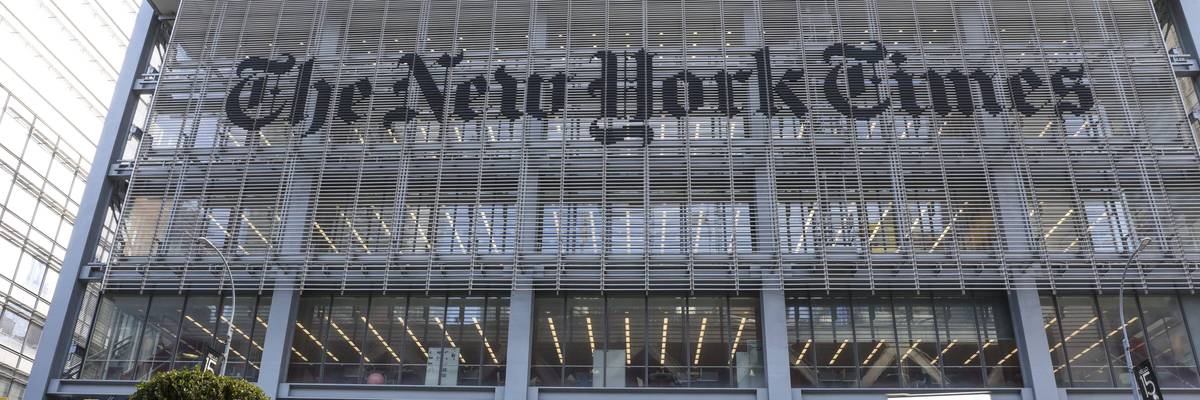
The New York Times logo is seen on the building’s facade in New York City on January 22, 2026.
'An Unmistakably Chilling Message': Trump DOJ Subpoenaed Phone Records of Journalists' Relatives
"Every American who values a free and independent press should see this for what it is: an abuse of power designed to silence scrutiny."
Attorneys representing The New York Times have revealed that the Trump administration's subpoenas of the newspaper's journalists are far more aggressive than what had been previously reported.
In a letter sent to US District Judge Arun Subramanian on Saturday and unsealed by the court on Monday, attorneys David O'Neil, Douglas Zolkind, and Julie Edelstein said that the US Department of Justice was engaged in an "alarming pattern of conduct" beyond its recently revealed efforts to compel Times reporters to testify before a grand jury for a probe related to unspecified national security leaks.
The attorneys said the administration had gone so far as to subpoena phone companies for subscriber information and toll records for phone numbers used by one reporter's mother and by two reporters' spouses, among others.
They also revealed that two administration subpoenas seek records going back as far as January 1 this year, "long before the events that are purportedly the basis for the department's investigation," suggesting that "the department is using this investigation... to forage for information about the journalists' source relationships more broadly."
The subpoenas of the Times journalists, issued earlier this month, came days after the paper published a story that detailed security concerns about the luxury jet the Qatari government gave to President Donald Trump.
The issued subpoenas did not specifically name the Times’ reporting on the Qatari jet as the reason for the grand jury probe, although they were given to all four journalists—Tyler Pager, Julian Barnes, Eric Schmitt, and Eric Lipton—who reported the story.
It is highly uncommon for government investigators to subpoena journalists when they are probing national security leaks, as such actions are generally seen as having a chilling effect on reporters’ ability to gather information.
Katie Fallow, deputy litigation director at the Knight First Amendment Institute at Columbia University, described news of the department seeking phone records of reporters' spouses and a parent as "an extraordinary escalation in the Trump administration’s campaign to intimidate the press."
"The Justice Department didn't stop at journalists—it went after their family members, too," Fallow noted. "That sends an unmistakably chilling message to anyone thinking about reporting on this administration. Every American who values a free and independent press should see this for what it is: an abuse of power designed to silence scrutiny."
Seth Stern, chief of advocacy for the Freedom of the Press Foundation, was even more scathing in his denunciation of the administration's actions.
"Even the Mafia says families are off limits," said Stern. "It’s gross that the administration—in its never-ending effort to harass and intimidate reporters who reveal its incompetence—is going after the communications of journalists’ relatives."
We are at a crossroads
This country and this world are at a monumental crossroads. In a few short weeks, US voters will have an opportunity to beat back the forces of fascism and confront the billionaires who are rigging the economy, our media system, and our democracy, making it increasingly impossible for ordinary people to get by. We’re not just talking about the election. We’re talking about what must be done once these fascist elements are vanquished from power. We need a bolder set of solutions than what either major party has so far been willing to offer and a working-class movement ready to fight like hell for it. Trump didn't emerge from nowhere. The conditions that fueled MAGA authoritarianism were created by decades of radical neoliberal economic policies and a corrupt political system dominated by corporate interests. They slashed taxes on the super-rich, promising that the benefits would trickle down. They said giveaways to the corporate titans would make life more affordable for the rest of us. It was all bullshit. And when a bitter, betrayed populace searches for someone to blame, right-wing demagogues have little trouble finding scapegoats. People know when they're being lied to, but you won't hear any of this from the corporate media. Only independent journalism—powered and funded by people who believe in building a better world—can deliver truly trustworthy daily news. Our Fall Campaign is underway, and we need your help. To power our newsroom through the rest of the year, we need to raise $125,000 by midnight on October 31. So if you share our vision, please contribute whatever you can to sustain our work. |
Attorneys representing The New York Times have revealed that the Trump administration's subpoenas of the newspaper's journalists are far more aggressive than what had been previously reported.
In a letter sent to US District Judge Arun Subramanian on Saturday and unsealed by the court on Monday, attorneys David O'Neil, Douglas Zolkind, and Julie Edelstein said that the US Department of Justice was engaged in an "alarming pattern of conduct" beyond its recently revealed efforts to compel Times reporters to testify before a grand jury for a probe related to unspecified national security leaks.
The attorneys said the administration had gone so far as to subpoena phone companies for subscriber information and toll records for phone numbers used by one reporter's mother and by two reporters' spouses, among others.
They also revealed that two administration subpoenas seek records going back as far as January 1 this year, "long before the events that are purportedly the basis for the department's investigation," suggesting that "the department is using this investigation... to forage for information about the journalists' source relationships more broadly."
The subpoenas of the Times journalists, issued earlier this month, came days after the paper published a story that detailed security concerns about the luxury jet the Qatari government gave to President Donald Trump.
The issued subpoenas did not specifically name the Times’ reporting on the Qatari jet as the reason for the grand jury probe, although they were given to all four journalists—Tyler Pager, Julian Barnes, Eric Schmitt, and Eric Lipton—who reported the story.
It is highly uncommon for government investigators to subpoena journalists when they are probing national security leaks, as such actions are generally seen as having a chilling effect on reporters’ ability to gather information.
Katie Fallow, deputy litigation director at the Knight First Amendment Institute at Columbia University, described news of the department seeking phone records of reporters' spouses and a parent as "an extraordinary escalation in the Trump administration’s campaign to intimidate the press."
"The Justice Department didn't stop at journalists—it went after their family members, too," Fallow noted. "That sends an unmistakably chilling message to anyone thinking about reporting on this administration. Every American who values a free and independent press should see this for what it is: an abuse of power designed to silence scrutiny."
Seth Stern, chief of advocacy for the Freedom of the Press Foundation, was even more scathing in his denunciation of the administration's actions.
"Even the Mafia says families are off limits," said Stern. "It’s gross that the administration—in its never-ending effort to harass and intimidate reporters who reveal its incompetence—is going after the communications of journalists’ relatives."
- 'Effort to Stifle and Intimidate': Trump DOJ Subpoenas News Outlets Over Iran War Coverage ›
- Trump DOJ's Use of Subpoenas Against Journalists Is 'Straight Out of the Dictator's Playbook': Press Freedom Group ›
- 'Should Shock the Conscience': Trump Admin Escalates War on Press With Subpoena of New York Times Reporters ›
- 'Fight and You Win': Free Press Advocates Cheer as Trump DOJ Withdraws Subpoenas of NYT Reporters | Common Dreams ›
Attorneys representing The New York Times have revealed that the Trump administration's subpoenas of the newspaper's journalists are far more aggressive than what had been previously reported.
In a letter sent to US District Judge Arun Subramanian on Saturday and unsealed by the court on Monday, attorneys David O'Neil, Douglas Zolkind, and Julie Edelstein said that the US Department of Justice was engaged in an "alarming pattern of conduct" beyond its recently revealed efforts to compel Times reporters to testify before a grand jury for a probe related to unspecified national security leaks.
The attorneys said the administration had gone so far as to subpoena phone companies for subscriber information and toll records for phone numbers used by one reporter's mother and by two reporters' spouses, among others.
They also revealed that two administration subpoenas seek records going back as far as January 1 this year, "long before the events that are purportedly the basis for the department's investigation," suggesting that "the department is using this investigation... to forage for information about the journalists' source relationships more broadly."
The subpoenas of the Times journalists, issued earlier this month, came days after the paper published a story that detailed security concerns about the luxury jet the Qatari government gave to President Donald Trump.
The issued subpoenas did not specifically name the Times’ reporting on the Qatari jet as the reason for the grand jury probe, although they were given to all four journalists—Tyler Pager, Julian Barnes, Eric Schmitt, and Eric Lipton—who reported the story.
It is highly uncommon for government investigators to subpoena journalists when they are probing national security leaks, as such actions are generally seen as having a chilling effect on reporters’ ability to gather information.
Katie Fallow, deputy litigation director at the Knight First Amendment Institute at Columbia University, described news of the department seeking phone records of reporters' spouses and a parent as "an extraordinary escalation in the Trump administration’s campaign to intimidate the press."
"The Justice Department didn't stop at journalists—it went after their family members, too," Fallow noted. "That sends an unmistakably chilling message to anyone thinking about reporting on this administration. Every American who values a free and independent press should see this for what it is: an abuse of power designed to silence scrutiny."
Seth Stern, chief of advocacy for the Freedom of the Press Foundation, was even more scathing in his denunciation of the administration's actions.
"Even the Mafia says families are off limits," said Stern. "It’s gross that the administration—in its never-ending effort to harass and intimidate reporters who reveal its incompetence—is going after the communications of journalists’ relatives."
- 'Effort to Stifle and Intimidate': Trump DOJ Subpoenas News Outlets Over Iran War Coverage ›
- Trump DOJ's Use of Subpoenas Against Journalists Is 'Straight Out of the Dictator's Playbook': Press Freedom Group ›
- 'Should Shock the Conscience': Trump Admin Escalates War on Press With Subpoena of New York Times Reporters ›
- 'Fight and You Win': Free Press Advocates Cheer as Trump DOJ Withdraws Subpoenas of NYT Reporters | Common Dreams ›