SUBSCRIBE TO OUR FREE NEWSLETTER
Daily news & progressive opinion—funded by the people, not the corporations—delivered straight to your inbox.
5
#000000
#FFFFFF
To donate by check, phone, or other method, see our More Ways to Give page.
Daily news & progressive opinion—funded by the people, not the corporations—delivered straight to your inbox.
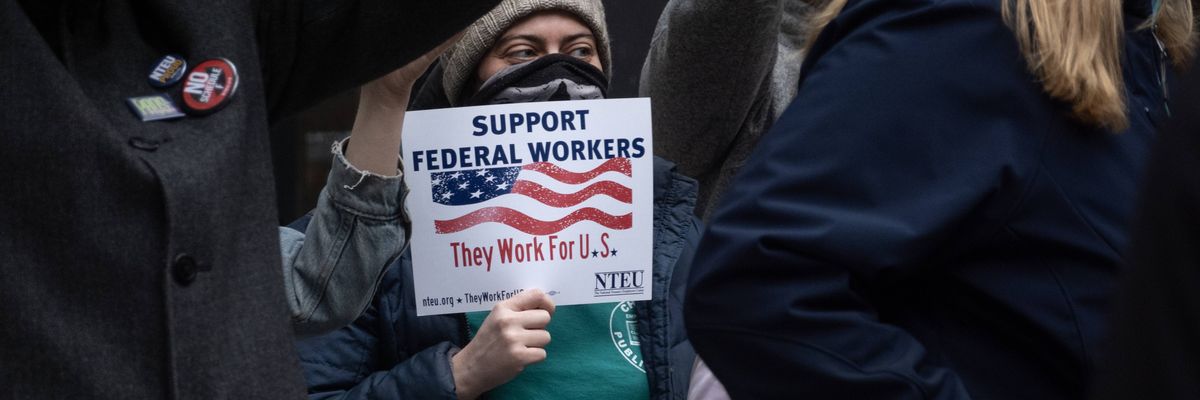
Federal employees rally in support of their jobs outside of the Kluczynski Federal Building on March 19, 2025 in Chicago, Illinois.
"Trump's actions since taking office a year ago reveal a clear and consistent effort... to serve the interests of his billionaire and corporate backers," said a co-author of the Economic Policy Institute report.
From "stripping collective bargaining rights from more than 1 million federal workers" to "denying 2 million in-home healthcare workers minimum wage and overtime pay," President Donald Trump "has actively made life less affordable for working people."
That's according to a Tuesday report from the Economic Policy Institute (EPI), which cataloged 47 key ways that the 47th president made life worse for working people during the first year of his second term.
The think tank sorted the actions into five categories: eroding workers' wages and economic security; undermining job creation; weakening workers' rights; enabling employer exploitation; and creating an ineffective government.
"Many of the actions outlined here have impacts across categories," the report notes. "Trump's attacks on union workers, for example, reduce workers' wages, weaken workers' rights, and promote employer exploitation of workers."
"Every dollar denied to typical workers in wages ends up as higher income for business owners and corporate managers."
The first section highlights that Trump (1) cut the minimum wage for nearly 400,000 federal contractors, (2) ended enforcement of protections for workers illegally classified as independent contractors, (3) slashed wages of migrant farmworkers in the H-2A program, (4) deprived in-home healthcare workers of minimum wage and overtime pay, and (5) facilitated the inclusion of cryptocurrencies among 401(k) investment options.
On the job creation front, the president (6) paused funding for projects authorized under a bipartisan infrastructure law, (7) signed the Laken Riley Act as part of his mass deportation agenda, (8) revoked an executive order that created a federal interagency working group focused on expanding apprenticeships, (9) is trying to shutter Job Corps centers operated by federal contractors, and (10) disrupted manufacturing supply chains with chaotic trade policy.
In addition to (11) attacking the union rights of over 1 million government employees, Trump (12) delayed enforcement of the silica rule for coal miners, (13) proposed limiting the scope of the Occupational Safety and Health Administration's general duty clause, (14) fired National Labor Relations Board (NLRB) General Counsel Jennifer Abruzzo, (15) stripped work permits and temporary protections from immigrants lawfully in the country, and (16) deterred worker organizing with immigration enforcement actions.
Trump's assault on workers' rights has included (17) nominating Labor Secretary Lori Chavez-DeRemer, who has pursued a deregulatory agenda, (18) illegally firing Gwynne Wilcox from the NLRB, (19) ending funding to fight human trafficking and child and forced labor globally, and (20) terminating International Labor Affairs Bureau grants.
Chavez-DeRemer isn't Trump's only controversial pick for a key labor post. He's also nominated (20) Jonathan Berry as solicitor of labor, (21) Crystal Carey as NLRB general counsel, (22) Scott Mayer as an NLRB board member, and (23) Daniel Aronowitz to lead the Employee Benefits Security Administration.
The 47th president has made life less affordable for everyone but himself & his billionaire backersTrump has 😠 slowed job growth,😡 undercut incomes for workers🤬 enriched the ultrawealthyThe latest from @joshbivens-econ.bsky.social , @cmcnich.bsky.social, and Margaret Poydock.
[image or embed]
— Economic Policy Institute (@epi.org) January 13, 2026 at 8:20 AM
Trump has also (24) weakened workplace safety penalties for smaller businesses, (25) nominated Andrea Lucas as Equal Employment Opportunity Commission (EEOC) chair, (26) revoked an executive order promoting strong labor standards on projects receiving federal funds, (27) appointed Elisabeth Messenger, the former leader of an anti-union group, to head the Office of Labor-Management Standards, (28) fired EEOC Commissioners Charlotte Burrows and Jocelyn Samuels, and (29) conducted systematic worksite raids that punished workers rather than improving wages and working conditions.
The president's various "deliberate actions to weaken the federal government" have included (30) politicizing career Senior Executive Service officials, (31) firing most staff at the National Institute for Occupational Safety and Health, (32) nominating Brittany Panuccio as an EEOC commissioner, (33) and picking Project 2025 architect Russell Vought as Office of Management and Budget director.
He has also fired (34) Federal Labor Relations Authority Chair Susan Tsui Grundmann and (35) Merit Systems Protection Board Member Cathy Harris, and (36) tried to fire Federal Reserve Governor Lisa Cook, whose case is set to be argued before the US Supreme Court next week. Trump further (37) fired Bureau of Labor Statistics (BLS) Commissioner Erika McEntarfer over accurate economic data, and is attempting to shut down (38) the Consumer Financial Protection Bureau, and (39) the Federal Mediation and Conciliation Service.
Additionally, the president (40) directed federal agencies to end the use of disparate impact liability, (41) put independent agencies under his supervision, (42) signed the so-called One Big Beautiful Bill Act that transfers wealth from working families to the ultrarich, (43) proposed a rule that would make it easier to fire federal employees for political reasons, and (44) issued an executive order on apprenticeships that does not require the government to consult with labor groups.
Finally, since returning to the White House, the Republican has (45) gutted the federal workforce, (46) directed US Attorney General Pam Bondi to challenge state laws that would regulate artificial intelligence technologies, and (47) fired 17 inspectors general.
"Trump's actions since taking office a year ago reveal a clear and consistent effort to make life less affordable for working people in order to serve the interests of his billionaire and corporate backers," said report co-author Celine McNicholas, EPI's director of policy and general counsel, in a statement.
"Every dollar denied to typical workers in wages ends up as higher income for business owners and corporate managers," McNicholas added. "This growing inequality is what is making life so unaffordable for workers and their families today."
EPI released the report as the BLS published its consumer price index data for December, which show a 2.7% year-over-year increase in prices for everyday goods and services.
Dear Common Dreams reader, It’s been nearly 30 years since I co-founded Common Dreams with my late wife, Lina Newhouser. We had the radical notion that journalism should serve the public good, not corporate profits. It was clear to us from the outset what it would take to build such a project. No paid advertisements. No corporate sponsors. No millionaire publisher telling us what to think or do. Many people said we wouldn't last a year, but we proved those doubters wrong. Together with a tremendous team of journalists and dedicated staff, we built an independent media outlet free from the constraints of profits and corporate control. Our mission has always been simple: To inform. To inspire. To ignite change for the common good. Building Common Dreams was not easy. Our survival was never guaranteed. When you take on the most powerful forces—Wall Street greed, fossil fuel industry destruction, Big Tech lobbyists, and uber-rich oligarchs who have spent billions upon billions rigging the economy and democracy in their favor—the only bulwark you have is supporters who believe in your work. But here’s the urgent message from me today. It's never been this bad out there. And it's never been this hard to keep us going. At the very moment Common Dreams is most needed, the threats we face are intensifying. We need your support now more than ever. We don't accept corporate advertising and never will. We don't have a paywall because we don't think people should be blocked from critical news based on their ability to pay. Everything we do is funded by the donations of readers like you. When everyone does the little they can afford, we are strong. But if that support retreats or dries up, so do we. Will you donate now to make sure Common Dreams not only survives but thrives? —Craig Brown, Co-founder |
From "stripping collective bargaining rights from more than 1 million federal workers" to "denying 2 million in-home healthcare workers minimum wage and overtime pay," President Donald Trump "has actively made life less affordable for working people."
That's according to a Tuesday report from the Economic Policy Institute (EPI), which cataloged 47 key ways that the 47th president made life worse for working people during the first year of his second term.
The think tank sorted the actions into five categories: eroding workers' wages and economic security; undermining job creation; weakening workers' rights; enabling employer exploitation; and creating an ineffective government.
"Many of the actions outlined here have impacts across categories," the report notes. "Trump's attacks on union workers, for example, reduce workers' wages, weaken workers' rights, and promote employer exploitation of workers."
"Every dollar denied to typical workers in wages ends up as higher income for business owners and corporate managers."
The first section highlights that Trump (1) cut the minimum wage for nearly 400,000 federal contractors, (2) ended enforcement of protections for workers illegally classified as independent contractors, (3) slashed wages of migrant farmworkers in the H-2A program, (4) deprived in-home healthcare workers of minimum wage and overtime pay, and (5) facilitated the inclusion of cryptocurrencies among 401(k) investment options.
On the job creation front, the president (6) paused funding for projects authorized under a bipartisan infrastructure law, (7) signed the Laken Riley Act as part of his mass deportation agenda, (8) revoked an executive order that created a federal interagency working group focused on expanding apprenticeships, (9) is trying to shutter Job Corps centers operated by federal contractors, and (10) disrupted manufacturing supply chains with chaotic trade policy.
In addition to (11) attacking the union rights of over 1 million government employees, Trump (12) delayed enforcement of the silica rule for coal miners, (13) proposed limiting the scope of the Occupational Safety and Health Administration's general duty clause, (14) fired National Labor Relations Board (NLRB) General Counsel Jennifer Abruzzo, (15) stripped work permits and temporary protections from immigrants lawfully in the country, and (16) deterred worker organizing with immigration enforcement actions.
Trump's assault on workers' rights has included (17) nominating Labor Secretary Lori Chavez-DeRemer, who has pursued a deregulatory agenda, (18) illegally firing Gwynne Wilcox from the NLRB, (19) ending funding to fight human trafficking and child and forced labor globally, and (20) terminating International Labor Affairs Bureau grants.
Chavez-DeRemer isn't Trump's only controversial pick for a key labor post. He's also nominated (20) Jonathan Berry as solicitor of labor, (21) Crystal Carey as NLRB general counsel, (22) Scott Mayer as an NLRB board member, and (23) Daniel Aronowitz to lead the Employee Benefits Security Administration.
The 47th president has made life less affordable for everyone but himself & his billionaire backersTrump has 😠 slowed job growth,😡 undercut incomes for workers🤬 enriched the ultrawealthyThe latest from @joshbivens-econ.bsky.social , @cmcnich.bsky.social, and Margaret Poydock.
[image or embed]
— Economic Policy Institute (@epi.org) January 13, 2026 at 8:20 AM
Trump has also (24) weakened workplace safety penalties for smaller businesses, (25) nominated Andrea Lucas as Equal Employment Opportunity Commission (EEOC) chair, (26) revoked an executive order promoting strong labor standards on projects receiving federal funds, (27) appointed Elisabeth Messenger, the former leader of an anti-union group, to head the Office of Labor-Management Standards, (28) fired EEOC Commissioners Charlotte Burrows and Jocelyn Samuels, and (29) conducted systematic worksite raids that punished workers rather than improving wages and working conditions.
The president's various "deliberate actions to weaken the federal government" have included (30) politicizing career Senior Executive Service officials, (31) firing most staff at the National Institute for Occupational Safety and Health, (32) nominating Brittany Panuccio as an EEOC commissioner, (33) and picking Project 2025 architect Russell Vought as Office of Management and Budget director.
He has also fired (34) Federal Labor Relations Authority Chair Susan Tsui Grundmann and (35) Merit Systems Protection Board Member Cathy Harris, and (36) tried to fire Federal Reserve Governor Lisa Cook, whose case is set to be argued before the US Supreme Court next week. Trump further (37) fired Bureau of Labor Statistics (BLS) Commissioner Erika McEntarfer over accurate economic data, and is attempting to shut down (38) the Consumer Financial Protection Bureau, and (39) the Federal Mediation and Conciliation Service.
Additionally, the president (40) directed federal agencies to end the use of disparate impact liability, (41) put independent agencies under his supervision, (42) signed the so-called One Big Beautiful Bill Act that transfers wealth from working families to the ultrarich, (43) proposed a rule that would make it easier to fire federal employees for political reasons, and (44) issued an executive order on apprenticeships that does not require the government to consult with labor groups.
Finally, since returning to the White House, the Republican has (45) gutted the federal workforce, (46) directed US Attorney General Pam Bondi to challenge state laws that would regulate artificial intelligence technologies, and (47) fired 17 inspectors general.
"Trump's actions since taking office a year ago reveal a clear and consistent effort to make life less affordable for working people in order to serve the interests of his billionaire and corporate backers," said report co-author Celine McNicholas, EPI's director of policy and general counsel, in a statement.
"Every dollar denied to typical workers in wages ends up as higher income for business owners and corporate managers," McNicholas added. "This growing inequality is what is making life so unaffordable for workers and their families today."
EPI released the report as the BLS published its consumer price index data for December, which show a 2.7% year-over-year increase in prices for everyday goods and services.
From "stripping collective bargaining rights from more than 1 million federal workers" to "denying 2 million in-home healthcare workers minimum wage and overtime pay," President Donald Trump "has actively made life less affordable for working people."
That's according to a Tuesday report from the Economic Policy Institute (EPI), which cataloged 47 key ways that the 47th president made life worse for working people during the first year of his second term.
The think tank sorted the actions into five categories: eroding workers' wages and economic security; undermining job creation; weakening workers' rights; enabling employer exploitation; and creating an ineffective government.
"Many of the actions outlined here have impacts across categories," the report notes. "Trump's attacks on union workers, for example, reduce workers' wages, weaken workers' rights, and promote employer exploitation of workers."
"Every dollar denied to typical workers in wages ends up as higher income for business owners and corporate managers."
The first section highlights that Trump (1) cut the minimum wage for nearly 400,000 federal contractors, (2) ended enforcement of protections for workers illegally classified as independent contractors, (3) slashed wages of migrant farmworkers in the H-2A program, (4) deprived in-home healthcare workers of minimum wage and overtime pay, and (5) facilitated the inclusion of cryptocurrencies among 401(k) investment options.
On the job creation front, the president (6) paused funding for projects authorized under a bipartisan infrastructure law, (7) signed the Laken Riley Act as part of his mass deportation agenda, (8) revoked an executive order that created a federal interagency working group focused on expanding apprenticeships, (9) is trying to shutter Job Corps centers operated by federal contractors, and (10) disrupted manufacturing supply chains with chaotic trade policy.
In addition to (11) attacking the union rights of over 1 million government employees, Trump (12) delayed enforcement of the silica rule for coal miners, (13) proposed limiting the scope of the Occupational Safety and Health Administration's general duty clause, (14) fired National Labor Relations Board (NLRB) General Counsel Jennifer Abruzzo, (15) stripped work permits and temporary protections from immigrants lawfully in the country, and (16) deterred worker organizing with immigration enforcement actions.
Trump's assault on workers' rights has included (17) nominating Labor Secretary Lori Chavez-DeRemer, who has pursued a deregulatory agenda, (18) illegally firing Gwynne Wilcox from the NLRB, (19) ending funding to fight human trafficking and child and forced labor globally, and (20) terminating International Labor Affairs Bureau grants.
Chavez-DeRemer isn't Trump's only controversial pick for a key labor post. He's also nominated (20) Jonathan Berry as solicitor of labor, (21) Crystal Carey as NLRB general counsel, (22) Scott Mayer as an NLRB board member, and (23) Daniel Aronowitz to lead the Employee Benefits Security Administration.
The 47th president has made life less affordable for everyone but himself & his billionaire backersTrump has 😠 slowed job growth,😡 undercut incomes for workers🤬 enriched the ultrawealthyThe latest from @joshbivens-econ.bsky.social , @cmcnich.bsky.social, and Margaret Poydock.
[image or embed]
— Economic Policy Institute (@epi.org) January 13, 2026 at 8:20 AM
Trump has also (24) weakened workplace safety penalties for smaller businesses, (25) nominated Andrea Lucas as Equal Employment Opportunity Commission (EEOC) chair, (26) revoked an executive order promoting strong labor standards on projects receiving federal funds, (27) appointed Elisabeth Messenger, the former leader of an anti-union group, to head the Office of Labor-Management Standards, (28) fired EEOC Commissioners Charlotte Burrows and Jocelyn Samuels, and (29) conducted systematic worksite raids that punished workers rather than improving wages and working conditions.
The president's various "deliberate actions to weaken the federal government" have included (30) politicizing career Senior Executive Service officials, (31) firing most staff at the National Institute for Occupational Safety and Health, (32) nominating Brittany Panuccio as an EEOC commissioner, (33) and picking Project 2025 architect Russell Vought as Office of Management and Budget director.
He has also fired (34) Federal Labor Relations Authority Chair Susan Tsui Grundmann and (35) Merit Systems Protection Board Member Cathy Harris, and (36) tried to fire Federal Reserve Governor Lisa Cook, whose case is set to be argued before the US Supreme Court next week. Trump further (37) fired Bureau of Labor Statistics (BLS) Commissioner Erika McEntarfer over accurate economic data, and is attempting to shut down (38) the Consumer Financial Protection Bureau, and (39) the Federal Mediation and Conciliation Service.
Additionally, the president (40) directed federal agencies to end the use of disparate impact liability, (41) put independent agencies under his supervision, (42) signed the so-called One Big Beautiful Bill Act that transfers wealth from working families to the ultrarich, (43) proposed a rule that would make it easier to fire federal employees for political reasons, and (44) issued an executive order on apprenticeships that does not require the government to consult with labor groups.
Finally, since returning to the White House, the Republican has (45) gutted the federal workforce, (46) directed US Attorney General Pam Bondi to challenge state laws that would regulate artificial intelligence technologies, and (47) fired 17 inspectors general.
"Trump's actions since taking office a year ago reveal a clear and consistent effort to make life less affordable for working people in order to serve the interests of his billionaire and corporate backers," said report co-author Celine McNicholas, EPI's director of policy and general counsel, in a statement.
"Every dollar denied to typical workers in wages ends up as higher income for business owners and corporate managers," McNicholas added. "This growing inequality is what is making life so unaffordable for workers and their families today."
EPI released the report as the BLS published its consumer price index data for December, which show a 2.7% year-over-year increase in prices for everyday goods and services.