SUBSCRIBE TO OUR FREE NEWSLETTER
Daily news & progressive opinion—funded by the people, not the corporations—delivered straight to your inbox.
5
#000000
#FFFFFF
To donate by check, phone, or other method, see our More Ways to Give page.
Daily news & progressive opinion—funded by the people, not the corporations—delivered straight to your inbox.

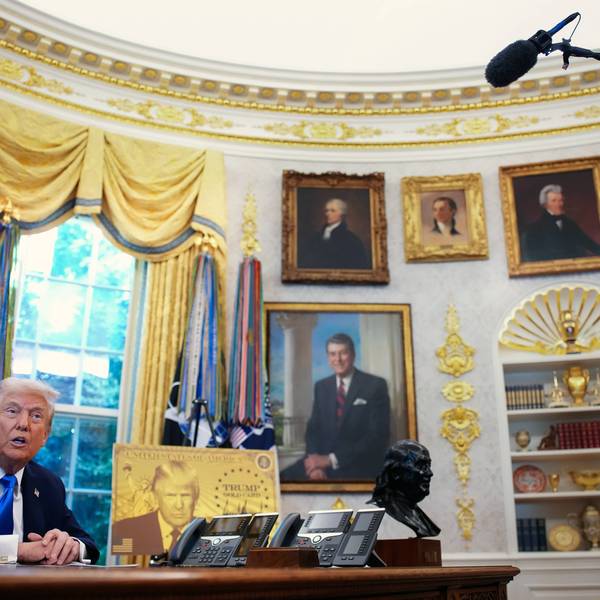
US President Donald Trump enters to deliver remarks during an event at Mount Airy Casino Resort on December 9, 2025 in Mount Pocono, Pennsylvania.
Sen. Tammy Baldwin said that when Trump gives his economy high marks, "it is so clear that he's talking about the economy for him, his billionaire friends, his billionaire Cabinet members."
As Americans increasingly struggle with the cost of living, nearly two-thirds now say President Donald Trump's policies favor the wealthy over everyone else, according to poll results published Sunday.
When respondents were asked by a CBS News/YouGov poll back in March who they felt the president's policies were most geared toward, already a majority, 55%, said the wealthy were benefiting the most, while 33% said his policies benefited everyone equally. Just 1% said his policies would most benefit the poor.
Since then, Trump has imposed a series of regressive tariffs that have driven inflation up, costing the average family an extra $1,200 this year, according to an estimate by Democrats on the Joint Economic Committee in Congress.
He also passed what has often been described as the largest upward transfer of wealth in US history. After July's One Big Beautiful Bill Act, the top 1% of earners are poised to pay over $1 trillion less in taxes over the next decade.
Meanwhile, its cuts to Medicaid and Affordable Care Act health insurance subsidies are expected to result in around 15 million people losing health insurance, while roughly 4 million—including 1 million children—will see cuts to their Supplemental Nutrition Assistance Program (SNAP) benefits.
When CBS/YouGov asked the same question nine months later, the number who said Trump's policies favored the wealthy had shot up by 10 points to 65%. The number who said they'd benefit everyone equally has dropped by about the same amount, and Trump convinced no one that he was primarily looking out for the poor.
Trump's approval ratings have hit record lows in 2025, with the economy—once the area where Americans had the greatest faith in him—now serving as one of the biggest sources of backlash.
Last week, after months of delay, a Labor Department report showed that unemployment had climbed to 4.6% in November, the highest rate since 2021—nearly 50,000 manufacturing jobs, which Trump's tariffs are supposedly meant to protect, were shed between February and September. At the same time, wage growth has decelerated to 3.5% year-over-year, the department said.
Just 18% told CBS News/YouGov they felt as if they were financially better off since Trump took office, while 50% said they were worse off. Thirty-two percent said they were about the same.
When not simply pretending that the economy has improved under his watch—as he did in his primetime address last week—Trump and his allies have blamed economic sluggishness on his predecessor, former President Joe Biden.
But Americans largely do not buy this framing: 47% say Trump's policies are more responsible for the state of the US economy today, while just 22% still predominantly blame Biden, and another 22% say both are equally to blame.
Last week, Trump said his economic performance deserves an "A++++." But just 5% of voters gave him an A. Instead, 24% gave him an F, another 25% gave him a D, and 26% gave him a C.
In a post on social media, Sen. Tammy Baldwin (D-Wis.) said that when Trump gives his economy high marks, "it is so clear that he's talking about the economy for him, his billionaire friends, his billionaire Cabinet members."
Dear Common Dreams reader, It’s been nearly 30 years since I co-founded Common Dreams with my late wife, Lina Newhouser. We had the radical notion that journalism should serve the public good, not corporate profits. It was clear to us from the outset what it would take to build such a project. No paid advertisements. No corporate sponsors. No millionaire publisher telling us what to think or do. Many people said we wouldn't last a year, but we proved those doubters wrong. Together with a tremendous team of journalists and dedicated staff, we built an independent media outlet free from the constraints of profits and corporate control. Our mission has always been simple: To inform. To inspire. To ignite change for the common good. Building Common Dreams was not easy. Our survival was never guaranteed. When you take on the most powerful forces—Wall Street greed, fossil fuel industry destruction, Big Tech lobbyists, and uber-rich oligarchs who have spent billions upon billions rigging the economy and democracy in their favor—the only bulwark you have is supporters who believe in your work. But here’s the urgent message from me today. It's never been this bad out there. And it's never been this hard to keep us going. At the very moment Common Dreams is most needed, the threats we face are intensifying. We need your support now more than ever. We don't accept corporate advertising and never will. We don't have a paywall because we don't think people should be blocked from critical news based on their ability to pay. Everything we do is funded by the donations of readers like you. When everyone does the little they can afford, we are strong. But if that support retreats or dries up, so do we. Will you donate now to make sure Common Dreams not only survives but thrives? —Craig Brown, Co-founder |
As Americans increasingly struggle with the cost of living, nearly two-thirds now say President Donald Trump's policies favor the wealthy over everyone else, according to poll results published Sunday.
When respondents were asked by a CBS News/YouGov poll back in March who they felt the president's policies were most geared toward, already a majority, 55%, said the wealthy were benefiting the most, while 33% said his policies benefited everyone equally. Just 1% said his policies would most benefit the poor.
Since then, Trump has imposed a series of regressive tariffs that have driven inflation up, costing the average family an extra $1,200 this year, according to an estimate by Democrats on the Joint Economic Committee in Congress.
He also passed what has often been described as the largest upward transfer of wealth in US history. After July's One Big Beautiful Bill Act, the top 1% of earners are poised to pay over $1 trillion less in taxes over the next decade.
Meanwhile, its cuts to Medicaid and Affordable Care Act health insurance subsidies are expected to result in around 15 million people losing health insurance, while roughly 4 million—including 1 million children—will see cuts to their Supplemental Nutrition Assistance Program (SNAP) benefits.
When CBS/YouGov asked the same question nine months later, the number who said Trump's policies favored the wealthy had shot up by 10 points to 65%. The number who said they'd benefit everyone equally has dropped by about the same amount, and Trump convinced no one that he was primarily looking out for the poor.
Trump's approval ratings have hit record lows in 2025, with the economy—once the area where Americans had the greatest faith in him—now serving as one of the biggest sources of backlash.
Last week, after months of delay, a Labor Department report showed that unemployment had climbed to 4.6% in November, the highest rate since 2021—nearly 50,000 manufacturing jobs, which Trump's tariffs are supposedly meant to protect, were shed between February and September. At the same time, wage growth has decelerated to 3.5% year-over-year, the department said.
Just 18% told CBS News/YouGov they felt as if they were financially better off since Trump took office, while 50% said they were worse off. Thirty-two percent said they were about the same.
When not simply pretending that the economy has improved under his watch—as he did in his primetime address last week—Trump and his allies have blamed economic sluggishness on his predecessor, former President Joe Biden.
But Americans largely do not buy this framing: 47% say Trump's policies are more responsible for the state of the US economy today, while just 22% still predominantly blame Biden, and another 22% say both are equally to blame.
Last week, Trump said his economic performance deserves an "A++++." But just 5% of voters gave him an A. Instead, 24% gave him an F, another 25% gave him a D, and 26% gave him a C.
In a post on social media, Sen. Tammy Baldwin (D-Wis.) said that when Trump gives his economy high marks, "it is so clear that he's talking about the economy for him, his billionaire friends, his billionaire Cabinet members."
As Americans increasingly struggle with the cost of living, nearly two-thirds now say President Donald Trump's policies favor the wealthy over everyone else, according to poll results published Sunday.
When respondents were asked by a CBS News/YouGov poll back in March who they felt the president's policies were most geared toward, already a majority, 55%, said the wealthy were benefiting the most, while 33% said his policies benefited everyone equally. Just 1% said his policies would most benefit the poor.
Since then, Trump has imposed a series of regressive tariffs that have driven inflation up, costing the average family an extra $1,200 this year, according to an estimate by Democrats on the Joint Economic Committee in Congress.
He also passed what has often been described as the largest upward transfer of wealth in US history. After July's One Big Beautiful Bill Act, the top 1% of earners are poised to pay over $1 trillion less in taxes over the next decade.
Meanwhile, its cuts to Medicaid and Affordable Care Act health insurance subsidies are expected to result in around 15 million people losing health insurance, while roughly 4 million—including 1 million children—will see cuts to their Supplemental Nutrition Assistance Program (SNAP) benefits.
When CBS/YouGov asked the same question nine months later, the number who said Trump's policies favored the wealthy had shot up by 10 points to 65%. The number who said they'd benefit everyone equally has dropped by about the same amount, and Trump convinced no one that he was primarily looking out for the poor.
Trump's approval ratings have hit record lows in 2025, with the economy—once the area where Americans had the greatest faith in him—now serving as one of the biggest sources of backlash.
Last week, after months of delay, a Labor Department report showed that unemployment had climbed to 4.6% in November, the highest rate since 2021—nearly 50,000 manufacturing jobs, which Trump's tariffs are supposedly meant to protect, were shed between February and September. At the same time, wage growth has decelerated to 3.5% year-over-year, the department said.
Just 18% told CBS News/YouGov they felt as if they were financially better off since Trump took office, while 50% said they were worse off. Thirty-two percent said they were about the same.
When not simply pretending that the economy has improved under his watch—as he did in his primetime address last week—Trump and his allies have blamed economic sluggishness on his predecessor, former President Joe Biden.
But Americans largely do not buy this framing: 47% say Trump's policies are more responsible for the state of the US economy today, while just 22% still predominantly blame Biden, and another 22% say both are equally to blame.
Last week, Trump said his economic performance deserves an "A++++." But just 5% of voters gave him an A. Instead, 24% gave him an F, another 25% gave him a D, and 26% gave him a C.
In a post on social media, Sen. Tammy Baldwin (D-Wis.) said that when Trump gives his economy high marks, "it is so clear that he's talking about the economy for him, his billionaire friends, his billionaire Cabinet members."