SUBSCRIBE TO OUR FREE NEWSLETTER
Daily news & progressive opinion—funded by the people, not the corporations—delivered straight to your inbox.
5
#000000
#FFFFFF
To donate by check, phone, or other method, see our More Ways to Give page.
Daily news & progressive opinion—funded by the people, not the corporations—delivered straight to your inbox.
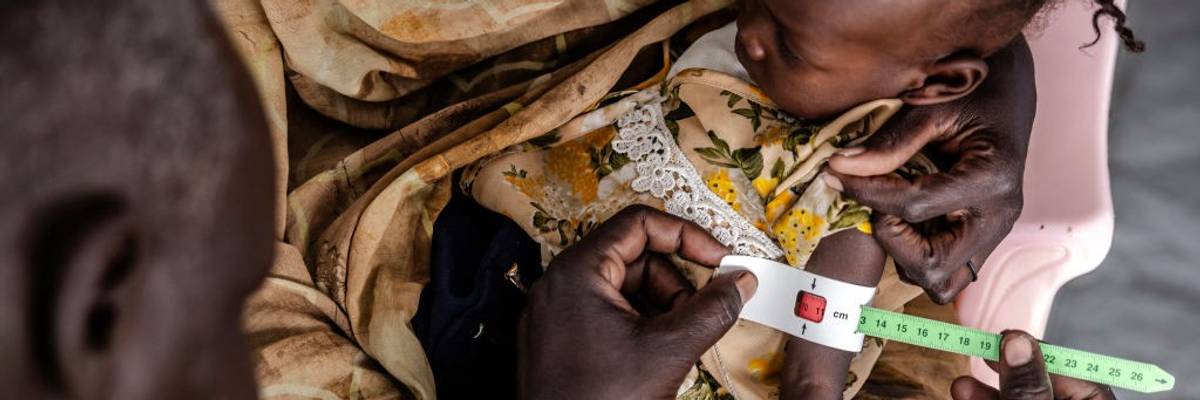
A health worker measures the circumference of a Sudanese child's arm at the clinic of a refugee transit center in Renk, South Sudan on February 13, 2024.
"Millions of lives and the peace and stability of an entire region are at stake," warned the head of the World Food Program.
International humanitarian organizations warned Wednesday that Sudan's civil war risks triggering severe famine unless the fighting stops.
Fighting between rival factions of Sudan's military government broke out nearly 11 months ago and spread rapidly throughout the northeastern African nation of 46 million people. Around 15,000 people have been killed and nearly 6 million others displaced during the war, while an estimated 1.5 million Sudanese have fled the country as refugees.
Those who remain in Sudan are reeling from recent drought and flooding driven by the climate emergency, a potent two-punch combination that has pushed millions of people to the brink of famine.
"The war in Sudan risks triggering the world's largest hunger crisis," said Cindy McCain, director of the United Nations World Food Program, in a statement. "Twenty years ago, Darfur was the world's largest hunger crisis and the world rallied to respond. But today, the people of Sudan have been forgotten. Millions of lives and the peace and stability of an entire region are at stake."
The crisis is particularly acute in and around the Sudanese capital, Khartoum, and in the vast, arid western region of Darfur, where one of the warring factions, the Rapid Support Forces, and its allies have massacred, pillaged, and terrorized members of the predominantly Massalit community.
In Khartoum, hundreds of thousands of people are struggling to find food due to dwindling supplies for the communal kitchens on which many depend and a communications blackout. People venturing outside their homes in search of food run the risk of being shot or shelled amid the fighting.
Meanwhile, some areas of Darfur haven't received any food aid in nearly a year as fighting has rendered it practically impossible for humanitarian workers to operate. According to a February report by Doctors Without Borders, one child is dying of starvation every two hours, and nearly 40% of infants and toddlers are malnourished.
"We are in grave danger of epic, biblical-style famine in Sudan," warned Jan Egeland, who heads the Norwegian Refugee Council, in a Reuters interview.
Egeland added that continued failure to deliver food aid to Darfur soon could mean "a death sentence for millions in desperate need."
According to the WFP:
Over 25 million people across Sudan, South Sudan, and Chad are trapped in a spiral of deteriorating food security. WFP is unable to get sufficient emergency food assistance to desperate communities in Sudan who are trapped by fighting because of the relentless violence and interference by the warring parties. Right now, 90% of people facing emergency levels of hunger in Sudan are stuck in areas that are largely inaccessible to WFP.
Humanitarian assistance has been further disrupted after authorities revoked permissions for cross-border truck convoys, forcing WFP to halt its operations from Chad into Darfur. Over one million people in West and Central Darfur had received WFP assistance via this lifeline route since August, and WFP was in the process of scaling up to support that number each month as hunger and malnutrition continue to skyrocket in Darfur.
Meanwhile, as hundreds of thousands of refugees flee into South Sudan and Chad, humanitarian efforts there have reached a breaking point.
"I met mothers and children who have fled for their lives not once, but multiple times, and now hunger is closing in on them," said McCain. "The consequences of inaction go far beyond a mother unable to feed her child and will shape the region for years to come. Today I am making an urgent plea for the fighting to stop, and that all humanitarian agencies must be allowed to do their lifesaving work."
WFP said it "urgently needs unimpeded access in Sudan to address the escalating food insecurity, which will have significant long-term impacts on the region, along with an injection of funding to respond to the spread of the humanitarian crisis to neighboring countries."
"Ultimately," the agency added, "a cessation of hostilities and lasting peace is the only way to reverse course and prevent catastrophe."
Dear Common Dreams reader, It’s been nearly 30 years since I co-founded Common Dreams with my late wife, Lina Newhouser. We had the radical notion that journalism should serve the public good, not corporate profits. It was clear to us from the outset what it would take to build such a project. No paid advertisements. No corporate sponsors. No millionaire publisher telling us what to think or do. Many people said we wouldn't last a year, but we proved those doubters wrong. Together with a tremendous team of journalists and dedicated staff, we built an independent media outlet free from the constraints of profits and corporate control. Our mission has always been simple: To inform. To inspire. To ignite change for the common good. Building Common Dreams was not easy. Our survival was never guaranteed. When you take on the most powerful forces—Wall Street greed, fossil fuel industry destruction, Big Tech lobbyists, and uber-rich oligarchs who have spent billions upon billions rigging the economy and democracy in their favor—the only bulwark you have is supporters who believe in your work. But here’s the urgent message from me today. It's never been this bad out there. And it's never been this hard to keep us going. At the very moment Common Dreams is most needed, the threats we face are intensifying. We need your support now more than ever. We don't accept corporate advertising and never will. We don't have a paywall because we don't think people should be blocked from critical news based on their ability to pay. Everything we do is funded by the donations of readers like you. When everyone does the little they can afford, we are strong. But if that support retreats or dries up, so do we. Will you donate now to make sure Common Dreams not only survives but thrives? —Craig Brown, Co-founder |
International humanitarian organizations warned Wednesday that Sudan's civil war risks triggering severe famine unless the fighting stops.
Fighting between rival factions of Sudan's military government broke out nearly 11 months ago and spread rapidly throughout the northeastern African nation of 46 million people. Around 15,000 people have been killed and nearly 6 million others displaced during the war, while an estimated 1.5 million Sudanese have fled the country as refugees.
Those who remain in Sudan are reeling from recent drought and flooding driven by the climate emergency, a potent two-punch combination that has pushed millions of people to the brink of famine.
"The war in Sudan risks triggering the world's largest hunger crisis," said Cindy McCain, director of the United Nations World Food Program, in a statement. "Twenty years ago, Darfur was the world's largest hunger crisis and the world rallied to respond. But today, the people of Sudan have been forgotten. Millions of lives and the peace and stability of an entire region are at stake."
The crisis is particularly acute in and around the Sudanese capital, Khartoum, and in the vast, arid western region of Darfur, where one of the warring factions, the Rapid Support Forces, and its allies have massacred, pillaged, and terrorized members of the predominantly Massalit community.
In Khartoum, hundreds of thousands of people are struggling to find food due to dwindling supplies for the communal kitchens on which many depend and a communications blackout. People venturing outside their homes in search of food run the risk of being shot or shelled amid the fighting.
Meanwhile, some areas of Darfur haven't received any food aid in nearly a year as fighting has rendered it practically impossible for humanitarian workers to operate. According to a February report by Doctors Without Borders, one child is dying of starvation every two hours, and nearly 40% of infants and toddlers are malnourished.
"We are in grave danger of epic, biblical-style famine in Sudan," warned Jan Egeland, who heads the Norwegian Refugee Council, in a Reuters interview.
Egeland added that continued failure to deliver food aid to Darfur soon could mean "a death sentence for millions in desperate need."
According to the WFP:
Over 25 million people across Sudan, South Sudan, and Chad are trapped in a spiral of deteriorating food security. WFP is unable to get sufficient emergency food assistance to desperate communities in Sudan who are trapped by fighting because of the relentless violence and interference by the warring parties. Right now, 90% of people facing emergency levels of hunger in Sudan are stuck in areas that are largely inaccessible to WFP.
Humanitarian assistance has been further disrupted after authorities revoked permissions for cross-border truck convoys, forcing WFP to halt its operations from Chad into Darfur. Over one million people in West and Central Darfur had received WFP assistance via this lifeline route since August, and WFP was in the process of scaling up to support that number each month as hunger and malnutrition continue to skyrocket in Darfur.
Meanwhile, as hundreds of thousands of refugees flee into South Sudan and Chad, humanitarian efforts there have reached a breaking point.
"I met mothers and children who have fled for their lives not once, but multiple times, and now hunger is closing in on them," said McCain. "The consequences of inaction go far beyond a mother unable to feed her child and will shape the region for years to come. Today I am making an urgent plea for the fighting to stop, and that all humanitarian agencies must be allowed to do their lifesaving work."
WFP said it "urgently needs unimpeded access in Sudan to address the escalating food insecurity, which will have significant long-term impacts on the region, along with an injection of funding to respond to the spread of the humanitarian crisis to neighboring countries."
"Ultimately," the agency added, "a cessation of hostilities and lasting peace is the only way to reverse course and prevent catastrophe."
International humanitarian organizations warned Wednesday that Sudan's civil war risks triggering severe famine unless the fighting stops.
Fighting between rival factions of Sudan's military government broke out nearly 11 months ago and spread rapidly throughout the northeastern African nation of 46 million people. Around 15,000 people have been killed and nearly 6 million others displaced during the war, while an estimated 1.5 million Sudanese have fled the country as refugees.
Those who remain in Sudan are reeling from recent drought and flooding driven by the climate emergency, a potent two-punch combination that has pushed millions of people to the brink of famine.
"The war in Sudan risks triggering the world's largest hunger crisis," said Cindy McCain, director of the United Nations World Food Program, in a statement. "Twenty years ago, Darfur was the world's largest hunger crisis and the world rallied to respond. But today, the people of Sudan have been forgotten. Millions of lives and the peace and stability of an entire region are at stake."
The crisis is particularly acute in and around the Sudanese capital, Khartoum, and in the vast, arid western region of Darfur, where one of the warring factions, the Rapid Support Forces, and its allies have massacred, pillaged, and terrorized members of the predominantly Massalit community.
In Khartoum, hundreds of thousands of people are struggling to find food due to dwindling supplies for the communal kitchens on which many depend and a communications blackout. People venturing outside their homes in search of food run the risk of being shot or shelled amid the fighting.
Meanwhile, some areas of Darfur haven't received any food aid in nearly a year as fighting has rendered it practically impossible for humanitarian workers to operate. According to a February report by Doctors Without Borders, one child is dying of starvation every two hours, and nearly 40% of infants and toddlers are malnourished.
"We are in grave danger of epic, biblical-style famine in Sudan," warned Jan Egeland, who heads the Norwegian Refugee Council, in a Reuters interview.
Egeland added that continued failure to deliver food aid to Darfur soon could mean "a death sentence for millions in desperate need."
According to the WFP:
Over 25 million people across Sudan, South Sudan, and Chad are trapped in a spiral of deteriorating food security. WFP is unable to get sufficient emergency food assistance to desperate communities in Sudan who are trapped by fighting because of the relentless violence and interference by the warring parties. Right now, 90% of people facing emergency levels of hunger in Sudan are stuck in areas that are largely inaccessible to WFP.
Humanitarian assistance has been further disrupted after authorities revoked permissions for cross-border truck convoys, forcing WFP to halt its operations from Chad into Darfur. Over one million people in West and Central Darfur had received WFP assistance via this lifeline route since August, and WFP was in the process of scaling up to support that number each month as hunger and malnutrition continue to skyrocket in Darfur.
Meanwhile, as hundreds of thousands of refugees flee into South Sudan and Chad, humanitarian efforts there have reached a breaking point.
"I met mothers and children who have fled for their lives not once, but multiple times, and now hunger is closing in on them," said McCain. "The consequences of inaction go far beyond a mother unable to feed her child and will shape the region for years to come. Today I am making an urgent plea for the fighting to stop, and that all humanitarian agencies must be allowed to do their lifesaving work."
WFP said it "urgently needs unimpeded access in Sudan to address the escalating food insecurity, which will have significant long-term impacts on the region, along with an injection of funding to respond to the spread of the humanitarian crisis to neighboring countries."
"Ultimately," the agency added, "a cessation of hostilities and lasting peace is the only way to reverse course and prevent catastrophe."