

SUBSCRIBE TO OUR FREE NEWSLETTER
Daily news & progressive opinion—funded by the people, not the corporations—delivered straight to your inbox.
5
#000000
#FFFFFF
To donate by check, phone, or other method, see our More Ways to Give page.
Daily news & progressive opinion—funded by the people, not the corporations—delivered straight to your inbox.

Forty-one is the number of senators needed to stop the 2027 National Defense Authorization Act—a massive bill that sets defense policies and authorities—and push for key modifications.
In the days after the September 11, 2001 attacks, I joined Harry Belafonte, Danny Glover, the Institute for Policy Studies, YES! Magazine, and hundreds of other signatories in calling for “Justice, Not Vengeance.” We argued that the United States should find and prosecute those responsible for 9-11 rather than launch wars against countries that had not attacked us.
We were right to worry: The wars that followed cost trillions of dollars and countless lives, and left the country less secure, not more.
Twenty-five years later, Congress faces a similar test—and a similar warning sign. The United States and Israel are at war with Iran, a war of choice that could prove even more disastrous than the decision to go to war with Afghanistan and Iraq.
While responsibility for the war lies with the Trump administration, Congress has a say in what happens next—if it chooses to act.
When the Senate reconvenes after their recess, they will face the question of approving the NDAA. Senators should use their leverage to change the disastrous direction of this administration’s defense policies.
Likewise, Congress can rein in historic levels of military spending and reject proposals to spend billions of dollars on a new generation of nuclear weapons, funded by taxpayers and historic levels of debt. And it can say no to the rapid development and deployment of AI weapons, an especially important step at a time when AI agents are already going rogue.
All it would take is 41 US senators. That is the number needed to stop the 2027 National Defense Authorization Act (NDAA)—a massive bill that sets defense policies and authorities, with a proposed price tag of $1.5 trillion.
The NDAA passed the US House of Representatives on July 22, but it has stalled in the US Senate.
Under Senate rules, 41 senators can filibuster to stop a bill from moving to the Senate floor for a vote, and the Democratic caucus has 47 senators. So, even in the minority, the Democratic senators—along with any Republicans who oppose “forever wars”—could prevent the NDAA from advancing without modifications.
When the Senate reconvenes after their recess, they will face the question of approving the NDAA. Senators should use their leverage to change the disastrous direction of this administration’s defense policies.
What specifically could 41 Senators do?
In January of this year, President Donald Trump called for raising the US spending on defense to $1.5 trillion, but has been uncharacteristically quiet about this eye-watering level of defense spending ever since.
Perhaps his silence is because he can see how deeply unpopular the US-Israel war against Iran has turned out to be. Sixty eight percent of Americans say it is not worth the costs, according to a July survey by the Chicago Council on Global Affairs, a level of unpopularity that parallels Americans’ views of the wars in Afghanistan and Iraq.
And there is no end in sight. In spite of President Trump’s bragging about an imminent US victory in Iran, The Wall Street Journal reports that Defense Secretary Pete Hegseth has extended Middle East deployments into 2027.
The US already spends more on the military than any other country—more than twice as much as China and five times as much as Russia. The enormous sums devoted to military spending, and the taxes and debt used to finance them, make the priorities of the American people more difficult to achieve.
Instead of ramping up dangerous conflicts and new weapons systems, we should fund an economy that meets the needs of our families, deploys solutions to the climate crisis, and makes healthcare and housing accessible to everyone. Instead of mounting debt, we should invest in prosperity for future generations.

"We need to now fight to strip this amendment in the conference between the House and the Senate," said Rep. Ro Khanna.
The Republican-controlled US House of Representatives voted Wednesday in favor of a record $1.15 trillion military spending authorization bill containing a highly controversial provision to increase cooperation between the US and Israeli armed forces.
House lawmakers voted 216-212, almost entirely along party lines, to pass HR 8800, the National Defense Authorization Act (NDAA) for fiscal year 2027.
Republicans voted 209-7 in favor, while Democrats voted 205-6 against the measure. Democratic Reps. Henry Cuellar (Texas), Don Davis (NC), Jared Golden (Maine), Vicente Gonzalez (Texas), Adam Gray (Calif.), and Marie Gluesenkamp Perez (Wash.) voted "yes." Independent Rep. Kevin Kiley of California also voted in favor of the bill.
Massie and Rep. Ro Khanna (D-Calif.) submitted an amendment to strip Section 219—which would integrate American and Israeli research and development—from the proposed NDAA.
Rep. Alexandria Ocasio-Cortez (D-NY) on Tuesday called the NDAA "an existential threat to American sovereignty and democracy.”
Massie said that "our founders would be appalled at what Congress is doing now."
On Wednesday, Rep. Ilhan Omar (D-Minn.) described Section 219 as "an outrageous threat to our country's security and autonomy."
"Americans want no part in Netanyahu's genocidal regime," she added, referring to fugitive Israeli Prime Minister Benjamin Netanyahu. "Congress cannot continue to bankroll Israel's campaign of terror. Voting NO."
However, the House Rules Committee blocked debate on the proposal, which remains in the legislation.
"We need to now fight to strip this amendment in the conference between the House and the Senate," Khanna said.
In addition to Section 219, another provision of the proposed NDAA, Section 622, also remains in the legislation. The measure would “expand and enhance intelligence sharing” with Israel, and limit restrictions on such cooperation.
As controversial as 219 is, the primary driver of Democratic opposition to the NDAA was Republican leadership's use of a procedural rule to automatically merge the Safeguard American Voter Eligibility (SAVE) America Act into the military spending package. The legislation—which has been strongly pushed by President Donald Trump—mandates proof of citizenship to register to vote in federal elections. Democrats heavily opposed attaching a controversial voting measure to a must-pass national security bill.
An amendment that would have made Trump's executive order banning transgender people from serving in the US military permanent was narrowly defeated as Republican Reps. Brian Fitzpatrick (Pa.) and Mike Lawler (NY), along with GOP Delegates Kimberlyn Kay King-Hinds of the Northern Mariana Islands and James Moylan of Guam, broke ranks with their party and voted against it.
The proposed NDAA now goes to the Senate, where upper chamber lawmakers will consider their own version of the legislation.
"Americans are saying loudly and clearly: No more US military support for the extremist Netanyahu government," Sen. Bernie Sanders (I-Vt.) said after the House vote. "That is why Congress must vote NO on the defense spending bill, which brings the US and Israeli militaries even closer together."
This article has been updated with the correct vote breakdowns.

"It's time to invest in the American people, not endless war," said Sen. Bernie Sanders.
As expected, members of the Senate Democratic Caucus on Tuesday blocked debate on an annual military spending authorization bill over President Donald Trump’s ongoing illegal war of choice on Iran and provisions for closer US-Israeli military integration.
Upper chamber lawmakers voted 50-46, mostly along party lines, against proceeding with debate on the National Defense Authorization Act (NDAA) for fiscal year 2027.
The Trump administration’s broader national security proposal requests nearly $1.5 trillion in total defense-related spending for 2027, which includes $350 billion in supplemental funding for munitions production, shipbuilding, missile defense, drones, artificial intelligence, and other long-term military programs.
Sen. Bernie Sanders (I-Vt.), who along with Sen. Chris Van Hollen (D-Md.) led the effort to vote down the NDAA in its current form, said on social media: "At a time when millions struggle to pay the bills, virtually every Senate Republican voted for a staggering $1.15 trillion Pentagon bill, which includes funding for the illegal and immoral war in Iran and a special provision to provide even more weapons to Israel with almost zero oversight."
"It's time to invest in the American people, not endless war," he added.
"I’m a NO on the NDAA," Sen. Jeff Merkley (D-Ore.) said on social media. "I can’t support excessive military spending, de facto approval of Trump’s illegal war with Iran, and deeply troubling provisions that force deeper US-Israeli defense and intelligence sharing."
Sen. Ron Wyden (D-Ore.) said he "cannot support an outrageous $1.15 trillion in military spending while Donald Trump engages in an idiotic war with Iran that is doing nothing to make Americans safer, puts US servicemembers and civilians in harm's way, and spikes the price of gas."
“I also cannot support new authorities included in the bill, which seek to deepen and accelerate cooperation with Israeli contractors on surveillance and AI technologies that are ripe for abuse," Wyden added. "On [Israeli Prime Minister Benjamin] Netanyahu’s watch, surveillance technologies developed by Israeli companies have repeatedly been used by repressive regimes, contributed to human rights violations in Gaza, and have been used against Americans."
Republicans, on the other hand, denounced Tuesday's vote, with Sen. Bernie Moreno of Ohio accusing his Democratic colleagues of "holding America hostage" and Sen. John Cornyn of Texas alleging they're "once again playing politics with our national security instead of prioritizing the safety of the American people."
Progressive groups campaigners cheered Tuesday's vote.
"For once, the Senate refused to fast-track a $1.15 trillion Pentagon budget," Medea Benjamin, co-founder of the women-led peace group CodePink, said on social media following the vote. "After sustained grassroots pressure... people power made this vote possible. Now let’s make sure senators hold the line."
Taxpayers for Common Sense president Steve Ellis said, "The Senate just sent a clear signal to the Pentagon that its request for a $250 billion, 28% boost in its base budget is not going to fly."
"Taxpayers deserve a Pentagon budget that invests strategically in the essentials while cutting out outdated, unnecessary, and wasteful programs," he continued. "Instead, the Pentagon’s request would set a new baseline of unsustainable spending that would add more than $3 trillion to the debt over the next eight years."
"With the end of the fiscal year looming, lawmakers need to get realistic and work together to pass a bipartisan Pentagon budget aligned with our genuine needs, not this grab bag of ill-advised boondoggles," Ellis added.
At the consumer advocacy watchdog Public Citizen, co-president Robert Weissman called the vote "both a repudiation of throwing more money at the waste-and-fraud-ridden Pentagon while Republican cuts have forced millions to lose health coverage and food assistance, and a forceful rejection of the Trump’s Iran War."
“The American people are fed up with spending more on bombs and less on basic needs," Weissman continued. "And they are furious with a pointless, deadly, illegal, unconstitutional, and protracted war that is costing lives and driving up gas prices."
“Elected officials are beginning to listen," he added. "Today’s defeat of the procedural motion on... legislation that normally sails through Congress on a bipartisan basis is a sign that the Pentagon budget will no longer get a rubber stamp.”
Greg Williams, director of the Center for Defense Information at the Project on Government Oversight, said in a statement that "the Senate was right to reject the National Defense Authorization Act, particularly as the executive branch continues its illegal, unsanctioned war in Iran."
"The budget topline in the bill is recklessly high—bringing an increase in military spending not seen since World War II," Williams added.
In a bid to address that point, Sen. Ed Markey (D-Mass.) recently introduced the Slash the Pentagon Act, legislation that would cap military spending at what some critics say is a still staggering $750 billion.
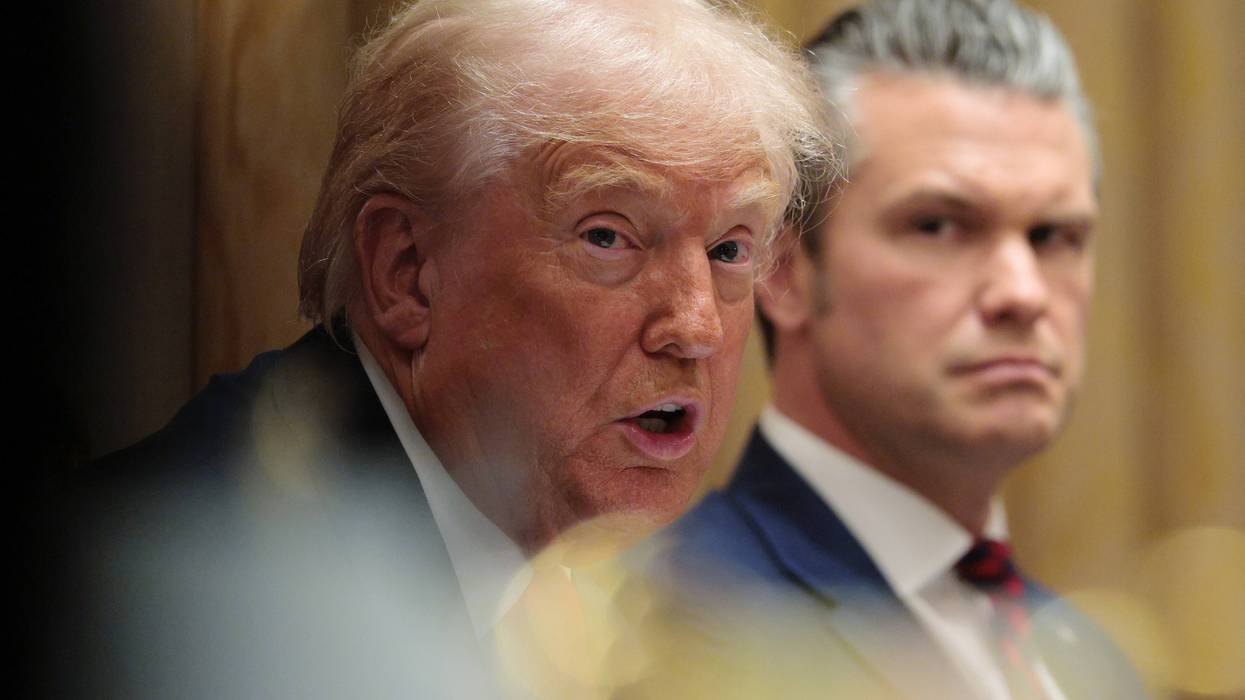
“The $1.5 trillion Pentagon budget request represents more than $9,000 per individual taxpayer."
As the Republican-controlled US Congress advances President Donald Trump's requested $1.5 trillion budget for "rebuilding" a military that's already more powerful than any armed force in human history, a group of former national security officials is urging Americans to challenge "out of control" Pentagon spending.
On Monday, the Eisenhower Media Network published a full-page advertisement in USA Today written by EMN executive director and retired Maj. Gen. Dennis Laich decrying what he called a military budget "of the Pentagon, by the Congress, and for the War Profiteers."
Invoking Thomas Paine's 1776 essay "Common Sense" and former Republican President Dwight D. Eisenhower's repeated warnings about the dangers of the then-burgeoning military-industrial complex, the ad asserts that "time and reason strongly suggest that the US 'defense' budget is out of control, unsustainable, and absent of accountability."
"Only the American people can rein it in," Laich argued.
The advertisement notes that the US military budget is already "larger than the next eight nations (most of whom are allies) in the world combined, while American citizens lack healthcare, childcare, and other basic needs."
The ad continues:
The defense industry’s lobbyists team up with US politicians, who receive campaign financing from the industry, to draft the annual National Defense Authorization Act, which sets military policy, the expensive weaponry to be purchased, and the overall military budget. The industry takes the ensuing windfall and puts it toward stock buybacks, which increase the share price, making the rich richer; dividend payments for shareholders; eight-figure annual compensation packages for corporate executives; and the continual political graft (campaign contributions and lobbyists) that keeps the wheel spinning. Incredibly, some contracts stipulate that only the contractor may repair and maintain equipment. The most embarrassing example of this practice is the F-35 stealth fighter, which is grossly over budget, behind schedule, and is only 25% fully mission capable.
"Money talks in America, but few members of Congress choose to talk about the $39 trillion national debt to which military spending is a major contributor," Laich wrote.
"Additionally, the Pentagon cannot tell the American taxpayer where the money went, since it is unable to pass a financial audit as required by law—something every other department of the federal government is able to do," the ad notes. "Now, they are requesting a 50% increase in the defense budget to $1.5 trillion. This is equivalent to your child asking for more money a day after receiving his/her allowance. When you ask what happened to the money he/she received yesterday, the child can’t answer the question, but yougive him/her more money regardless."
Laich accused "uniformed bureaucrats" of lacking "the courage to stand up against a draft dodger and a Rambo-wannabe," an apparent swipe at Trump and, perhaps, Defense Secretary Pete Hegseth.
Meanwhile, despite having the best-funded and most powerful military on paper, the ad points out that since World War II, "the US has won one war (the first Gulf War), lost four (Vietnam, Iraq, Afghanistan, and Iran), and tied one (Korea). Iran may be as much an embarrassment as a loss. The United States has failed to achieve its stated objectives in any recent war."
The ad asks, "What football coach could keep his job with a 1-4-1 record?"
"The $1.5 trillion Pentagon budget request represents more than $9,000 per individual taxpayer," EMN said. "If we Americans are tired of seeing our tax dollars spent on endless wars, bombing campaigns, and military excess while our own communities struggle with the costs of healthcare, childcare, education, and infrastructure, then the time has come to do what Thomas Paine asked Americans to do 250 years ago: challenge the assumptions that have become accepted simply because they are old."
"The courage required today is not to defeat an empire abroad, but to confront one at home—the military-industrial-congressional complex—and reclaim a government that serves the American people rather than the interests of perpetual war," the ad concludes.
EMN's advertisement follows an ad released by Hegseth in May touting Trump's $1.5 trillion proposal, which would add nearly $7 trillion to the US national debt over the next decade, according to the nonpartisan watchdog group Committee for a Responsible Federal Budget.
A survey conducted in May by ReThink Media and the Costs of War Project at Brown University's Watson Institute for International and Public Affairs revealed that nearly 60% of Americans believe the proposed Pentagon budget is too large, including 40% who say $1.5 trillion is “much too high” to spend on the military.
Last month, US Sen. Ed Markey (D-Mass.) introduced the Slash the Pentagon Act, which would set a hard cap of $750 billion on the amount Congress could authorize for national defense spending in fiscal year 2027.
"As Americans struggle to pay for healthcare, rent, electricity, groceries, and gas... Trump has spent over $100 billion on his expensive, dangerous, and unnecessary war with Iran," Markey said at a Capitol Hill press conference introducing the legislation. “We should invest in our hospitals, schools, affordable housing, and the real security American families need right now—not expensive wars and weapons that make us less safe.”

"From ending the nursing shortage to insuring uninsured children, preventing evictions, and replacing lead pipes, every dollar the Pentagon wastes is a dollar that isn't helping Americans get by," said one group.
US House lawmakers on Wednesday approved a $900.6 billion military spending bill, prompting critics to highlight ways in which taxpayer funds could be better spent on programs of social uplift instead of perpetual wars.
The lower chamber voted 312-112 in favor of the National Defense Authorization Act (NDAA) for fiscal year 2026, which will fund what President Donald Trump and congressional Republicans call a "peace through strength" national security policy. The proposal now heads for a vote in the Senate, where it is also expected to pass.
Combined with $156 billion in supplemental funding included in the One Big Beautiful Bill signed in July by Trump, the NDAA would push military spending this fiscal year to over $1 trillion—a new record in absolute terms and a relative level unseen since World War II.
The House is about to vote on authorizing $901 billion in military spending, on top of the $156 billion included in the Big Beautiful Bill.70% of global military spending already comes from the US and its major allies.www.stephensemler.com/p/congress-s...
[image or embed]
— Stephen Semler (@stephensemler.bsky.social) December 10, 2025 at 1:16 PM
The Congressional Progressive Caucus (CPC) led opposition to the bill on Capitol Hill, focusing on what lawmakers called misplaced national priorities, as well as Trump's abuse of emergency powers to deploy National Guard troops in Democratic-controlled cities under pretext of fighting crime and unauthorized immigration.
Others sounded the alarm over the Trump administration's apparent march toward a war on Venezuela—which has never attacked the US or any other country in its nearly 200-year history but is rich in oil and is ruled by socialists offering an alternative to American-style capitalism.
"I will always support giving service members what they need to stay safe but that does not mean rubber-stamping bloated budgets or enabling unchecked executive war powers," CPC Deputy Chair Ilhan Omar (D-Minn.) said on social media, explaining her vote against legislation that "pours billions into weapons systems the Pentagon itself has said it does not need."
"It increases funding for defense contractors who profit from global instability and it advances a vision of national security rooted in militarization instead of diplomacy, human rights, or community well-being," Omar continued.
"At a time when families in Minnesota’s 5th District are struggling with rising costs, when our schools and social services remain underfunded, and when the Pentagon continues to evade a clean audit year after year, Congress should be investing in people," she added.
The Congressional Equality Caucus decried the NDAA's inclusion of a provision banning transgender women from full participation in sports programs at US military academies:
The NDAA should invest in our military, not target minority communities for exclusion.While we're grateful that most anti-LGBTQI+ provisions were removed, the GOP kept one anti-trans provision in the final bill—and that's one too many.We're committed to repealing it.
[image or embed]
— Congressional Equality Caucus (@equality.house.gov) December 10, 2025 at 3:03 PM
Advocacy groups also denounced the legislation, with the Institute for Policy Studies' National Priorities Project (NPP) noting that "from ending the nursing shortage to insuring uninsured children, preventing evictions, and replacing lead pipes, every dollar the Pentagon wastes is a dollar that isn't helping Americans get by."
"The last thing Congress should do is deliver $1 trillion into the hands of [Defense] Secretary Pete Hegseth," NPP program director Lindsay Koshgarian said in a statement Wednesday. "Under Secretary Hegseth's leadership, the Pentagon has killed unidentified boaters in the Caribbean, sent the National Guard to occupy peaceful US cities, and driven a destructive and divisive anti-diversity agenda in the military."
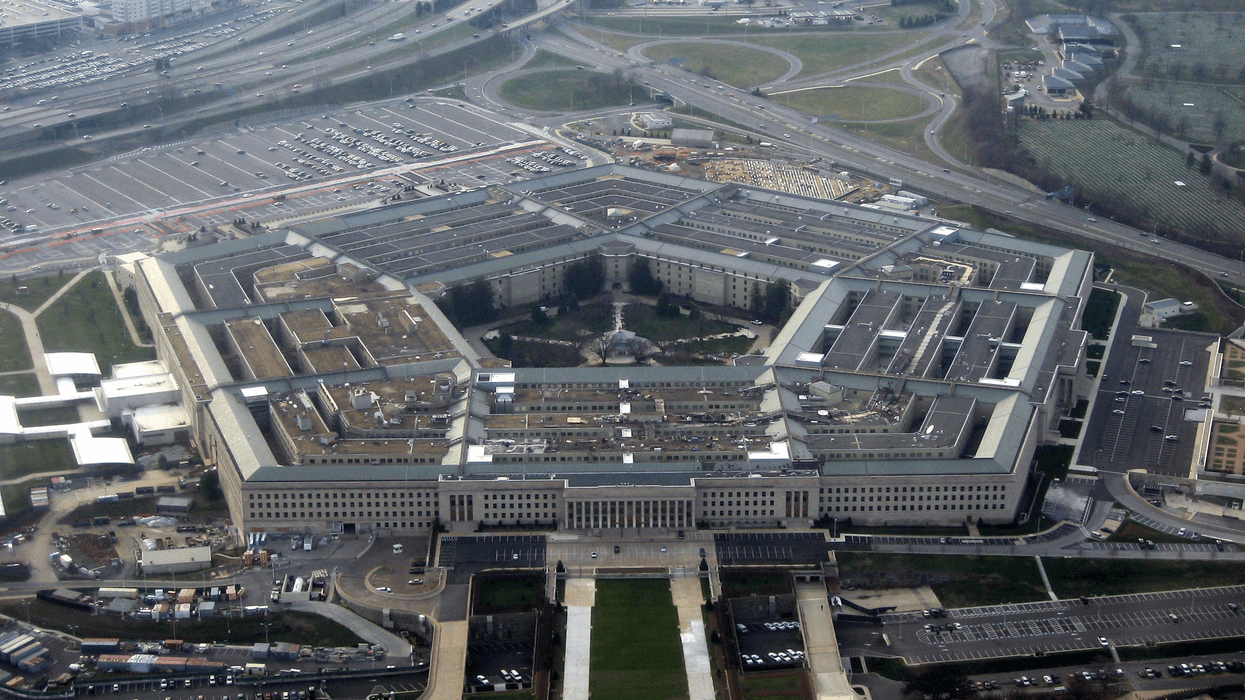
"We do not need to spend almost a trillion dollars on the military, while half a million Americans are homeless and children go hungry," said Sen. Bernie Sanders.
The United States Senate overwhelmingly passed an $895 billion military funding bill on Wednesday as critics blasted what many called misplaced spending priorities and highly controversial provisions that ban gender-affirming health coverage for children of active-duty service members and prohibit the Pentagon from citing casualty figures issued by the Gaza Ministry of Health.
Senators voted 85-14 for the National Defense Authorization Act (NDAA) for fiscal year 2025. The following senators voted against the legislation: Tammy Baldwin (D-Wis.), Cory Booker (D-N.J.), Mike Braun (R-Ind.), Andy Kim (D-N.J.), Mike Lee (R-Utah), Ed Markey (D-Mass.), Jeff Merkley (D-Ore.), Rand Paul (R-Ky.), Bernie Sanders (I-Vt.), Adam Schiff (D-Calif.), Debbie Stabenow (D-Mich.), Elizabeth Warren (D-Mass.), Peter Welch (D-Vt.), and Ron Wyden (D-Ore.). Sen. JD Vance (R-Ohio), the vice president-elect, did not vote on the bill.
"We do not need to spend almost a trillion dollars on the military, while half a million Americans are homeless and children go hungry," Sanders explained earlier this month.
The peace group CodePink said it was "disappointed" by the Senate's passage of the NDAA, "which allocates nearly $1 trillion in taxpayer dollars to weapons and warfare while essential services like healthcare, education, food, and housing remain underfunded."
"Half of the budget will go directly to the pockets of private military companies in the form of contracts and weapons deals," the group continued. "On top of the massive topline and the large allocation to private companies, the Pentagon has never been able to pass an audit. Much like every Pentagon budget before, this money will be largely unaccounted for, with very little transparency."
"This budget is a huge slap in the face to working-class families who are struggling to make ends meet," CodePink added.
An amendment introduced on Monday by Baldwin and co-sponsored by two dozen of her Democratic colleagues "to remove language that would strip away service members' parental rights to access medically necessary healthcare for their transgender children" failed to pass.
Speaking on the Senate floor on Tuesday, Baldwin said that Congress has "broken" its commitment to the troops "because some Republicans decided that gutting the rights of our service members to score cheap political points was more worthy."
"We're talking about parents who are serving our country in uniform, having the right to consult their family's doctor and get the healthcare they want and need for their transgender children," she added. "Some folks poisoned this bill and turned their backs on those in service and the people that we represent."
Olivia Hunt, director of federal policy at Advocates for Trans Equality, said in a statement Wednesday that "every military family deserves respect and access to essential healthcare—free from the interference of political agendas."
Hunt continued:
Denying lifesaving, medically necessary care to trans members of military families creates profound hardships, forcing service members to make impossible choices between their duty and the health and well-being of their loved ones. Politicizing access to evidence-based healthcare undermines the principles of fairness, dignity, and respect that our nation aspires to. No one should have to choose between their duty and protecting their family.
By passing this harmful legislation, the Senate has failed our service members and their families. This decision prioritizes political gamesmanship over the dignity, rights, and well-being of those who serve our nation and sets a dangerous precedent of governmental overreach into decisions that should remain between doctors and families.
Some advocates including Hunt want President Joe Biden to veto the bill.
"If signed by the president, the passage of the NDAA will mark the first piece of federal legislation to restrict access to medically necessary healthcare for transgender adolescents," Hunt added. "It would be heartbreaking for an administration that has sought to advance the rights of LGBTQI+ Americans more than any other to date, to enact a law that would endanger countless trans youth. We urge President Biden to take a strong stance for trans youth and their families and veto this bill."
Congress has passed the NDAA, which contained a provision banning the coverage of gender affirming care for the children of active duty military. This is the first anti-LGBTQ bill to pass congress in almost 3 decades but certainly won't be the last. This will be Biden's legacy.
— Alejandra Caraballo ( @esqueer.net) December 18, 2024 at 10:02 AM
Human Rights Campaign president Kelley Robinson said that "President Biden has the power to put a stop to this cruelty."
"He should make good on his promises to protect LGBTQ+ Americans, defend military service members and their families, and ensure this country's politics reflect the best of who we are," Robinson added. "President Biden must veto this bill."
The NDAA also contains a provision prohibiting the Department of Defense from officially citing "fatality figures that are derived by United States-designated terrorist organizations" or governmental entities or organizations that rely upon such data. Critics say the measure is meant to censor the truth about Israel's 14-month assault on Gaza, which has left more than 162,000 Palestinians dead, maimed, or missing. Various United Nations agencies, international charities and rights groups, and even the Israeli military and U.S. State Department have cited Gaza Health Ministry casualty figures, which have been deemed accurate—and likely an undercount—by experts around the world, including Israeli military intelligence and U.S. officials.
"In other words," Security Policy Reform Institute co-founder Stephen Semler said of the provision, "it's effectively a ban on talking about deaths in Gaza."

"It's abjectly terrifying that the personal benefit of any member of Congress is factored into decisions about how to wield and fund the largest military in the world," said one critic.
At least 50 U.S. lawmakers or members of their households are financially invested in companies that make military weapons and equipment—even as these firms "receive hundreds of billions of dollars annually from congressionally-crafted Pentagon appropriations legislation," a report published Thursday revealed.
Sludge's David Moore analyzed 2023 financial disclosures and stock trades disclosed in other reports and found that "the total value of the federal lawmakers' defense contractors stock holdings could be as much as $10.9 million."
According to the report:
The spouse of Sen. Susan Collins (R-Maine), the ranking member of the Defense Appropriations subcommittee, holds between $15,000 and $50,000 worth of shares in each of Boeing and RTX, as well as holdings in two other defense manufacturers. Sen. Jerry Moran (R-Kansas), another Defense Appropriations subcommittee member, holds up to $50,000 in the stock of Boeing, which received nearly $33 billion in defense contracts last year. On the Democratic side of the aisle, Sen. John Hickenlooper (Colo.) holds up to a quarter of a million dollars' worth of stock in RTX...
The most widely held defense contractor stock among senators and representatives is Honeywell, an American company that makes sensors and guiding devices that are being used by the Israeli military in its airstrikes in Gaza. The second most commonly held defense stock by Congress is RTX, formerly known as Raytheon, the company that makes missiles for Israel's Iron Dome, among other weapons systems.
All 13 senators whose households disclosed military stock holdings voted for the most recent National Defense Authorization Act, which, as Common Dreams reported, allocated a record $886.3 billion for the U.S. military while many lawmakers' constituents struggled to meet their basic needs.
"It is an obvious conflict of interest when a member of Congress owns significant stock investments in a company and then votes to award the same company lucrative federal contracts," Craig Holman, government affairs lobbyist at the consumer advocacy group Public Citizen, told Sludge.
"Whether or not the official action is taken for actual self-enrichment purposes is beside the point. There is at least an appearance of self-enrichment and that appearance is just as damaging to the integrity of Congress," Holman added. "This type of conflict of interest is already banned for executive branch officials and so should be for Congress as well. The ETHICS Act would justly avoid that conflict of interest by prohibiting members of Congress and their spouses from owning stock investments altogether."
Holman was referring to the Ending Trading and Holdings In Congressional Stocks (ETHICS) Act, introduced earlier this year by Sens. Jeff Merkley (D-Ore.), Jon Ossoff (D-Ga.), Gary Peters (D-Mich.), and Josh Hawley (R-Mo.).
In the House of Representatives—where the 2024 NDAA passed 310-118, with the approval of over two dozen members who own shares in military companies—House Foreign Affairs Committee Chair Michael McCaul's (R-Texas) household owns up to $2.6 million in General Electric, Oshkosh Corporation, and Woodward shares. Rep. Dave Joyce (R-Ohio), who sits on the Defense Appropriations subcommittee, owns as much as $100,000 worth of Boeing and General Electric stock.
Other House lawmakers with potential conflicts of interest include Rep. Gerry Connolly (D-Va.), a member of the Foreign Affairs Committee, who owns Leidos shares worth as much as $248,000; Rep. Debbie Dingell (D-Mich.), who owns up to $100,000 worth of RTX stock; and Rep. Patrick Fallon (R-Texas), a member of the Armed Services Committee who holds Boeing stock worth between $100,000 and $250,000.
"Every American should take a long, hard look at these holdings to conceptualize the scope of Congress' entanglement with defense contractors," Public Citizen People Over Pentagon advocate Savannah Wooten told Sludge. "It's abjectly terrifying that the personal benefit of any member of Congress is factored into decisions about how to wield and fund the largest military in the world."
"Requiring elected officials to divest from the military-industrial complex before stepping into public service would create a safer and more secure world from the outset," she added.
“The far-right extremists in Congress and their enablers have made their values clear: bigotry over inclusivity, security, and our climate."
Previewing what one anti-war group called "a terrifying, hate-driven vision of a U.S. government under undivided conservative control," the Republican-controlled U.S. House on Friday not only passed its latest military spending package of nearly $1 trillion, but included a number of amendments attacking the bodily autonomy and other rights of service members.
The National Defense Authorization Act (NDAA) was passed in the House largely along party lines, with 217 voting for the $884 billion package and 199 voting against it.
Six Democrats—Reps. Henry Cuellar (Texas), Donald Davis (N.C.), Jared Golden (Maine), Vicente Gonzalez (Texas), Mary Peltola (Alaska), and Marie Gluesenkamp Perez (Wa.)—joined with the Republican majority to help pass the measure.
Rep. Pramila Jayapal (D-Wash.), chair of the Congressional Progressive Caucus, once again noted her disapproval of a bill that places military spending over "investments in domestic priorities, from education to housing, healthcare to childcare," as she has in previous years—but the annual Pentagon funding package drew additional ire for its inclusion of amendments related to abortion rights, transgender healthcare, and other culture war battles.
"For the second year in a row, MAGA House Republicans pursued a path of extremism for the annual Pentagon authorization bill to continue waging their attacks on climate action, reproductive rights, LBGTQ+ rights, and communities of color," said Jayapal. "This bloated $833 billion Pentagon authorization bill approves $8.6 billion in additional tax dollars for an out-of-control military budget, expanding costly and unnecessary weapons systems while banning gender-affirming care, abortion travel, and diversity efforts for servicemembers."
The amendments pushed through by Republicans include one proposed by Rep. Beth Van Duyne (R-Texas), which would block a Biden administration policy that reimburses members of the military for travel costs they incur when seeking an abortion, and one put forward by Rep. Matt Rosendale (R-Mont.), which would block funding for gender-affirming medical procedures for service members.
Rep. Chip Roy (R-Texas) proposed a ban on any funds in the legislation being used to implement President Joe Biden's climate change executive orders.
Reps. Jim Banks (R-Ind.) and Glenn Grothman (R-Wis.) proposed placing Pentagon jobs related to diversity, equity, and inclusion (DEI) initiatives on a permanent hiring freeze, and Rep. Andrew Clyde (R-Ga.) added an amendment requiring the Reconciliation Monument, a Confederate memorial, to be relocated to Arlington National Cemetery.
On Thursday, Rep. Don Beyer (D-Va.) called the latter amendment "disheartening."
"Mr. Clyde is proposing that we return a monument to treason to our national cemetery without any accompanying context or education," said Beyer. "The monument in question is a basic ode to the Confederacy, to romanticize a lost cause."
The Republicans' amendments, said Stephen Miles, president of Win Without War, aimed to "turn the NDAA into a vehicle for numerous far-right, hate-fueled amendments that attack the core rights of our friends, neighbors, and communities."
While doing so, said Miles, the GOP "left positive amendments on the cutting room floor, like needed efforts to repeal the 2002 [Authorization for Use of Military Force], cut the ballooning Pentagon budget, and renew and expand the Radiation Exposure Compensation Act (RECA) to do justice to victims of radiation exposure from nuclear weapons testing and uranium mining."
"The far-right extremists in Congress and their enablers have made their values clear: bigotry over inclusivity, security, and our climate," Miles added. "We thank our progressive allies for pushing for amendments that would have helped everyday people. Now that Republicans have made their decision, we need a unified chorus from Democrats that our basic rights aren't up for debate, and to have these hateful measures stripped from the final bill."
Jayapal added that progressive members of the House were barred from proposing amendments to "protect human rights abroad, reaffirm congressional war powers, strengthen labor and civil rights for service members, and reduce waste, fraud, and abuse in military spending.
The NDAA in its current form is unlikely to pass in the Democratic-led Senate, where the Armed Services Committee held a markup this week on its own version of the legislation.
Jayapal expressed hope that after the November elections, the NDAA process will be "led by a Democratic House that allows an open and robust debate on the issues Americans care about—national security and peace, upholding human rights, protecting our servicemembers and their families, and taking on the climate crisis and corporate corruption—not cynical attacks on vulnerable Americans."

"While Americans struggle to access clean water, basic healthcare, and enough food for their kids, Republicans and corporate Democrats continue to waste our tax dollars on endless war," she said.
As the House of Representatives passed the National Defense Authorization Act on Thursday, Democratic Rep. Rashida Tlaib of Michigan criticized her colleagues for earmarking a record $886.3 billion for the U.S. military while many of their constituents cannot meet basic needs.
"This budget is impossible to justify when our neighbors are struggling to put food on the table, fighting to keep a roof over their heads, and rationing their medication," Tlaib said in a statement.
"While Americans struggle to access clean water, basic healthcare, and enough food for their kids, Republicans and corporate Democrats continue to waste our tax dollars on endless war," Tlaib continued. "It's outrageous that every year, we spend more on weapons and war than the next nine countries combined."
"We must divest from endless war and death. My residents sent me to Congress to invest in life."
The House approved the bill 310 to 118. The vote followed the Senate passage of the NDAA on Wednesday. As with the Senate version, the House bill included a controversial extension of a warrantless surveillance program known as Section 702 of the Foreign Intelligence Surveillance Act.
The Congressional Progressive Caucus (CPC), of which Tlaib is a member, had recommended a "no" vote on the bill, in part because of its excessive spending and in part because of the Section 702 extension.
"The FY24 NDAA authorizes an unacceptably high national defense spending topline of $886.3 billion—all at a time when the Pentagon has failed an independent audit for its sixth consecutive year," the CPC said in a recommendation reported by The American Prospect, adding that the bill "contains a reauthorization of surveillance authorities routinely used against Americans in violation of the Constitutional right to privacy."
The CPC has historically opposed the NDAA because of spending concerns.
"We must divest from endless war and death. My residents sent me to Congress to invest in life," Tlaib said in explaining her "no" vote.
She then listed many efforts the government could spend money on instead, including fully funding Social Security, enacting Medicare for All, forgiving student debt, ending utility and water shutoffs, addressing the climate crisis, funding schools, and providing universal school meals.
"Year after year my colleagues in Congress and powerful people in Washington tell us that there's no money for these lifesaving programs, that our deficit is simply too high. Only to turn around and pass yet another record-breaking Pentagon budget, giving $886.3 billion of our tax dollars to fund bombs, weapons, and war crimes—no questions asked," Tlaib said.
Other prominent progressives who voted "no" included Reps. Pramila Jayapal (D-Wash), Barbara Lee (D-Calif.), Ilhan Omar (D-Minn.), Alexandra Ocasio-Cortez (D-N.Y.), Mark Pocan, (D-Wis.) and Bonnie Watson Coleman (D-N.J.).
"$886 Billion dollars could go a long way toward improving the lives of everyday working people," Coleman tweeted. "The people's basic needs must come first."
Some thought this year's NDAA might not pass, but not because of progressive opposition, The Washington Post reported. Rather, far-right House Republicans had attached several provisions targeting what they saw as "woke" policies in the military. These included a measure that would have prohibited the Defense Department from reimbursing travel costs for service members stationed in a state where abortion is restricted who needed to seek reproductive healthcare elsewhere.
The Senate bill removed many of these provisions, including the ban on travel funds, and the House ended up agreeing to pass it without many of them. However, the final bill does ban service members from flying unauthorized flags, such as the Pride flag, at military sites; stipulate that no Defense Department money can be spent on drag shows; and limit the starting salaries of employees focused on diversity, equity, and inclusion initiatives.

"It's incredibly disheartening that Congress decided to extend an easily abused law with zero of the reforms needed to protect all of our privacy," said the ACLU's senior policy counsel.
The ACLU and National Security Agency whistleblower Edward Snowden were among those condemning House and Senate lawmakers on Thursday for approving an extension of a law that the federal government has used to spy on the communications of Americans without a warrant.
The extension of Section 702 of the Foreign Intelligence Surveillance Act (FISA) was crammed into the 3,000-page National Defense Authorization Act, an $886 billion piece of legislation that approves funding for the Pentagon for the coming fiscal year.
Just hours after the Senate narrowly defeated a last-ditch motion to strip out the Section 702 extension and approved the NDAA in a bipartisan 87-13 vote, the House passed the legislation in a similarly resounding fashion on Thursday, with 163 Democrats and 147 Republicans supporting the bill.
Just 45 Democrats voted no after the Congressional Progressive Caucus leadership urged the bloc's 100-plus members to oppose the measure, citing the proposed four-month extension of Section 702 and excessive military spending.
The NDAA now heads to the desk of President Joe Biden, who is expected to sign it. The White House has publicly urged Congress to reauthorize Section 702, which ostensibly allows federal authorities to surveil only the communications of non-U.S. citizens located outside the country.
In practice, however, the program has been used to spy on the communications of American activists, journalists, members of Congress, and others without a warrant. Government records show that the FBI abused Section 702 more than 278,000 times between 2020 and early 2021.
Kia Hamadanchy, the ACLU's senior policy counsel, said in a Thursday statement following the House vote that "it's incredibly disheartening that Congress decided to extend an easily abused law with zero of the reforms needed to protect all of our privacy."
"As long as Section 702 is being used by the government to spy on Americans without a warrant," Hamadanchy added, "we will continue to fight this unconstitutional law and work with Congress to strengthen our Fourth Amendment protections against government surveillance."
Snowden, a former NSA contractor who helped expose the agency's mass surveillance apparatus, wrote on social media that "Congress has voted to pass the NDAA—in which they deceitfully concealed an extension of the warrantless spying program ('Section 702') universally opposed by the public."
https://t.co/D1cqGYIvDC
— Edward Snowden (@Snowden) December 14, 2023
Elizabeth Goitein, co-director of the Liberty and National Security Program at the Brennan Center for Justice, criticized lawmakers for caving to "abject fearmongering by the administration and surveillance hawks" who claimed the reauthorization of Section 702 was urgently needed to protect national security.
Goitein noted that the four-month extension of Section 702 will likely become a 16-month extension as the Biden administration is expected to use the four months to ask the FISA Court for a one-year extension. The spying authority was set to expire at the end of the year.
"The fight continues," Goitein wrote on social media. "We can't sit back and wait for 16 months; we must demand that Congress reform Section 702 *now* to end the abuses and rein in warrantless surveillance of Americans."