SUBSCRIBE TO OUR FREE NEWSLETTER
Daily news & progressive opinion—funded by the people, not the corporations—delivered straight to your inbox.
5
#000000
#FFFFFF
To donate by check, phone, or other method, see our More Ways to Give page.
Daily news & progressive opinion—funded by the people, not the corporations—delivered straight to your inbox.
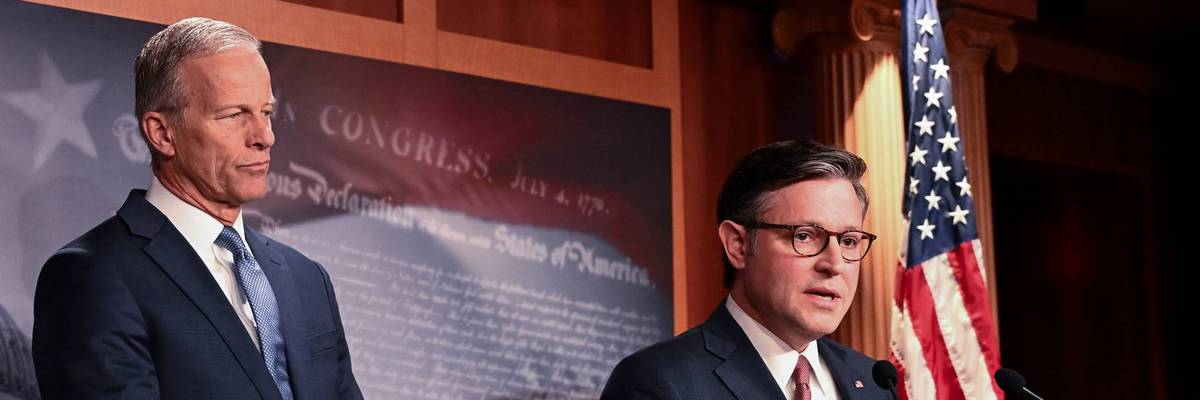
US Senate Majority Leader John Thune (R-SD) and Speaker of the House Mike Johnson (R-La.) hold a news conference at the Captiol in Washington, DC on October 10, 2025.
"Our bipartisan movement in defense of civil liberties is holding strong," a Demand Progress campaigner said after Congress passed a short-term extension to continue talks on a longer renewal.
Just a day after Democrats in the GOP-controlled US House of Representatives helped Republicans send a major spying bill to the Senate, despite warnings that it was dead on arrival there, both chambers on Thursday passed a 45-day extension to continue negotiations.
The Senate approved the stopgap bill for Section 702 of the Foreign Intelligence Surveillance Act (FISA)—which allows the federal government to spy on electronic communications of noncitizens located outside the United States without a warrant—by a voice vote. The House signed off with a 261-11 vote, just hours before a previous short-term extension was set to expire.
President Donald Trump and his homeland security adviser, Stephen Miller, have been demanding a "clean" extension of the program, while critical lawmakers from both parties and over 100 civil society groups have called for privacy reforms to protect Americans whose data is swept up in federal surveillance efforts.
Hajar Hammado, senior policy adviser at Demand Progress, one of the organizations leading reform calls, said in a Thursday statement that "intelligence agencies, the White House, and their allies in Congress have tried every trick in the book from fearmongering to misinformation, but they still can't get their warrantless FISA reauthorization across the finish line."
"The reason we keep ending up at this point is congressional leaders' refusal to allow votes on overwhelmingly popular, bipartisan reforms," she continued. "This 'my way or the highway' approach needs to stop."
According to Politico, US Senate Majority Leader John Thune (R-SD) told reporters on Thursday that he and House Speaker Mike Johnson (R-La.) discussed the short-term extension during a closed-door meeting the previous day.
"I think there's already a pretty substantial dialog going on" between key Democrats and Republicans in both chambers, Thune added. "We're interested in looking at some ways in which it can be reformed... So we're entertaining those ideas at the moment."
Hammado declared that "when Congress returns, Speaker Johnson and Leader Thune must allow votes on amendments for real privacy protections or we'll keep repeating this farce over and over again. Our bipartisan movement in defense of civil liberties is holding strong, and we won't accept anything less."
Sen. Ron Wyden (D-Ore.), a longtime defender of privacy rights who had threatened to block the extension, highlighted on social media Thursday that he "secured a commitment that the FISA court opinion revealing abuses of Americans' rights will be DECLASSIFIED before Congress votes on reauthorization."
"The more Americans know about these abuses," he said, "the more they'll demand real reforms."
Dear Common Dreams reader, It’s been nearly 30 years since I co-founded Common Dreams with my late wife, Lina Newhouser. We had the radical notion that journalism should serve the public good, not corporate profits. It was clear to us from the outset what it would take to build such a project. No paid advertisements. No corporate sponsors. No millionaire publisher telling us what to think or do. Many people said we wouldn't last a year, but we proved those doubters wrong. Together with a tremendous team of journalists and dedicated staff, we built an independent media outlet free from the constraints of profits and corporate control. Our mission has always been simple: To inform. To inspire. To ignite change for the common good. Building Common Dreams was not easy. Our survival was never guaranteed. When you take on the most powerful forces—Wall Street greed, fossil fuel industry destruction, Big Tech lobbyists, and uber-rich oligarchs who have spent billions upon billions rigging the economy and democracy in their favor—the only bulwark you have is supporters who believe in your work. But here’s the urgent message from me today. It's never been this bad out there. And it's never been this hard to keep us going. At the very moment Common Dreams is most needed, the threats we face are intensifying. We need your support now more than ever. We don't accept corporate advertising and never will. We don't have a paywall because we don't think people should be blocked from critical news based on their ability to pay. Everything we do is funded by the donations of readers like you. When everyone does the little they can afford, we are strong. But if that support retreats or dries up, so do we. Will you donate now to make sure Common Dreams not only survives but thrives? —Craig Brown, Co-founder |
Just a day after Democrats in the GOP-controlled US House of Representatives helped Republicans send a major spying bill to the Senate, despite warnings that it was dead on arrival there, both chambers on Thursday passed a 45-day extension to continue negotiations.
The Senate approved the stopgap bill for Section 702 of the Foreign Intelligence Surveillance Act (FISA)—which allows the federal government to spy on electronic communications of noncitizens located outside the United States without a warrant—by a voice vote. The House signed off with a 261-11 vote, just hours before a previous short-term extension was set to expire.
President Donald Trump and his homeland security adviser, Stephen Miller, have been demanding a "clean" extension of the program, while critical lawmakers from both parties and over 100 civil society groups have called for privacy reforms to protect Americans whose data is swept up in federal surveillance efforts.
Hajar Hammado, senior policy adviser at Demand Progress, one of the organizations leading reform calls, said in a Thursday statement that "intelligence agencies, the White House, and their allies in Congress have tried every trick in the book from fearmongering to misinformation, but they still can't get their warrantless FISA reauthorization across the finish line."
"The reason we keep ending up at this point is congressional leaders' refusal to allow votes on overwhelmingly popular, bipartisan reforms," she continued. "This 'my way or the highway' approach needs to stop."
According to Politico, US Senate Majority Leader John Thune (R-SD) told reporters on Thursday that he and House Speaker Mike Johnson (R-La.) discussed the short-term extension during a closed-door meeting the previous day.
"I think there's already a pretty substantial dialog going on" between key Democrats and Republicans in both chambers, Thune added. "We're interested in looking at some ways in which it can be reformed... So we're entertaining those ideas at the moment."
Hammado declared that "when Congress returns, Speaker Johnson and Leader Thune must allow votes on amendments for real privacy protections or we'll keep repeating this farce over and over again. Our bipartisan movement in defense of civil liberties is holding strong, and we won't accept anything less."
Sen. Ron Wyden (D-Ore.), a longtime defender of privacy rights who had threatened to block the extension, highlighted on social media Thursday that he "secured a commitment that the FISA court opinion revealing abuses of Americans' rights will be DECLASSIFIED before Congress votes on reauthorization."
"The more Americans know about these abuses," he said, "the more they'll demand real reforms."
Just a day after Democrats in the GOP-controlled US House of Representatives helped Republicans send a major spying bill to the Senate, despite warnings that it was dead on arrival there, both chambers on Thursday passed a 45-day extension to continue negotiations.
The Senate approved the stopgap bill for Section 702 of the Foreign Intelligence Surveillance Act (FISA)—which allows the federal government to spy on electronic communications of noncitizens located outside the United States without a warrant—by a voice vote. The House signed off with a 261-11 vote, just hours before a previous short-term extension was set to expire.
President Donald Trump and his homeland security adviser, Stephen Miller, have been demanding a "clean" extension of the program, while critical lawmakers from both parties and over 100 civil society groups have called for privacy reforms to protect Americans whose data is swept up in federal surveillance efforts.
Hajar Hammado, senior policy adviser at Demand Progress, one of the organizations leading reform calls, said in a Thursday statement that "intelligence agencies, the White House, and their allies in Congress have tried every trick in the book from fearmongering to misinformation, but they still can't get their warrantless FISA reauthorization across the finish line."
"The reason we keep ending up at this point is congressional leaders' refusal to allow votes on overwhelmingly popular, bipartisan reforms," she continued. "This 'my way or the highway' approach needs to stop."
According to Politico, US Senate Majority Leader John Thune (R-SD) told reporters on Thursday that he and House Speaker Mike Johnson (R-La.) discussed the short-term extension during a closed-door meeting the previous day.
"I think there's already a pretty substantial dialog going on" between key Democrats and Republicans in both chambers, Thune added. "We're interested in looking at some ways in which it can be reformed... So we're entertaining those ideas at the moment."
Hammado declared that "when Congress returns, Speaker Johnson and Leader Thune must allow votes on amendments for real privacy protections or we'll keep repeating this farce over and over again. Our bipartisan movement in defense of civil liberties is holding strong, and we won't accept anything less."
Sen. Ron Wyden (D-Ore.), a longtime defender of privacy rights who had threatened to block the extension, highlighted on social media Thursday that he "secured a commitment that the FISA court opinion revealing abuses of Americans' rights will be DECLASSIFIED before Congress votes on reauthorization."
"The more Americans know about these abuses," he said, "the more they'll demand real reforms."