5
#000000
#FFFFFF
To donate by check, phone, or other method, see our More Ways to Give page.
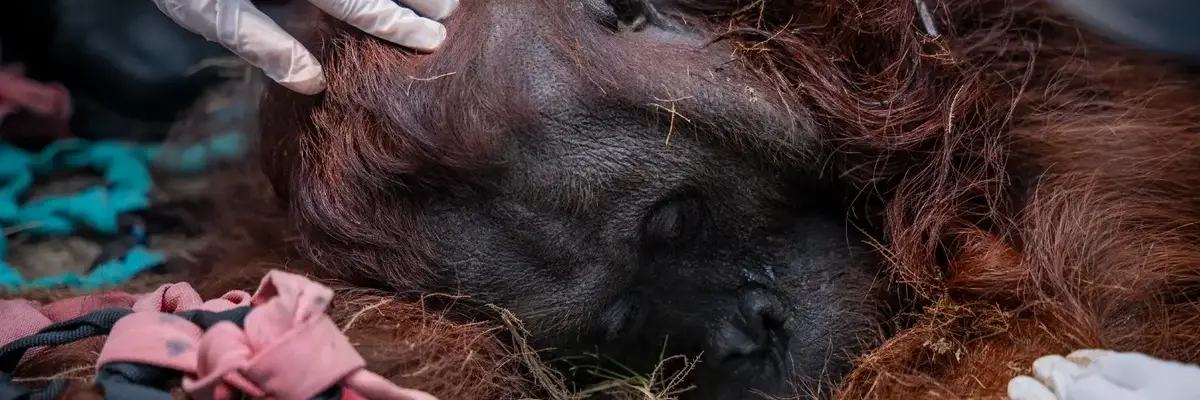
Conservationists worldwide are mourning Friday following news that a rescued orangutan on the Indonesian island of Borneo has died—a singular though heartbreaking symbol of humanity's rapacious destruction of fragile ecosystems, in this case the ravages of the palm oil industry on the rainforests where the critically endangered primates once thrived but now struggle "dangerously close to the point of extinction."
The death of the orangutan named Sampurna was confirmed Thursday by the West Kalimantan Natural Resources Conservation Agency (BKSDA) in Borneo, who said the adult male primate died over the weekend after being found, struggling to stand or take in oxygen, by villagers near Ketapang, West Kalimantan earlier in the day.
"It was very weak, then I gave it water," said Jais, the local farmer who first found Sampurna in a roadside ditch and only goes by one name.
According to the Sarawak Tribune:
Sampurna was first reported by villagers at about 7am after he was found lying inside a dry drainage ditch in a community-owned oil palm plantation.
When rescuers from BKSDA and the Foundation for International Animal Rescue Indonesia (YIARI) arrived, Sampurna was unable to stand, could only move with difficulty and was suffering from severe breathing problems.
Emergency treatment, including oxygen therapy and intravenous fluids, was administered before he was transported to YIARI’s rehabilitation centre at about 11.30am for further medical care.
However, his condition continued to deteriorate.
With wildfires raging in the area in and around the palm tree plantation—a source of frustration for those who have for decades tried to curb the palm oil industry's destruction of fragile rainforest habitat across Indonesia—BKSDA said "lung abnormalities" found during a post-mortem of Sampura were thought to be caused by prolonged exposure to wildfire smoke, impairing lung function and leading to "acute hypoxia," or oxygen deprivation.
“We deeply regret that Sampurna could not be saved,” said BKSDA's natural conservation chief Murlan Dameria Pane in a statement.
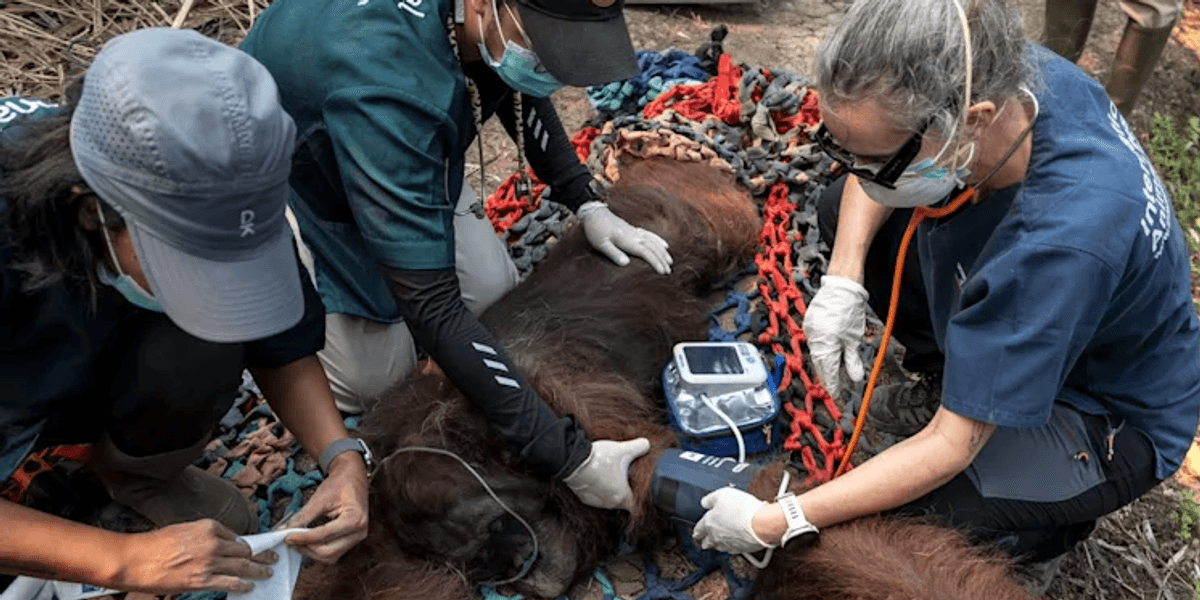 Karmele Llano Sanchez, CEO of wildlife foundation Yayasan Inisiasi Alam Rehabilitasi Indonesia, along with other veterinarians, gives treatment to an orangutan named Sampurna, during a rescue operation at a palm-oil plantation near an area affected by wildfires, in Kuala Satong village, Ketapang regency, West Kalimantan province, Indonesia, on Aug 30, 2026. (Photo: Reuters/Willy Kurniawan)
"Sampurna the orangutan has died," said Dr. Tom Montgomery, a marine biologist and conservationist, in a social media post. "He collapsed on a palm-oil plantation in West Kalimantan province, Indonesia—his lungs destroyed by the smoke of his burning forest."
As the German Press Agency reported:
Sampurna had been monitored by YIARI’s Orangutan Protection Unit on August 16 and was still moving actively at the time. About two weeks later, he was found collapsed in a plantation near areas affected by fires.
His death highlights the threat that forest fires pose to orangutans, which depend on increasingly fragmented forests across Borneo.
Fires can destroy food sources and habitats, forcing the critically endangered animals into plantations and other areas where they are exposed to smoke and potential conflict with people.
Karmele Llano Sanchez, CEO of YIARI, told Reuters that the "orangutan got hypoxia because of the very thick smoke in the area," and while it showed no outward signs of being burned by the fires it could not properly breath and was vomiting.
In a statement last month, the Borneo Orangutan Survival (BOS) Foundation warned that "for wild orangutan, one fire can mean losing everything." With climate change a constant threat to crucial habit, new warnings of a "supersized" El Nino event forming is only elevating concerns about the impact on threatened species in the coming years.
- YouTube youtu.be
"The forest they call home, the food they depend on, and their chance of survival," BOS said, is all under threat. "These forests are also home to countless other species and include some of the world’s most important tropical peatland ecosystems and carbon stores."
With the fire season on the island already raging in August, the group said danger of wildfires for orangutans and others species "is not a future threat."
Conservationists worldwide are mourning Friday following news that a rescued orangutan on the Indonesian island of Borneo has died—a singular though heartbreaking symbol of humanity's rapacious destruction of fragile ecosystems, in this case the ravages of the palm oil industry on the rainforests where the critically endangered primates once thrived but now struggle "dangerously close to the point of extinction."
The death of the orangutan named Sampurna was confirmed Thursday by the West Kalimantan Natural Resources Conservation Agency (BKSDA) in Borneo, who said the adult male primate died over the weekend after being found, struggling to stand or take in oxygen, by villagers near Ketapang, West Kalimantan earlier in the day.
"It was very weak, then I gave it water," said Jais, the local farmer who first found Sampurna in a roadside ditch and only goes by one name.
According to the Sarawak Tribune:
Sampurna was first reported by villagers at about 7am after he was found lying inside a dry drainage ditch in a community-owned oil palm plantation.
When rescuers from BKSDA and the Foundation for International Animal Rescue Indonesia (YIARI) arrived, Sampurna was unable to stand, could only move with difficulty and was suffering from severe breathing problems.
Emergency treatment, including oxygen therapy and intravenous fluids, was administered before he was transported to YIARI’s rehabilitation centre at about 11.30am for further medical care.
However, his condition continued to deteriorate.
With wildfires raging in the area in and around the palm tree plantation—a source of frustration for those who have for decades tried to curb the palm oil industry's destruction of fragile rainforest habitat across Indonesia—BKSDA said "lung abnormalities" found during a post-mortem of Sampura were thought to be caused by prolonged exposure to wildfire smoke, impairing lung function and leading to "acute hypoxia," or oxygen deprivation.
“We deeply regret that Sampurna could not be saved,” said BKSDA's natural conservation chief Murlan Dameria Pane in a statement.
Karmele Llano Sanchez, CEO of wildlife foundation Yayasan Inisiasi Alam Rehabilitasi Indonesia, along with other veterinarians, gives treatment to an orangutan named Sampurna, during a rescue operation at a palm-oil plantation near an area affected by wildfires, in Kuala Satong village, Ketapang regency, West Kalimantan province, Indonesia, on Aug 30, 2026. (Photo: Reuters/Willy Kurniawan)
"Sampurna the orangutan has died," said Dr. Tom Montgomery, a marine biologist and conservationist, in a social media post. "He collapsed on a palm-oil plantation in West Kalimantan province, Indonesia—his lungs destroyed by the smoke of his burning forest."
As the German Press Agency reported:
Sampurna had been monitored by YIARI’s Orangutan Protection Unit on August 16 and was still moving actively at the time. About two weeks later, he was found collapsed in a plantation near areas affected by fires.
His death highlights the threat that forest fires pose to orangutans, which depend on increasingly fragmented forests across Borneo.
Fires can destroy food sources and habitats, forcing the critically endangered animals into plantations and other areas where they are exposed to smoke and potential conflict with people.
Karmele Llano Sanchez, CEO of YIARI, told Reuters that the "orangutan got hypoxia because of the very thick smoke in the area," and while it showed no outward signs of being burned by the fires it could not properly breath and was vomiting.
In a statement last month, the Borneo Orangutan Survival (BOS) Foundation warned that "for wild orangutan, one fire can mean losing everything." With climate change a constant threat to crucial habit, new warnings of a "supersized" El Nino event forming is only elevating concerns about the impact on threatened species in the coming years.
- YouTube youtu.be
"The forest they call home, the food they depend on, and their chance of survival," BOS said, is all under threat. "These forests are also home to countless other species and include some of the world’s most important tropical peatland ecosystems and carbon stores."
With the fire season on the island already raging in August, the group said danger of wildfires for orangutans and others species "is not a future threat."
Conservationists worldwide are mourning Friday following news that a rescued orangutan on the Indonesian island of Borneo has died—a singular though heartbreaking symbol of humanity's rapacious destruction of fragile ecosystems, in this case the ravages of the palm oil industry on the rainforests where the critically endangered primates once thrived but now struggle "dangerously close to the point of extinction."
The death of the orangutan named Sampurna was confirmed Thursday by the West Kalimantan Natural Resources Conservation Agency (BKSDA) in Borneo, who said the adult male primate died over the weekend after being found, struggling to stand or take in oxygen, by villagers near Ketapang, West Kalimantan earlier in the day.
"It was very weak, then I gave it water," said Jais, the local farmer who first found Sampurna in a roadside ditch and only goes by one name.
According to the Sarawak Tribune:
Sampurna was first reported by villagers at about 7am after he was found lying inside a dry drainage ditch in a community-owned oil palm plantation.
When rescuers from BKSDA and the Foundation for International Animal Rescue Indonesia (YIARI) arrived, Sampurna was unable to stand, could only move with difficulty and was suffering from severe breathing problems.
Emergency treatment, including oxygen therapy and intravenous fluids, was administered before he was transported to YIARI’s rehabilitation centre at about 11.30am for further medical care.
However, his condition continued to deteriorate.
With wildfires raging in the area in and around the palm tree plantation—a source of frustration for those who have for decades tried to curb the palm oil industry's destruction of fragile rainforest habitat across Indonesia—BKSDA said "lung abnormalities" found during a post-mortem of Sampura were thought to be caused by prolonged exposure to wildfire smoke, impairing lung function and leading to "acute hypoxia," or oxygen deprivation.
“We deeply regret that Sampurna could not be saved,” said BKSDA's natural conservation chief Murlan Dameria Pane in a statement.
Karmele Llano Sanchez, CEO of wildlife foundation Yayasan Inisiasi Alam Rehabilitasi Indonesia, along with other veterinarians, gives treatment to an orangutan named Sampurna, during a rescue operation at a palm-oil plantation near an area affected by wildfires, in Kuala Satong village, Ketapang regency, West Kalimantan province, Indonesia, on Aug 30, 2026. (Photo: Reuters/Willy Kurniawan)
"Sampurna the orangutan has died," said Dr. Tom Montgomery, a marine biologist and conservationist, in a social media post. "He collapsed on a palm-oil plantation in West Kalimantan province, Indonesia—his lungs destroyed by the smoke of his burning forest."
As the German Press Agency reported:
Sampurna had been monitored by YIARI’s Orangutan Protection Unit on August 16 and was still moving actively at the time. About two weeks later, he was found collapsed in a plantation near areas affected by fires.
His death highlights the threat that forest fires pose to orangutans, which depend on increasingly fragmented forests across Borneo.
Fires can destroy food sources and habitats, forcing the critically endangered animals into plantations and other areas where they are exposed to smoke and potential conflict with people.
Karmele Llano Sanchez, CEO of YIARI, told Reuters that the "orangutan got hypoxia because of the very thick smoke in the area," and while it showed no outward signs of being burned by the fires it could not properly breath and was vomiting.
In a statement last month, the Borneo Orangutan Survival (BOS) Foundation warned that "for wild orangutan, one fire can mean losing everything." With climate change a constant threat to crucial habit, new warnings of a "supersized" El Nino event forming is only elevating concerns about the impact on threatened species in the coming years.
- YouTube youtu.be
"The forest they call home, the food they depend on, and their chance of survival," BOS said, is all under threat. "These forests are also home to countless other species and include some of the world’s most important tropical peatland ecosystems and carbon stores."
With the fire season on the island already raging in August, the group said danger of wildfires for orangutans and others species "is not a future threat."