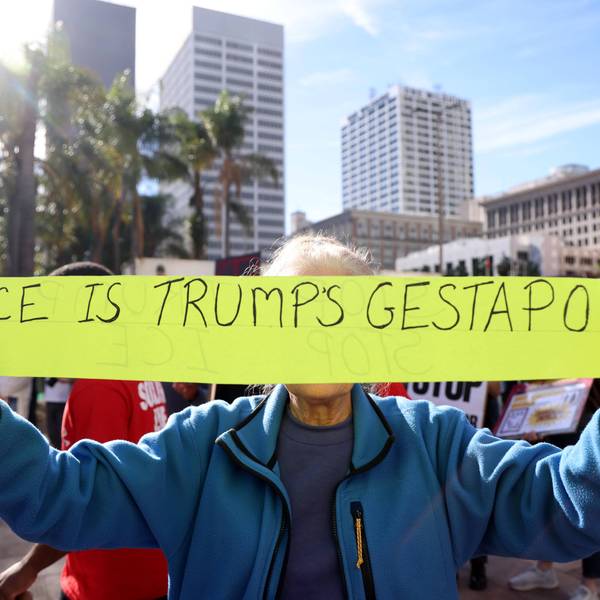

People record and gesture at federal agents as they arrest a man of Somali origin in Minneapolis on January 8, 2026.
Under Right to Record Act, People Could Sue Federal Agents for First Amendment Violations
“Without recordings, we wouldn’t know the truth of what happened to Renee Nicole Good, Alex Pretti, Marimar Martinez, George Retes, and so, so many others,” said one of the bill's sponsors.
A pair of congressional Democrats on Monday introduced legislation that would protect the constitutional right to legally record federal agents and open the door to civil compensation for people whose rights have been violated.
Congressman Maxwell Frost of Florida and Sen. Richard Blumenthal of Connecticut introduced the Right to Record Act, which according to Frost's office, "establishes the right to sue individual law enforcement agents if they violate First Amendment rights, including the right to record, observe, or peacefully protest."
“The First Amendment defends the right to assemble, protest, and record government officials in public," Frost said in a statement.
No federal agent is above the Constitution. My bill, the Right to Record Act, with @blumenthal.senate.gov strengthens your First Amendment right to record, observe, and peacefully protest — and gives you the power to sue federal agents who violate those rights.
[image or embed]
— Rep. Maxwell Alejandro Frost (@frost.house.gov) June 8, 2026 at 2:24 PM
"That right has never been more important. In cases like the murders of Alex Pretti and Renee Good, officials and their allies tried to paint the victims as threats despite evidence showing otherwise,” the congressman said, referring to two people shot and killed during the Department of Homeland Security's (DHS) Operation Metro Surge anti-immigrant blitz in Minneapolis.
"Without firsthand recordings, those false narratives might have become the official story, which is why the Right to Record Act is so important," Frost added. "It would protect the public’s ability to expose the truth without fear, giving individuals a legal path forward if an officer does violate their constitutional rights.”
In the same statement, Blumenthal said that “over the last year, I’ve investigated dozens of cases of Americans brutalized by agents of their own government, and across the board, video footage corroborated their testimony—showing the world what they experienced and making sure that justice was served."
"Without recordings, we wouldn’t know the truth of what happened to Renee Nicole Good, Alex Pretti, Marimar Martinez, George Retes, and so, so many others," the senator continued.
Martinez, a US citizen, was shot five times by a US Customs and Border Protection agent last October in Chicago while going to donate clothing to her church. Officer body camera footage showed that DHS officials—who labeled Martinez a "domestic terrorist"—lied about events leading up to the shooting.
Retes, who is also a US citizen, is an Iraq War veteran who was violently arrested last July during an immigration raid on his job site and subsequently jailed for three days.
"The right to bear witness has never been more important," Blumenthal said in his statement Monday. "I’m proud to work with Congressman Frost on bicameral legislation that will strengthen the right to record, observe, and peacefully protest—creating real enforcement tools for the protections of the First Amendment that lay the foundation for our democracy.”
Recording federal law enforcement agents in public is protected First Amendment activity, as long as the recorder is not interfering with the officers' duties. Federal courts have repeatedly upheld this right.
"The right to observe and record law enforcement is fundamental to our democracy," Jenna Leventoff, senior policy counsel with the ACLU—which has endorsed the Right to Record Act—asserted Monday.
"We can't hold our government accountable if we can't see for ourselves what they're doing in our communities," she argued. "Observing and filming allows people to create an independent record, share information with their communities, and demand better from our government."
"Protesting for what we believe in is a core American value, and observing and filming government activity can drive the protest movements that spark change," Leventoff added. "All of these rights are squarely protected by the First Amendment, and we're hopeful that Congress will codify them into law by enacting the Right to Record Act."
We are at a crossroads
This country and this world are at a monumental crossroads. In a few short weeks, US voters will have an opportunity to beat back the forces of fascism and confront the billionaires who are rigging the economy, our media system, and our democracy, making it increasingly impossible for ordinary people to get by. We’re not just talking about the election. We’re talking about what must be done once these fascist elements are vanquished from power. We need a bolder set of solutions than what either major party has so far been willing to offer and a working-class movement ready to fight like hell for it. Trump didn't emerge from nowhere. The conditions that fueled MAGA authoritarianism were created by decades of radical neoliberal economic policies and a corrupt political system dominated by corporate interests. They slashed taxes on the super-rich, promising that the benefits would trickle down. They said giveaways to the corporate titans would make life more affordable for the rest of us. It was all bullshit. And when a bitter, betrayed populace searches for someone to blame, right-wing demagogues have little trouble finding scapegoats. People know when they're being lied to, but you won't hear any of this from the corporate media. Only independent journalism—powered and funded by people who believe in building a better world—can deliver truly trustworthy daily news. Our Fall Campaign is underway, and we need your help. To power our newsroom through the rest of the year, we need to raise $125,000 by midnight on October 31. So if you share our vision, please contribute whatever you can to sustain our work. |
A pair of congressional Democrats on Monday introduced legislation that would protect the constitutional right to legally record federal agents and open the door to civil compensation for people whose rights have been violated.
Congressman Maxwell Frost of Florida and Sen. Richard Blumenthal of Connecticut introduced the Right to Record Act, which according to Frost's office, "establishes the right to sue individual law enforcement agents if they violate First Amendment rights, including the right to record, observe, or peacefully protest."
“The First Amendment defends the right to assemble, protest, and record government officials in public," Frost said in a statement.
No federal agent is above the Constitution. My bill, the Right to Record Act, with @blumenthal.senate.gov strengthens your First Amendment right to record, observe, and peacefully protest — and gives you the power to sue federal agents who violate those rights.
[image or embed]
— Rep. Maxwell Alejandro Frost (@frost.house.gov) June 8, 2026 at 2:24 PM
"That right has never been more important. In cases like the murders of Alex Pretti and Renee Good, officials and their allies tried to paint the victims as threats despite evidence showing otherwise,” the congressman said, referring to two people shot and killed during the Department of Homeland Security's (DHS) Operation Metro Surge anti-immigrant blitz in Minneapolis.
"Without firsthand recordings, those false narratives might have become the official story, which is why the Right to Record Act is so important," Frost added. "It would protect the public’s ability to expose the truth without fear, giving individuals a legal path forward if an officer does violate their constitutional rights.”
In the same statement, Blumenthal said that “over the last year, I’ve investigated dozens of cases of Americans brutalized by agents of their own government, and across the board, video footage corroborated their testimony—showing the world what they experienced and making sure that justice was served."
"Without recordings, we wouldn’t know the truth of what happened to Renee Nicole Good, Alex Pretti, Marimar Martinez, George Retes, and so, so many others," the senator continued.
Martinez, a US citizen, was shot five times by a US Customs and Border Protection agent last October in Chicago while going to donate clothing to her church. Officer body camera footage showed that DHS officials—who labeled Martinez a "domestic terrorist"—lied about events leading up to the shooting.
Retes, who is also a US citizen, is an Iraq War veteran who was violently arrested last July during an immigration raid on his job site and subsequently jailed for three days.
"The right to bear witness has never been more important," Blumenthal said in his statement Monday. "I’m proud to work with Congressman Frost on bicameral legislation that will strengthen the right to record, observe, and peacefully protest—creating real enforcement tools for the protections of the First Amendment that lay the foundation for our democracy.”
Recording federal law enforcement agents in public is protected First Amendment activity, as long as the recorder is not interfering with the officers' duties. Federal courts have repeatedly upheld this right.
"The right to observe and record law enforcement is fundamental to our democracy," Jenna Leventoff, senior policy counsel with the ACLU—which has endorsed the Right to Record Act—asserted Monday.
"We can't hold our government accountable if we can't see for ourselves what they're doing in our communities," she argued. "Observing and filming allows people to create an independent record, share information with their communities, and demand better from our government."
"Protesting for what we believe in is a core American value, and observing and filming government activity can drive the protest movements that spark change," Leventoff added. "All of these rights are squarely protected by the First Amendment, and we're hopeful that Congress will codify them into law by enacting the Right to Record Act."
A pair of congressional Democrats on Monday introduced legislation that would protect the constitutional right to legally record federal agents and open the door to civil compensation for people whose rights have been violated.
Congressman Maxwell Frost of Florida and Sen. Richard Blumenthal of Connecticut introduced the Right to Record Act, which according to Frost's office, "establishes the right to sue individual law enforcement agents if they violate First Amendment rights, including the right to record, observe, or peacefully protest."
“The First Amendment defends the right to assemble, protest, and record government officials in public," Frost said in a statement.
No federal agent is above the Constitution. My bill, the Right to Record Act, with @blumenthal.senate.gov strengthens your First Amendment right to record, observe, and peacefully protest — and gives you the power to sue federal agents who violate those rights.
[image or embed]
— Rep. Maxwell Alejandro Frost (@frost.house.gov) June 8, 2026 at 2:24 PM
"That right has never been more important. In cases like the murders of Alex Pretti and Renee Good, officials and their allies tried to paint the victims as threats despite evidence showing otherwise,” the congressman said, referring to two people shot and killed during the Department of Homeland Security's (DHS) Operation Metro Surge anti-immigrant blitz in Minneapolis.
"Without firsthand recordings, those false narratives might have become the official story, which is why the Right to Record Act is so important," Frost added. "It would protect the public’s ability to expose the truth without fear, giving individuals a legal path forward if an officer does violate their constitutional rights.”
In the same statement, Blumenthal said that “over the last year, I’ve investigated dozens of cases of Americans brutalized by agents of their own government, and across the board, video footage corroborated their testimony—showing the world what they experienced and making sure that justice was served."
"Without recordings, we wouldn’t know the truth of what happened to Renee Nicole Good, Alex Pretti, Marimar Martinez, George Retes, and so, so many others," the senator continued.
Martinez, a US citizen, was shot five times by a US Customs and Border Protection agent last October in Chicago while going to donate clothing to her church. Officer body camera footage showed that DHS officials—who labeled Martinez a "domestic terrorist"—lied about events leading up to the shooting.
Retes, who is also a US citizen, is an Iraq War veteran who was violently arrested last July during an immigration raid on his job site and subsequently jailed for three days.
"The right to bear witness has never been more important," Blumenthal said in his statement Monday. "I’m proud to work with Congressman Frost on bicameral legislation that will strengthen the right to record, observe, and peacefully protest—creating real enforcement tools for the protections of the First Amendment that lay the foundation for our democracy.”
Recording federal law enforcement agents in public is protected First Amendment activity, as long as the recorder is not interfering with the officers' duties. Federal courts have repeatedly upheld this right.
"The right to observe and record law enforcement is fundamental to our democracy," Jenna Leventoff, senior policy counsel with the ACLU—which has endorsed the Right to Record Act—asserted Monday.
"We can't hold our government accountable if we can't see for ourselves what they're doing in our communities," she argued. "Observing and filming allows people to create an independent record, share information with their communities, and demand better from our government."
"Protesting for what we believe in is a core American value, and observing and filming government activity can drive the protest movements that spark change," Leventoff added. "All of these rights are squarely protected by the First Amendment, and we're hopeful that Congress will codify them into law by enacting the Right to Record Act."