SUBSCRIBE TO OUR FREE NEWSLETTER
Daily news & progressive opinion—funded by the people, not the corporations—delivered straight to your inbox.
5
#000000
#FFFFFF
To donate by check, phone, or other method, see our More Ways to Give page.
Daily news & progressive opinion—funded by the people, not the corporations—delivered straight to your inbox.
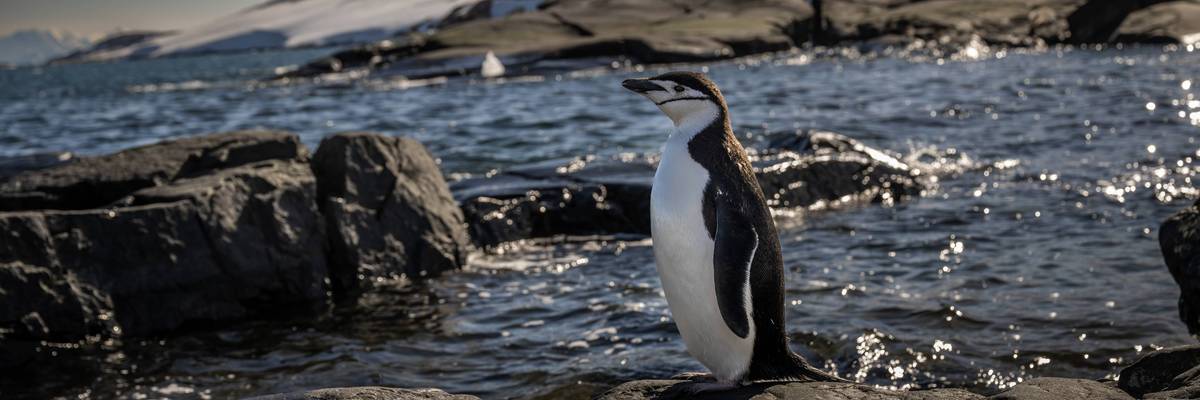
A Chinstrap penguin is seen during Turkey's 10th National Antarctic Scientific Expedition on February 11, 2026.
"Big Oil is doing everything in its power to turn this beautiful, miraculous world into a wasteland."
The population of the world's largest penguin colony has collapsed, according to a new study. The researchers say the climate crisis is to blame.
Zavodovski Island, a speck of land in the remote subantarctic South Sandwich archipelago, was once home to about 1.09 million breeding chinstrap penguins. By 2025, there were just over 400,000 of them left, according to research published Wednesday in the journal Current Biology—a 63% population decline.
For years, Zavodovski had been considered an exception to the penguin declines seen elsewhere around Antarctica. But the sudden drop over the past 15 years is the fastest ever for the chinstrap species, which is marked by the thin black line beneath its beak.
Norman Ratcliffe, a penguin ecologist with the British Antarctic Survey (BAS), said that after an "enormous population crash," Zavodovski Island—which he said once resembled a "Penguin Mordor"—can no longer even claim the title of the world's largest colony. That distinction now belongs to Cape Adare in Antarctica's Ross Sea, which is dominated by Adélie penguins.
The decline is so severe that the BAS says chinstraps may now be eligible for the "endangered" category on the International Union for Conservation of Nature's list of threatened species.
Ratcliffe said the most likely explanation is a climate-driven upheaval in the penguins' food supply. Chinstrap penguins feed exclusively on Antarctic krill, which reside in the colder waters near Zavodovski.
"Chinstrap penguins are krill specialists," Ratcliffe explained in a video posted by the BAS. "That's pretty much all they eat throughout their entire range."
But the Antarctic has warmed faster than almost anywhere else on Earth—reaching 5°C above temperatures from half a century ago in some places.
"What we found is that the krill distribution is contracting southwards with warming," Ratcliffe said. "Chinstraps... like cool waters, but they're really averse to sea ice.
"One of the problems chinstraps are facing: they like cool waters, but they're really averse to sea ice. So there's a limit to how far they can go south," he continued. "Chinstraps are therefore left with less food to eat. That affects their survival and breeding success, and hence their numbers tend to decline."
Researchers at the BAS have raised concerns that rapid fluctuations in penguin populations could disrupt the wider southern marine ecosystem. But they said the problem is much bigger than just the Antarctic.
"Our study is another example of a warming climate impacting even the most remote parts of our planet," said BAS penguin researcher Peter Fretwell. "The South Sandwich Islands are far from any humans, home to almost a third of the world’s chinstrap penguins—but not even they can escape the impacts of climate change.”
Despite the accelerating consequences of global heating, international consumption of oil, gas, and coal rose again last year, according to the International Energy Agency. Energy-related carbon dioxide emissions reached nearly 38.4 billion metric tons in 2025, 5% higher than in 2019.
Responding to news of the dramatic decline of penguins in the Antarctic, Aaron Regunberg, the director of Public Citizen’s Climate Accountability Project, remarked, "Big Oil is doing everything in its power to turn this beautiful, miraculous world into a wasteland."
Dear Common Dreams reader, It’s been nearly 30 years since I co-founded Common Dreams with my late wife, Lina Newhouser. We had the radical notion that journalism should serve the public good, not corporate profits. It was clear to us from the outset what it would take to build such a project. No paid advertisements. No corporate sponsors. No millionaire publisher telling us what to think or do. Many people said we wouldn't last a year, but we proved those doubters wrong. Together with a tremendous team of journalists and dedicated staff, we built an independent media outlet free from the constraints of profits and corporate control. Our mission has always been simple: To inform. To inspire. To ignite change for the common good. Building Common Dreams was not easy. Our survival was never guaranteed. When you take on the most powerful forces—Wall Street greed, fossil fuel industry destruction, Big Tech lobbyists, and uber-rich oligarchs who have spent billions upon billions rigging the economy and democracy in their favor—the only bulwark you have is supporters who believe in your work. But here’s the urgent message from me today. It's never been this bad out there. And it's never been this hard to keep us going. At the very moment Common Dreams is most needed, the threats we face are intensifying. We need your support now more than ever. We don't accept corporate advertising and never will. We don't have a paywall because we don't think people should be blocked from critical news based on their ability to pay. Everything we do is funded by the donations of readers like you. When everyone does the little they can afford, we are strong. But if that support retreats or dries up, so do we. Will you donate now to make sure Common Dreams not only survives but thrives? —Craig Brown, Co-founder |
The population of the world's largest penguin colony has collapsed, according to a new study. The researchers say the climate crisis is to blame.
Zavodovski Island, a speck of land in the remote subantarctic South Sandwich archipelago, was once home to about 1.09 million breeding chinstrap penguins. By 2025, there were just over 400,000 of them left, according to research published Wednesday in the journal Current Biology—a 63% population decline.
For years, Zavodovski had been considered an exception to the penguin declines seen elsewhere around Antarctica. But the sudden drop over the past 15 years is the fastest ever for the chinstrap species, which is marked by the thin black line beneath its beak.
Norman Ratcliffe, a penguin ecologist with the British Antarctic Survey (BAS), said that after an "enormous population crash," Zavodovski Island—which he said once resembled a "Penguin Mordor"—can no longer even claim the title of the world's largest colony. That distinction now belongs to Cape Adare in Antarctica's Ross Sea, which is dominated by Adélie penguins.
The decline is so severe that the BAS says chinstraps may now be eligible for the "endangered" category on the International Union for Conservation of Nature's list of threatened species.
Ratcliffe said the most likely explanation is a climate-driven upheaval in the penguins' food supply. Chinstrap penguins feed exclusively on Antarctic krill, which reside in the colder waters near Zavodovski.
"Chinstrap penguins are krill specialists," Ratcliffe explained in a video posted by the BAS. "That's pretty much all they eat throughout their entire range."
But the Antarctic has warmed faster than almost anywhere else on Earth—reaching 5°C above temperatures from half a century ago in some places.
"What we found is that the krill distribution is contracting southwards with warming," Ratcliffe said. "Chinstraps... like cool waters, but they're really averse to sea ice.
"One of the problems chinstraps are facing: they like cool waters, but they're really averse to sea ice. So there's a limit to how far they can go south," he continued. "Chinstraps are therefore left with less food to eat. That affects their survival and breeding success, and hence their numbers tend to decline."
Researchers at the BAS have raised concerns that rapid fluctuations in penguin populations could disrupt the wider southern marine ecosystem. But they said the problem is much bigger than just the Antarctic.
"Our study is another example of a warming climate impacting even the most remote parts of our planet," said BAS penguin researcher Peter Fretwell. "The South Sandwich Islands are far from any humans, home to almost a third of the world’s chinstrap penguins—but not even they can escape the impacts of climate change.”
Despite the accelerating consequences of global heating, international consumption of oil, gas, and coal rose again last year, according to the International Energy Agency. Energy-related carbon dioxide emissions reached nearly 38.4 billion metric tons in 2025, 5% higher than in 2019.
Responding to news of the dramatic decline of penguins in the Antarctic, Aaron Regunberg, the director of Public Citizen’s Climate Accountability Project, remarked, "Big Oil is doing everything in its power to turn this beautiful, miraculous world into a wasteland."
The population of the world's largest penguin colony has collapsed, according to a new study. The researchers say the climate crisis is to blame.
Zavodovski Island, a speck of land in the remote subantarctic South Sandwich archipelago, was once home to about 1.09 million breeding chinstrap penguins. By 2025, there were just over 400,000 of them left, according to research published Wednesday in the journal Current Biology—a 63% population decline.
For years, Zavodovski had been considered an exception to the penguin declines seen elsewhere around Antarctica. But the sudden drop over the past 15 years is the fastest ever for the chinstrap species, which is marked by the thin black line beneath its beak.
Norman Ratcliffe, a penguin ecologist with the British Antarctic Survey (BAS), said that after an "enormous population crash," Zavodovski Island—which he said once resembled a "Penguin Mordor"—can no longer even claim the title of the world's largest colony. That distinction now belongs to Cape Adare in Antarctica's Ross Sea, which is dominated by Adélie penguins.
The decline is so severe that the BAS says chinstraps may now be eligible for the "endangered" category on the International Union for Conservation of Nature's list of threatened species.
Ratcliffe said the most likely explanation is a climate-driven upheaval in the penguins' food supply. Chinstrap penguins feed exclusively on Antarctic krill, which reside in the colder waters near Zavodovski.
"Chinstrap penguins are krill specialists," Ratcliffe explained in a video posted by the BAS. "That's pretty much all they eat throughout their entire range."
But the Antarctic has warmed faster than almost anywhere else on Earth—reaching 5°C above temperatures from half a century ago in some places.
"What we found is that the krill distribution is contracting southwards with warming," Ratcliffe said. "Chinstraps... like cool waters, but they're really averse to sea ice.
"One of the problems chinstraps are facing: they like cool waters, but they're really averse to sea ice. So there's a limit to how far they can go south," he continued. "Chinstraps are therefore left with less food to eat. That affects their survival and breeding success, and hence their numbers tend to decline."
Researchers at the BAS have raised concerns that rapid fluctuations in penguin populations could disrupt the wider southern marine ecosystem. But they said the problem is much bigger than just the Antarctic.
"Our study is another example of a warming climate impacting even the most remote parts of our planet," said BAS penguin researcher Peter Fretwell. "The South Sandwich Islands are far from any humans, home to almost a third of the world’s chinstrap penguins—but not even they can escape the impacts of climate change.”
Despite the accelerating consequences of global heating, international consumption of oil, gas, and coal rose again last year, according to the International Energy Agency. Energy-related carbon dioxide emissions reached nearly 38.4 billion metric tons in 2025, 5% higher than in 2019.
Responding to news of the dramatic decline of penguins in the Antarctic, Aaron Regunberg, the director of Public Citizen’s Climate Accountability Project, remarked, "Big Oil is doing everything in its power to turn this beautiful, miraculous world into a wasteland."