SUBSCRIBE TO OUR FREE NEWSLETTER
Daily news & progressive opinion—funded by the people, not the corporations—delivered straight to your inbox.
5
#000000
#FFFFFF
To donate by check, phone, or other method, see our More Ways to Give page.
Daily news & progressive opinion—funded by the people, not the corporations—delivered straight to your inbox.
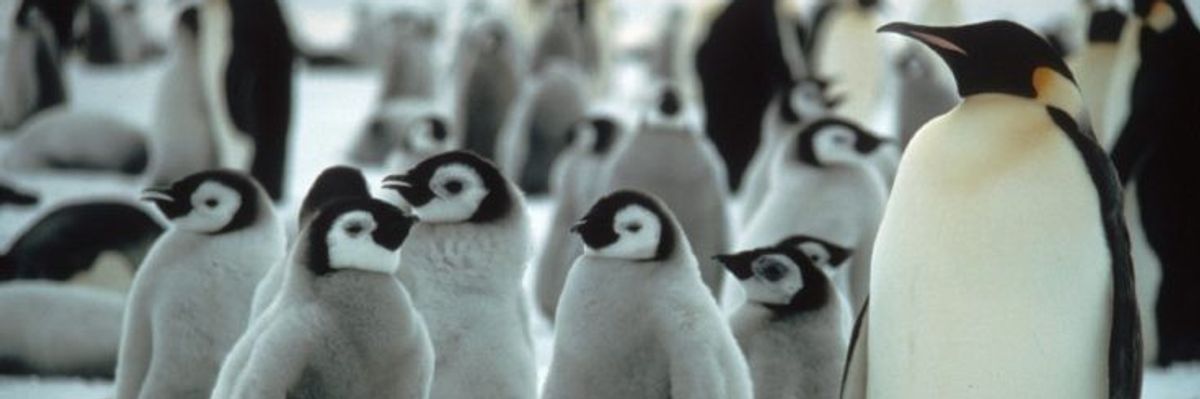
Emperor penguin chicks and their parents huddle on the sea ice they need to breed.
One scientist warned that if humanity doesn't stop burning fossil fuels, "we will drive these iconic, beautiful birds to the verge of extinction."
As Antarctic sea ice dwindled to match record low levels last year, it caused "catastrophic breeding failure" in four emperor penguin colonies.
The loss of more than 9,000 chicks was documented in a study published in Communications Earth & Environment Thursday. It's the first recorded case of such extensive breeding failure in the charismatic penguins due to sea-ice loss, but the study authors warn it may be a "snapshot of a future, warming Antarctica."
"There is hope: We can cut our carbon emissions that are causing the warming," study lead author Peter Fretwell of the British Antarctic Survey (BAS) told BBC News. "But if we don't we will drive these iconic, beautiful birds to the verge of extinction."
Antarctic sea ice is in the midst of a striking decline. Four of the years with the lowest sea-ice extent in the 45-year satellite record have been in the last seven years, with the lowest in 2021-22 and 2022-23, according to BAS. In February of this year, ice extent shrank to a record low. And it has not fully recovered during the Antarctic winter months, BAS pointed out. The winter extent as of August 20 was lower than the previous record low by about half of a square mile and differed from the 1981 to 2022 median by an area larger than Greenland.
Natural variations like El Niño can alter sea-ice extent year to year, and it will take more data and research to determine the cause of the current anomaly, polar scientist Caroline Holmes told BAS.
"However," she added, "the recent years of tumbling sea-ice records and warming of the subsurface Southern Ocean point strongly to human-induced global warming exacerbating these extremes."
"This paper dramatically reveals the connection between sea-ice loss and ecosystem annihilation."
This is bad news for emperor penguins. Between April and January, they spend their time on sea ice connected to the land. There, they lay and hatch their eggs in the Antarctic winter and rear them through the spring until the chicks develop waterproof plumage in December or January and are ready to strike off on their own, as Inside Climate News explained.
"But if it breaks earlier than that, the chicks basically lose that platform," study co-author Norm Ratcliffe told Inside Climate News. "So they either fall into the sea and they drown."
Ratcliffe added that while the chicks might be able to make it to an iceberg, their feathers would still be wet, so "they'll probably freeze to death."
That's exactly what the scientists think happened to 4 out of 5 emperor penguin colonies in the Bellingshausen Sea region. Researchers had been tracking the colonies using satellite imagery for years based on the buildup of guano on the ice. Then, in November, that ice suddenly disintegrated, with some areas seeing a loss of 100%. With the ice went the guano, leading the scientists to conclude the colonies were abandoned. They think it's unlikely that the chicks survived the loss.
"It's a grim story," Fretwell told The Guardian. "I was shocked. It's very hard to think of these cute fluffy chicks dying in large numbers."
While individual colonies have been impacted by sea-ice loss before, what happened in the Bellingshausen Sea region was "unprecedented," BAS said.
When sea ice disappeared locally from Halley Bay in the Weddell Sea after 2016, for example, penguins with a colony there relocated to Dawson Lambton Glacier, the study authors noted.
"However, such a strategy will not be possible if breeding habitat becomes unsuitable at a regional scale," the study authors wrote.
Up until now, emperor penguins have emerged relatively unscathed from the pressures of industrial capitalism, such as massive hunting, overfishing, or habitat loss. But that is changing. BAS observed that the study lends support to the prediction that more than 90% of emperor penguin colonies could be nearly extinct by 2100 if nothing is done to stop burning fossil fuels and curb predicted temperature rise.
"This paper dramatically reveals the connection between sea-ice loss and ecosystem annihilation," BAS sea ice physicist Jeremy Wilkinson said in a statement.
"It is another warning sign for humanity that we cannot continue down this path, politicians must act to minimize the impact of climate change," Wilkinson added. " There is no time left."
Dear Common Dreams reader, It’s been nearly 30 years since I co-founded Common Dreams with my late wife, Lina Newhouser. We had the radical notion that journalism should serve the public good, not corporate profits. It was clear to us from the outset what it would take to build such a project. No paid advertisements. No corporate sponsors. No millionaire publisher telling us what to think or do. Many people said we wouldn't last a year, but we proved those doubters wrong. Together with a tremendous team of journalists and dedicated staff, we built an independent media outlet free from the constraints of profits and corporate control. Our mission has always been simple: To inform. To inspire. To ignite change for the common good. Building Common Dreams was not easy. Our survival was never guaranteed. When you take on the most powerful forces—Wall Street greed, fossil fuel industry destruction, Big Tech lobbyists, and uber-rich oligarchs who have spent billions upon billions rigging the economy and democracy in their favor—the only bulwark you have is supporters who believe in your work. But here’s the urgent message from me today. It's never been this bad out there. And it's never been this hard to keep us going. At the very moment Common Dreams is most needed, the threats we face are intensifying. We need your support now more than ever. We don't accept corporate advertising and never will. We don't have a paywall because we don't think people should be blocked from critical news based on their ability to pay. Everything we do is funded by the donations of readers like you. When everyone does the little they can afford, we are strong. But if that support retreats or dries up, so do we. Will you donate now to make sure Common Dreams not only survives but thrives? —Craig Brown, Co-founder |
As Antarctic sea ice dwindled to match record low levels last year, it caused "catastrophic breeding failure" in four emperor penguin colonies.
The loss of more than 9,000 chicks was documented in a study published in Communications Earth & Environment Thursday. It's the first recorded case of such extensive breeding failure in the charismatic penguins due to sea-ice loss, but the study authors warn it may be a "snapshot of a future, warming Antarctica."
"There is hope: We can cut our carbon emissions that are causing the warming," study lead author Peter Fretwell of the British Antarctic Survey (BAS) told BBC News. "But if we don't we will drive these iconic, beautiful birds to the verge of extinction."
Antarctic sea ice is in the midst of a striking decline. Four of the years with the lowest sea-ice extent in the 45-year satellite record have been in the last seven years, with the lowest in 2021-22 and 2022-23, according to BAS. In February of this year, ice extent shrank to a record low. And it has not fully recovered during the Antarctic winter months, BAS pointed out. The winter extent as of August 20 was lower than the previous record low by about half of a square mile and differed from the 1981 to 2022 median by an area larger than Greenland.
Natural variations like El Niño can alter sea-ice extent year to year, and it will take more data and research to determine the cause of the current anomaly, polar scientist Caroline Holmes told BAS.
"However," she added, "the recent years of tumbling sea-ice records and warming of the subsurface Southern Ocean point strongly to human-induced global warming exacerbating these extremes."
"This paper dramatically reveals the connection between sea-ice loss and ecosystem annihilation."
This is bad news for emperor penguins. Between April and January, they spend their time on sea ice connected to the land. There, they lay and hatch their eggs in the Antarctic winter and rear them through the spring until the chicks develop waterproof plumage in December or January and are ready to strike off on their own, as Inside Climate News explained.
"But if it breaks earlier than that, the chicks basically lose that platform," study co-author Norm Ratcliffe told Inside Climate News. "So they either fall into the sea and they drown."
Ratcliffe added that while the chicks might be able to make it to an iceberg, their feathers would still be wet, so "they'll probably freeze to death."
That's exactly what the scientists think happened to 4 out of 5 emperor penguin colonies in the Bellingshausen Sea region. Researchers had been tracking the colonies using satellite imagery for years based on the buildup of guano on the ice. Then, in November, that ice suddenly disintegrated, with some areas seeing a loss of 100%. With the ice went the guano, leading the scientists to conclude the colonies were abandoned. They think it's unlikely that the chicks survived the loss.
"It's a grim story," Fretwell told The Guardian. "I was shocked. It's very hard to think of these cute fluffy chicks dying in large numbers."
While individual colonies have been impacted by sea-ice loss before, what happened in the Bellingshausen Sea region was "unprecedented," BAS said.
When sea ice disappeared locally from Halley Bay in the Weddell Sea after 2016, for example, penguins with a colony there relocated to Dawson Lambton Glacier, the study authors noted.
"However, such a strategy will not be possible if breeding habitat becomes unsuitable at a regional scale," the study authors wrote.
Up until now, emperor penguins have emerged relatively unscathed from the pressures of industrial capitalism, such as massive hunting, overfishing, or habitat loss. But that is changing. BAS observed that the study lends support to the prediction that more than 90% of emperor penguin colonies could be nearly extinct by 2100 if nothing is done to stop burning fossil fuels and curb predicted temperature rise.
"This paper dramatically reveals the connection between sea-ice loss and ecosystem annihilation," BAS sea ice physicist Jeremy Wilkinson said in a statement.
"It is another warning sign for humanity that we cannot continue down this path, politicians must act to minimize the impact of climate change," Wilkinson added. " There is no time left."
As Antarctic sea ice dwindled to match record low levels last year, it caused "catastrophic breeding failure" in four emperor penguin colonies.
The loss of more than 9,000 chicks was documented in a study published in Communications Earth & Environment Thursday. It's the first recorded case of such extensive breeding failure in the charismatic penguins due to sea-ice loss, but the study authors warn it may be a "snapshot of a future, warming Antarctica."
"There is hope: We can cut our carbon emissions that are causing the warming," study lead author Peter Fretwell of the British Antarctic Survey (BAS) told BBC News. "But if we don't we will drive these iconic, beautiful birds to the verge of extinction."
Antarctic sea ice is in the midst of a striking decline. Four of the years with the lowest sea-ice extent in the 45-year satellite record have been in the last seven years, with the lowest in 2021-22 and 2022-23, according to BAS. In February of this year, ice extent shrank to a record low. And it has not fully recovered during the Antarctic winter months, BAS pointed out. The winter extent as of August 20 was lower than the previous record low by about half of a square mile and differed from the 1981 to 2022 median by an area larger than Greenland.
Natural variations like El Niño can alter sea-ice extent year to year, and it will take more data and research to determine the cause of the current anomaly, polar scientist Caroline Holmes told BAS.
"However," she added, "the recent years of tumbling sea-ice records and warming of the subsurface Southern Ocean point strongly to human-induced global warming exacerbating these extremes."
"This paper dramatically reveals the connection between sea-ice loss and ecosystem annihilation."
This is bad news for emperor penguins. Between April and January, they spend their time on sea ice connected to the land. There, they lay and hatch their eggs in the Antarctic winter and rear them through the spring until the chicks develop waterproof plumage in December or January and are ready to strike off on their own, as Inside Climate News explained.
"But if it breaks earlier than that, the chicks basically lose that platform," study co-author Norm Ratcliffe told Inside Climate News. "So they either fall into the sea and they drown."
Ratcliffe added that while the chicks might be able to make it to an iceberg, their feathers would still be wet, so "they'll probably freeze to death."
That's exactly what the scientists think happened to 4 out of 5 emperor penguin colonies in the Bellingshausen Sea region. Researchers had been tracking the colonies using satellite imagery for years based on the buildup of guano on the ice. Then, in November, that ice suddenly disintegrated, with some areas seeing a loss of 100%. With the ice went the guano, leading the scientists to conclude the colonies were abandoned. They think it's unlikely that the chicks survived the loss.
"It's a grim story," Fretwell told The Guardian. "I was shocked. It's very hard to think of these cute fluffy chicks dying in large numbers."
While individual colonies have been impacted by sea-ice loss before, what happened in the Bellingshausen Sea region was "unprecedented," BAS said.
When sea ice disappeared locally from Halley Bay in the Weddell Sea after 2016, for example, penguins with a colony there relocated to Dawson Lambton Glacier, the study authors noted.
"However, such a strategy will not be possible if breeding habitat becomes unsuitable at a regional scale," the study authors wrote.
Up until now, emperor penguins have emerged relatively unscathed from the pressures of industrial capitalism, such as massive hunting, overfishing, or habitat loss. But that is changing. BAS observed that the study lends support to the prediction that more than 90% of emperor penguin colonies could be nearly extinct by 2100 if nothing is done to stop burning fossil fuels and curb predicted temperature rise.
"This paper dramatically reveals the connection between sea-ice loss and ecosystem annihilation," BAS sea ice physicist Jeremy Wilkinson said in a statement.
"It is another warning sign for humanity that we cannot continue down this path, politicians must act to minimize the impact of climate change," Wilkinson added. " There is no time left."