SUBSCRIBE TO OUR FREE NEWSLETTER
Daily news & progressive opinion—funded by the people, not the corporations—delivered straight to your inbox.
5
#000000
#FFFFFF
To donate by check, phone, or other method, see our More Ways to Give page.
Daily news & progressive opinion—funded by the people, not the corporations—delivered straight to your inbox.
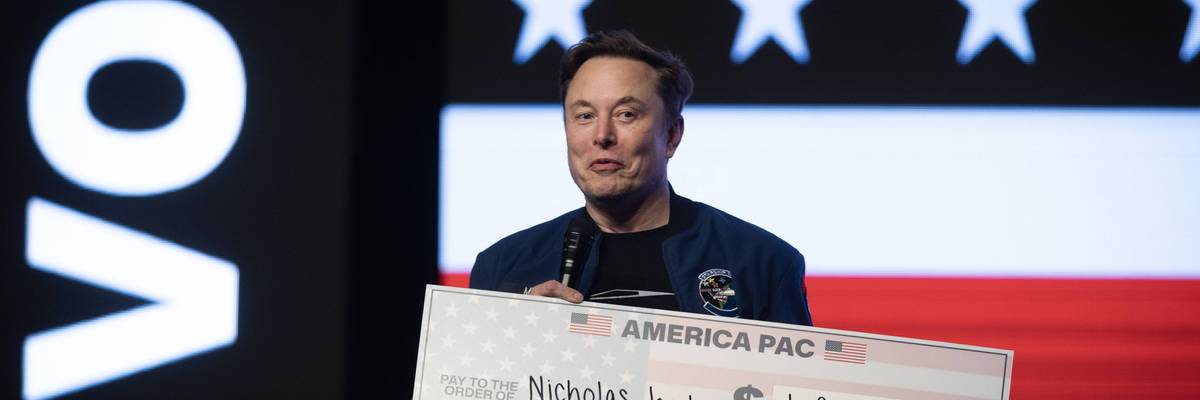
SpaceX CEO Elon Musk prepares to give $1,000,000 to a Wisconsin voter during a town hall meeting on March 30, 2025 in Green Bay, Wisconsin.
DOGE was a "slapdash and deceptive effort" that only succeeded in "putting Americans’ sensitive data at risk and hollowing out critical agencies," said US Sen. Gary Peters.
A report from the Government Accountability Office released Thursday details how Elon Musk's Department of Government Efficiency wildly exaggerated the savings it was able to deliver for the US federal government.
The report, requested by Sens. Gary Peters (D-Mich.) and Richard Blumenthal (D-Conn.), finds that DOGE used a number of tricks to inflate the value of its purported savings, including taking credit for ending leases that were already in the process of being terminated and falsely claiming to have canceled contracts that were left intact.
The report also finds that DOGE "did not provide sufficient information to verify the method used to calculate 96%" of savings purportedly achieved through grant cancellations.
And in cases where DOGE actually was responsible for terminating a contract or cancelling a lease, the report notes that it "did not consistently use its stated methodology for calculating savings or disclose limitations in a sufficient manner."
Even in instances where the department followed its stated methodology, the report adds, "it did not account for many complexities and nuances of federal contracting," such as obligations or settlement costs that may have come from ending a contract.
In touting the GAO report, Peters said it exposed DOGE as a "slapdash and deceptive effort" at streamlining government spending that only succeeded in "putting Americans’ sensitive data at risk and hollowing out critical agencies."
Blumenthal accused the Trump administration of using DOGE as cover to "recklessly slash government programs, ransacking critical services and resources and proudly displaying supposed 'savings.'"
Jessica Tillipman, associate dean for government procurement law at the George Washington University Law School, highlighted a number of DOGE flubs in a social media post breaking down the GAO report, including a "favorite example" of DOGE claiming $28 million in savings related to an Air Force contract that in reality only saved around $600,000.
Eric Boehm, writer for libertarian magazine Reason, said that the GAO report revealed that the savings Musk and his minions claimed from their work was "mostly just made up."
In his assessment, Blumenthal said the report only "underscores the need for increased transparency and accountability from the Trump administration so the American public can better understand DOGE’s activities as the organization guts vital government programs."
Dear Common Dreams reader, It’s been nearly 30 years since I co-founded Common Dreams with my late wife, Lina Newhouser. We had the radical notion that journalism should serve the public good, not corporate profits. It was clear to us from the outset what it would take to build such a project. No paid advertisements. No corporate sponsors. No millionaire publisher telling us what to think or do. Many people said we wouldn't last a year, but we proved those doubters wrong. Together with a tremendous team of journalists and dedicated staff, we built an independent media outlet free from the constraints of profits and corporate control. Our mission has always been simple: To inform. To inspire. To ignite change for the common good. Building Common Dreams was not easy. Our survival was never guaranteed. When you take on the most powerful forces—Wall Street greed, fossil fuel industry destruction, Big Tech lobbyists, and uber-rich oligarchs who have spent billions upon billions rigging the economy and democracy in their favor—the only bulwark you have is supporters who believe in your work. But here’s the urgent message from me today. It's never been this bad out there. And it's never been this hard to keep us going. At the very moment Common Dreams is most needed, the threats we face are intensifying. We need your support now more than ever. We don't accept corporate advertising and never will. We don't have a paywall because we don't think people should be blocked from critical news based on their ability to pay. Everything we do is funded by the donations of readers like you. When everyone does the little they can afford, we are strong. But if that support retreats or dries up, so do we. Will you donate now to make sure Common Dreams not only survives but thrives? —Craig Brown, Co-founder |
A report from the Government Accountability Office released Thursday details how Elon Musk's Department of Government Efficiency wildly exaggerated the savings it was able to deliver for the US federal government.
The report, requested by Sens. Gary Peters (D-Mich.) and Richard Blumenthal (D-Conn.), finds that DOGE used a number of tricks to inflate the value of its purported savings, including taking credit for ending leases that were already in the process of being terminated and falsely claiming to have canceled contracts that were left intact.
The report also finds that DOGE "did not provide sufficient information to verify the method used to calculate 96%" of savings purportedly achieved through grant cancellations.
And in cases where DOGE actually was responsible for terminating a contract or cancelling a lease, the report notes that it "did not consistently use its stated methodology for calculating savings or disclose limitations in a sufficient manner."
Even in instances where the department followed its stated methodology, the report adds, "it did not account for many complexities and nuances of federal contracting," such as obligations or settlement costs that may have come from ending a contract.
In touting the GAO report, Peters said it exposed DOGE as a "slapdash and deceptive effort" at streamlining government spending that only succeeded in "putting Americans’ sensitive data at risk and hollowing out critical agencies."
Blumenthal accused the Trump administration of using DOGE as cover to "recklessly slash government programs, ransacking critical services and resources and proudly displaying supposed 'savings.'"
Jessica Tillipman, associate dean for government procurement law at the George Washington University Law School, highlighted a number of DOGE flubs in a social media post breaking down the GAO report, including a "favorite example" of DOGE claiming $28 million in savings related to an Air Force contract that in reality only saved around $600,000.
Eric Boehm, writer for libertarian magazine Reason, said that the GAO report revealed that the savings Musk and his minions claimed from their work was "mostly just made up."
In his assessment, Blumenthal said the report only "underscores the need for increased transparency and accountability from the Trump administration so the American public can better understand DOGE’s activities as the organization guts vital government programs."
A report from the Government Accountability Office released Thursday details how Elon Musk's Department of Government Efficiency wildly exaggerated the savings it was able to deliver for the US federal government.
The report, requested by Sens. Gary Peters (D-Mich.) and Richard Blumenthal (D-Conn.), finds that DOGE used a number of tricks to inflate the value of its purported savings, including taking credit for ending leases that were already in the process of being terminated and falsely claiming to have canceled contracts that were left intact.
The report also finds that DOGE "did not provide sufficient information to verify the method used to calculate 96%" of savings purportedly achieved through grant cancellations.
And in cases where DOGE actually was responsible for terminating a contract or cancelling a lease, the report notes that it "did not consistently use its stated methodology for calculating savings or disclose limitations in a sufficient manner."
Even in instances where the department followed its stated methodology, the report adds, "it did not account for many complexities and nuances of federal contracting," such as obligations or settlement costs that may have come from ending a contract.
In touting the GAO report, Peters said it exposed DOGE as a "slapdash and deceptive effort" at streamlining government spending that only succeeded in "putting Americans’ sensitive data at risk and hollowing out critical agencies."
Blumenthal accused the Trump administration of using DOGE as cover to "recklessly slash government programs, ransacking critical services and resources and proudly displaying supposed 'savings.'"
Jessica Tillipman, associate dean for government procurement law at the George Washington University Law School, highlighted a number of DOGE flubs in a social media post breaking down the GAO report, including a "favorite example" of DOGE claiming $28 million in savings related to an Air Force contract that in reality only saved around $600,000.
Eric Boehm, writer for libertarian magazine Reason, said that the GAO report revealed that the savings Musk and his minions claimed from their work was "mostly just made up."
In his assessment, Blumenthal said the report only "underscores the need for increased transparency and accountability from the Trump administration so the American public can better understand DOGE’s activities as the organization guts vital government programs."