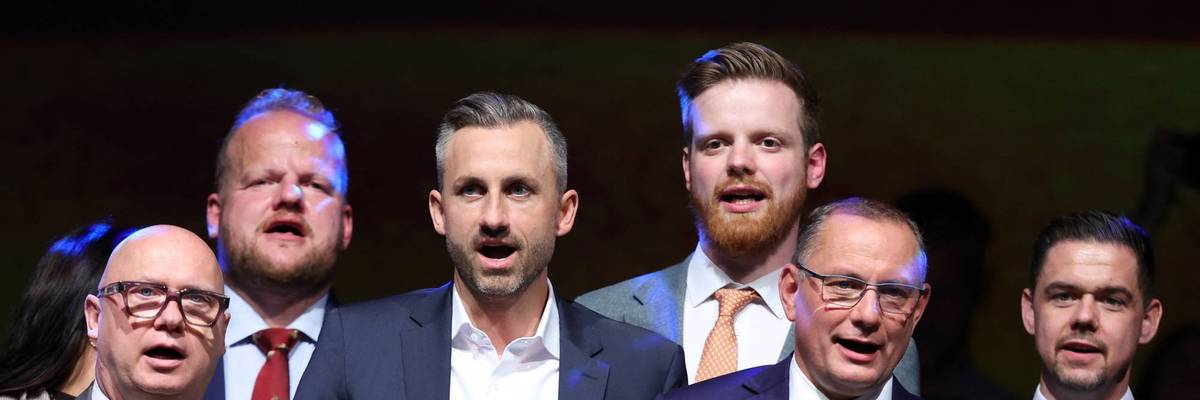
Ulrich Siegmund, Alternative for Germany's main candidate in the Saxony-Anhalt state election, sings the national anthem in Magdeburg, eastern Germany on September 6, 2026.
Far-Right Alternative for Germany Thanks Elon Musk After Regional Election Win
"The far-right rampage is not slowing down, but accelerating instead."
The far-right Alternative for Germany party thanked the world's richest man, Elon Musk, after decisively winning a key regional election on Sunday, sparking alarm across Europe and around the globe.
Ulrich Siegmund, AfD's lead candidate in the eastern state of Saxony-Anhalt, praised Musk—who has openly advocated for the far-right, xenophobic party—for his support and "clear and highly important perspective on the political developments of our time—including here in Germany." Siegmund wrote that if AfD ends up leading the state government, the party "would very much welcome the opportunity for strong and constructive cooperation," adding that "Germany would once again be a place worth investing in."
Siegmund's post on the social media platform X, which Musk owns, came after AfD won just over 44% of the vote in the Saxony-Anhalt election, trouncing the Christian Democratic Union (CDU), led by Chancellor Friedrich Merz. CDU finished a distant second with 17.1% of the vote.
"Well done!" Musk wrote, in German, following AfD's election win. The mega-billionaire has called AfD "the only hope for Germany."
US President Donald Trump, a political ally of Musk, posted to Truth Social a screenshot of exit polls showing AfD leading the regional election on Sunday afternoon.
"Leave it to Trump to celebrate the victory of a far-right German party that shows sympathy for the Nazis, downplays the Holocaust, and flirts with Putin," Kenneth Roth, the former executive director of Human Rights Watch, wrote on social media in response to the US president.
The Associated Press noted that "to win an absolute majority, AfD needed to clinch 42 of the 83 seats in the state parliament, but the party appeared on track to win 39. Depending on the ultimate make-up of parliament, it could still end up leading the state government." Siegmund would be the first far-right leader to govern a German state since 1945.
But other German parties have refused to work with AfD, raising doubts about its ability to form a government in Saxony-Anhalt, which has a population of around 2.1 million people.
David Adler, co-general coordinator of the Progressive International, wrote that the election "sent a clear message, to Germany as to all of Europe, that the far-right rampage is not slowing down, but accelerating instead."
AfD focuses heavily on immigration, vowing "deportation from minute one" and calling for abolition of "the fundamental right to asylum."
"In addition to deporting immigrants, the party has proposed cutting funding for public broadcasters, banning gay pride flags in schools, and teaching more Russian, as well as tax breaks for large families and free childcare," The New York Times reported. The newspaper noted that Siegmund declined to condemn supporters who "chanted his surname... in the style of the Nazi salute, 'Sieg Heil.'"
European officials voiced deep concern about AfD's surge in the regional election, with France's Europe minister calling the results "a serious moment."
"Nationalism and xenophobia will never be a solution," said Benjamin Haddad. "We must listen with humility to the anger, the concerns, the fears, and respond to them. We cannot forget our history. That is the meaning behind the choices made by France and Germany.”
Spanish Julen Bollain wrote on social media that "the far-right is managing to turn discontent, economic insecurity, and disaffection into votes."
"AfD is doing something that should especially worry the left: transforming precarity, frustration, and disaffection into political identity and votes," Bollain added. "And if we don't manage to give a collective response to the existing social discontent, someone always shows up ready to turn it into fear, hate, and scapegoats. And there they beat us, because they move like fish in water."
We are at a crossroads
This country and this world are at a monumental crossroads. In a few short weeks, US voters will have an opportunity to beat back the forces of fascism and confront the billionaires who are rigging the economy, our media system, and our democracy, making it increasingly impossible for ordinary people to get by. We’re not just talking about the election. We’re talking about what must be done once these fascist elements are vanquished from power. We need a bolder set of solutions than what either major party has so far been willing to offer and a working-class movement ready to fight like hell for it. Trump didn't emerge from nowhere. The conditions that fueled MAGA authoritarianism were created by decades of radical neoliberal economic policies and a corrupt political system dominated by corporate interests. They slashed taxes on the super-rich, promising that the benefits would trickle down. They said giveaways to the corporate titans would make life more affordable for the rest of us. It was all bullshit. And when a bitter, betrayed populace searches for someone to blame, right-wing demagogues have little trouble finding scapegoats. People know when they're being lied to, but you won't hear any of this from the corporate media. Only independent journalism—powered and funded by people who believe in building a better world—can deliver truly trustworthy daily news. Our Fall Campaign is underway, and we need your help. To power our newsroom through the rest of the year, we need to raise $125,000 by midnight on October 31. So if you share our vision, please contribute whatever you can to sustain our work. |
The far-right Alternative for Germany party thanked the world's richest man, Elon Musk, after decisively winning a key regional election on Sunday, sparking alarm across Europe and around the globe.
Ulrich Siegmund, AfD's lead candidate in the eastern state of Saxony-Anhalt, praised Musk—who has openly advocated for the far-right, xenophobic party—for his support and "clear and highly important perspective on the political developments of our time—including here in Germany." Siegmund wrote that if AfD ends up leading the state government, the party "would very much welcome the opportunity for strong and constructive cooperation," adding that "Germany would once again be a place worth investing in."
Siegmund's post on the social media platform X, which Musk owns, came after AfD won just over 44% of the vote in the Saxony-Anhalt election, trouncing the Christian Democratic Union (CDU), led by Chancellor Friedrich Merz. CDU finished a distant second with 17.1% of the vote.
"Well done!" Musk wrote, in German, following AfD's election win. The mega-billionaire has called AfD "the only hope for Germany."
US President Donald Trump, a political ally of Musk, posted to Truth Social a screenshot of exit polls showing AfD leading the regional election on Sunday afternoon.
"Leave it to Trump to celebrate the victory of a far-right German party that shows sympathy for the Nazis, downplays the Holocaust, and flirts with Putin," Kenneth Roth, the former executive director of Human Rights Watch, wrote on social media in response to the US president.
The Associated Press noted that "to win an absolute majority, AfD needed to clinch 42 of the 83 seats in the state parliament, but the party appeared on track to win 39. Depending on the ultimate make-up of parliament, it could still end up leading the state government." Siegmund would be the first far-right leader to govern a German state since 1945.
But other German parties have refused to work with AfD, raising doubts about its ability to form a government in Saxony-Anhalt, which has a population of around 2.1 million people.
David Adler, co-general coordinator of the Progressive International, wrote that the election "sent a clear message, to Germany as to all of Europe, that the far-right rampage is not slowing down, but accelerating instead."
AfD focuses heavily on immigration, vowing "deportation from minute one" and calling for abolition of "the fundamental right to asylum."
"In addition to deporting immigrants, the party has proposed cutting funding for public broadcasters, banning gay pride flags in schools, and teaching more Russian, as well as tax breaks for large families and free childcare," The New York Times reported. The newspaper noted that Siegmund declined to condemn supporters who "chanted his surname... in the style of the Nazi salute, 'Sieg Heil.'"
European officials voiced deep concern about AfD's surge in the regional election, with France's Europe minister calling the results "a serious moment."
"Nationalism and xenophobia will never be a solution," said Benjamin Haddad. "We must listen with humility to the anger, the concerns, the fears, and respond to them. We cannot forget our history. That is the meaning behind the choices made by France and Germany.”
Spanish Julen Bollain wrote on social media that "the far-right is managing to turn discontent, economic insecurity, and disaffection into votes."
"AfD is doing something that should especially worry the left: transforming precarity, frustration, and disaffection into political identity and votes," Bollain added. "And if we don't manage to give a collective response to the existing social discontent, someone always shows up ready to turn it into fear, hate, and scapegoats. And there they beat us, because they move like fish in water."
The far-right Alternative for Germany party thanked the world's richest man, Elon Musk, after decisively winning a key regional election on Sunday, sparking alarm across Europe and around the globe.
Ulrich Siegmund, AfD's lead candidate in the eastern state of Saxony-Anhalt, praised Musk—who has openly advocated for the far-right, xenophobic party—for his support and "clear and highly important perspective on the political developments of our time—including here in Germany." Siegmund wrote that if AfD ends up leading the state government, the party "would very much welcome the opportunity for strong and constructive cooperation," adding that "Germany would once again be a place worth investing in."
Siegmund's post on the social media platform X, which Musk owns, came after AfD won just over 44% of the vote in the Saxony-Anhalt election, trouncing the Christian Democratic Union (CDU), led by Chancellor Friedrich Merz. CDU finished a distant second with 17.1% of the vote.
"Well done!" Musk wrote, in German, following AfD's election win. The mega-billionaire has called AfD "the only hope for Germany."
US President Donald Trump, a political ally of Musk, posted to Truth Social a screenshot of exit polls showing AfD leading the regional election on Sunday afternoon.
"Leave it to Trump to celebrate the victory of a far-right German party that shows sympathy for the Nazis, downplays the Holocaust, and flirts with Putin," Kenneth Roth, the former executive director of Human Rights Watch, wrote on social media in response to the US president.
The Associated Press noted that "to win an absolute majority, AfD needed to clinch 42 of the 83 seats in the state parliament, but the party appeared on track to win 39. Depending on the ultimate make-up of parliament, it could still end up leading the state government." Siegmund would be the first far-right leader to govern a German state since 1945.
But other German parties have refused to work with AfD, raising doubts about its ability to form a government in Saxony-Anhalt, which has a population of around 2.1 million people.
David Adler, co-general coordinator of the Progressive International, wrote that the election "sent a clear message, to Germany as to all of Europe, that the far-right rampage is not slowing down, but accelerating instead."
AfD focuses heavily on immigration, vowing "deportation from minute one" and calling for abolition of "the fundamental right to asylum."
"In addition to deporting immigrants, the party has proposed cutting funding for public broadcasters, banning gay pride flags in schools, and teaching more Russian, as well as tax breaks for large families and free childcare," The New York Times reported. The newspaper noted that Siegmund declined to condemn supporters who "chanted his surname... in the style of the Nazi salute, 'Sieg Heil.'"
European officials voiced deep concern about AfD's surge in the regional election, with France's Europe minister calling the results "a serious moment."
"Nationalism and xenophobia will never be a solution," said Benjamin Haddad. "We must listen with humility to the anger, the concerns, the fears, and respond to them. We cannot forget our history. That is the meaning behind the choices made by France and Germany.”
Spanish Julen Bollain wrote on social media that "the far-right is managing to turn discontent, economic insecurity, and disaffection into votes."
"AfD is doing something that should especially worry the left: transforming precarity, frustration, and disaffection into political identity and votes," Bollain added. "And if we don't manage to give a collective response to the existing social discontent, someone always shows up ready to turn it into fear, hate, and scapegoats. And there they beat us, because they move like fish in water."