SUBSCRIBE TO OUR FREE NEWSLETTER
Daily news & progressive opinion—funded by the people, not the corporations—delivered straight to your inbox.
5
#000000
#FFFFFF
To donate by check, phone, or other method, see our More Ways to Give page.
Daily news & progressive opinion—funded by the people, not the corporations—delivered straight to your inbox.

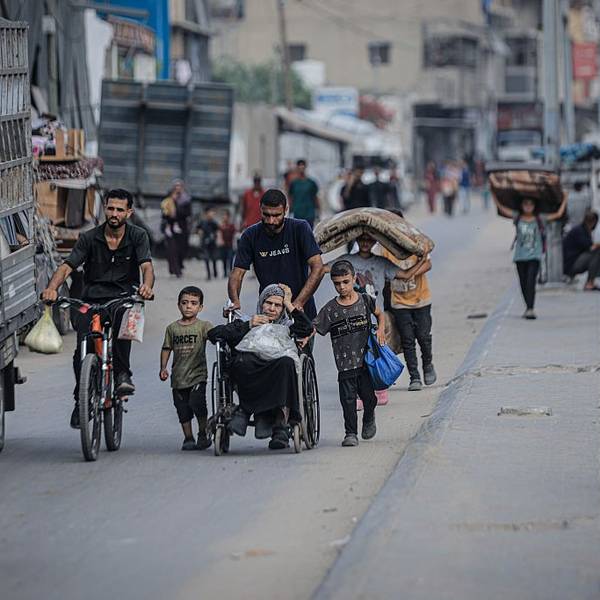
Displaced Palestinians, including many children, wait in long queues to receive hot meals distributed by a charitable organization in Gaza City, Gaza on June 7, 2026.
"What we are witnessing in Gaza is not a series of isolated shortages, it is a policy of attrition by design."
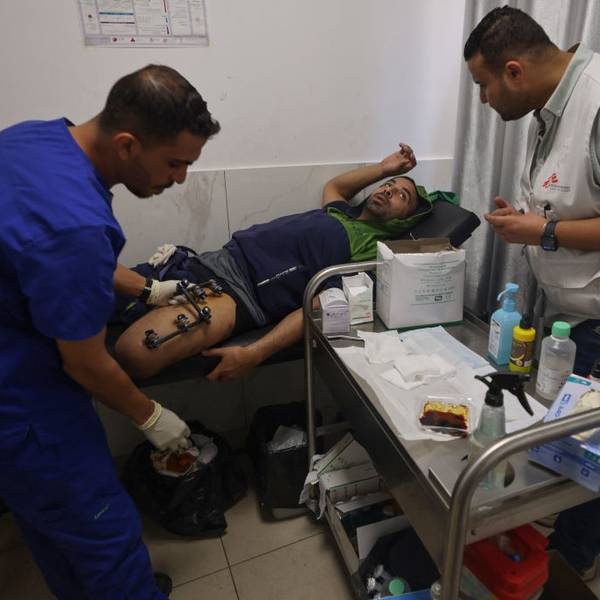
The renowned humanitarian group Doctors Without Borders said Wednesday that the Israeli government is still restricting the entry of engine oil and generator parts to the Gaza Strip, imperiling life-saving hospital functions and other essential services in the decimated territory.
Doctors Without Borders, known internationally as Médecins Sans Frontières (MSF), noted that Gaza's remaining healthcare system relies "almost entirely" on generators, "with most electricity cut by Israeli authorities and much of the electrical infrastructure destroyed." The group said that in some Gaza facilities, its teams barely have sufficient engine oil to last a month and have been forced to "buy engine oil at the local market at exorbitant prices."
Filipe Ribeiro, MSF's head of mission in Palestine, said that "what we are witnessing in Gaza is not a series of isolated shortages, it is a policy of attrition by design."
"For more than two years, we have observed Israel's policies restricting the entry of supplies," said Ribeiro. "These policies do not merely delay aid; they dismantle the very systems people rely on to survive."
Israel's continued restriction of supplies comes as the country's military, which is armed by the United States, keeps up its deadly bombing of the strip despite a purported ceasefire deal that took effect in October 2025. Israeli attacks have killed more than 1,200 people in Gaza since the start of the ceasefire agreement. The Israeli government, headed by Prime Minister Benjamin Netanyahu, has rejected a US-backed plan for Hamas disarmament in exchange for Israeli withdrawal from Gaza.
Earlier this week, a group of United Nations experts condemned Israel's recent "strikes on hospitals and shelters, the killing of police officers and UN-contracted staff, attacks on fishers, and abductions and abuses by armed groups reportedly collaborating with the Israeli military, as well as the killing of humanitarian workers, who through their work protecting and promoting fundamental human rights, are human rights defenders."
"These restrictions have become increasingly far-reaching, also preventing the entry of routine items ranging from ointments for skin diseases to rubber seals needed for medical sterilization equipment."
According to MSF, Israel's sustained attacks and obstruction of supplies "extend far beyond hospitals."
"Without engine oil, all transport services could stop, including much-needed water trucks during the peak of summer heat, ambulances, buses transporting medical staff to work, and trucks delivering humanitarian supplies," the group said. "Bakeries and flour mills also rely on generators, meaning food production could also be affected."
MSF characterized Israel's continued obstruction of engine oil and spare generator parts as "one piece of a larger pattern of structural violence imposed by Israeli authorities to intentionally restrict access to vital services and supplies as part of the ongoing genocide against Palestinians in Gaza."
"These restrictions have become increasingly far-reaching, also preventing the entry of routine items ranging from ointments for skin diseases to rubber seals needed for medical sterilization equipment," the group said. "The shortages now impact virtually every aspect of life in Gaza, leaving hospitals and humanitarian organizations without basic supplies."
Ribeiro said in a statement that "the items change, but the logic remains the same: reducing people to conditions in which life becomes untenable, and dignity is systematically stripped away through the denial of the most ordinary, most essential goods."
"This is not bureaucracy," he added. "It is a deliberate effort to make existence itself impossible."
Dear Common Dreams reader, It’s been nearly 30 years since I co-founded Common Dreams with my late wife, Lina Newhouser. We had the radical notion that journalism should serve the public good, not corporate profits. It was clear to us from the outset what it would take to build such a project. No paid advertisements. No corporate sponsors. No millionaire publisher telling us what to think or do. Many people said we wouldn't last a year, but we proved those doubters wrong. Together with a tremendous team of journalists and dedicated staff, we built an independent media outlet free from the constraints of profits and corporate control. Our mission has always been simple: To inform. To inspire. To ignite change for the common good. Building Common Dreams was not easy. Our survival was never guaranteed. When you take on the most powerful forces—Wall Street greed, fossil fuel industry destruction, Big Tech lobbyists, and uber-rich oligarchs who have spent billions upon billions rigging the economy and democracy in their favor—the only bulwark you have is supporters who believe in your work. But here’s the urgent message from me today. It's never been this bad out there. And it's never been this hard to keep us going. At the very moment Common Dreams is most needed, the threats we face are intensifying. We need your support now more than ever. We don't accept corporate advertising and never will. We don't have a paywall because we don't think people should be blocked from critical news based on their ability to pay. Everything we do is funded by the donations of readers like you. When everyone does the little they can afford, we are strong. But if that support retreats or dries up, so do we. Will you donate now to make sure Common Dreams not only survives but thrives? —Craig Brown, Co-founder |
The renowned humanitarian group Doctors Without Borders said Wednesday that the Israeli government is still restricting the entry of engine oil and generator parts to the Gaza Strip, imperiling life-saving hospital functions and other essential services in the decimated territory.
Doctors Without Borders, known internationally as Médecins Sans Frontières (MSF), noted that Gaza's remaining healthcare system relies "almost entirely" on generators, "with most electricity cut by Israeli authorities and much of the electrical infrastructure destroyed." The group said that in some Gaza facilities, its teams barely have sufficient engine oil to last a month and have been forced to "buy engine oil at the local market at exorbitant prices."
Filipe Ribeiro, MSF's head of mission in Palestine, said that "what we are witnessing in Gaza is not a series of isolated shortages, it is a policy of attrition by design."
"For more than two years, we have observed Israel's policies restricting the entry of supplies," said Ribeiro. "These policies do not merely delay aid; they dismantle the very systems people rely on to survive."
Israel's continued restriction of supplies comes as the country's military, which is armed by the United States, keeps up its deadly bombing of the strip despite a purported ceasefire deal that took effect in October 2025. Israeli attacks have killed more than 1,200 people in Gaza since the start of the ceasefire agreement. The Israeli government, headed by Prime Minister Benjamin Netanyahu, has rejected a US-backed plan for Hamas disarmament in exchange for Israeli withdrawal from Gaza.
Earlier this week, a group of United Nations experts condemned Israel's recent "strikes on hospitals and shelters, the killing of police officers and UN-contracted staff, attacks on fishers, and abductions and abuses by armed groups reportedly collaborating with the Israeli military, as well as the killing of humanitarian workers, who through their work protecting and promoting fundamental human rights, are human rights defenders."
"These restrictions have become increasingly far-reaching, also preventing the entry of routine items ranging from ointments for skin diseases to rubber seals needed for medical sterilization equipment."
According to MSF, Israel's sustained attacks and obstruction of supplies "extend far beyond hospitals."
"Without engine oil, all transport services could stop, including much-needed water trucks during the peak of summer heat, ambulances, buses transporting medical staff to work, and trucks delivering humanitarian supplies," the group said. "Bakeries and flour mills also rely on generators, meaning food production could also be affected."
MSF characterized Israel's continued obstruction of engine oil and spare generator parts as "one piece of a larger pattern of structural violence imposed by Israeli authorities to intentionally restrict access to vital services and supplies as part of the ongoing genocide against Palestinians in Gaza."
"These restrictions have become increasingly far-reaching, also preventing the entry of routine items ranging from ointments for skin diseases to rubber seals needed for medical sterilization equipment," the group said. "The shortages now impact virtually every aspect of life in Gaza, leaving hospitals and humanitarian organizations without basic supplies."
Ribeiro said in a statement that "the items change, but the logic remains the same: reducing people to conditions in which life becomes untenable, and dignity is systematically stripped away through the denial of the most ordinary, most essential goods."
"This is not bureaucracy," he added. "It is a deliberate effort to make existence itself impossible."
The renowned humanitarian group Doctors Without Borders said Wednesday that the Israeli government is still restricting the entry of engine oil and generator parts to the Gaza Strip, imperiling life-saving hospital functions and other essential services in the decimated territory.
Doctors Without Borders, known internationally as Médecins Sans Frontières (MSF), noted that Gaza's remaining healthcare system relies "almost entirely" on generators, "with most electricity cut by Israeli authorities and much of the electrical infrastructure destroyed." The group said that in some Gaza facilities, its teams barely have sufficient engine oil to last a month and have been forced to "buy engine oil at the local market at exorbitant prices."
Filipe Ribeiro, MSF's head of mission in Palestine, said that "what we are witnessing in Gaza is not a series of isolated shortages, it is a policy of attrition by design."
"For more than two years, we have observed Israel's policies restricting the entry of supplies," said Ribeiro. "These policies do not merely delay aid; they dismantle the very systems people rely on to survive."
Israel's continued restriction of supplies comes as the country's military, which is armed by the United States, keeps up its deadly bombing of the strip despite a purported ceasefire deal that took effect in October 2025. Israeli attacks have killed more than 1,200 people in Gaza since the start of the ceasefire agreement. The Israeli government, headed by Prime Minister Benjamin Netanyahu, has rejected a US-backed plan for Hamas disarmament in exchange for Israeli withdrawal from Gaza.
Earlier this week, a group of United Nations experts condemned Israel's recent "strikes on hospitals and shelters, the killing of police officers and UN-contracted staff, attacks on fishers, and abductions and abuses by armed groups reportedly collaborating with the Israeli military, as well as the killing of humanitarian workers, who through their work protecting and promoting fundamental human rights, are human rights defenders."
"These restrictions have become increasingly far-reaching, also preventing the entry of routine items ranging from ointments for skin diseases to rubber seals needed for medical sterilization equipment."
According to MSF, Israel's sustained attacks and obstruction of supplies "extend far beyond hospitals."
"Without engine oil, all transport services could stop, including much-needed water trucks during the peak of summer heat, ambulances, buses transporting medical staff to work, and trucks delivering humanitarian supplies," the group said. "Bakeries and flour mills also rely on generators, meaning food production could also be affected."
MSF characterized Israel's continued obstruction of engine oil and spare generator parts as "one piece of a larger pattern of structural violence imposed by Israeli authorities to intentionally restrict access to vital services and supplies as part of the ongoing genocide against Palestinians in Gaza."
"These restrictions have become increasingly far-reaching, also preventing the entry of routine items ranging from ointments for skin diseases to rubber seals needed for medical sterilization equipment," the group said. "The shortages now impact virtually every aspect of life in Gaza, leaving hospitals and humanitarian organizations without basic supplies."
Ribeiro said in a statement that "the items change, but the logic remains the same: reducing people to conditions in which life becomes untenable, and dignity is systematically stripped away through the denial of the most ordinary, most essential goods."
"This is not bureaucracy," he added. "It is a deliberate effort to make existence itself impossible."