SUBSCRIBE TO OUR FREE NEWSLETTER
Daily news & progressive opinion—funded by the people, not the corporations—delivered straight to your inbox.
5
#000000
#FFFFFF
To donate by check, phone, or other method, see our More Ways to Give page.
Daily news & progressive opinion—funded by the people, not the corporations—delivered straight to your inbox.
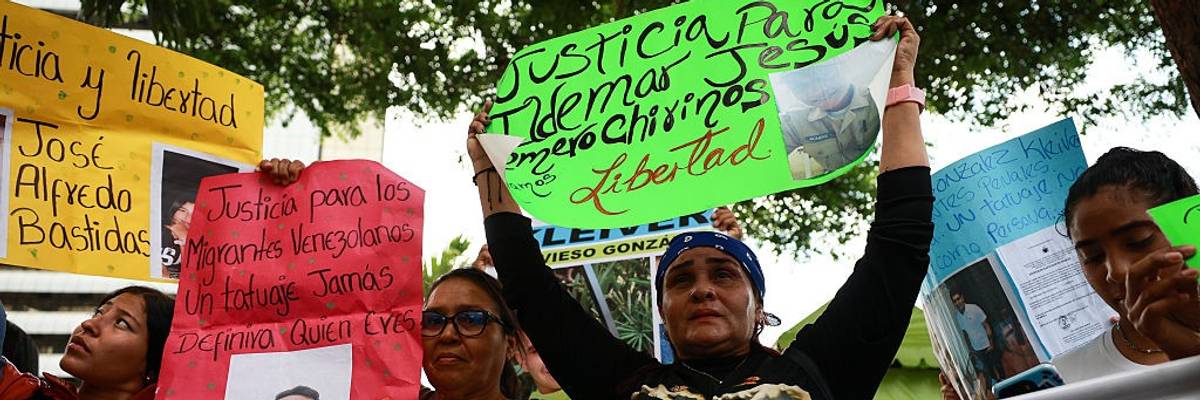
People in Caracas, Venezuela protest against the deportation of Venezuelans from the United States to a megaprison in El Salvador.
Citing other courts' decisions in the case of Kilmar Abrego Garcia, Judge Stephanie Gallagher stressed that "standing by and taking no action is not facilitation."
A federal judge appointed by U.S. President Donald Trump during his first term directed his second administration on Wednesday to facilitate the return of a 20-year-old Venezuelan deported to El Salvador in breach of a settlement agreement—as the government continues to defy a similar order to bring Kilmar Abrego Garcia home to Maryland.
Abrego Garcia, a Salvadoran native who was supposed to be protected from deportation by an immigration judge's order, and this man, identified in court filings with the pseudonym Cristian, are among hundreds of migrants whom the Trump administration sent to El Salvador last month to be imprisoned in a notorious gang prison called the Terrorism Confinement Center (CECOT).
As Maryland-based U.S. District Judge Stephanie Gallagher explained in her Wednesday opinion, Cristian was deported while waiting on his asylum case to be decided by United States Citizenship and Immigration Services (USCIS) following a legal fight that resulted in a settlement agreement approved last November.
In class action litigation launched in 2019, Gallagher detailed, a group of people who entered the U.S. as unaccompanied minors, including Cristian, "sought to enforce its members' rights to have their asylum applications adjudicated on the merits by USCIS while they remained physically present in the United States."
Trump has used the Alien Enemies Act of 1798 to fast-track the expulsion of alleged gang members—and, as Gallagher noted, his administration argued "that removal of Cristian did not violate the settlement agreement because 'his designation as an alien enemy pursuant to the AEA results in him ceasing to be a member' of the class."
However, the judge concluded that "allegations that class members, like Cristian, are subject to the AEA do not exclude those individuals from the class under the plain terms of the settlement agreement."
Gallagher further found that "under the plain terms of the settlement agreement and fundamental tenets of contract law, removal from the United States of a class member, including but not limited to Cristian, without a final determination on the merits by USCIS on the class member's pending asylum application violates the settlement agreement."
Thus, she wrote, "Cristian, and any other class member who has been removed in violation of the settlement agreement, must be returned to the United States to await adjudication of his asylum application on the merits by USCIS."
According to ABC News, which first reported on Gallagher's decision:
Counsel for the class of migrants also alleged in court filings that another Venezuelan man, identified as an 18-year-old named Javier in the court records, was in imminent danger of being deported earlier this month.
Judge Gallagher determined that Javier was covered by the settlement agreement and entered a temporary restraining order prohibiting the government from removing him from the United States.
Citing Abrego Garcia's legal battle—which is being handled by Maryland-based U.S. District Judge Paula Xinis, an appointee of former President Barack Obama—Gallagher acknowledged that her Wednesday decision regarding Cristain "puts this case squarely into the procedural morass that has been playing out very publicly, across many levels of the federal judiciary."
"Discovery is underway regarding the government's efforts to comply with court orders (including from the United States Supreme Court) to 'facilitate' Mr. Abrego Garcia's return to the United States," the judge continued. "This court is mindful of the Supreme Court's reminder to afford the 'deference owed to the executive branch in the conduct of foreign affairs.'"
"However, this court is also guided by, and fully agrees with, the definition of 'facilitate' espoused by Judge Xinis and the United States Court of Appeals for the 4th Circuit in Abrego Garcia," she stressed. "Standing by and taking no action is not facilitation."
Xinis on Wednesday postponed discovery in the Abrego Garcia case for a week, with the agreement of both his legal team and the government, following a sealed filing from the Trump administration earlier in the day.
Meanwhile, Abrego Garcia's wife and her three children—all U.S. citizens—have
moved to a safe house after multiple Trump administration social media accounts posted paperwork with their home address on X.
Dear Common Dreams reader, It’s been nearly 30 years since I co-founded Common Dreams with my late wife, Lina Newhouser. We had the radical notion that journalism should serve the public good, not corporate profits. It was clear to us from the outset what it would take to build such a project. No paid advertisements. No corporate sponsors. No millionaire publisher telling us what to think or do. Many people said we wouldn't last a year, but we proved those doubters wrong. Together with a tremendous team of journalists and dedicated staff, we built an independent media outlet free from the constraints of profits and corporate control. Our mission has always been simple: To inform. To inspire. To ignite change for the common good. Building Common Dreams was not easy. Our survival was never guaranteed. When you take on the most powerful forces—Wall Street greed, fossil fuel industry destruction, Big Tech lobbyists, and uber-rich oligarchs who have spent billions upon billions rigging the economy and democracy in their favor—the only bulwark you have is supporters who believe in your work. But here’s the urgent message from me today. It's never been this bad out there. And it's never been this hard to keep us going. At the very moment Common Dreams is most needed, the threats we face are intensifying. We need your support now more than ever. We don't accept corporate advertising and never will. We don't have a paywall because we don't think people should be blocked from critical news based on their ability to pay. Everything we do is funded by the donations of readers like you. When everyone does the little they can afford, we are strong. But if that support retreats or dries up, so do we. Will you donate now to make sure Common Dreams not only survives but thrives? —Craig Brown, Co-founder |
A federal judge appointed by U.S. President Donald Trump during his first term directed his second administration on Wednesday to facilitate the return of a 20-year-old Venezuelan deported to El Salvador in breach of a settlement agreement—as the government continues to defy a similar order to bring Kilmar Abrego Garcia home to Maryland.
Abrego Garcia, a Salvadoran native who was supposed to be protected from deportation by an immigration judge's order, and this man, identified in court filings with the pseudonym Cristian, are among hundreds of migrants whom the Trump administration sent to El Salvador last month to be imprisoned in a notorious gang prison called the Terrorism Confinement Center (CECOT).
As Maryland-based U.S. District Judge Stephanie Gallagher explained in her Wednesday opinion, Cristian was deported while waiting on his asylum case to be decided by United States Citizenship and Immigration Services (USCIS) following a legal fight that resulted in a settlement agreement approved last November.
In class action litigation launched in 2019, Gallagher detailed, a group of people who entered the U.S. as unaccompanied minors, including Cristian, "sought to enforce its members' rights to have their asylum applications adjudicated on the merits by USCIS while they remained physically present in the United States."
Trump has used the Alien Enemies Act of 1798 to fast-track the expulsion of alleged gang members—and, as Gallagher noted, his administration argued "that removal of Cristian did not violate the settlement agreement because 'his designation as an alien enemy pursuant to the AEA results in him ceasing to be a member' of the class."
However, the judge concluded that "allegations that class members, like Cristian, are subject to the AEA do not exclude those individuals from the class under the plain terms of the settlement agreement."
Gallagher further found that "under the plain terms of the settlement agreement and fundamental tenets of contract law, removal from the United States of a class member, including but not limited to Cristian, without a final determination on the merits by USCIS on the class member's pending asylum application violates the settlement agreement."
Thus, she wrote, "Cristian, and any other class member who has been removed in violation of the settlement agreement, must be returned to the United States to await adjudication of his asylum application on the merits by USCIS."
According to ABC News, which first reported on Gallagher's decision:
Counsel for the class of migrants also alleged in court filings that another Venezuelan man, identified as an 18-year-old named Javier in the court records, was in imminent danger of being deported earlier this month.
Judge Gallagher determined that Javier was covered by the settlement agreement and entered a temporary restraining order prohibiting the government from removing him from the United States.
Citing Abrego Garcia's legal battle—which is being handled by Maryland-based U.S. District Judge Paula Xinis, an appointee of former President Barack Obama—Gallagher acknowledged that her Wednesday decision regarding Cristain "puts this case squarely into the procedural morass that has been playing out very publicly, across many levels of the federal judiciary."
"Discovery is underway regarding the government's efforts to comply with court orders (including from the United States Supreme Court) to 'facilitate' Mr. Abrego Garcia's return to the United States," the judge continued. "This court is mindful of the Supreme Court's reminder to afford the 'deference owed to the executive branch in the conduct of foreign affairs.'"
"However, this court is also guided by, and fully agrees with, the definition of 'facilitate' espoused by Judge Xinis and the United States Court of Appeals for the 4th Circuit in Abrego Garcia," she stressed. "Standing by and taking no action is not facilitation."
Xinis on Wednesday postponed discovery in the Abrego Garcia case for a week, with the agreement of both his legal team and the government, following a sealed filing from the Trump administration earlier in the day.
Meanwhile, Abrego Garcia's wife and her three children—all U.S. citizens—have
moved to a safe house after multiple Trump administration social media accounts posted paperwork with their home address on X.
A federal judge appointed by U.S. President Donald Trump during his first term directed his second administration on Wednesday to facilitate the return of a 20-year-old Venezuelan deported to El Salvador in breach of a settlement agreement—as the government continues to defy a similar order to bring Kilmar Abrego Garcia home to Maryland.
Abrego Garcia, a Salvadoran native who was supposed to be protected from deportation by an immigration judge's order, and this man, identified in court filings with the pseudonym Cristian, are among hundreds of migrants whom the Trump administration sent to El Salvador last month to be imprisoned in a notorious gang prison called the Terrorism Confinement Center (CECOT).
As Maryland-based U.S. District Judge Stephanie Gallagher explained in her Wednesday opinion, Cristian was deported while waiting on his asylum case to be decided by United States Citizenship and Immigration Services (USCIS) following a legal fight that resulted in a settlement agreement approved last November.
In class action litigation launched in 2019, Gallagher detailed, a group of people who entered the U.S. as unaccompanied minors, including Cristian, "sought to enforce its members' rights to have their asylum applications adjudicated on the merits by USCIS while they remained physically present in the United States."
Trump has used the Alien Enemies Act of 1798 to fast-track the expulsion of alleged gang members—and, as Gallagher noted, his administration argued "that removal of Cristian did not violate the settlement agreement because 'his designation as an alien enemy pursuant to the AEA results in him ceasing to be a member' of the class."
However, the judge concluded that "allegations that class members, like Cristian, are subject to the AEA do not exclude those individuals from the class under the plain terms of the settlement agreement."
Gallagher further found that "under the plain terms of the settlement agreement and fundamental tenets of contract law, removal from the United States of a class member, including but not limited to Cristian, without a final determination on the merits by USCIS on the class member's pending asylum application violates the settlement agreement."
Thus, she wrote, "Cristian, and any other class member who has been removed in violation of the settlement agreement, must be returned to the United States to await adjudication of his asylum application on the merits by USCIS."
According to ABC News, which first reported on Gallagher's decision:
Counsel for the class of migrants also alleged in court filings that another Venezuelan man, identified as an 18-year-old named Javier in the court records, was in imminent danger of being deported earlier this month.
Judge Gallagher determined that Javier was covered by the settlement agreement and entered a temporary restraining order prohibiting the government from removing him from the United States.
Citing Abrego Garcia's legal battle—which is being handled by Maryland-based U.S. District Judge Paula Xinis, an appointee of former President Barack Obama—Gallagher acknowledged that her Wednesday decision regarding Cristain "puts this case squarely into the procedural morass that has been playing out very publicly, across many levels of the federal judiciary."
"Discovery is underway regarding the government's efforts to comply with court orders (including from the United States Supreme Court) to 'facilitate' Mr. Abrego Garcia's return to the United States," the judge continued. "This court is mindful of the Supreme Court's reminder to afford the 'deference owed to the executive branch in the conduct of foreign affairs.'"
"However, this court is also guided by, and fully agrees with, the definition of 'facilitate' espoused by Judge Xinis and the United States Court of Appeals for the 4th Circuit in Abrego Garcia," she stressed. "Standing by and taking no action is not facilitation."
Xinis on Wednesday postponed discovery in the Abrego Garcia case for a week, with the agreement of both his legal team and the government, following a sealed filing from the Trump administration earlier in the day.
Meanwhile, Abrego Garcia's wife and her three children—all U.S. citizens—have
moved to a safe house after multiple Trump administration social media accounts posted paperwork with their home address on X.