SUBSCRIBE TO OUR FREE NEWSLETTER
Daily news & progressive opinion—funded by the people, not the corporations—delivered straight to your inbox.
5
#000000
#FFFFFF
To donate by check, phone, or other method, see our More Ways to Give page.
Daily news & progressive opinion—funded by the people, not the corporations—delivered straight to your inbox.
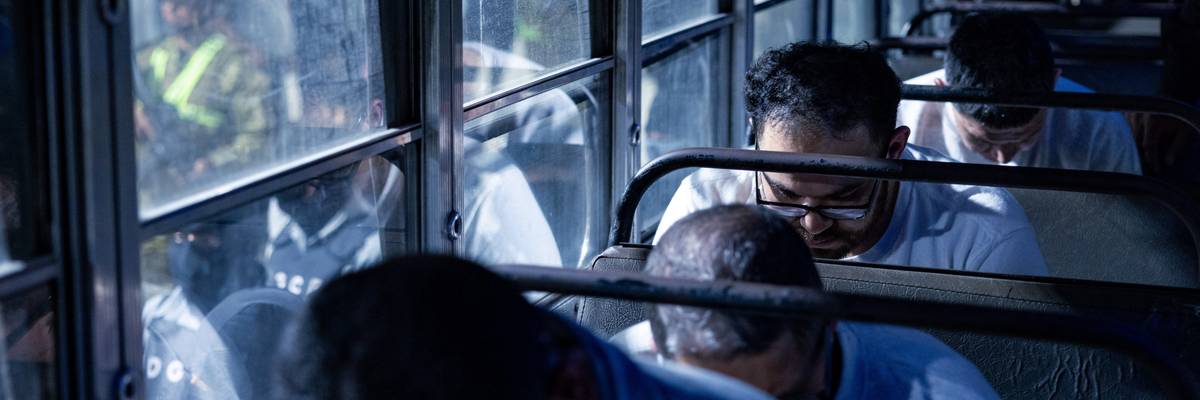
People who were sent to El Salvador by the Trump administration arrive in San Salvador on March 31, 2025.
"You may not deport a U.S. citizen, period," said one legal expert.
With a deadline looming for the Trump administration to return a Maryland resident to the U.S. after expelling him along with hundreds of other people to an El Salvador detention center under a shadowy deal with the Central American country, U.S. President Donald Trump on Sunday stunned observers by expressing a desire to send U.S. citizens into El Salvador's prison system.
In a press briefing aboard Air Force One Sunday evening, Trump was asked by a reporter about an offer made by Salvadoran President Nayib Bukele to accept prisoners sent by the U.S. from its federal prison population.
"I love that," Trump said. "If we could take some of our 20-time wise guys that push people into subways and hit people over the back of the head and purposely run people over in cars, if he would take them, I would be honored to give them."
"I don't know what the law says on that," he added. "I have suggested that, why should we stop at people who cross the border illegally?"
Podcaster and former Obama administration staffer Jon Favreau said Trump's remarks could be summed up as: "He wants to send American citizens to a foreign gulag."
Trump has invoked the Alien Enemies Act of 1798, which permits the U.S. government to detain and deport noncitizens during wartime, to expel 238 Venezuelan migrants to El Salvador, where they are being held in the country's Terrorism Confinement Center (CECOT). About two dozen people who were originally from El Salvador were also sent to the prison, including Kilmar Abrego Garcia—a Maryland man who had legal protected status, was not convicted of a crime, and had previously received a court order barring the U.S. from deporting him to his home country for fear of persecution and torture.
Trump said several times in his comments Sunday that he was unsure of the legality of sending U.S. federal prison inmates to a foreign prison system.
In February, after Bukele first offered to imprison U.S. citizens, Lee Gelernt of the ACLU told NPR that the idea was a "non-starter."
"You may not deport a U.S. citizen, period," Gelernt, deputy director of the group's Immigrants' Rights Project, told the outlet. "The courts have not allowed that, and they would not allow it... It would be blatantly unconstitutional to deport a U.S. citizen."
Secretary of State Marco Rubio also touted Bukele's offer at the time, calling it "an extraordinary gesture never before extended by any country."
Trump's remarks on potentially expanding his deal with the Salvadoran president to include U.S. citizens followed U.S. District Judge Paula Xinis's order mandating the return of Abrego Garcia to the U.S. with a deadline of 11:59 pm Monday.
Xinis on Sunday rejected the administration's request to lift the order, saying Abrego Garcia's expulsion had been "wholly lawless" and that the "risk of harm shocks the conscience."
On Monday, the administration asked the U.S. Supreme Court to block Xinis' order, saying her demand that the White House adhere to the Constitution was "district-court diplomacy" and accusing the judge of trying to "seize control over foreign relations."
The administration has attacked the district court in Washington, D.C. in recent days over the order, with homeland security adviser Stephen Miller calling on Congress last week to "step up" and abolish the panel by refusing to fund it.
The White House has called Abrego Garcia's expulsion and imprisonment in El Salvador an "administrative error" and claimed the Maryland father is no longer under U.S. jurisdiction, so the administration cannot order him to be returned.
"We suggest the judge contact President Bukele because we are unaware of the judge having jurisdiction or authority over the country of El Salvador," said White House Press Secretary Karoline Leavitt last week.
Washington Monthly contributor David Atkins said that under the same logic, "there is also nothing that prevents them from shipping American citizens to a gulag in El Salvador and saying, 'Nothing we can do.'"
Hope people understand the trajectory that we’re on: if the executive is arguing that it has no recourse once people here end up in a prison in El Salvador, then that’s the precedent for there being no recourse when this starts happening to United States citizens.
[image or embed]
— Alexander Ross (@alexander-ross.bsky.social) April 4, 2025 at 7:03 PM
As Trump expressed interest in expelling U.S. citizens to a foreign prison system, Aaron Reichlin-Melnick of the American Immigration Council pointed out that the details of the White House's deal with Bukele have not been publicly disclosed.
"We literally know nothing about it, other than we're paying them $6 million," said Reichlin-Melnick. "No law in the United States authorizes us to pay another country to imprison people. And yet! They're doing it."
Setareh Ghandehari, advocacy director for Detention Watch Network, told Newsweek Monday that the deal with Bukele is being used "as a tool of propaganda with the core objective to dehumanize and villainize people while carrying out their cruel mass detention and deportation agenda unchecked."
"Bottom line, Trump and Bukele's partnership deepens collaboration with authoritarian leaders," said Ghandehari, "further jeopardizing democratic values in the U.S. and around the world."
Dear Common Dreams reader, It’s been nearly 30 years since I co-founded Common Dreams with my late wife, Lina Newhouser. We had the radical notion that journalism should serve the public good, not corporate profits. It was clear to us from the outset what it would take to build such a project. No paid advertisements. No corporate sponsors. No millionaire publisher telling us what to think or do. Many people said we wouldn't last a year, but we proved those doubters wrong. Together with a tremendous team of journalists and dedicated staff, we built an independent media outlet free from the constraints of profits and corporate control. Our mission has always been simple: To inform. To inspire. To ignite change for the common good. Building Common Dreams was not easy. Our survival was never guaranteed. When you take on the most powerful forces—Wall Street greed, fossil fuel industry destruction, Big Tech lobbyists, and uber-rich oligarchs who have spent billions upon billions rigging the economy and democracy in their favor—the only bulwark you have is supporters who believe in your work. But here’s the urgent message from me today. It's never been this bad out there. And it's never been this hard to keep us going. At the very moment Common Dreams is most needed, the threats we face are intensifying. We need your support now more than ever. We don't accept corporate advertising and never will. We don't have a paywall because we don't think people should be blocked from critical news based on their ability to pay. Everything we do is funded by the donations of readers like you. When everyone does the little they can afford, we are strong. But if that support retreats or dries up, so do we. Will you donate now to make sure Common Dreams not only survives but thrives? —Craig Brown, Co-founder |
With a deadline looming for the Trump administration to return a Maryland resident to the U.S. after expelling him along with hundreds of other people to an El Salvador detention center under a shadowy deal with the Central American country, U.S. President Donald Trump on Sunday stunned observers by expressing a desire to send U.S. citizens into El Salvador's prison system.
In a press briefing aboard Air Force One Sunday evening, Trump was asked by a reporter about an offer made by Salvadoran President Nayib Bukele to accept prisoners sent by the U.S. from its federal prison population.
"I love that," Trump said. "If we could take some of our 20-time wise guys that push people into subways and hit people over the back of the head and purposely run people over in cars, if he would take them, I would be honored to give them."
"I don't know what the law says on that," he added. "I have suggested that, why should we stop at people who cross the border illegally?"
Podcaster and former Obama administration staffer Jon Favreau said Trump's remarks could be summed up as: "He wants to send American citizens to a foreign gulag."
Trump has invoked the Alien Enemies Act of 1798, which permits the U.S. government to detain and deport noncitizens during wartime, to expel 238 Venezuelan migrants to El Salvador, where they are being held in the country's Terrorism Confinement Center (CECOT). About two dozen people who were originally from El Salvador were also sent to the prison, including Kilmar Abrego Garcia—a Maryland man who had legal protected status, was not convicted of a crime, and had previously received a court order barring the U.S. from deporting him to his home country for fear of persecution and torture.
Trump said several times in his comments Sunday that he was unsure of the legality of sending U.S. federal prison inmates to a foreign prison system.
In February, after Bukele first offered to imprison U.S. citizens, Lee Gelernt of the ACLU told NPR that the idea was a "non-starter."
"You may not deport a U.S. citizen, period," Gelernt, deputy director of the group's Immigrants' Rights Project, told the outlet. "The courts have not allowed that, and they would not allow it... It would be blatantly unconstitutional to deport a U.S. citizen."
Secretary of State Marco Rubio also touted Bukele's offer at the time, calling it "an extraordinary gesture never before extended by any country."
Trump's remarks on potentially expanding his deal with the Salvadoran president to include U.S. citizens followed U.S. District Judge Paula Xinis's order mandating the return of Abrego Garcia to the U.S. with a deadline of 11:59 pm Monday.
Xinis on Sunday rejected the administration's request to lift the order, saying Abrego Garcia's expulsion had been "wholly lawless" and that the "risk of harm shocks the conscience."
On Monday, the administration asked the U.S. Supreme Court to block Xinis' order, saying her demand that the White House adhere to the Constitution was "district-court diplomacy" and accusing the judge of trying to "seize control over foreign relations."
The administration has attacked the district court in Washington, D.C. in recent days over the order, with homeland security adviser Stephen Miller calling on Congress last week to "step up" and abolish the panel by refusing to fund it.
The White House has called Abrego Garcia's expulsion and imprisonment in El Salvador an "administrative error" and claimed the Maryland father is no longer under U.S. jurisdiction, so the administration cannot order him to be returned.
"We suggest the judge contact President Bukele because we are unaware of the judge having jurisdiction or authority over the country of El Salvador," said White House Press Secretary Karoline Leavitt last week.
Washington Monthly contributor David Atkins said that under the same logic, "there is also nothing that prevents them from shipping American citizens to a gulag in El Salvador and saying, 'Nothing we can do.'"
Hope people understand the trajectory that we’re on: if the executive is arguing that it has no recourse once people here end up in a prison in El Salvador, then that’s the precedent for there being no recourse when this starts happening to United States citizens.
[image or embed]
— Alexander Ross (@alexander-ross.bsky.social) April 4, 2025 at 7:03 PM
As Trump expressed interest in expelling U.S. citizens to a foreign prison system, Aaron Reichlin-Melnick of the American Immigration Council pointed out that the details of the White House's deal with Bukele have not been publicly disclosed.
"We literally know nothing about it, other than we're paying them $6 million," said Reichlin-Melnick. "No law in the United States authorizes us to pay another country to imprison people. And yet! They're doing it."
Setareh Ghandehari, advocacy director for Detention Watch Network, told Newsweek Monday that the deal with Bukele is being used "as a tool of propaganda with the core objective to dehumanize and villainize people while carrying out their cruel mass detention and deportation agenda unchecked."
"Bottom line, Trump and Bukele's partnership deepens collaboration with authoritarian leaders," said Ghandehari, "further jeopardizing democratic values in the U.S. and around the world."
With a deadline looming for the Trump administration to return a Maryland resident to the U.S. after expelling him along with hundreds of other people to an El Salvador detention center under a shadowy deal with the Central American country, U.S. President Donald Trump on Sunday stunned observers by expressing a desire to send U.S. citizens into El Salvador's prison system.
In a press briefing aboard Air Force One Sunday evening, Trump was asked by a reporter about an offer made by Salvadoran President Nayib Bukele to accept prisoners sent by the U.S. from its federal prison population.
"I love that," Trump said. "If we could take some of our 20-time wise guys that push people into subways and hit people over the back of the head and purposely run people over in cars, if he would take them, I would be honored to give them."
"I don't know what the law says on that," he added. "I have suggested that, why should we stop at people who cross the border illegally?"
Podcaster and former Obama administration staffer Jon Favreau said Trump's remarks could be summed up as: "He wants to send American citizens to a foreign gulag."
Trump has invoked the Alien Enemies Act of 1798, which permits the U.S. government to detain and deport noncitizens during wartime, to expel 238 Venezuelan migrants to El Salvador, where they are being held in the country's Terrorism Confinement Center (CECOT). About two dozen people who were originally from El Salvador were also sent to the prison, including Kilmar Abrego Garcia—a Maryland man who had legal protected status, was not convicted of a crime, and had previously received a court order barring the U.S. from deporting him to his home country for fear of persecution and torture.
Trump said several times in his comments Sunday that he was unsure of the legality of sending U.S. federal prison inmates to a foreign prison system.
In February, after Bukele first offered to imprison U.S. citizens, Lee Gelernt of the ACLU told NPR that the idea was a "non-starter."
"You may not deport a U.S. citizen, period," Gelernt, deputy director of the group's Immigrants' Rights Project, told the outlet. "The courts have not allowed that, and they would not allow it... It would be blatantly unconstitutional to deport a U.S. citizen."
Secretary of State Marco Rubio also touted Bukele's offer at the time, calling it "an extraordinary gesture never before extended by any country."
Trump's remarks on potentially expanding his deal with the Salvadoran president to include U.S. citizens followed U.S. District Judge Paula Xinis's order mandating the return of Abrego Garcia to the U.S. with a deadline of 11:59 pm Monday.
Xinis on Sunday rejected the administration's request to lift the order, saying Abrego Garcia's expulsion had been "wholly lawless" and that the "risk of harm shocks the conscience."
On Monday, the administration asked the U.S. Supreme Court to block Xinis' order, saying her demand that the White House adhere to the Constitution was "district-court diplomacy" and accusing the judge of trying to "seize control over foreign relations."
The administration has attacked the district court in Washington, D.C. in recent days over the order, with homeland security adviser Stephen Miller calling on Congress last week to "step up" and abolish the panel by refusing to fund it.
The White House has called Abrego Garcia's expulsion and imprisonment in El Salvador an "administrative error" and claimed the Maryland father is no longer under U.S. jurisdiction, so the administration cannot order him to be returned.
"We suggest the judge contact President Bukele because we are unaware of the judge having jurisdiction or authority over the country of El Salvador," said White House Press Secretary Karoline Leavitt last week.
Washington Monthly contributor David Atkins said that under the same logic, "there is also nothing that prevents them from shipping American citizens to a gulag in El Salvador and saying, 'Nothing we can do.'"
Hope people understand the trajectory that we’re on: if the executive is arguing that it has no recourse once people here end up in a prison in El Salvador, then that’s the precedent for there being no recourse when this starts happening to United States citizens.
[image or embed]
— Alexander Ross (@alexander-ross.bsky.social) April 4, 2025 at 7:03 PM
As Trump expressed interest in expelling U.S. citizens to a foreign prison system, Aaron Reichlin-Melnick of the American Immigration Council pointed out that the details of the White House's deal with Bukele have not been publicly disclosed.
"We literally know nothing about it, other than we're paying them $6 million," said Reichlin-Melnick. "No law in the United States authorizes us to pay another country to imprison people. And yet! They're doing it."
Setareh Ghandehari, advocacy director for Detention Watch Network, told Newsweek Monday that the deal with Bukele is being used "as a tool of propaganda with the core objective to dehumanize and villainize people while carrying out their cruel mass detention and deportation agenda unchecked."
"Bottom line, Trump and Bukele's partnership deepens collaboration with authoritarian leaders," said Ghandehari, "further jeopardizing democratic values in the U.S. and around the world."