

SUBSCRIBE TO OUR FREE NEWSLETTER
Daily news & progressive opinion—funded by the people, not the corporations—delivered straight to your inbox.
5
#000000
#FFFFFF
To donate by check, phone, or other method, see our More Ways to Give page.
Daily news & progressive opinion—funded by the people, not the corporations—delivered straight to your inbox.

“Hiding the consumer narratives and concealing the wrongdoing of corporations and powerful interests—that’s what you do if you’re afraid of the truth,” said one advocate.
Consumer complaints against financial companies have skyrocketed over the past three years, and the trend drove President Donald Trump's Consumer Financial Protection Bureau to take action Friday—but not against the firms that have been accused of charging unfair fees, failing to resolve disputed credit card charges, attempting to wrongly collect debts, and other offenses.
Instead, the CFPB announced that it would no longer be publishing complaint "narratives"—the written description by a complainant of their interaction with the financial company—or data visualizations in the database of complaints, hiding from public view consumers' remarks on the institutions' business practices.
“Hiding the consumer narratives and concealing the wrongdoing of corporations and powerful interests—that’s what you do if you’re afraid of the truth,” said Diane Thompson, deputy director and chief advocacy officer at the National Consumer Law Center, in response to the bureau's announcement. “Nothing could be a clearer sign of the Trump CFPB’s choice to stand against ordinary people and for corporate power and predation.”
The CFPB asserted that "the utility" of the public database of complaint narratives has proven "minimal" since the bureau began publishing the complaints in 2015, four years after it began allowing consumers to submit the complaints, as required by law.
"By their very nature, complaint narratives reflect negative consumer experiences and present only one side of an issue," said the CFPB.
Christine Hines, senior policy director at the National Association of Consumer Advocates, suggested that presenting "only one side" of an interaction that a consumer has with a financial institution is the point of the database.
"Nearly 6 million consumers who have filed with the CFPB have received some kind of relief, such as getting money back or getting a mistake on a credit report fixed. That’s a real, tangible benefit the public database makes possible."
“As it shuts down narratives in the complaint database, this CFPB is disregarding its obligation to make the marketplace fair and transparent for everyday consumers, and instead, is helping big banks, lenders, debt collectors, credit bureaus, and others to evade public scrutiny and accountability,” said Hines.
Companies have 15 days to respond to a complaint before the CFPB makes the consumers' comments public. The bureau has published more than 17 million complaints that have been made since 2011, and in each of the last three years, the complaints have doubled annually.
The bureau received 6.6. million complaints in 2025, up from 3.2 million in 2024 and 1.6 million in 2023.
Erie Meyer, who served as chief technologist at the CFPB and helped build the complaint database, accused the Trump administration of "inventing excuses to hide credit reporting and Wall Street abuses from the public."
"More than 17 million people have filed complaints with the CFPB about their credit report, mortgage provider, student loan servicer, payment app, or bank account—and the CFPB in turn has worked diligently to resolve these problems, even saving people’s homes from foreclosure and cars from repossession," said Meyer. "Taking down this data doesn’t protect consumers from confusion, but it does protect companies from public transparency and scrutiny."
Meyer also pushed back against the administration's claim that the database is rife with "confusing or misleading information" submitted by complainants.
"The CFPB complaint database and its narratives are the earliest warning system we have for what’s breaking in the economy," said Meyer. "Before a single story is published, the CFPB confirms the person is a real customer of that company. The company gets two weeks to respond, on the record, in public. That’s not an anonymous internet review—that’s closer to due process than most Americans get anywhere else in their financial lives. Burying this information is an intentional decision to make corporate misconduct harder to see.”
The new rule was announced two months after former CFPB acting Director Russell Vought purged the bureau's backlog of complaints and made other changes that, the administration said, were aimed at eliminating artificial intelligence-generated and duplicative complaints.
The database, said Public Interest Research Network consumer campaign director Mike Litt, ensures that "companies have an incentive to respond to and fix problems precisely because complaints are made public."
“Hiding the ‘narratives’ or any other part of the CFPB’s Consumer Complaint Database would truly hurt consumers. Americans deserve user-friendly, searchable access to details about these issues, so they can make educated purchasing decisions," said Litt. "Nearly 6 million consumers who have filed with the CFPB have received some kind of relief, such as getting money back or getting a mistake on a credit report fixed. That’s a real, tangible benefit the public database makes possible."
Adam Rust, director of financial services at the Consumer Federation of America, added that law enforcement agencies, Congress, and the press have all been informed by complaint narratives "on what problems are occurring in their communities."
“These narratives, all published with consumer consent, convey the emotional hurt caused when companies act without regard for the law," said Rust. "It’s wrong, especially at a time when so many people are struggling to make ends meet, to blunt their voices.”
"The gridlock and partisanship we see in Washington, DC can be dispiriting. But history shows that states can build momentum that eventually leads to change at the federal level."
Even as President Donald Trump and his administration have been ripping up environmental and consumer protection regulations, a number of state laws are set to take effect next year that could at least mitigate some of the damage.
A Monday statement from Environment America and the Public Interest Network highlighted a number of new laws aimed at curbing corporate polluters and enhancing consumer welfare.
First, the groups highlighted "Right to Repair" laws set to take effect in Washington, Nevada, Oregon, and Colorado, which give people the right to repair their own appliances and electronics without burdensome costs or barriers.
The groups lavished particular praise on Colorado's "Right to Repair" laws that they said provide "the broadest repair protections in the country," with new regulations that will give businesses in the state "access to what they and independent repair providers need to fix their electronics themselves."
Illinois, meanwhile, will fully phase out the sale of fluorescent lightbulbs, which will be replaced by energy-efficient LED bulbs. The groups estimate that eliminating the fluorescent bulbs will collectively save Illinois households more than $1.5 billion on their utility bills by 2050, while also reducing energy waste and mercury pollution.
Illinois also drew praise for enacting a ban on polystyrene foam foodware that will take effect on January 1.
The groups also highlighted the work being done in Oregon to protect consumers with legislation mandating price transparency to eliminate surprise junk fees on purchases; prohibiting ambulance companies from socking out-of-network patients with massive fees for rides to nearby hospitals; and placing new restrictions on the ability of medical debt to negatively impact a person's credit score.
California also got a mention in the groups' release for closing a loophole that allowed supermarkets to continue using plastic bags and for creating a new privacy tool for consumers allowing them to request that online data brokers delete all of the personal information they have gathered on them over the years.
Emily Rusch, vice president and senior director of state offices for the Public Interest Network, contrasted the action being taken in the states to protect consumers and the environment with a lack of action being done at the federal level.
"The gridlock and partisanship we see in Washington, DC can be dispiriting," said Rusch. "But history shows that states can build momentum that eventually leads to change at the federal level. As we build on this progress in 2026, we look forward to working with anyone—Republican, Democrat, or independent—with whom we can find common ground."
"The billions begin to add up. This is, more or less, how the states slowly and then quite rapidly took down the tobacco industry," said climate leader Bill McKibben.
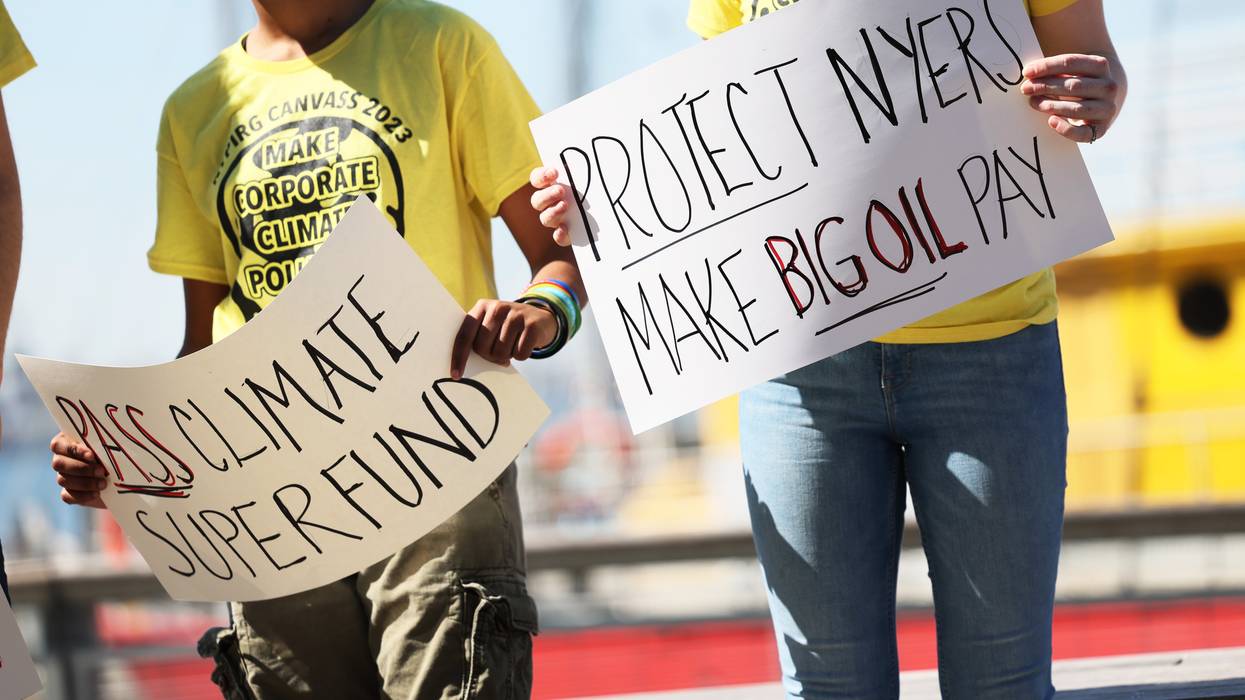
Climate advocates in New York on Thursday celebrated a "massive win" for working people, youth, and the climate as Democratic Gov. Kathy Hochul made the state the second to pass a law to make fossil fuel giants financially responsible for the environmental damages they cause.
Hochul signed the Climate Change Superfund Act into law after years of advocacy, delivering what Blair Horner, executive director of the New York Public Interest Research Group (NYPIRG), called "a welcome holiday gift for New York taxpayers."
The law is modeled on the 1980 State and Federal Superfund law, which requires corporations to fund the cleanup of toxic waste that they cause, and will require the largest fossil fuel companies, which are responsible for a majority of carbon emissions since the beginning of this century, to pay about $3 billion per year for 25 years.
The money—which otherwise would have to be paid by taxpayers, many of whom are already suffering from the extreme weather caused by fossil fuel emissions—will be used to restore and safeguard wetlands, upgrade public infrastructure, improve storm water drainage systems, and pay for climate disaster recovery efforts.
The law will "reinvest $75 billion into the communities most impacted by toxic air pollution, record-breaking storms, and dangerous heatwaves," said Theodore Moore, executive director of the Alliance for a Greater New York.
Lee Wasserman, director of the Rockefeller Family Fund, which lobbied for the new law, told The New York Times that "nothing could be fairer than making climate polluters pay."
New York state Sen. Liz Krueger (D-28), who sponsored the legislation, told the Times that repairs from extreme weather disasters and climate adaptation is projected to cost half a trillion dollars in New York by 2050.
"That's over $65,000 per household, and that's on top of the disruption, injury, and death that the climate crisis is causing in every corner of our state," Krueger said.
State Rep. Phara Souffrant Forrest (D-57) said the new law adopts a "they broke it, they bought it" approach for climate disasters and fossil fuel emissions.
New York taxpayers learned in 2024 that they would be funding $2.2 billion in climate-related infrastructure repairs and upgrades, and the U.S. Army Corps of Engineers estimates $52 billion would be needed to protect New York Harbor.
"On top of that, we’ll need $75-100 billion to protect Long Island, and $55 billion for climate costs across the rest of the state," said NYPIRG. "The state comptroller has predicted that more than half of local governments' costs will be attributable to the climate crisis."
Looking at the industry and its $1 trillion in profits over the last four years, one would never know that the emissions of the world's largest polluting corporations have helped rack up $5.4 trillion in climate damages over the last 26 years.
"Our future is on fire, New York is on fire, and meanwhile the fossil fuel industry is bringing in trillions of dollars in profit year after year," said Keanu Arpels-Josiah, organizer for Fridays for Future NYC. "It's high time for them to pay their fair share in New York. The signing of the full Climate Superfund Act, as youth across the state have advocated for year after year, is a critical step toward that—let this be the beginning of a shift on climate from this governor."
NYPIRG emphasized that the costs will not fall back on consumers.
"According to experts, because Big Oil's payments would reflect past contributions to greenhouse gas emissions, oil companies would have to treat their payments as one-time fixed costs," said the group.
New York is the second state to pass a law ensuring big polluters will play for climate damages. Vermont passed a similar law over the summer—a year after a federal emergency was declared across the state after a storm dumped two months' worth of rain in just two days, causing historic and devastating flooding.
Jamie Henn, director of Fossil Free Media, said the Climate Change Superfund Act "kicks open the door for more states to follow."
Similar legislation has been proposed in states including Maryland and New Jersey.
Krueger told The Wall Street Journal earlier this year that she would "prefer this all be done at the federal level," but as author and 350.org co-founder Bill McKibben wrote Thursday, Hochul's signing of the Climate Change Superfund Act answers the question: "How do we proceed with the most important fight in the world, when the most important office in the world is about to be filled by a climate denier, and when there's a Congress with no hope of advancing serious legislation?"
"One important answer is: We go state by state, and city by city, making gains everywhere we still can," said McKibben, less than a month before President-elect Donald Trump's inauguration.
"And now those other states may join in too. The billions begin to add up. This is, more or less, how the states slowly and then quite rapidly took down the tobacco industry," he wrote. "So—many many thanks to the people who but their bodies on the line these past days, and those who have worked so hard for years to get us here. This may be what progress looks like in the Trump years."
Calling the vote "disappointing," one campaigner warned: "Nuclear is, at best, a waste of resources. At worst, it's a meltdown."
Just U.S. Sens. Ed Markey and Bernie Sanders on Tuesday voted against legislation that one scientist warned this week "will only increase the danger to people already living downwind" of nuclear power facilities.
The Fire Grants and Safety Act—which now includes provisions from the Accelerating Deployment of Versatile, Advanced Nuclear for Clean Energy (ADVANCE) Act—passed 88-2, with six Republicans, three Democrats, and one Independent not voting.
Speaking on the upper chamber's floor Tuesday, Markey (D-Mass.)—who chairs the Senate Environment and Public Works Subcommittee on Clean Air, Climate, and Nuclear Safety—stressed his support for the United States Fire Administration and firefighter assistance grant programs, and those working to keep U.S. communities safe.
"Unfortunately, the vote today is not just for the lifesaving programs that I am staunchly on record as supporting," he explained. "On the coattails of this noncontroversial bill to protect our heroes, our colleagues in the House tacked on a dangerous additional 90-page package of provisions that merged the Senate's ADVANCE Act and the House's Atomic Energy Advancement Act."
The legislation—now on its way to President Joe Biden's desk—puts "corporate profits over community cleanup," the senator said. "Notably, the provisions from the Senate bill that would have provided a much-needed $225 million for communities affected by nuclear closures and $100 million to clean up contaminated tribal communities are not in the legislation anymore, as it came back from the House of Representatives—but the provisions to prop up the nuclear industry, they remain."
Highlighting that the bill would, among other things, require the Nuclear Regulatory Commission to rewrite its mission statement to say that its regulation and oversight should "not unnecessarily limit... civilian use of radioactive materials and deployment of nuclear energy," Markey declared that the NRC "shouldn't be the Nuclear Retail Commission."
"We have a duty to set the strongest possible standards for domestic and international nuclear activities, as an example to the rest of the world," he said of the United States. "We also have to clean up our existing messes, particularly in tribal and environmental justice communities, before investing in anything that might make those messes worse. As a result, despite my strong and continued support for the fire safety grants and my respect for my colleagues working on this issue, I must vote no."
"It's disappointing that the Senate chose to promote nuclear power when America is flush with energy options that are better for people and the planet."
Praising Markey and Sanders (I-Vt.), Beyond Nuclear on Wednesday urged the bill's critics to call their offices "to thank them for their courageous, wise, and good NO votes, despite it all," adding that "they spoke truth to power, and have kept some glimmer of hope alive, despite this very dark moment in the cause of anti-nuclear, environmental, and environmental justice activism."
The Senate's approval of the legislation was celebrated by the nuclear industry and its advocates. Environment America noted that in addition to the NRC mission statement rewrite, the bill "promotes nuclear power, including small modular reactors (SMRs) and highly concentrated nuclear fuel, and the export of nuclear materials and technology."
Johanna Neumann, senior director of the group's Campaign for 100% Renewable Energy, said after the vote, "It's disappointing that the Senate chose to promote nuclear power when America is flush with energy options that are better for people and the planet."
"Nuclear is, at best, a waste of resources. At worst, it's a meltdown," she continued. "Why are we choosing to split atoms when it's cheaper, faster, and better for the environment to cut energy waste and power our lives with wind and solar?"
"Government officials should embrace energy efficiency and renewables as the best solutions to America's challenges," she added.
Isaac Bowers, federal legislative director of Public Interest Research Group, similarly said that "American consumers have better energy options than nuclear power. It makes no sense to perpetuate this expensive, risky industry when America has an abundance of cleaner, safer, and more affordable renewable energy sources."
Critics also spoke out ahead of the vote. Union of Concerned Scientists director of nuclear power safety Edwin Lyman warned Monday that the aim of this bill is "weakening safety and security oversight across the board, a long-standing industry goal," and "a compromised NRC could lead to a catastrophic reactor meltdown impacting an entire region for a generation."
Food & Water Watch executive director Wenonah Hauter said last week that "every dollar wasted on unproven, enormously expensive nuclear energy schemes is a dollar not invested in truly clean, safe, and increasingly efficient wind and solar power. The Senate and President Biden must quickly come to their senses and reject the dangerous and unaffordable false promises of toxic nuclear energy."
While most senators made their positions on the bill clear on Tuesday, Beyond Nuclear is encouraging voters who still oppose the legislation "to express your displeasure and disagreement" to senators who supported it or didn't bother to vote.
Beyond Nuclear is also urging the bill's opponents to contact the White House, to pressure Biden to block it. "In the unlikely event" that he does so, the group acknowledged, "we would have a very tall mountain to climb to prevent Congress from overriding the presidential veto."
"Gov. Hochul, fresh off a spineless congestion pricing reversal that scandalized New Yorkers, needs to get back to work and make this landmark legislation the law of the land," said one campaigner.
After what New Yorkers and environmental campaigners called a "betrayal" by Gov. Kathy Hochul earlier this week, the Democrat is now under pressure to sign the Climate Change Superfund Act, which state legislators finally passed early Saturday morning.
Noting that the 95-46 New York State Assembly vote happened after 3:00am and followed the Senate passing the bill, Empire State Indivisible declared Saturday that "there can be no further delay! Gov. Kathy Hochul must sign the climate superfund into law IMMEDIATELY so NYS' worst and wealthiest polluters pay for the harm they've caused our communities!"
New York Public Interest Research Group (NYPIRG) similarly celebrated the passage of the bill, which—if signed by the governor—will force establish a 25-year fund financed by fossil fuel companies, with a third of the $3 billion in annual funding reserved for disadvantaged communities disproportionately affected by the climate emergency.
"The historic legislative approval of the Climate Change Superfund Act," NYPIRG said, "is a huge step toward ensuring that Big Oil contributes to the mounting costs of climate catastrophe. Of course, the bill cannot become law without Gov. Hochul's approval, but the act helps protect taxpayers and allows revenues to be made available to contribute toward necessary—but expensive—resiliency projects."
"The sponsors and the supportive lawmakers in both the Senate and Assembly deserve credit for making sure that Big Oil adheres to the lesson that we all learned as kids, 'you make a mess, you clean it up,'" the group added.
"It's time to make polluters pay, and it's time Gov. Hochul acted as the climate leader she promised the Pope she would be."
Food & Water Watch senior New York organizer Eric Weltman also welcomed the vote, saying that "the Climate Change Superfund Act is the legislation New Yorkers need right now. We applaud the Assembly for coming to their senses in the final hours of the legislative session and passing this critical bill. Now, Gov. Hochul, fresh off a spineless congestion pricing reversal that scandalized New Yorkers, needs to get back to work and make this landmark legislation the law of the land."
As Common Dreams reported Thursday, Hochul faced intense criticism this week for reversing her support for a first-in-the-nation congestion pricing plan and halting its implementation in New York City, jeopardizing not only expected emissions cuts but also much-needed funding for the Metropolitan Transportation Authority.
Weltman asserted that "it's time to make polluters pay, and it's time Gov. Hochul acted as the climate leader she promised the Pope she would be. Hochul desperately needs to look good—signing this legislation is the perfect opportunity to do something right for a change."
Other campaigners and New Yorkers also noted the governor's recent move. After highlighting some "huge victories for workers," ALIGN executive director Theodore A. Moore said that "at the eleventh hour, the Assembly also passed the Climate Superfund Act, joining the ever-growing chorus of New Yorkers saying enough is enough, and placing the burden of rising climate costs on Big Oil and corporate polluters, not just working families."
"But one 'environmental thing' a year won't meet the climate crisis at the speed it's racing past us, especially when long-fought wins like congestion pricing can be demolished in an instant," Moore stressed. "Without aggressively transitioning New York off of fossil fuels and creating the green jobs of the future, the Legislature calls it quits on our state's survival."
After the congestion pricing decision, author and activist Bill McKibben, who founded Third Act, wrote that "if any possible good could come from Hochul's cold-blooded betrayal, it's that she, and Albany Democrats in general, might feel the need to give environmentalists some kind of win."
The New York Home Energy Affordable Transition (NY HEAT) Act, "and the climate superfund bill, are both up for action in this final week of the legislative session," McKibben noted earlier this week. "It would be scant comfort to see them passed in the wake of this shocking schism, but it would be something."
While supporters of the Climate Change Superfund Act are now hopeful that Hochul will sign it—and make her state the second, after Vermont, to enact such legislation—they also expressed disappointment that other bills weren't passed this session, particularly Senate-approved NY HEAT Act, which aims to limit reliance on gas.
"With Gov. Hochul dropping a major bomb on climate action by delaying congestion pricing, the Assembly failed to rise to the occasion to pass the key climate policy New Yorkers need to cut energy bills and ensure the state is on track to meet our climate goal—the NY HEAT Act," said Liz Moran, New York policy advocate for Earthjustice.
"With utilities already proposing to raise already high bills rising due to our reliance upon gas infrastructure, and one year after we saw orange skies, the Assembly has turned their backs on the policy solution," she continued. "The same body that once championed our nation-leading climate law has now earned a reputation as the body holding back the policies New York needs to meet what is laid out in this law."
The Renewable Heat Now also decried the Assembly's "astonishing failure" to pass the bill. Jessica Azulay, executive director of Alliance for a Green Economy, which is part of the campaign, emphasized that "the NY HEAT Act would have been a lifeline for New Yorkers struggling with high energy costs and facing the devastating impacts of the climate emergency."
"Our leaders in Albany—the state Assembly first and foremost—have once again shown where they stand by refusing to implement the state's landmark climate law and enable a strategic and cost-effective transition away from fossil fuels in buildings," Azulay said. "Their blockage of this bill for three years in a row is a shameful abdication of their duty to serve the people they represent. We will not forget this failure as we struggle with utility shutoffs, high temperatures, and bad air this summer."
Along with also expressing support for the NY HEAT Act, which "would help save ratepayer dollars and curtail the expansion of the state's reliance on fossil fuels," NYPIRG noted that "the state's worsening solid waste disposal problem was not addressed and both the Packaging Reduction and Recycling Infrastructure Act and the Bigger, Better, Bottle Bill are two important components toward reducing trash that is filling up the state's landfills."
"We urge action on those issues," the group said, "and we urge Gov. Hochul to approve the Climate Change Superfund Act."

"Oregon becomes the first state to ban 'parts pairing,' which let companies like Apple decide when and how you replace parts."
In a move that advocates said will save Oregon residents money while supporting small businesses and reducing waste of electronic devices, Democratic Gov. Tina Kotek on Wednesday signed the Right to Repair Act, a law that passed earlier this month despite Apple's lobbying efforts.
The Public Interest Research Group (PIRG), applauded the signing of the bill, which requires manufacturers to provide Oregonians and small repair businesses with access to the parts, tools, and information needed to fix personal electronics and household appliances.
Manufacturers like Apple frequently require consumers to go to their stores or authorized service providers for repairs, making them expensive for customers and difficult to access for people who live far from the providers.
Charlie Fisher, state director of Oregon PIRG, said the law means Oregon is "moving forward on an innovation even more critical than a new gadget: the right to fix our electronic devices."
"By eliminating manufacturer restrictions, the right to repair will make it easier for Oregonians to keep their personal electronics running," said Fisher. "That will conserve precious natural resources and prevent waste. It's a refreshing alternative to a 'throwaway' system that treats everything as disposable."
The Right to Repair Act, which will go into effect on January 1, 2025, was supported by roughly 100 small businesses that provide repairs across the state, as well as recycling nonprofit organizations.
Apple testified against the bill, saying it opposed a provision against "parts pairing." The practice requires consumers or independent repair businesses to purchase parts from Apple and have them validated by the company.
John Perry, a senior security manager at Apple, told state senators that the provision would "undermine the security, safety, and privacy of Oregonians by forcing device manufacturers to allow the use of parts of unknown origin and consumer devices."
State Rep. Courtney Neron (D-26) cited a letter from the Federal Trade Commission when she told her colleagues that Apple's parts paring requirements "drive up the price that consumers must pay to fix a device and cause consumers to purchase a new device before the end of its useful life."
"Manufacturer repair restrictions also make it more challenging for small repair businesses to compete and contribute to unnecessary e-waste," she said.
Pro-labor media organization More Perfect Union called Kotek's signing of the bill "a major loss for Apple."
"Oregon has a proud history of passing forward thinking policies that help Oregonians steward and respect the resources that go into making the products we use everyday," said Celeste Meiffren-Swango, state director of Environment Oregon, "and we are building on that legacy with the Right to Repair Act."