5
#000000
#FFFFFF
To donate by check, phone, or other method, see our More Ways to Give page.
Daily news & progressive opinion—funded by the people, not the corporations—delivered straight to your inbox.

People wait in line to receive food aid during the Covid-19 pandemic, in Madrid, Spain on January 29, 2021.
"A world without hunger is possible," said one United Nations agency leader. "What we are missing is the investments and political will to implement solutions at scale."
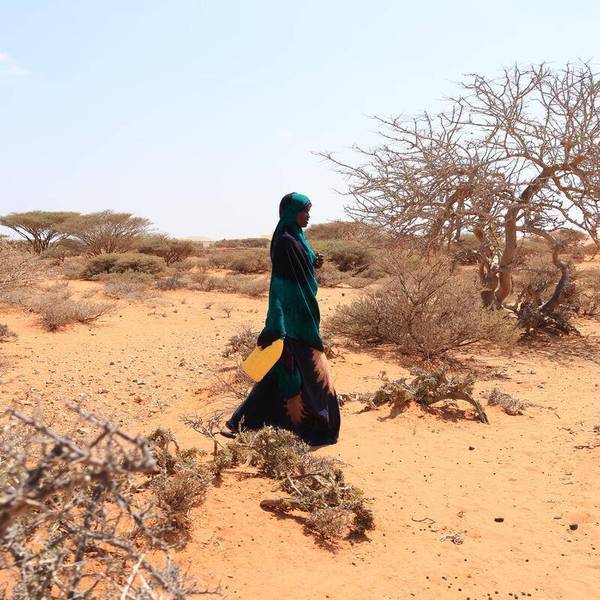
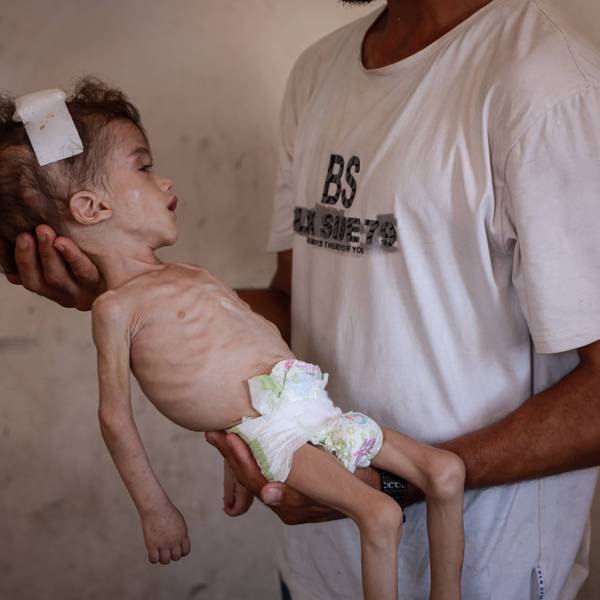
The climate emergency, armed conflicts, and the Covid-19 pandemic have pushed over 100 million more people into hunger around the world during the past few years, five United Nations agencies revealed Wednesday in an annual report.
The latest State of Food Security and Nutrition in the World report estimates that hunger affected between 691 million and 783 million people last year, with a mid-range of 735 million—or 122 million more than 2019, before the public health disaster.
"From 2021 to 2022, progress was made towards reducing hunger in Asia and in Latin America, but hunger is still on the rise in Western Asia, the Caribbean, and all subregions of Africa," states the report from the Food and Agriculture Organization (FAO), International Fund for Agricultural Development (IFAD), United Nations Children's Fund (UNICEF), World Health Organization (WHO), and World Food Program (WFP).
In terms of nutrition, "more than 3.1 billion people in the world—or 42%—were unable to afford a healthy diet in 2021," or "an overall increase of 134 million people compared to 2019," the publication says. "Worldwide in 2022, an estimated 148.1 million children under 5 years of age (22.3%) were stunted, 45 million (6.8%) were wasted, and 37 million (5.6%) were overweight."
The document also looks ahead, warning of the projection that "almost 600 million people will be chronically undernourished in 2030," which "is about 119 million more than in a scenario in which neither the pandemic nor the war in Ukraine had occurred, and around 23 million more than if the war in Ukraine had not happened."
The second of the 17 sustainable development goals (SDGs) that U.N. member states have set for 2030 is eradicating hunger. Given current conditions as well as expectations for the rest of this decade, meeting that goal "poses a daunting challenge," the leaders of the five agencies wrote in the report's foreword.
"As past editions of this report have highlighted, the intensification of the major drivers of food insecurity and malnutrition—conflict, climate extremes, economic slowdowns and downturns, and growing inequality—often occurring in combination, is challenging our efforts to achieve the SDGs," the document says.
"There is no question these threats will continue, requiring that we remain steadfast to build resilience against them. However, there are still important megatrends that must be fully understood when devising policies to meet the SDG 2 targets," the publication continues. "One such megatrend, and the focus of this year's report, is urbanization."
The new publication prompted passionate calls for action from U.N. leaders—including Secretary-General António Guterres, who said in a video message that "in a world of plenty, no one should go hungry, and no one should suffer the cruelty of malnutrition. But this report on the state of food security and nutrition paints a stark picture of our reality."
"There are rays of hope: Some regions are on track to achieve some 2030 nutrition targets. But overall, we need an intense and immediate global effort to rescue the sustainable development goals," Guterres declared. "We must build resilience against the crises and shocks that drive food insecurity—from conflict to climate. We must protect gains in child nutrition, including from risks posed by rising obesity. And we must ensure food systems are fit for the future."
IFAD President Alvaro Lario stressed in a statement that "a world without hunger is possible. What we are missing is the investments and political will to implement solutions at scale. We can eradicate hunger if we make it a global priority."
Dear Common Dreams reader, It’s been nearly 30 years since I co-founded Common Dreams with my late wife, Lina Newhouser. We had the radical notion that journalism should serve the public good, not corporate profits. It was clear to us from the outset what it would take to build such a project. No paid advertisements. No corporate sponsors. No millionaire publisher telling us what to think or do. Many people said we wouldn't last a year, but we proved those doubters wrong. Together with a tremendous team of journalists and dedicated staff, we built an independent media outlet free from the constraints of profits and corporate control. Our mission has always been simple: To inform. To inspire. To ignite change for the common good. Building Common Dreams was not easy. Our survival was never guaranteed. When you take on the most powerful forces—Wall Street greed, fossil fuel industry destruction, Big Tech lobbyists, and uber-rich oligarchs who have spent billions upon billions rigging the economy and democracy in their favor—the only bulwark you have is supporters who believe in your work. But here’s the urgent message from me today. It's never been this bad out there. And it's never been this hard to keep us going. At the very moment Common Dreams is most needed, the threats we face are intensifying. We need your support now more than ever. We don't accept corporate advertising and never will. We don't have a paywall because we don't think people should be blocked from critical news based on their ability to pay. Everything we do is funded by the donations of readers like you. When everyone does the little they can afford, we are strong. But if that support retreats or dries up, so do we. Will you donate now to make sure Common Dreams not only survives but thrives? —Craig Brown, Co-founder |
The climate emergency, armed conflicts, and the Covid-19 pandemic have pushed over 100 million more people into hunger around the world during the past few years, five United Nations agencies revealed Wednesday in an annual report.
The latest State of Food Security and Nutrition in the World report estimates that hunger affected between 691 million and 783 million people last year, with a mid-range of 735 million—or 122 million more than 2019, before the public health disaster.
"From 2021 to 2022, progress was made towards reducing hunger in Asia and in Latin America, but hunger is still on the rise in Western Asia, the Caribbean, and all subregions of Africa," states the report from the Food and Agriculture Organization (FAO), International Fund for Agricultural Development (IFAD), United Nations Children's Fund (UNICEF), World Health Organization (WHO), and World Food Program (WFP).
In terms of nutrition, "more than 3.1 billion people in the world—or 42%—were unable to afford a healthy diet in 2021," or "an overall increase of 134 million people compared to 2019," the publication says. "Worldwide in 2022, an estimated 148.1 million children under 5 years of age (22.3%) were stunted, 45 million (6.8%) were wasted, and 37 million (5.6%) were overweight."
The document also looks ahead, warning of the projection that "almost 600 million people will be chronically undernourished in 2030," which "is about 119 million more than in a scenario in which neither the pandemic nor the war in Ukraine had occurred, and around 23 million more than if the war in Ukraine had not happened."
The second of the 17 sustainable development goals (SDGs) that U.N. member states have set for 2030 is eradicating hunger. Given current conditions as well as expectations for the rest of this decade, meeting that goal "poses a daunting challenge," the leaders of the five agencies wrote in the report's foreword.
"As past editions of this report have highlighted, the intensification of the major drivers of food insecurity and malnutrition—conflict, climate extremes, economic slowdowns and downturns, and growing inequality—often occurring in combination, is challenging our efforts to achieve the SDGs," the document says.
"There is no question these threats will continue, requiring that we remain steadfast to build resilience against them. However, there are still important megatrends that must be fully understood when devising policies to meet the SDG 2 targets," the publication continues. "One such megatrend, and the focus of this year's report, is urbanization."
The new publication prompted passionate calls for action from U.N. leaders—including Secretary-General António Guterres, who said in a video message that "in a world of plenty, no one should go hungry, and no one should suffer the cruelty of malnutrition. But this report on the state of food security and nutrition paints a stark picture of our reality."
"There are rays of hope: Some regions are on track to achieve some 2030 nutrition targets. But overall, we need an intense and immediate global effort to rescue the sustainable development goals," Guterres declared. "We must build resilience against the crises and shocks that drive food insecurity—from conflict to climate. We must protect gains in child nutrition, including from risks posed by rising obesity. And we must ensure food systems are fit for the future."
IFAD President Alvaro Lario stressed in a statement that "a world without hunger is possible. What we are missing is the investments and political will to implement solutions at scale. We can eradicate hunger if we make it a global priority."
The climate emergency, armed conflicts, and the Covid-19 pandemic have pushed over 100 million more people into hunger around the world during the past few years, five United Nations agencies revealed Wednesday in an annual report.
The latest State of Food Security and Nutrition in the World report estimates that hunger affected between 691 million and 783 million people last year, with a mid-range of 735 million—or 122 million more than 2019, before the public health disaster.
"From 2021 to 2022, progress was made towards reducing hunger in Asia and in Latin America, but hunger is still on the rise in Western Asia, the Caribbean, and all subregions of Africa," states the report from the Food and Agriculture Organization (FAO), International Fund for Agricultural Development (IFAD), United Nations Children's Fund (UNICEF), World Health Organization (WHO), and World Food Program (WFP).
In terms of nutrition, "more than 3.1 billion people in the world—or 42%—were unable to afford a healthy diet in 2021," or "an overall increase of 134 million people compared to 2019," the publication says. "Worldwide in 2022, an estimated 148.1 million children under 5 years of age (22.3%) were stunted, 45 million (6.8%) were wasted, and 37 million (5.6%) were overweight."
The document also looks ahead, warning of the projection that "almost 600 million people will be chronically undernourished in 2030," which "is about 119 million more than in a scenario in which neither the pandemic nor the war in Ukraine had occurred, and around 23 million more than if the war in Ukraine had not happened."
The second of the 17 sustainable development goals (SDGs) that U.N. member states have set for 2030 is eradicating hunger. Given current conditions as well as expectations for the rest of this decade, meeting that goal "poses a daunting challenge," the leaders of the five agencies wrote in the report's foreword.
"As past editions of this report have highlighted, the intensification of the major drivers of food insecurity and malnutrition—conflict, climate extremes, economic slowdowns and downturns, and growing inequality—often occurring in combination, is challenging our efforts to achieve the SDGs," the document says.
"There is no question these threats will continue, requiring that we remain steadfast to build resilience against them. However, there are still important megatrends that must be fully understood when devising policies to meet the SDG 2 targets," the publication continues. "One such megatrend, and the focus of this year's report, is urbanization."
The new publication prompted passionate calls for action from U.N. leaders—including Secretary-General António Guterres, who said in a video message that "in a world of plenty, no one should go hungry, and no one should suffer the cruelty of malnutrition. But this report on the state of food security and nutrition paints a stark picture of our reality."
"There are rays of hope: Some regions are on track to achieve some 2030 nutrition targets. But overall, we need an intense and immediate global effort to rescue the sustainable development goals," Guterres declared. "We must build resilience against the crises and shocks that drive food insecurity—from conflict to climate. We must protect gains in child nutrition, including from risks posed by rising obesity. And we must ensure food systems are fit for the future."
IFAD President Alvaro Lario stressed in a statement that "a world without hunger is possible. What we are missing is the investments and political will to implement solutions at scale. We can eradicate hunger if we make it a global priority."