SUBSCRIBE TO OUR FREE NEWSLETTER
Daily news & progressive opinion—funded by the people, not the corporations—delivered straight to your inbox.
5
#000000
#FFFFFF
To donate by check, phone, or other method, see our More Ways to Give page.
Daily news & progressive opinion—funded by the people, not the corporations—delivered straight to your inbox.
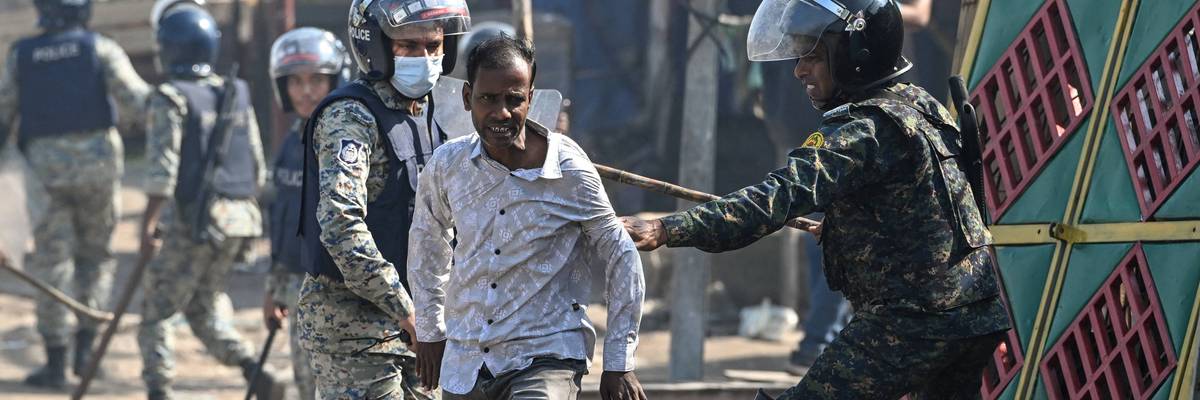
Police attack a garment worker as protesters block the Dhaka-Tangail Highway during a protest demanding higher wages, in Gazipur, on November 26, 2026.
Workers demanding a monthly minimum wage equivalent of about $240 say the government's proposed increase to $138 falls far short as police disperse demonstrators with tear gas and sonic grenades.
Bangladeshi garment workers continued protesting Thursday after rejecting a government-approved minimum-wage increase they contend is inadequate to meet the soaring cost of living, with police attacking demonstrators with "less-lethal" weapons to disperse them.
The latest demonstrations in Gazipur—a major garment manufacturing hub in the country of 178 million people—came a day after a government-appointed panel approved a 36% increase in the monthly minimum wage, from Tk12,500 to Tk17,000, or $100 to $138. Workers have been demanding Tk30,000, or roughly $240 per month.
"Let me be clear: Garment workers are not asking for luxury; they are demanding the right to live with dignity," Sultana Begum, president of the Green Bangla Garments Workers Federation, said earlier in November, the second month of major demonstrations.
On Thursday, police said they deployed tear gas and sound grenades after protesters blocked the Dhaka-Tangail Highway.
Garment worker Nazul Islam explained why he and other demonstrators moved to block the major roadway.
“Our factory declared a holiday," he told Prothom Alo. "After that, everyone was returning home along the highway. At that time, several people armed with sticks attacked us. We then took up positions on the highway and blocked it.”
At a demonstration on Wednesday, worker Kabir Hossain told Prothom Alo that supporting his family on the previous Tk12,500 minimum wage had become increasingly difficult.
After paying rent, buying food, and covering other expenses, he said, virtually nothing remained at the end of the month. He vowed to continue protesting until workers' demand for higher wages was met.
Another worker, Shariful Islam, said prices had risen while workers' incomes remained inadequate.
The garment industry employs more than 4 million people and accounts for the overwhelming majority of Bangladesh's export earnings, making workers' demands central to the country's economy.
The center-right government of Prime Minister Tarique Rahman has responded to the protests in part by arresting and intimidating labor organizers, including Begum and Green Bangla Garment Workers Federation general secretary Md Ilias, who were apprehended after they took part in an international webinar on workers' wage demands.
Other detained union figures included Mostafa Kamal, vice president of the Bangladesh Garments Trade Union Federation, and organizer Rozina Akter Sumi.
Amnesty International South Asia condemned the arrests on social media Wednesday, saying the crackdown "raises concerns about the targeting of workers for exercising their rights to freedom of peaceful assembly, freedom of association, and collective bargaining."
"The government of Bangladesh must immediately stop the arrest, intimidation, and harassment of workers and trade union representatives for participating in peaceful protests or organizing to demand better wages," the group continued. "Where incidents of violence occur, law enforcement authorities must distinguish between peaceful protesters and individuals engaging in violence. Any use of force must comply with international human rights standards."
Amnesty said that the government "must ensure that the minimum wage is fair, nondiscriminatory, and based on the actual cost of living. It must meet international standards and allow workers to support themselves and their families with dignity."
"The government must also protect workers' rights to organize, protest peacefully, and engage in collective bargaining," the group added, "and ensure accountability for human rights violations against those exercising these rights."
As shoppers in the United States once again prepare to descend on retailers for Black Friday bargains, the workers who make much of the world's inexpensive clothing face risks that extend well beyond low wages and long hours. Factory floors in Bangladesh are often crowded, poorly ventilated, and dangerously hot, with workers exposed to high-speed machinery, repetitive-motion injuries, chemical hazards and fire risks.
The low prices of "fast fashion" clothes come at a high price no only for textile workers but also the climate and environment, as manufacturing consumes large quantities of water and energy, while dyeing and finishing generate wastewater that can pollute rivers and groundwater.
This country and this world are at a monumental crossroads. US voters have an opportunity to beat back the forces of fascism and confront the billionaires who are rigging the economy, our media system, and our democracy, making it increasingly impossible for ordinary people to get by. We’re not just talking about the election. We’re talking about what must be done once these fascist elements are vanquished from power. We need a bolder set of solutions than what either major party has so far been willing to offer and a working-class movement ready to fight like hell for it. Trump didn't emerge from nowhere. The conditions that fueled MAGA authoritarianism were created by decades of radical neoliberal economic policies and a corrupt political system dominated by corporate interests. They slashed taxes on the super-rich, promising that the benefits would trickle down. They said giveaways to the corporate titans would make life more affordable for the rest of us. It was all bullshit. And when a bitter, betrayed populace searches for someone to blame, right-wing demagogues have little trouble finding scapegoats. People know when they're being lied to, but you won't hear any of this from the corporate media. Only independent journalism—powered and funded by people who believe in building a better world—can deliver truly trustworthy daily news. If you share our vision, please contribute whatever you can to sustain our work. |
Bangladeshi garment workers continued protesting Thursday after rejecting a government-approved minimum-wage increase they contend is inadequate to meet the soaring cost of living, with police attacking demonstrators with "less-lethal" weapons to disperse them.
The latest demonstrations in Gazipur—a major garment manufacturing hub in the country of 178 million people—came a day after a government-appointed panel approved a 36% increase in the monthly minimum wage, from Tk12,500 to Tk17,000, or $100 to $138. Workers have been demanding Tk30,000, or roughly $240 per month.
"Let me be clear: Garment workers are not asking for luxury; they are demanding the right to live with dignity," Sultana Begum, president of the Green Bangla Garments Workers Federation, said earlier in November, the second month of major demonstrations.
On Thursday, police said they deployed tear gas and sound grenades after protesters blocked the Dhaka-Tangail Highway.
Garment worker Nazul Islam explained why he and other demonstrators moved to block the major roadway.
“Our factory declared a holiday," he told Prothom Alo. "After that, everyone was returning home along the highway. At that time, several people armed with sticks attacked us. We then took up positions on the highway and blocked it.”
At a demonstration on Wednesday, worker Kabir Hossain told Prothom Alo that supporting his family on the previous Tk12,500 minimum wage had become increasingly difficult.
After paying rent, buying food, and covering other expenses, he said, virtually nothing remained at the end of the month. He vowed to continue protesting until workers' demand for higher wages was met.
Another worker, Shariful Islam, said prices had risen while workers' incomes remained inadequate.
The garment industry employs more than 4 million people and accounts for the overwhelming majority of Bangladesh's export earnings, making workers' demands central to the country's economy.
The center-right government of Prime Minister Tarique Rahman has responded to the protests in part by arresting and intimidating labor organizers, including Begum and Green Bangla Garment Workers Federation general secretary Md Ilias, who were apprehended after they took part in an international webinar on workers' wage demands.
Other detained union figures included Mostafa Kamal, vice president of the Bangladesh Garments Trade Union Federation, and organizer Rozina Akter Sumi.
Amnesty International South Asia condemned the arrests on social media Wednesday, saying the crackdown "raises concerns about the targeting of workers for exercising their rights to freedom of peaceful assembly, freedom of association, and collective bargaining."
"The government of Bangladesh must immediately stop the arrest, intimidation, and harassment of workers and trade union representatives for participating in peaceful protests or organizing to demand better wages," the group continued. "Where incidents of violence occur, law enforcement authorities must distinguish between peaceful protesters and individuals engaging in violence. Any use of force must comply with international human rights standards."
Amnesty said that the government "must ensure that the minimum wage is fair, nondiscriminatory, and based on the actual cost of living. It must meet international standards and allow workers to support themselves and their families with dignity."
"The government must also protect workers' rights to organize, protest peacefully, and engage in collective bargaining," the group added, "and ensure accountability for human rights violations against those exercising these rights."
As shoppers in the United States once again prepare to descend on retailers for Black Friday bargains, the workers who make much of the world's inexpensive clothing face risks that extend well beyond low wages and long hours. Factory floors in Bangladesh are often crowded, poorly ventilated, and dangerously hot, with workers exposed to high-speed machinery, repetitive-motion injuries, chemical hazards and fire risks.
The low prices of "fast fashion" clothes come at a high price no only for textile workers but also the climate and environment, as manufacturing consumes large quantities of water and energy, while dyeing and finishing generate wastewater that can pollute rivers and groundwater.