

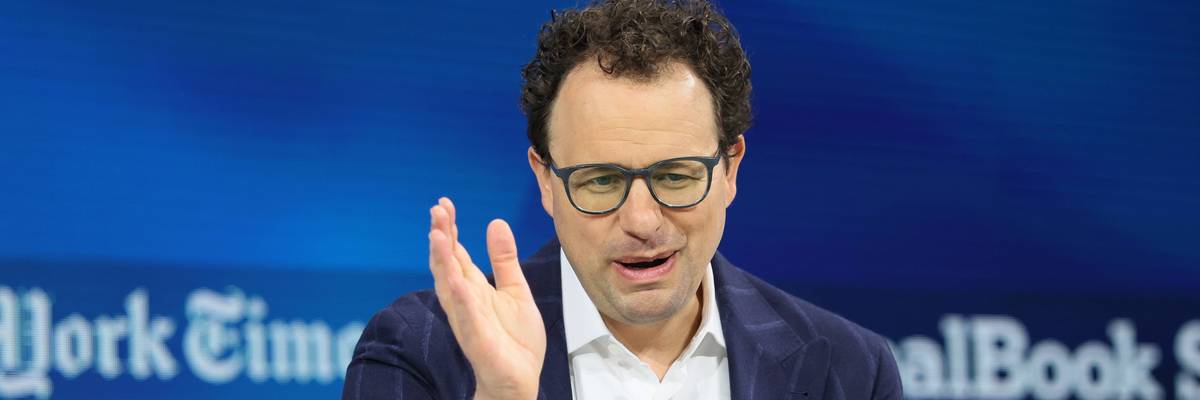
Anthropic CEO Dario Amodei speaks onstage during the 2025 New York Times Dealbook Summit on December 3, 2025, in New York City.
Anthropic Building a 'Pre-Crime' System to Surveil Anti-AI Dissenters, Investigation Shows
One legal expert said that as AI companies “become more hated, there’s more pressure on them to over-disclose knowing that some of the people they identify for law enforcement shouldn’t be targeted.”
The American Prospect on Wednesday published an investigation revealing that top artificial intelligence firm Anthropic is building a predictive surveillance system aimed at tracking activists who are opposed to advanced AI development.
The Prospect found that Anthropic last month issued a job posting seeking an intelligence specialist to "identify, assess, track, and investigate global threats including geopolitical instability, terrorism, crime, activism, nation-state targeting of the AI sector."
This job will also employ a "pre-crime" approach that will involve "attempting to predict incidents before a crime occurs," according to the Prospect. The concept of "pre-crime" was explored in Minority Report, a dystopian science fiction novel by Philip K. Dick.
A report last week in The San Francisco Standard revealed there is already at least one example of Anthropic taking this kind of predictive approach to policing.
Specifically, Anthropic called police last year and informed them that one of its users told the company's Claude AI chatbot that he had purchased a rifle and had CEO Dario Amodei "in his sights."
The AI lab told police that this person "was going to kill everyone at Anthropic," but it didn't provide law enforcement officials with transcripts of the chats, which would have let them make their own determination about the seriousness of the threat.
The person in question was not arrested or charged with a crime, and they told the Standard that they were "just fucking around" when they talked about buying a gun.
Eric Goldman, a law professor at Santa Clara University, told the Standard that he had some sympathy for Anthropic because if they don't report potential crimes to police then "they face significant liability if, in fact, a crime does occur."
"As they become more hated," Goldman said of the AI companies, "there’s more pressure on them to over-disclose knowing that some of the people they identify for law enforcement shouldn’t be targeted at all."
Anthropic isn't merely using technology to monitor potential crimes, but also to keep tabs on US citizens lawfully exercising their First Amendment rights.
The Prospect tracked down a podcast interview with Keon Ellison, global security operations center manager at Anthropic, where he revealed how employees at the company use technology provided by risk detection firm Samdesk to monitor activists.
"Last year we had an executive travel into a major city when we received some intelligence through Samdesk about a planned protest,” Ellison said. "Samdesk gave us about 60 minutes of advanced notice that the protest organizers had moved the timeline... That extra hour was critical. Without it our executives would have departed their meetings, they would have ran right into the heart of the disruption."
This story about taking great lengths to evade protesters drew a sarcastic reaction from tech journalist and author Brian Merchant.
"You know what you're doing is good," Merchant wrote in a social media post, "when you have to develop an in-house, real-time surveillance system to help your executives locate the ideal service exit to avoid contact with the public."
We are at a crossroads
This country and this world are at a monumental crossroads. In a few short weeks, US voters will have an opportunity to beat back the forces of fascism and confront the billionaires who are rigging the economy, our media system, and our democracy, making it increasingly impossible for ordinary people to get by. We’re not just talking about the election. We’re talking about what must be done once these fascist elements are vanquished from power. We need a bolder set of solutions than what either major party has so far been willing to offer and a working-class movement ready to fight like hell for it. Trump didn't emerge from nowhere. The conditions that fueled MAGA authoritarianism were created by decades of radical neoliberal economic policies and a corrupt political system dominated by corporate interests. They slashed taxes on the super-rich, promising that the benefits would trickle down. They said giveaways to the corporate titans would make life more affordable for the rest of us. It was all bullshit. And when a bitter, betrayed populace searches for someone to blame, right-wing demagogues have little trouble finding scapegoats. People know when they're being lied to, but you won't hear any of this from the corporate media. Only independent journalism—powered and funded by people who believe in building a better world—can deliver truly trustworthy daily news. Our Fall Campaign is underway, and we need your help. To power our newsroom through the rest of the year, we need to raise $125,000 by midnight on October 31. So if you share our vision, please contribute whatever you can to sustain our work. |
The American Prospect on Wednesday published an investigation revealing that top artificial intelligence firm Anthropic is building a predictive surveillance system aimed at tracking activists who are opposed to advanced AI development.
The Prospect found that Anthropic last month issued a job posting seeking an intelligence specialist to "identify, assess, track, and investigate global threats including geopolitical instability, terrorism, crime, activism, nation-state targeting of the AI sector."
This job will also employ a "pre-crime" approach that will involve "attempting to predict incidents before a crime occurs," according to the Prospect. The concept of "pre-crime" was explored in Minority Report, a dystopian science fiction novel by Philip K. Dick.
A report last week in The San Francisco Standard revealed there is already at least one example of Anthropic taking this kind of predictive approach to policing.
Specifically, Anthropic called police last year and informed them that one of its users told the company's Claude AI chatbot that he had purchased a rifle and had CEO Dario Amodei "in his sights."
The AI lab told police that this person "was going to kill everyone at Anthropic," but it didn't provide law enforcement officials with transcripts of the chats, which would have let them make their own determination about the seriousness of the threat.
The person in question was not arrested or charged with a crime, and they told the Standard that they were "just fucking around" when they talked about buying a gun.
Eric Goldman, a law professor at Santa Clara University, told the Standard that he had some sympathy for Anthropic because if they don't report potential crimes to police then "they face significant liability if, in fact, a crime does occur."
"As they become more hated," Goldman said of the AI companies, "there’s more pressure on them to over-disclose knowing that some of the people they identify for law enforcement shouldn’t be targeted at all."
Anthropic isn't merely using technology to monitor potential crimes, but also to keep tabs on US citizens lawfully exercising their First Amendment rights.
The Prospect tracked down a podcast interview with Keon Ellison, global security operations center manager at Anthropic, where he revealed how employees at the company use technology provided by risk detection firm Samdesk to monitor activists.
"Last year we had an executive travel into a major city when we received some intelligence through Samdesk about a planned protest,” Ellison said. "Samdesk gave us about 60 minutes of advanced notice that the protest organizers had moved the timeline... That extra hour was critical. Without it our executives would have departed their meetings, they would have ran right into the heart of the disruption."
This story about taking great lengths to evade protesters drew a sarcastic reaction from tech journalist and author Brian Merchant.
"You know what you're doing is good," Merchant wrote in a social media post, "when you have to develop an in-house, real-time surveillance system to help your executives locate the ideal service exit to avoid contact with the public."
- 'Wake the F Up. This Is Going to Destroy Us': Senator Sounds Alarm After AI Cyberattack ›
- Anthropic Researcher Quits, Citing Internal Fears That AI 'Could Kill Us All' This Decade ›
- Hegseth Demands Anthropic Let Military Use AI However It Wants—Even for Autonomous Killer Drones and Spying On Americans ›
- 'Hit the Brakes': Anthropic CEO's Push to 'Pace' AI Development Called Latest Sign Congress Must Act | Common Dreams ›
- AI Firms Can and Must Face Liability for 'Dangerous, Unvetted Products,' Says Lina Khan | Common Dreams ›
- Opinion | If AI Commits a Crime, We Already Know Who to Charge | Common Dreams ›
The American Prospect on Wednesday published an investigation revealing that top artificial intelligence firm Anthropic is building a predictive surveillance system aimed at tracking activists who are opposed to advanced AI development.
The Prospect found that Anthropic last month issued a job posting seeking an intelligence specialist to "identify, assess, track, and investigate global threats including geopolitical instability, terrorism, crime, activism, nation-state targeting of the AI sector."
This job will also employ a "pre-crime" approach that will involve "attempting to predict incidents before a crime occurs," according to the Prospect. The concept of "pre-crime" was explored in Minority Report, a dystopian science fiction novel by Philip K. Dick.
A report last week in The San Francisco Standard revealed there is already at least one example of Anthropic taking this kind of predictive approach to policing.
Specifically, Anthropic called police last year and informed them that one of its users told the company's Claude AI chatbot that he had purchased a rifle and had CEO Dario Amodei "in his sights."
The AI lab told police that this person "was going to kill everyone at Anthropic," but it didn't provide law enforcement officials with transcripts of the chats, which would have let them make their own determination about the seriousness of the threat.
The person in question was not arrested or charged with a crime, and they told the Standard that they were "just fucking around" when they talked about buying a gun.
Eric Goldman, a law professor at Santa Clara University, told the Standard that he had some sympathy for Anthropic because if they don't report potential crimes to police then "they face significant liability if, in fact, a crime does occur."
"As they become more hated," Goldman said of the AI companies, "there’s more pressure on them to over-disclose knowing that some of the people they identify for law enforcement shouldn’t be targeted at all."
Anthropic isn't merely using technology to monitor potential crimes, but also to keep tabs on US citizens lawfully exercising their First Amendment rights.
The Prospect tracked down a podcast interview with Keon Ellison, global security operations center manager at Anthropic, where he revealed how employees at the company use technology provided by risk detection firm Samdesk to monitor activists.
"Last year we had an executive travel into a major city when we received some intelligence through Samdesk about a planned protest,” Ellison said. "Samdesk gave us about 60 minutes of advanced notice that the protest organizers had moved the timeline... That extra hour was critical. Without it our executives would have departed their meetings, they would have ran right into the heart of the disruption."
This story about taking great lengths to evade protesters drew a sarcastic reaction from tech journalist and author Brian Merchant.
"You know what you're doing is good," Merchant wrote in a social media post, "when you have to develop an in-house, real-time surveillance system to help your executives locate the ideal service exit to avoid contact with the public."
- 'Wake the F Up. This Is Going to Destroy Us': Senator Sounds Alarm After AI Cyberattack ›
- Anthropic Researcher Quits, Citing Internal Fears That AI 'Could Kill Us All' This Decade ›
- Hegseth Demands Anthropic Let Military Use AI However It Wants—Even for Autonomous Killer Drones and Spying On Americans ›
- 'Hit the Brakes': Anthropic CEO's Push to 'Pace' AI Development Called Latest Sign Congress Must Act | Common Dreams ›
- AI Firms Can and Must Face Liability for 'Dangerous, Unvetted Products,' Says Lina Khan | Common Dreams ›
- Opinion | If AI Commits a Crime, We Already Know Who to Charge | Common Dreams ›