
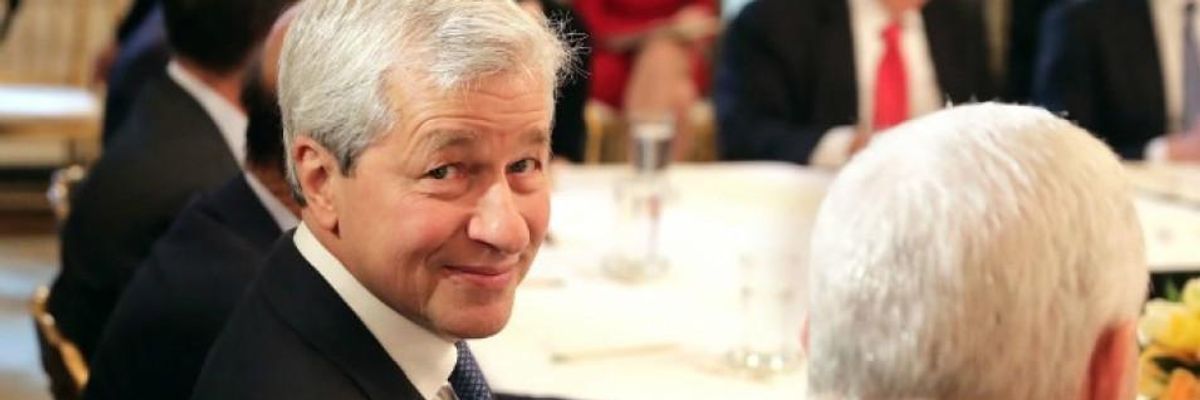
JPMorgan Chase CEO Jamie Dimon attends a policy forum with President Donald Trump in the State Dining Room at the White House February 3, 2017 in Washington, D.C. (Photo: Chip Somodevilla/Getty Images)
As Economic Suffering Grips Regular Americans, Wall Street Behemoths Ready Feast of Stock Buybacks
"We're going to be aggressively buying back, and consistently," said Morgan Stanley chief executive James Gorman.
For millions of regular Americans, the end of 2020 was marked by economic distress, with millions suffering pandemic-triggered job losses--and thus the loss of their employer-tied health insurance--still waiting on robust economic relief from federal lawmakers, and facing a weak social safety net.
For the nation's biggest banks, however, the year closed out with reason for celebration, and they're looking to take advantage of the banner year with a feast of stock buybacks.
As Axios reported Friday,
Banks cashed in on the white-hot IPO market, record debt issuance, and sky-high trading volume--all of which played out as economic peril softened the consumer side of their businesses.
The big picture: Financial results show that banks, which rake in money as middlemen, made a killing thanks to unprecedented action by the Federal Reserve--which caused a rush of activity in financial markets, pushed a slew of companies to issue debt, and led to a flood of others to go public for the first time.
Earnings were particularly sweet for banking behemoths including JPMorgan Chase, Goldman Sachs, and Morgan Stanley.
Reporting from Bloomberg on Tuesday gave a picture of the final quarter:
As the banner year for markets came to a close, JPMorgan Chase & Co. posted record profit in the fourth quarter, helped by a 20% increase in revenue from trading, a business where it already ranked No. 1 heading into the turmoil. At rival Goldman Sachs Group Inc., second only to JPMorgan in dealmaking, a flurry of transactions helped send its quarterly profit soaring 135%.
The results--from JPMorgan on Friday and Goldman on Tuesday--mirrored trends in many corners of industry and society during the shocks set off by Covid-19: The strong got stronger.
"Big banks' Wall Street business is booming," as the New York Times put it Friday. The banks signaled they may take advantage of that windfall by buying back shares--a practice the Fed last month allowed to resume last month and which critics say simply rewards wealthy shareholders but are essentially "manipulation of the stock market." From the Times:
What do banks plan to do with all that cash? "We have so much capital, we cannot use it," Jamie Dimon of JPMorgan told investors. The bank's cash pile has doubled over the past year, to more than $500 billion.
It's a similar story at other banks, and now that they've been cleared by regulators to resume share buybacks, "we're going to be aggressively buying back, and consistently," said James Gorman, Morgan Stanley's chief executive.
The reporting came as a new regulatory filing revealed that Dimon, a billionaire, was rewarded in 2020 with the same compensation as in 2019--$31.5 million.
"In determining Mr. Dimon's compensation, the independent members of the board took into account thefirm's strong performance in 2020 and over the long term, across four broad dimensions: Business Results; Risk, Controls, and Conduct; Client/Customer/Stakeholder; and Teamwork & Leadership," the company said.
At a conference call earlier this month, Dimon referenced the nation's growing wealth divide.
"We believe that inequality is a real problem," said Dimon, adding that "40% of Americans make $15 an hour or less."
Dimon also pointed to the fact with the new Biden administration, "there will be a new set of regulators," whom he expected would "be tougher" than those in the Trump administration.
President Joe Biden, according to reporting Friday, is considering naming former Obama Treasury Department official Michael Barr as the nation's top bank cop.
As head the Office of the Comptroller of the Currency, Barr would have the power to regulate banks like JPMorgan Chase.
Progressive groups like People's Action, however, have urged Biden to instead tap Mehrsa Baradaran, who teaches at the University of California at Irvine Law School and is an expert on the racial wealth gap. Bree Carlson, deputy director of People's Action, said in a statement Friday of Barr that "it's hard to imagine a worse pick," citing his ties to Wall Street and Silicon Valley corporations as reasons for his disqualification.
"President Biden must prove to voters that the government cares about all of us, not just wealthy elites," said Carlson. "If Biden truly wants to 'Build Back Better,' he needs to lock the revolving door and ensure no one with ties to the financial industry is in charge of regulating it."
We are at a crossroads
This country and this world are at a monumental crossroads. In a few short weeks, US voters will have an opportunity to beat back the forces of fascism and confront the billionaires who are rigging the economy, our media system, and our democracy, making it increasingly impossible for ordinary people to get by. We’re not just talking about the election. We’re talking about what must be done once these fascist elements are vanquished from power. We need a bolder set of solutions than what either major party has so far been willing to offer and a working-class movement ready to fight like hell for it. Trump didn't emerge from nowhere. The conditions that fueled MAGA authoritarianism were created by decades of radical neoliberal economic policies and a corrupt political system dominated by corporate interests. They slashed taxes on the super-rich, promising that the benefits would trickle down. They said giveaways to the corporate titans would make life more affordable for the rest of us. It was all bullshit. And when a bitter, betrayed populace searches for someone to blame, right-wing demagogues have little trouble finding scapegoats. People know when they're being lied to, but you won't hear any of this from the corporate media. Only independent journalism—powered and funded by people who believe in building a better world—can deliver truly trustworthy daily news. Our Fall Campaign is underway, and we need your help. To power our newsroom through the rest of the year, we need to raise $125,000 by midnight on October 31. So if you share our vision, please contribute whatever you can to sustain our work. |
For millions of regular Americans, the end of 2020 was marked by economic distress, with millions suffering pandemic-triggered job losses--and thus the loss of their employer-tied health insurance--still waiting on robust economic relief from federal lawmakers, and facing a weak social safety net.
For the nation's biggest banks, however, the year closed out with reason for celebration, and they're looking to take advantage of the banner year with a feast of stock buybacks.
As Axios reported Friday,
Banks cashed in on the white-hot IPO market, record debt issuance, and sky-high trading volume--all of which played out as economic peril softened the consumer side of their businesses.
The big picture: Financial results show that banks, which rake in money as middlemen, made a killing thanks to unprecedented action by the Federal Reserve--which caused a rush of activity in financial markets, pushed a slew of companies to issue debt, and led to a flood of others to go public for the first time.
Earnings were particularly sweet for banking behemoths including JPMorgan Chase, Goldman Sachs, and Morgan Stanley.
Reporting from Bloomberg on Tuesday gave a picture of the final quarter:
As the banner year for markets came to a close, JPMorgan Chase & Co. posted record profit in the fourth quarter, helped by a 20% increase in revenue from trading, a business where it already ranked No. 1 heading into the turmoil. At rival Goldman Sachs Group Inc., second only to JPMorgan in dealmaking, a flurry of transactions helped send its quarterly profit soaring 135%.
The results--from JPMorgan on Friday and Goldman on Tuesday--mirrored trends in many corners of industry and society during the shocks set off by Covid-19: The strong got stronger.
"Big banks' Wall Street business is booming," as the New York Times put it Friday. The banks signaled they may take advantage of that windfall by buying back shares--a practice the Fed last month allowed to resume last month and which critics say simply rewards wealthy shareholders but are essentially "manipulation of the stock market." From the Times:
What do banks plan to do with all that cash? "We have so much capital, we cannot use it," Jamie Dimon of JPMorgan told investors. The bank's cash pile has doubled over the past year, to more than $500 billion.
It's a similar story at other banks, and now that they've been cleared by regulators to resume share buybacks, "we're going to be aggressively buying back, and consistently," said James Gorman, Morgan Stanley's chief executive.
The reporting came as a new regulatory filing revealed that Dimon, a billionaire, was rewarded in 2020 with the same compensation as in 2019--$31.5 million.
"In determining Mr. Dimon's compensation, the independent members of the board took into account thefirm's strong performance in 2020 and over the long term, across four broad dimensions: Business Results; Risk, Controls, and Conduct; Client/Customer/Stakeholder; and Teamwork & Leadership," the company said.
At a conference call earlier this month, Dimon referenced the nation's growing wealth divide.
"We believe that inequality is a real problem," said Dimon, adding that "40% of Americans make $15 an hour or less."
Dimon also pointed to the fact with the new Biden administration, "there will be a new set of regulators," whom he expected would "be tougher" than those in the Trump administration.
President Joe Biden, according to reporting Friday, is considering naming former Obama Treasury Department official Michael Barr as the nation's top bank cop.
As head the Office of the Comptroller of the Currency, Barr would have the power to regulate banks like JPMorgan Chase.
Progressive groups like People's Action, however, have urged Biden to instead tap Mehrsa Baradaran, who teaches at the University of California at Irvine Law School and is an expert on the racial wealth gap. Bree Carlson, deputy director of People's Action, said in a statement Friday of Barr that "it's hard to imagine a worse pick," citing his ties to Wall Street and Silicon Valley corporations as reasons for his disqualification.
"President Biden must prove to voters that the government cares about all of us, not just wealthy elites," said Carlson. "If Biden truly wants to 'Build Back Better,' he needs to lock the revolving door and ensure no one with ties to the financial industry is in charge of regulating it."
For millions of regular Americans, the end of 2020 was marked by economic distress, with millions suffering pandemic-triggered job losses--and thus the loss of their employer-tied health insurance--still waiting on robust economic relief from federal lawmakers, and facing a weak social safety net.
For the nation's biggest banks, however, the year closed out with reason for celebration, and they're looking to take advantage of the banner year with a feast of stock buybacks.
As Axios reported Friday,
Banks cashed in on the white-hot IPO market, record debt issuance, and sky-high trading volume--all of which played out as economic peril softened the consumer side of their businesses.
The big picture: Financial results show that banks, which rake in money as middlemen, made a killing thanks to unprecedented action by the Federal Reserve--which caused a rush of activity in financial markets, pushed a slew of companies to issue debt, and led to a flood of others to go public for the first time.
Earnings were particularly sweet for banking behemoths including JPMorgan Chase, Goldman Sachs, and Morgan Stanley.
Reporting from Bloomberg on Tuesday gave a picture of the final quarter:
As the banner year for markets came to a close, JPMorgan Chase & Co. posted record profit in the fourth quarter, helped by a 20% increase in revenue from trading, a business where it already ranked No. 1 heading into the turmoil. At rival Goldman Sachs Group Inc., second only to JPMorgan in dealmaking, a flurry of transactions helped send its quarterly profit soaring 135%.
The results--from JPMorgan on Friday and Goldman on Tuesday--mirrored trends in many corners of industry and society during the shocks set off by Covid-19: The strong got stronger.
"Big banks' Wall Street business is booming," as the New York Times put it Friday. The banks signaled they may take advantage of that windfall by buying back shares--a practice the Fed last month allowed to resume last month and which critics say simply rewards wealthy shareholders but are essentially "manipulation of the stock market." From the Times:
What do banks plan to do with all that cash? "We have so much capital, we cannot use it," Jamie Dimon of JPMorgan told investors. The bank's cash pile has doubled over the past year, to more than $500 billion.
It's a similar story at other banks, and now that they've been cleared by regulators to resume share buybacks, "we're going to be aggressively buying back, and consistently," said James Gorman, Morgan Stanley's chief executive.
The reporting came as a new regulatory filing revealed that Dimon, a billionaire, was rewarded in 2020 with the same compensation as in 2019--$31.5 million.
"In determining Mr. Dimon's compensation, the independent members of the board took into account thefirm's strong performance in 2020 and over the long term, across four broad dimensions: Business Results; Risk, Controls, and Conduct; Client/Customer/Stakeholder; and Teamwork & Leadership," the company said.
At a conference call earlier this month, Dimon referenced the nation's growing wealth divide.
"We believe that inequality is a real problem," said Dimon, adding that "40% of Americans make $15 an hour or less."
Dimon also pointed to the fact with the new Biden administration, "there will be a new set of regulators," whom he expected would "be tougher" than those in the Trump administration.
President Joe Biden, according to reporting Friday, is considering naming former Obama Treasury Department official Michael Barr as the nation's top bank cop.
As head the Office of the Comptroller of the Currency, Barr would have the power to regulate banks like JPMorgan Chase.
Progressive groups like People's Action, however, have urged Biden to instead tap Mehrsa Baradaran, who teaches at the University of California at Irvine Law School and is an expert on the racial wealth gap. Bree Carlson, deputy director of People's Action, said in a statement Friday of Barr that "it's hard to imagine a worse pick," citing his ties to Wall Street and Silicon Valley corporations as reasons for his disqualification.
"President Biden must prove to voters that the government cares about all of us, not just wealthy elites," said Carlson. "If Biden truly wants to 'Build Back Better,' he needs to lock the revolving door and ensure no one with ties to the financial industry is in charge of regulating it."