

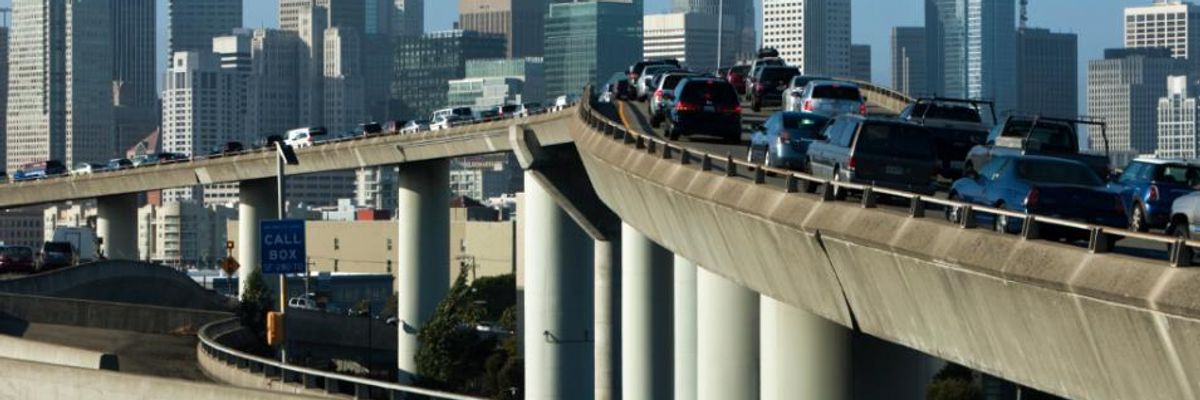
A traffic jam is seen on the freeway in San Francisco. (Photo: Rolf Schulten/ullstein bild via Getty Images)
The Anthropocene Is... Heavy: Scientists Find Human-Made Objects Now Outweigh All Life on Earth
"The science-fiction scenario of an engineered planet is already here."
As human consumption and pollution have led to a reduction in the Earth's biodiversity, those same activities have helped to create so many human-made objects that the weight of such materials is expected to exceed that of all people, other living animals, and plants by the end of 2020.
Scientists at the Weizmann Institute of Sciences in Rehovot, Israel, published (pdf) a study in Nature on Wednesday showing that the weight of all human-made objects, or "anthropogenic mass"--including automobiles, buildings, roads, and smaller plastics and other materials--is estimated at one teratonne, or one trillion metric tons.
"We find that Earth is exactly at the crossover point; in the year 2020, the anthropogenic mass, which has recently doubled roughly every 20 years, will surpass all global living biomass," wrote the scientists in Nature. "On average, for each person on the globe, anthropogenic mass equal to more than his or her body weight is produced every week."
While the weight of human-made objects has doubled every two decades recently, that of living animals and plants has dropped; the United Nations warned in a report last year that about one million species are now threatened with extinction as humans have encroached on natural habitats for agricultural and development purposes, exploited wild animals, and driven the climate crisis through fossil fuel extraction.
The significance of the new study regarding the weight of anthropogenic mass "is symbolic in the sense that it tells us something about the major role that humanity now plays in shaping the world and the state of the Earth around us," Dr. Ron Milo, who led the research, told BBC News.
The new research, wrote Jan Zalasiewicz and Mark Williams, professors of palaeobiology at the University of Leicester in the U.K., upends the long-held idea of "a natural world that dwarfed humanity and its creations":
Our constructions have now--indeed, spookily, just this year--attained the same mass as that of all living organisms on Earth. The human enterprise is growing fast, too, while nature keeps shrinking. The science-fiction scenario of an engineered planet is already here.
[...]
Since the mid-20th century, the Earth has been set on a new, human-driven trajectory... The weight of evidence, here, seems unarguable.
The scientists behind the study found that in 1900, human-made objects weighed roughly 35 billion tonnes, and that the weight doubled by the middle of the 20th century.
Since the Great Acceleration after World War II, "our stuff increased several-fold to a little over half a trillion tonnes by the end of the century," wrote Zalasiewicz and Williams at The Conversation. "In coming years, the living world will be far outweighed--threefold by 2040, they say, if current trends hold."
The scientists wrote in their study that their "quantification of the human enterprise" provides new evidence that the planet has entered "the human-induced epoch of the Anthropocene"--a geological age in which humanity's impacts on the living world will be visible in sediments millions of years from now.
We are at a crossroads
This country and this world are at a monumental crossroads. In a few short weeks, US voters will have an opportunity to beat back the forces of fascism and confront the billionaires who are rigging the economy, our media system, and our democracy, making it increasingly impossible for ordinary people to get by. We’re not just talking about the election. We’re talking about what must be done once these fascist elements are vanquished from power. We need a bolder set of solutions than what either major party has so far been willing to offer and a working-class movement ready to fight like hell for it. Trump didn't emerge from nowhere. The conditions that fueled MAGA authoritarianism were created by decades of radical neoliberal economic policies and a corrupt political system dominated by corporate interests. They slashed taxes on the super-rich, promising that the benefits would trickle down. They said giveaways to the corporate titans would make life more affordable for the rest of us. It was all bullshit. And when a bitter, betrayed populace searches for someone to blame, right-wing demagogues have little trouble finding scapegoats. People know when they're being lied to, but you won't hear any of this from the corporate media. Only independent journalism—powered and funded by people who believe in building a better world—can deliver truly trustworthy daily news. Our Fall Campaign is underway, and we need your help. To power our newsroom through the rest of the year, we need to raise $125,000 by midnight on October 31. So if you share our vision, please contribute whatever you can to sustain our work. |
As human consumption and pollution have led to a reduction in the Earth's biodiversity, those same activities have helped to create so many human-made objects that the weight of such materials is expected to exceed that of all people, other living animals, and plants by the end of 2020.
Scientists at the Weizmann Institute of Sciences in Rehovot, Israel, published (pdf) a study in Nature on Wednesday showing that the weight of all human-made objects, or "anthropogenic mass"--including automobiles, buildings, roads, and smaller plastics and other materials--is estimated at one teratonne, or one trillion metric tons.
"We find that Earth is exactly at the crossover point; in the year 2020, the anthropogenic mass, which has recently doubled roughly every 20 years, will surpass all global living biomass," wrote the scientists in Nature. "On average, for each person on the globe, anthropogenic mass equal to more than his or her body weight is produced every week."
While the weight of human-made objects has doubled every two decades recently, that of living animals and plants has dropped; the United Nations warned in a report last year that about one million species are now threatened with extinction as humans have encroached on natural habitats for agricultural and development purposes, exploited wild animals, and driven the climate crisis through fossil fuel extraction.
The significance of the new study regarding the weight of anthropogenic mass "is symbolic in the sense that it tells us something about the major role that humanity now plays in shaping the world and the state of the Earth around us," Dr. Ron Milo, who led the research, told BBC News.
The new research, wrote Jan Zalasiewicz and Mark Williams, professors of palaeobiology at the University of Leicester in the U.K., upends the long-held idea of "a natural world that dwarfed humanity and its creations":
Our constructions have now--indeed, spookily, just this year--attained the same mass as that of all living organisms on Earth. The human enterprise is growing fast, too, while nature keeps shrinking. The science-fiction scenario of an engineered planet is already here.
[...]
Since the mid-20th century, the Earth has been set on a new, human-driven trajectory... The weight of evidence, here, seems unarguable.
The scientists behind the study found that in 1900, human-made objects weighed roughly 35 billion tonnes, and that the weight doubled by the middle of the 20th century.
Since the Great Acceleration after World War II, "our stuff increased several-fold to a little over half a trillion tonnes by the end of the century," wrote Zalasiewicz and Williams at The Conversation. "In coming years, the living world will be far outweighed--threefold by 2040, they say, if current trends hold."
The scientists wrote in their study that their "quantification of the human enterprise" provides new evidence that the planet has entered "the human-induced epoch of the Anthropocene"--a geological age in which humanity's impacts on the living world will be visible in sediments millions of years from now.