SUBSCRIBE TO OUR FREE NEWSLETTER
Daily news & progressive opinion—funded by the people, not the corporations—delivered straight to your inbox.
5
#000000
#FFFFFF
To donate by check, phone, or other method, see our More Ways to Give page.
Daily news & progressive opinion—funded by the people, not the corporations—delivered straight to your inbox.
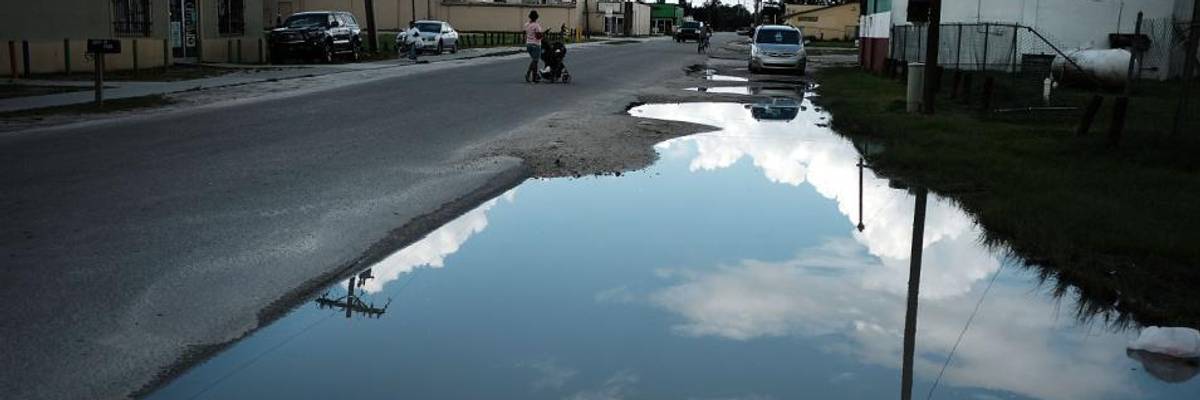
People walk along a street in the rural agriculture community of Immokalee, Florida on September 9, 2018. The Immokalee community, which is made up mainly of seasonal farm workers, was severely effected by Hurricane Irma which caused severe flooding in the area. Nearly one year later many residents still haven't fully recovered from the storm. Mobile homes make up roughly a quarter of the housing in Immokalee and many were destroyed in the Category 3 storm that caused major damage throughout the state. (Photo: Spencer Platt/Getty Images)
Climate scientists have warned for years that millions of people living in coastal areas will be increasingly vulnerable to flooding in the coming decades--one of the many risks of policymakers failing to confront the climate crisis. But a new study details how people in low-income housing are expected to face the most drastic consequences of inaction.
The New Jersey-based climate research organization Climate Central released a study Tuesday showing that 7,668 houses, townhomes, and apartments that are either in low-income areas or are subsidized affordable housing units are currently exposed to at least one "coastal flood risk event" per year, and that number is expected to triple by 2050 if fossil fuel emissions are not dramatically reduced in the coming years.
"Flood-damaged affordable housing can have long-term consequences for residents, owners, and communities, including increased homelessness, loss of rental income that can make it difficult for housing owners to provide affordable housing, and neighborhood-level economic downturns."
--Climate Central
Analyzing maps of affordable housing across the U.S., researchers found that homes in New Jersey, New York, Massachusetts, and California are particularly at risk for flooding damage brought on by hurricanes and sea level rise.
"'A rising tide lifts all boats' is a phrase often used to articulate the idea that a prosperous economy will benefit all its participants," wrote Climate Central. "But the rising tides driven by global warming are increasing flood threats for thousands of residents in low-income communities and neighborhoods. Flooding can wreak havoc on buildings and the residents who live in them, threatening public health and causing profound disruption to families struggling to make ends meet. Chronic or 'nuisance' flooding can also damage cars and keep residents from getting to work, school, or medical care."
Middle- and high-income households are expected to be affected by flooding in the coming decades as well, but Climate Central noted that people living in affordable housing are more likely to be adversely affected, "as affordable housing tends to be older and is rarely equipped with resilience-enhancing features (such as flood proofing, off-grid energy, or backwater valves), due to the cost of such measures."
"Additionally, residents of affordable housing often lack the financial resources to repair, rebuild, or retreat from their housing after it is damaged by flood waters," the group said. "Flood-damaged affordable housing can have long-term consequences for residents, owners, and communities, including increased homelessness, loss of rental income that can make it difficult for housing owners to provide affordable housing, and neighborhood-level economic downturns."
The study demonstrated that climate action is, "always, a justice issue first," tweeted 350.org co-founder Bill McKibben.
"We don't train our attention on these neighborhoods but many of them are already suffering significantly from these problems," Benjamin Strauss, chief executive and chief scientist of Climate Central, told The Guardian.
Since 1880, the mean sea level worldwide has climbed by about eight inches. The rise has accelerated in some U.S. cities in the last century, increasing by about one foot. The National Oceanic and Atmospheric Administration (NOAA) warned in a report in August that by the end of the century, the global sea level could rise more than eight feet above 2000 levels if world governments don't take urgent action to reduce planet-heating greenhouse gas emissions. Last month, scientists were startled to observe that a huge swath of Arctic sea ice in Siberia had yet to begin freezing for the year--among the latest signs that policymakers are not doing enough to rapidly reduce emissions.
Climate Central's study served as "a reminder that major climate-related events, like hurricanes, aren't the only challenges we need to consider," tweeted Sarah Stanley, director of communications at the U.S. Green Building Council. "The quieter threat of sea level rise is already crippling communities, particularly the underserved."
This country and this world are at a monumental crossroads. US voters have an opportunity to beat back the forces of fascism and confront the billionaires who are rigging the economy, our media system, and our democracy, making it increasingly impossible for ordinary people to get by. We’re not just talking about the election. We’re talking about what must be done once these fascist elements are vanquished from power. We need a bolder set of solutions than what either major party has so far been willing to offer and a working-class movement ready to fight like hell for it. Trump didn't emerge from nowhere. The conditions that fueled MAGA authoritarianism were created by decades of radical neoliberal economic policies and a corrupt political system dominated by corporate interests. They slashed taxes on the super-rich, promising that the benefits would trickle down. They said giveaways to the corporate titans would make life more affordable for the rest of us. It was all bullshit. And when a bitter, betrayed populace searches for someone to blame, right-wing demagogues have little trouble finding scapegoats. People know when they're being lied to, but you won't hear any of this from the corporate media. Only independent journalism—powered and funded by people who believe in building a better world—can deliver truly trustworthy daily news. If you share our vision, please contribute whatever you can to sustain our work. |
Climate scientists have warned for years that millions of people living in coastal areas will be increasingly vulnerable to flooding in the coming decades--one of the many risks of policymakers failing to confront the climate crisis. But a new study details how people in low-income housing are expected to face the most drastic consequences of inaction.
The New Jersey-based climate research organization Climate Central released a study Tuesday showing that 7,668 houses, townhomes, and apartments that are either in low-income areas or are subsidized affordable housing units are currently exposed to at least one "coastal flood risk event" per year, and that number is expected to triple by 2050 if fossil fuel emissions are not dramatically reduced in the coming years.
"Flood-damaged affordable housing can have long-term consequences for residents, owners, and communities, including increased homelessness, loss of rental income that can make it difficult for housing owners to provide affordable housing, and neighborhood-level economic downturns."
--Climate Central
Analyzing maps of affordable housing across the U.S., researchers found that homes in New Jersey, New York, Massachusetts, and California are particularly at risk for flooding damage brought on by hurricanes and sea level rise.
"'A rising tide lifts all boats' is a phrase often used to articulate the idea that a prosperous economy will benefit all its participants," wrote Climate Central. "But the rising tides driven by global warming are increasing flood threats for thousands of residents in low-income communities and neighborhoods. Flooding can wreak havoc on buildings and the residents who live in them, threatening public health and causing profound disruption to families struggling to make ends meet. Chronic or 'nuisance' flooding can also damage cars and keep residents from getting to work, school, or medical care."
Middle- and high-income households are expected to be affected by flooding in the coming decades as well, but Climate Central noted that people living in affordable housing are more likely to be adversely affected, "as affordable housing tends to be older and is rarely equipped with resilience-enhancing features (such as flood proofing, off-grid energy, or backwater valves), due to the cost of such measures."
"Additionally, residents of affordable housing often lack the financial resources to repair, rebuild, or retreat from their housing after it is damaged by flood waters," the group said. "Flood-damaged affordable housing can have long-term consequences for residents, owners, and communities, including increased homelessness, loss of rental income that can make it difficult for housing owners to provide affordable housing, and neighborhood-level economic downturns."
The study demonstrated that climate action is, "always, a justice issue first," tweeted 350.org co-founder Bill McKibben.
"We don't train our attention on these neighborhoods but many of them are already suffering significantly from these problems," Benjamin Strauss, chief executive and chief scientist of Climate Central, told The Guardian.
Since 1880, the mean sea level worldwide has climbed by about eight inches. The rise has accelerated in some U.S. cities in the last century, increasing by about one foot. The National Oceanic and Atmospheric Administration (NOAA) warned in a report in August that by the end of the century, the global sea level could rise more than eight feet above 2000 levels if world governments don't take urgent action to reduce planet-heating greenhouse gas emissions. Last month, scientists were startled to observe that a huge swath of Arctic sea ice in Siberia had yet to begin freezing for the year--among the latest signs that policymakers are not doing enough to rapidly reduce emissions.
Climate Central's study served as "a reminder that major climate-related events, like hurricanes, aren't the only challenges we need to consider," tweeted Sarah Stanley, director of communications at the U.S. Green Building Council. "The quieter threat of sea level rise is already crippling communities, particularly the underserved."