SUBSCRIBE TO OUR FREE NEWSLETTER
Daily news & progressive opinion—funded by the people, not the corporations—delivered straight to your inbox.
5
#000000
#FFFFFF
To donate by check, phone, or other method, see our More Ways to Give page.
Daily news & progressive opinion—funded by the people, not the corporations—delivered straight to your inbox.
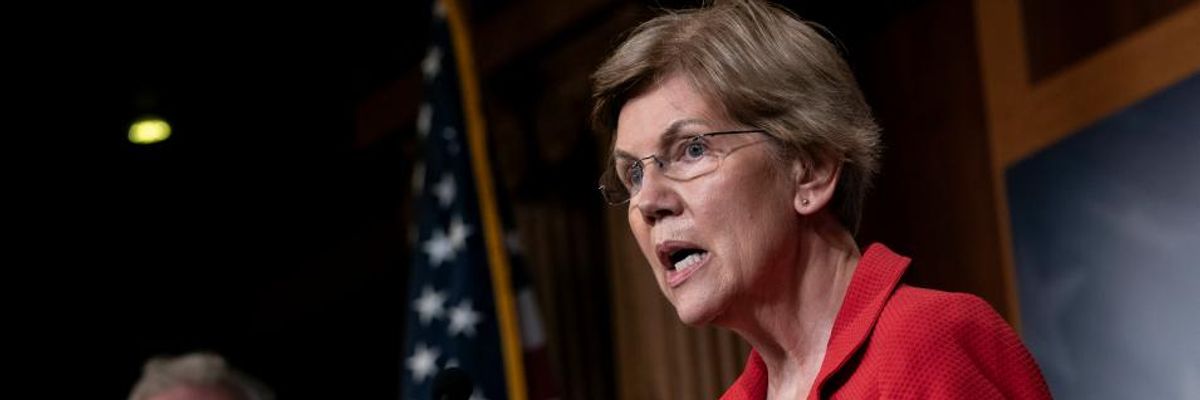
Sen. Elizabeth Warren (D-Mass.) speaks during a news conference at the U.S. Capitol on July 22, 2020 in Washington, D.C. (Photo: Drew Angerer/Getty Images)
The Securities and Exchange Commission on Tuesday reportedly launched an investigation into Kodak after Sen. Elizabeth Warren demanded a probe of possible insider trading at the tech company, which gifted its CEO nearly two million stock options just a day before President Donald Trump last week handed the company a $765 million federal loan to produce generic pharmaceuticals to combat Covid-19.
"Good," Warren tweeted in response to reports of the SEC's investigation. "If investors or Kodak employees were trading based on the unauthorized disclosure or discussion of nonpublic information, then it would appear to be a clear violation of securities law. The SEC should hold them accountable."
Trump's announcement of the $765 million deal on July 28 sent Kodak shares surging by more than 1000%, increasing the value of CEO Jim Continenza's new stock options to around $50 million.
In a letter (pdf) to the Securities and Exchange Commission (SEC) on Tuesday, Warren said the decision to grant Continenza stock options was just one of "several instances of unusual trading activity prior to the announcement, raising questions about whether one or more individuals may have engaged in insider trading or in the unauthorized disclosure of material, nonpublic information regarding the forthcoming $765 million loan awarded under the Defense Production Act."
Kodak's stock began to surge a day before Trump's announcement of the massive federal loan, drawing suspicion from analysts who saw the sudden spike in activity as abnormal.
The Wall Street Journal reported that some of the stock activity can be explained by a Kodak media advisory announcing an unspecified and historic new initiative with the federal government. Because the advisory did not indicate that the information was not yet supposed to be released to the public, local media outlets ran stories on the announcement, causing Kodak's stock to jump.
Warren said that while the Journal report "may resolve questions about the individuals who purchased the stock after seeing those public disclosures, it also opens up new questions about how Kodak handled what appears to be 'non-intentional disclosure of material nonpublic information.'"
The Massachusetts Democrat noted that SEC regulations require companies to "publicly disclose the information promptly after it knows (or is reckless in not knowing) that the information selectively disclosed was both material and nonpublic." Instead of adhering to SEC rules, Warren wrote, Kodak simply asked reporters to remove their stories on the inadvertent announcement.
Warren went on to point out that Continenza and other members of Kodak's board of directors also purchased stock while Kodak and the Trump administration were "negotiating the deal in secret." As the New York Times reported, Kodak granted 240,000 stock options to board members on May 20.
"The purchase of stock... while the company was involved in secret negotiations with the government over a lucrative contract raises questions about whether these executives potentially made investment decisions based on material, non-public information derived from their positions," Warren wrote.
"If investors or Kodak employees were trading based on the unauthorized disclosure or discussion of nonpublic information," Warren added, "then it would appear to be a clear violation of securities law."
This country and this world are at a monumental crossroads. US voters have an opportunity to beat back the forces of fascism and confront the billionaires who are rigging the economy, our media system, and our democracy, making it increasingly impossible for ordinary people to get by. We’re not just talking about the election. We’re talking about what must be done once these fascist elements are vanquished from power. We need a bolder set of solutions than what either major party has so far been willing to offer and a working-class movement ready to fight like hell for it. Trump didn't emerge from nowhere. The conditions that fueled MAGA authoritarianism were created by decades of radical neoliberal economic policies and a corrupt political system dominated by corporate interests. They slashed taxes on the super-rich, promising that the benefits would trickle down. They said giveaways to the corporate titans would make life more affordable for the rest of us. It was all bullshit. And when a bitter, betrayed populace searches for someone to blame, right-wing demagogues have little trouble finding scapegoats. People know when they're being lied to, but you won't hear any of this from the corporate media. Only independent journalism—powered and funded by people who believe in building a better world—can deliver truly trustworthy daily news. If you share our vision, please contribute whatever you can to sustain our work. |
The Securities and Exchange Commission on Tuesday reportedly launched an investigation into Kodak after Sen. Elizabeth Warren demanded a probe of possible insider trading at the tech company, which gifted its CEO nearly two million stock options just a day before President Donald Trump last week handed the company a $765 million federal loan to produce generic pharmaceuticals to combat Covid-19.
"Good," Warren tweeted in response to reports of the SEC's investigation. "If investors or Kodak employees were trading based on the unauthorized disclosure or discussion of nonpublic information, then it would appear to be a clear violation of securities law. The SEC should hold them accountable."
Trump's announcement of the $765 million deal on July 28 sent Kodak shares surging by more than 1000%, increasing the value of CEO Jim Continenza's new stock options to around $50 million.
In a letter (pdf) to the Securities and Exchange Commission (SEC) on Tuesday, Warren said the decision to grant Continenza stock options was just one of "several instances of unusual trading activity prior to the announcement, raising questions about whether one or more individuals may have engaged in insider trading or in the unauthorized disclosure of material, nonpublic information regarding the forthcoming $765 million loan awarded under the Defense Production Act."
Kodak's stock began to surge a day before Trump's announcement of the massive federal loan, drawing suspicion from analysts who saw the sudden spike in activity as abnormal.
The Wall Street Journal reported that some of the stock activity can be explained by a Kodak media advisory announcing an unspecified and historic new initiative with the federal government. Because the advisory did not indicate that the information was not yet supposed to be released to the public, local media outlets ran stories on the announcement, causing Kodak's stock to jump.
Warren said that while the Journal report "may resolve questions about the individuals who purchased the stock after seeing those public disclosures, it also opens up new questions about how Kodak handled what appears to be 'non-intentional disclosure of material nonpublic information.'"
The Massachusetts Democrat noted that SEC regulations require companies to "publicly disclose the information promptly after it knows (or is reckless in not knowing) that the information selectively disclosed was both material and nonpublic." Instead of adhering to SEC rules, Warren wrote, Kodak simply asked reporters to remove their stories on the inadvertent announcement.
Warren went on to point out that Continenza and other members of Kodak's board of directors also purchased stock while Kodak and the Trump administration were "negotiating the deal in secret." As the New York Times reported, Kodak granted 240,000 stock options to board members on May 20.
"The purchase of stock... while the company was involved in secret negotiations with the government over a lucrative contract raises questions about whether these executives potentially made investment decisions based on material, non-public information derived from their positions," Warren wrote.
"If investors or Kodak employees were trading based on the unauthorized disclosure or discussion of nonpublic information," Warren added, "then it would appear to be a clear violation of securities law."