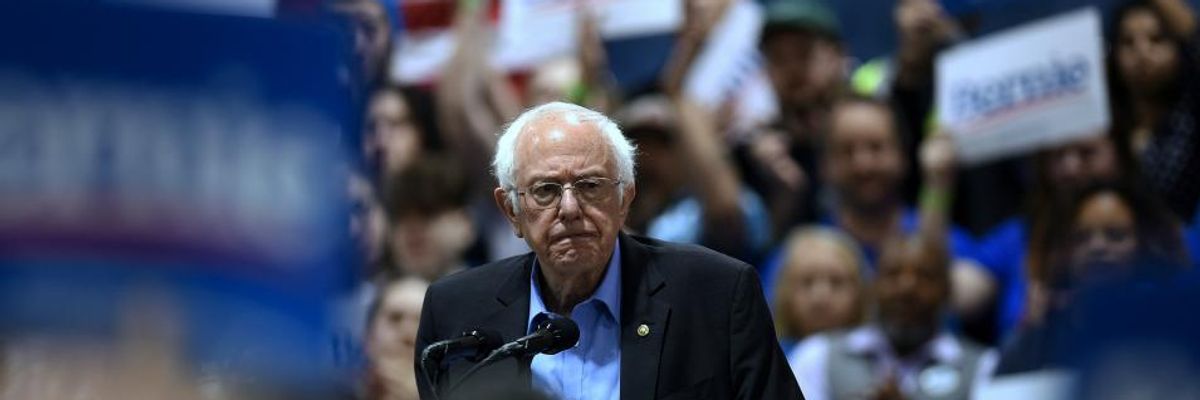
Democratic presidential candidate Sen. Bernie Sanders (I-Vt.) addresses his supporters at a campaign rally at the Charleston Area Convention Center in South Carolina on February 26, 2020. (Photo: Paul Hennessy/Echoes Wire/Barcroft Media via Getty Images)
'You'll See Rebellion': Sanders Supporters Denounce Open Threats by Superdelegates to Steal Nomination
"The Democrats might be able to stop Sanders, but in doing so they would destroy their party's own electoral prospects."
Nearly 100 Democratic superdelegates told the New York Times in interviews this week that if Sen. Bernie Sanders does not arrive at the party's 2020 convention in July with a majority of pledged delegates, they are willing to thwart the will of the plurality of primary voters--and potentially risk damaging Democrats' chances of defeating President Donald Trump--in order to stop Sanders from winning the nomination.
"If Bernie gets a plurality and nobody else is even close and the superdelegates weigh in and say, 'We know better than the voters,' I think that will be a big problem."
--Rep. Pramila Jayapal
"In a reflection of the establishment's wariness about Mr. Sanders," the Times reported Thursday morning, "only nine of the 93 superdelegates interviewed said that Mr. Sanders should become the nominee purely on the basis of arriving at the convention with a plurality, if he was short of a majority."
The superdelegates, many of whom are current elected officials, are "willing to risk intraparty damage to stop his nomination at the national convention in July if they get the chance," the Times reported.
"If he doesn't have a majority, it stands to reason that he may not become the nominee," Jay Jacobs, the New York State Democratic Party chairman, said of Sanders, who has won the popular vote in the first three states of the Democratic primary race.
Osita Nwanevu, political columnist for The New Republic, suggested the Times headline could be written another way:
Democratic Leaders Willing to Lose the Election to Stop Bernie Sanders pic.twitter.com/HhK2FDqkwB
-- Osita Nwanevu (@OsitaNwanevu) February 27, 2020
Under the current convention rules, if Sanders does not arrive in Milwaukee with at least 1,991 pledged delegates (just over 50 percent of the total), the convention will go to a second round in which superdelegates and all 3,979 pledged delegates will be free to vote for any candidate they choose.
As Common Dreams reported, Sanders was the only Democratic presidential hopeful on the debate stage in Las Vegas last week to say the candidate with the most votes at the convention should become the party's nominee.
"The will of the people should prevail," said Sanders. "The person who has the most votes should become the nominee."
"If that's what our party leaders are going to do, you'll see rebellion not just in the presidential race, but in down-ballot races as well."
--Jane Kleeb, Nebraska Democratic Party
Progressives warn that nominating a candidate other than Sanders if the senator wins a plurality of delegates would have nightmarish consequences for the Democratic Party come November.
"If Bernie gets a plurality and nobody else is even close and the superdelegates weigh in and say, 'We know better than the voters,' I think that will be a big problem," said Rep. Pramila Jayapal (D-Wash.), who endorsed Sanders for president.
Jane Kleeb, chairwoman of the Nebraska Democratic Party who endorsed Sanders in 2016, told the Times that party leaders "shouldn't be second-guessing voters."
"If that's what our party leaders are going to do," warned Kleeb, "you'll see rebellion not just in the presidential race, but in down-ballot races as well."
According to the Times, Democratic superdelegates are casting about for a "savior candidate" who is not currently in the 2020 race, floating an array of names including former First Lady Michelle Obama, Sen. Chris Coons (D-Del.), and House Speaker Nancy Pelosi (D-Calif.), who said Wednesday that she would be comfortable with Sanders at the top of the ticket.
"At some point you could imagine saying, 'Let's go get [Virginia Sen.] Mark Warner, Chris Coons, Nancy Pelosi,'" Rep. Don Beyer (D-Va.) told the Times. "Somebody that could win and we could all get behind and celebrate."
The Times reporting comes just two days before the South Carolina Democratic primary, a contest the party establishment views as a key opportunity to slow Sanders' momentum heading into Super Tuesday, when 1,357 delegates are up for grabs.
New York Magazine's Eric Levitz tweeted that the superdelegates' on-the-record commitment to thwarting Sanders at the convention "enables Bernie to credibly tell voters after Super Tuesday, 'You can either deliver me a majority, or vote for someone else and ensure our party has a huge ugly fight this summer.'"
"Given his approval rating," Levitz added, "I think that's a winning argument."
In a column for The Guardian on Tuesday, Current Affairs editor and outspoken Sanders supporter Nathan Robinson argued that a brokered convention would be a "disaster" for the Democratic Party.
"Millions of Sanders supporters would be enraged at having the nomination snatched from them and might defect to a third party," wrote Robinson. "Even those who did support a nominee they considered illegitimate would do so only grudgingly."
"The Democrats might be able to stop Sanders, but in doing so they would destroy their party's own electoral prospects," Robinson added. "It would be a completely reckless and irrational maneuver, and every sensible Democrat should oppose it."
Urgent. It's never been this bad.
Dear Common Dreams reader, It’s been nearly 30 years since I co-founded Common Dreams with my late wife, Lina Newhouser. We had the radical notion that journalism should serve the public good, not corporate profits. It was clear to us from the outset what it would take to build such a project. No paid advertisements. No corporate sponsors. No millionaire publisher telling us what to think or do. Many people said we wouldn't last a year, but we proved those doubters wrong. Together with a tremendous team of journalists and dedicated staff, we built an independent media outlet free from the constraints of profits and corporate control. Our mission from the outset was simple. To inform. To inspire. To ignite change for the common good. Building Common Dreams was not easy. Our survival was never guaranteed. When you take on the most powerful forces—Wall Street greed, fossil fuel industry destruction, Big Tech lobbyists, and uber-rich oligarchs who have spent billions upon billions rigging the economy and democracy in their favor—the only bulwark you have is supporters who believe in your work. But here’s the urgent message from me today. It’s never been this bad out there. And it’s never been this hard to keep us going. At the very moment Common Dreams is most needed and doing some of its best and most important work, the threats we face are intensifying. Right now, with just three days to go in our Spring Campaign, we're falling short of our make-or-break goal. When everyone does the little they can afford, we are strong. But if that support retreats or dries up, so do we. Can you make a gift right now to make sure Common Dreams not only survives but thrives? There is no backup plan or rainy day fund. There is only you. —Craig Brown, Co-founder |
Nearly 100 Democratic superdelegates told the New York Times in interviews this week that if Sen. Bernie Sanders does not arrive at the party's 2020 convention in July with a majority of pledged delegates, they are willing to thwart the will of the plurality of primary voters--and potentially risk damaging Democrats' chances of defeating President Donald Trump--in order to stop Sanders from winning the nomination.
"If Bernie gets a plurality and nobody else is even close and the superdelegates weigh in and say, 'We know better than the voters,' I think that will be a big problem."
--Rep. Pramila Jayapal
"In a reflection of the establishment's wariness about Mr. Sanders," the Times reported Thursday morning, "only nine of the 93 superdelegates interviewed said that Mr. Sanders should become the nominee purely on the basis of arriving at the convention with a plurality, if he was short of a majority."
The superdelegates, many of whom are current elected officials, are "willing to risk intraparty damage to stop his nomination at the national convention in July if they get the chance," the Times reported.
"If he doesn't have a majority, it stands to reason that he may not become the nominee," Jay Jacobs, the New York State Democratic Party chairman, said of Sanders, who has won the popular vote in the first three states of the Democratic primary race.
Osita Nwanevu, political columnist for The New Republic, suggested the Times headline could be written another way:
Democratic Leaders Willing to Lose the Election to Stop Bernie Sanders pic.twitter.com/HhK2FDqkwB
-- Osita Nwanevu (@OsitaNwanevu) February 27, 2020
Under the current convention rules, if Sanders does not arrive in Milwaukee with at least 1,991 pledged delegates (just over 50 percent of the total), the convention will go to a second round in which superdelegates and all 3,979 pledged delegates will be free to vote for any candidate they choose.
As Common Dreams reported, Sanders was the only Democratic presidential hopeful on the debate stage in Las Vegas last week to say the candidate with the most votes at the convention should become the party's nominee.
"The will of the people should prevail," said Sanders. "The person who has the most votes should become the nominee."
"If that's what our party leaders are going to do, you'll see rebellion not just in the presidential race, but in down-ballot races as well."
--Jane Kleeb, Nebraska Democratic Party
Progressives warn that nominating a candidate other than Sanders if the senator wins a plurality of delegates would have nightmarish consequences for the Democratic Party come November.
"If Bernie gets a plurality and nobody else is even close and the superdelegates weigh in and say, 'We know better than the voters,' I think that will be a big problem," said Rep. Pramila Jayapal (D-Wash.), who endorsed Sanders for president.
Jane Kleeb, chairwoman of the Nebraska Democratic Party who endorsed Sanders in 2016, told the Times that party leaders "shouldn't be second-guessing voters."
"If that's what our party leaders are going to do," warned Kleeb, "you'll see rebellion not just in the presidential race, but in down-ballot races as well."
According to the Times, Democratic superdelegates are casting about for a "savior candidate" who is not currently in the 2020 race, floating an array of names including former First Lady Michelle Obama, Sen. Chris Coons (D-Del.), and House Speaker Nancy Pelosi (D-Calif.), who said Wednesday that she would be comfortable with Sanders at the top of the ticket.
"At some point you could imagine saying, 'Let's go get [Virginia Sen.] Mark Warner, Chris Coons, Nancy Pelosi,'" Rep. Don Beyer (D-Va.) told the Times. "Somebody that could win and we could all get behind and celebrate."
The Times reporting comes just two days before the South Carolina Democratic primary, a contest the party establishment views as a key opportunity to slow Sanders' momentum heading into Super Tuesday, when 1,357 delegates are up for grabs.
New York Magazine's Eric Levitz tweeted that the superdelegates' on-the-record commitment to thwarting Sanders at the convention "enables Bernie to credibly tell voters after Super Tuesday, 'You can either deliver me a majority, or vote for someone else and ensure our party has a huge ugly fight this summer.'"
"Given his approval rating," Levitz added, "I think that's a winning argument."
In a column for The Guardian on Tuesday, Current Affairs editor and outspoken Sanders supporter Nathan Robinson argued that a brokered convention would be a "disaster" for the Democratic Party.
"Millions of Sanders supporters would be enraged at having the nomination snatched from them and might defect to a third party," wrote Robinson. "Even those who did support a nominee they considered illegitimate would do so only grudgingly."
"The Democrats might be able to stop Sanders, but in doing so they would destroy their party's own electoral prospects," Robinson added. "It would be a completely reckless and irrational maneuver, and every sensible Democrat should oppose it."
Nearly 100 Democratic superdelegates told the New York Times in interviews this week that if Sen. Bernie Sanders does not arrive at the party's 2020 convention in July with a majority of pledged delegates, they are willing to thwart the will of the plurality of primary voters--and potentially risk damaging Democrats' chances of defeating President Donald Trump--in order to stop Sanders from winning the nomination.
"If Bernie gets a plurality and nobody else is even close and the superdelegates weigh in and say, 'We know better than the voters,' I think that will be a big problem."
--Rep. Pramila Jayapal
"In a reflection of the establishment's wariness about Mr. Sanders," the Times reported Thursday morning, "only nine of the 93 superdelegates interviewed said that Mr. Sanders should become the nominee purely on the basis of arriving at the convention with a plurality, if he was short of a majority."
The superdelegates, many of whom are current elected officials, are "willing to risk intraparty damage to stop his nomination at the national convention in July if they get the chance," the Times reported.
"If he doesn't have a majority, it stands to reason that he may not become the nominee," Jay Jacobs, the New York State Democratic Party chairman, said of Sanders, who has won the popular vote in the first three states of the Democratic primary race.
Osita Nwanevu, political columnist for The New Republic, suggested the Times headline could be written another way:
Democratic Leaders Willing to Lose the Election to Stop Bernie Sanders pic.twitter.com/HhK2FDqkwB
-- Osita Nwanevu (@OsitaNwanevu) February 27, 2020
Under the current convention rules, if Sanders does not arrive in Milwaukee with at least 1,991 pledged delegates (just over 50 percent of the total), the convention will go to a second round in which superdelegates and all 3,979 pledged delegates will be free to vote for any candidate they choose.
As Common Dreams reported, Sanders was the only Democratic presidential hopeful on the debate stage in Las Vegas last week to say the candidate with the most votes at the convention should become the party's nominee.
"The will of the people should prevail," said Sanders. "The person who has the most votes should become the nominee."
"If that's what our party leaders are going to do, you'll see rebellion not just in the presidential race, but in down-ballot races as well."
--Jane Kleeb, Nebraska Democratic Party
Progressives warn that nominating a candidate other than Sanders if the senator wins a plurality of delegates would have nightmarish consequences for the Democratic Party come November.
"If Bernie gets a plurality and nobody else is even close and the superdelegates weigh in and say, 'We know better than the voters,' I think that will be a big problem," said Rep. Pramila Jayapal (D-Wash.), who endorsed Sanders for president.
Jane Kleeb, chairwoman of the Nebraska Democratic Party who endorsed Sanders in 2016, told the Times that party leaders "shouldn't be second-guessing voters."
"If that's what our party leaders are going to do," warned Kleeb, "you'll see rebellion not just in the presidential race, but in down-ballot races as well."
According to the Times, Democratic superdelegates are casting about for a "savior candidate" who is not currently in the 2020 race, floating an array of names including former First Lady Michelle Obama, Sen. Chris Coons (D-Del.), and House Speaker Nancy Pelosi (D-Calif.), who said Wednesday that she would be comfortable with Sanders at the top of the ticket.
"At some point you could imagine saying, 'Let's go get [Virginia Sen.] Mark Warner, Chris Coons, Nancy Pelosi,'" Rep. Don Beyer (D-Va.) told the Times. "Somebody that could win and we could all get behind and celebrate."
The Times reporting comes just two days before the South Carolina Democratic primary, a contest the party establishment views as a key opportunity to slow Sanders' momentum heading into Super Tuesday, when 1,357 delegates are up for grabs.
New York Magazine's Eric Levitz tweeted that the superdelegates' on-the-record commitment to thwarting Sanders at the convention "enables Bernie to credibly tell voters after Super Tuesday, 'You can either deliver me a majority, or vote for someone else and ensure our party has a huge ugly fight this summer.'"
"Given his approval rating," Levitz added, "I think that's a winning argument."
In a column for The Guardian on Tuesday, Current Affairs editor and outspoken Sanders supporter Nathan Robinson argued that a brokered convention would be a "disaster" for the Democratic Party.
"Millions of Sanders supporters would be enraged at having the nomination snatched from them and might defect to a third party," wrote Robinson. "Even those who did support a nominee they considered illegitimate would do so only grudgingly."
"The Democrats might be able to stop Sanders, but in doing so they would destroy their party's own electoral prospects," Robinson added. "It would be a completely reckless and irrational maneuver, and every sensible Democrat should oppose it."