SUBSCRIBE TO OUR FREE NEWSLETTER
Daily news & progressive opinion—funded by the people, not the corporations—delivered straight to your inbox.
5
#000000
#FFFFFF
To donate by check, phone, or other method, see our More Ways to Give page.
Daily news & progressive opinion—funded by the people, not the corporations—delivered straight to your inbox.
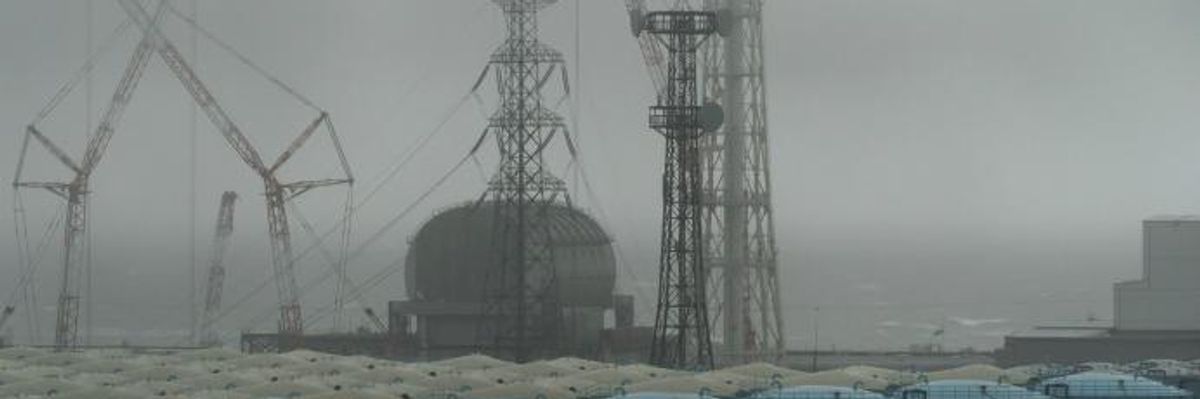
Storage tanks for radioactive water stand at Tokyo Electric Power Co.'s (TEPCO) Fukushima Dai-ichi nuclear power plant on Jan. 29, 2020 in Okuma, Fukushima Prefecture, Japan. Tepco hosted a media tour to the nuclear plant wrecked by an earthquake and tsunami in 2011. (Photo: Tomohiro Ohsumi/Getty Images)
As cleanup of the 2011 Fukushima disaster continues, the Japanese government made its case to embassy officials from 23 countries Monday that dumping contaminated water from the nuclear power plant into the ocean is the best course of action.
According to Kyodo News, officials from the Ministry of Economy, Trade, and Industry claimed releasing the water and evaporating it are both "feasible methods" but said the former could be done "with certainty" because radiation levels could be monitored.
There's more than one million tons of contaminated water already stored at the plant, with 170 tons more added each day. Utility TEPCO says there will be no more capacity for tanks holding contaminated water by 2022.
As Agence France-Presse reported, "The radioactive water comes from several different sources--including water used for cooling at the plant, and groundwater and rain that seeps into the plant daily--and is put through an extensive filtration process."
That process still leaves tritium in the water and "has been found to leave small amounts of other radioactive materials," Kyodo added.
The session for embassy officials followed Friday's recommendation by a Japanese government panel that releasing the water into the ocean was the most feasible plan. As Reuters reported Friday:
The panel under the industry ministry came to the conclusion after narrowing the choice to either releasing the contaminated water into the Pacific Ocean or letting it evaporate--and opted for the former. Based on past practice it is likely the government will accept the recommendation.
Local fishermen oppose the plan and Reuters noted it is "likely to alarm neighboring countries."
They're not alone.
Nuclear policy expert Paul Dorfman said Saturday, "Releasing Fukushima radioactive water into ocean is an appalling act of industrial vandalism."
Greenpeace opposes the plan as well.
Shaun Burnie, a senior nuclear specialist the group's German office, has previously called on Japanese authorities to "commit to the only environmentally acceptable option for managing this water crisis, which is long-term storage and processing to remove radioactivity, including tritium."
Dear Common Dreams reader, It’s been nearly 30 years since I co-founded Common Dreams with my late wife, Lina Newhouser. We had the radical notion that journalism should serve the public good, not corporate profits. It was clear to us from the outset what it would take to build such a project. No paid advertisements. No corporate sponsors. No millionaire publisher telling us what to think or do. Many people said we wouldn't last a year, but we proved those doubters wrong. Together with a tremendous team of journalists and dedicated staff, we built an independent media outlet free from the constraints of profits and corporate control. Our mission has always been simple: To inform. To inspire. To ignite change for the common good. Building Common Dreams was not easy. Our survival was never guaranteed. When you take on the most powerful forces—Wall Street greed, fossil fuel industry destruction, Big Tech lobbyists, and uber-rich oligarchs who have spent billions upon billions rigging the economy and democracy in their favor—the only bulwark you have is supporters who believe in your work. But here’s the urgent message from me today. It's never been this bad out there. And it's never been this hard to keep us going. At the very moment Common Dreams is most needed, the threats we face are intensifying. We need your support now more than ever. We don't accept corporate advertising and never will. We don't have a paywall because we don't think people should be blocked from critical news based on their ability to pay. Everything we do is funded by the donations of readers like you. When everyone does the little they can afford, we are strong. But if that support retreats or dries up, so do we. Will you donate now to make sure Common Dreams not only survives but thrives? —Craig Brown, Co-founder |
As cleanup of the 2011 Fukushima disaster continues, the Japanese government made its case to embassy officials from 23 countries Monday that dumping contaminated water from the nuclear power plant into the ocean is the best course of action.
According to Kyodo News, officials from the Ministry of Economy, Trade, and Industry claimed releasing the water and evaporating it are both "feasible methods" but said the former could be done "with certainty" because radiation levels could be monitored.
There's more than one million tons of contaminated water already stored at the plant, with 170 tons more added each day. Utility TEPCO says there will be no more capacity for tanks holding contaminated water by 2022.
As Agence France-Presse reported, "The radioactive water comes from several different sources--including water used for cooling at the plant, and groundwater and rain that seeps into the plant daily--and is put through an extensive filtration process."
That process still leaves tritium in the water and "has been found to leave small amounts of other radioactive materials," Kyodo added.
The session for embassy officials followed Friday's recommendation by a Japanese government panel that releasing the water into the ocean was the most feasible plan. As Reuters reported Friday:
The panel under the industry ministry came to the conclusion after narrowing the choice to either releasing the contaminated water into the Pacific Ocean or letting it evaporate--and opted for the former. Based on past practice it is likely the government will accept the recommendation.
Local fishermen oppose the plan and Reuters noted it is "likely to alarm neighboring countries."
They're not alone.
Nuclear policy expert Paul Dorfman said Saturday, "Releasing Fukushima radioactive water into ocean is an appalling act of industrial vandalism."
Greenpeace opposes the plan as well.
Shaun Burnie, a senior nuclear specialist the group's German office, has previously called on Japanese authorities to "commit to the only environmentally acceptable option for managing this water crisis, which is long-term storage and processing to remove radioactivity, including tritium."
As cleanup of the 2011 Fukushima disaster continues, the Japanese government made its case to embassy officials from 23 countries Monday that dumping contaminated water from the nuclear power plant into the ocean is the best course of action.
According to Kyodo News, officials from the Ministry of Economy, Trade, and Industry claimed releasing the water and evaporating it are both "feasible methods" but said the former could be done "with certainty" because radiation levels could be monitored.
There's more than one million tons of contaminated water already stored at the plant, with 170 tons more added each day. Utility TEPCO says there will be no more capacity for tanks holding contaminated water by 2022.
As Agence France-Presse reported, "The radioactive water comes from several different sources--including water used for cooling at the plant, and groundwater and rain that seeps into the plant daily--and is put through an extensive filtration process."
That process still leaves tritium in the water and "has been found to leave small amounts of other radioactive materials," Kyodo added.
The session for embassy officials followed Friday's recommendation by a Japanese government panel that releasing the water into the ocean was the most feasible plan. As Reuters reported Friday:
The panel under the industry ministry came to the conclusion after narrowing the choice to either releasing the contaminated water into the Pacific Ocean or letting it evaporate--and opted for the former. Based on past practice it is likely the government will accept the recommendation.
Local fishermen oppose the plan and Reuters noted it is "likely to alarm neighboring countries."
They're not alone.
Nuclear policy expert Paul Dorfman said Saturday, "Releasing Fukushima radioactive water into ocean is an appalling act of industrial vandalism."
Greenpeace opposes the plan as well.
Shaun Burnie, a senior nuclear specialist the group's German office, has previously called on Japanese authorities to "commit to the only environmentally acceptable option for managing this water crisis, which is long-term storage and processing to remove radioactivity, including tritium."