SUBSCRIBE TO OUR FREE NEWSLETTER
Daily news & progressive opinion—funded by the people, not the corporations—delivered straight to your inbox.
5
#000000
#FFFFFF
To donate by check, phone, or other method, see our More Ways to Give page.
Daily news & progressive opinion—funded by the people, not the corporations—delivered straight to your inbox.
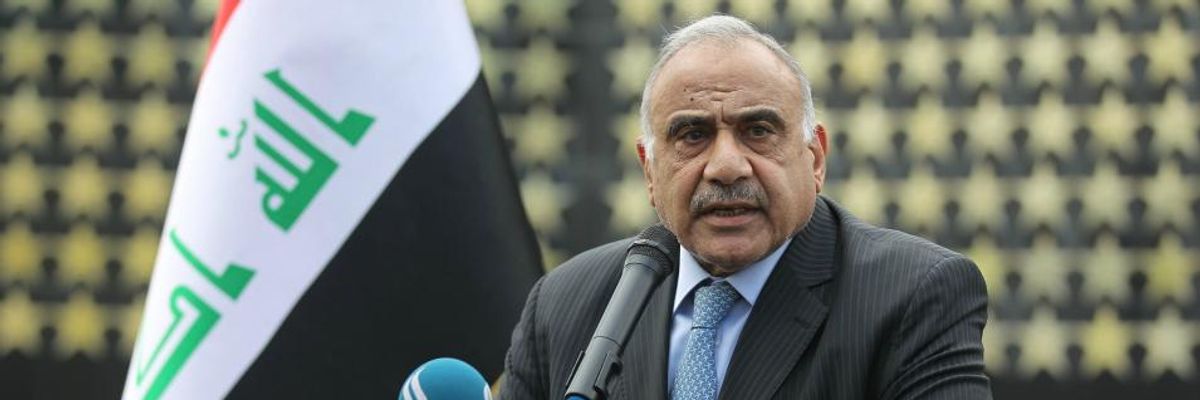
Iraq's Prime Minister Adel Abdel Mahdi speaks during afuneral ceremony in Baghdad on October 23, 2019. (Photo: Ahmad Al-Rubaye/AFP via Getty Images)
Update:
Iraq's parliament voted in an extraordinary session Sunday to expel all American troops from the country and file a United Nations complaint against the U.S. for violating Iraq's sovereignty with its assassination of Iranian General Qasem Soleimani in Baghdad.
Ahead of the vote, chants of "No, no, America" rang out inside the hall.
"Iraq called on the U.N. Security Council to condemn the bombing and assassinations," Iraq's foreign ministry said in a statement following the vote.
As The National reported, the Iraqi parliament approved "a five-point action plan that would require the Iraqi government to end the presence of foreign troops in the country, and withdraw its request for assistance from the anti-ISIS global coalition."
"Parliament also called on the government to ban the use of Iraqi airspace by any foreign power," according to The National. The resolution is non-binding, and the plan to expel American troops still requires the approval of the Iraqi government.
The U.S. currently has around 5,000 troops stationed in Iraq.
Earlier:
Speaking before an extraordinary session of parliament Sunday, Iraq's outgoing Prime Minister Adil Abdul-Mahdi recommended that the nation's lawmakers approve a measure to end U.S. troop presence in "immediately" following the assassination of Iranian General Qasem Soleimani in Baghdad.
The prime minister's remarks came before Iraqi lawmakers are set to vote on a resolution to end permission for American troops to remain in Iraq.
Washington Post reporter Mustafa Salim summarized Mahdi's recommendations:
The U.S. assassination Soleimani on Iraqi soil was met with fierce condemnation from Iraq's foreign ministry and the prime minister, who called the drone strike a violation of the nation's sovereignty.
"What happened was a political assassination," Mahdi said. "Iraq cannot accept this."
In a previously undisclosed detail one observer described as "stunning," Mahdi said Soleimani was in Baghdad to meet with him about a Saudi request for dialogue to relieve tensions in the region--not, as the U.S. has claimed, to plan attacks against American forces.
This country and this world are at a monumental crossroads. US voters have an opportunity to beat back the forces of fascism and confront the billionaires who are rigging the economy, our media system, and our democracy, making it increasingly impossible for ordinary people to get by. We’re not just talking about the election. We’re talking about what must be done once these fascist elements are vanquished from power. We need a bolder set of solutions than what either major party has so far been willing to offer and a working-class movement ready to fight like hell for it. Trump didn't emerge from nowhere. The conditions that fueled MAGA authoritarianism were created by decades of radical neoliberal economic policies and a corrupt political system dominated by corporate interests. They slashed taxes on the super-rich, promising that the benefits would trickle down. They said giveaways to the corporate titans would make life more affordable for the rest of us. It was all bullshit. And when a bitter, betrayed populace searches for someone to blame, right-wing demagogues have little trouble finding scapegoats. People know when they're being lied to, but you won't hear any of this from the corporate media. Only independent journalism—powered and funded by people who believe in building a better world—can deliver truly trustworthy daily news. If you share our vision, please contribute whatever you can to sustain our work. |
Update:
Iraq's parliament voted in an extraordinary session Sunday to expel all American troops from the country and file a United Nations complaint against the U.S. for violating Iraq's sovereignty with its assassination of Iranian General Qasem Soleimani in Baghdad.
Ahead of the vote, chants of "No, no, America" rang out inside the hall.
"Iraq called on the U.N. Security Council to condemn the bombing and assassinations," Iraq's foreign ministry said in a statement following the vote.
As The National reported, the Iraqi parliament approved "a five-point action plan that would require the Iraqi government to end the presence of foreign troops in the country, and withdraw its request for assistance from the anti-ISIS global coalition."
"Parliament also called on the government to ban the use of Iraqi airspace by any foreign power," according to The National. The resolution is non-binding, and the plan to expel American troops still requires the approval of the Iraqi government.
The U.S. currently has around 5,000 troops stationed in Iraq.
Earlier:
Speaking before an extraordinary session of parliament Sunday, Iraq's outgoing Prime Minister Adil Abdul-Mahdi recommended that the nation's lawmakers approve a measure to end U.S. troop presence in "immediately" following the assassination of Iranian General Qasem Soleimani in Baghdad.
The prime minister's remarks came before Iraqi lawmakers are set to vote on a resolution to end permission for American troops to remain in Iraq.
Washington Post reporter Mustafa Salim summarized Mahdi's recommendations:
The U.S. assassination Soleimani on Iraqi soil was met with fierce condemnation from Iraq's foreign ministry and the prime minister, who called the drone strike a violation of the nation's sovereignty.
"What happened was a political assassination," Mahdi said. "Iraq cannot accept this."
In a previously undisclosed detail one observer described as "stunning," Mahdi said Soleimani was in Baghdad to meet with him about a Saudi request for dialogue to relieve tensions in the region--not, as the U.S. has claimed, to plan attacks against American forces.