
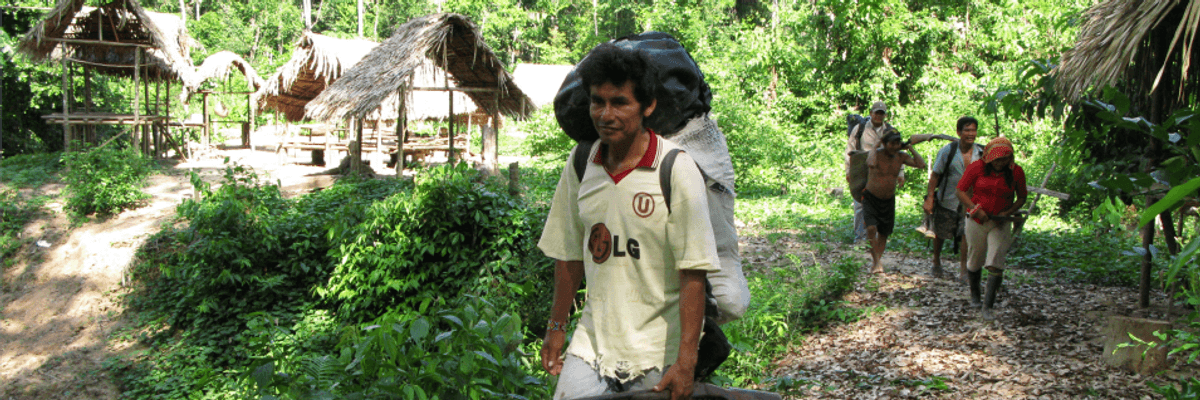
Peruvian anti-logging activist Edwin Chota walks on a trail near the village of Saweto, Peru in 2011. Chota and three other Indigenous activists were killed in 2014, and on Thursday, five men in the logging industry were charged with their murders. (Photo by Scott Wallace/Getty Images)
In 'Glimmer of Accountability,' Executives, Loggers Charged in 2014 Murders of Four Indigenous Land Defenders in Peru
Environmental campaigners called the charges "unprecedented."
Environmental defenders applauded Friday as prosecutors in Peru charged five men in the powerful logging industry with the murders of four Indigenous land protectors.
After a years-long investigation, "Peruvian justice did a 180," said the Rainforest Foundation.
After a years-long investigation, two executives and three loggers were formally accused on Wednesday of murdering Edwin Chota, Jorge Rios Perez, Leoncio Quinticima, and Francisco Pinedo in 2014. The four men had fought illegal logging in the Upper Tamaya-Saweto Ashaninka territory in the Amazon of Peru, where they were found shot to death.
Charges for industry executives in the deaths of land defenders--164 of whom were killed around the world in 2018--are thought to be "unprecedented," according to the Associated Press.
"Five years after the murder of four Indigenous leaders who stood up to illegal loggers in the Peruvian Amazon, the family and community is finally getting some justice," tweeted the Rainforest Foundation.
The news was also praised by the nonprofit Indigenous rights group Amazon Watch and sustainability consultant Andrea Johnson, who applauded the "glimmer of accountability."
Chota, Perez, Quinticima, and Pinedo were found dead after filing formal complaints with prosecutors in their territory about illegal logging.
A 2012 report by the World Bank revealed that about 80 percent of logging exports from Peru are obtained illegally by the timber industry.
The four men were among 10 land defenders from around the world who were killed in 2014 amid disputes with logging industries. According to Global Witness, which tracks the killings of environmental campaigners every year, 116 people were killed that year in struggles against agribusiness, mining companies, and other corporate interests. Forty percent of those killed were Indigenous people.
In the case of the four Indigenous men in Peru, Global Witness reported, "The loggers were able to take advantage of the Peruvian government's failure to fulfill [its] pledge to officially recognize the Indigenous land."
Illegal loggers were immediately suspected by the local community of being behind the killings, but supporters expressed doubt in 2014 that anyone would be held to account.
"There's so much corruption in the regional governments that these logging mafias can kill our brothers with impunity," Henderson Renfigo of the Peruvian Indigenous rights organization AIDESEP told The Guardian at the time.
Prosecutor Otoniel Jara charged the five suspects after authorities who had previously overseen the case abandoned it. The suspects each face up to 35 years in prison if convicted.
"This is good," Ashaninka Diana Rios, the daughter of Jorge Rios, told the AP. "This is not going to be filed away and forgotten."
We are at a crossroads
This country and this world are at a monumental crossroads. In a few short weeks, US voters will have an opportunity to beat back the forces of fascism and confront the billionaires who are rigging the economy, our media system, and our democracy, making it increasingly impossible for ordinary people to get by. We’re not just talking about the election. We’re talking about what must be done once these fascist elements are vanquished from power. We need a bolder set of solutions than what either major party has so far been willing to offer and a working-class movement ready to fight like hell for it. Trump didn't emerge from nowhere. The conditions that fueled MAGA authoritarianism were created by decades of radical neoliberal economic policies and a corrupt political system dominated by corporate interests. They slashed taxes on the super-rich, promising that the benefits would trickle down. They said giveaways to the corporate titans would make life more affordable for the rest of us. It was all bullshit. And when a bitter, betrayed populace searches for someone to blame, right-wing demagogues have little trouble finding scapegoats. People know when they're being lied to, but you won't hear any of this from the corporate media. Only independent journalism—powered and funded by people who believe in building a better world—can deliver truly trustworthy daily news. Our Fall Campaign is underway, and we need your help. To power our newsroom through the rest of the year, we need to raise $125,000 by midnight on October 31. So if you share our vision, please contribute whatever you can to sustain our work. |
Environmental defenders applauded Friday as prosecutors in Peru charged five men in the powerful logging industry with the murders of four Indigenous land protectors.
After a years-long investigation, "Peruvian justice did a 180," said the Rainforest Foundation.
After a years-long investigation, two executives and three loggers were formally accused on Wednesday of murdering Edwin Chota, Jorge Rios Perez, Leoncio Quinticima, and Francisco Pinedo in 2014. The four men had fought illegal logging in the Upper Tamaya-Saweto Ashaninka territory in the Amazon of Peru, where they were found shot to death.
Charges for industry executives in the deaths of land defenders--164 of whom were killed around the world in 2018--are thought to be "unprecedented," according to the Associated Press.
"Five years after the murder of four Indigenous leaders who stood up to illegal loggers in the Peruvian Amazon, the family and community is finally getting some justice," tweeted the Rainforest Foundation.
The news was also praised by the nonprofit Indigenous rights group Amazon Watch and sustainability consultant Andrea Johnson, who applauded the "glimmer of accountability."
Chota, Perez, Quinticima, and Pinedo were found dead after filing formal complaints with prosecutors in their territory about illegal logging.
A 2012 report by the World Bank revealed that about 80 percent of logging exports from Peru are obtained illegally by the timber industry.
The four men were among 10 land defenders from around the world who were killed in 2014 amid disputes with logging industries. According to Global Witness, which tracks the killings of environmental campaigners every year, 116 people were killed that year in struggles against agribusiness, mining companies, and other corporate interests. Forty percent of those killed were Indigenous people.
In the case of the four Indigenous men in Peru, Global Witness reported, "The loggers were able to take advantage of the Peruvian government's failure to fulfill [its] pledge to officially recognize the Indigenous land."
Illegal loggers were immediately suspected by the local community of being behind the killings, but supporters expressed doubt in 2014 that anyone would be held to account.
"There's so much corruption in the regional governments that these logging mafias can kill our brothers with impunity," Henderson Renfigo of the Peruvian Indigenous rights organization AIDESEP told The Guardian at the time.
Prosecutor Otoniel Jara charged the five suspects after authorities who had previously overseen the case abandoned it. The suspects each face up to 35 years in prison if convicted.
"This is good," Ashaninka Diana Rios, the daughter of Jorge Rios, told the AP. "This is not going to be filed away and forgotten."