

SUBSCRIBE TO OUR FREE NEWSLETTER
Daily news & progressive opinion—funded by the people, not the corporations—delivered straight to your inbox.
5
#000000
#FFFFFF
To donate by check, phone, or other method, see our More Ways to Give page.
Daily news & progressive opinion—funded by the people, not the corporations—delivered straight to your inbox.
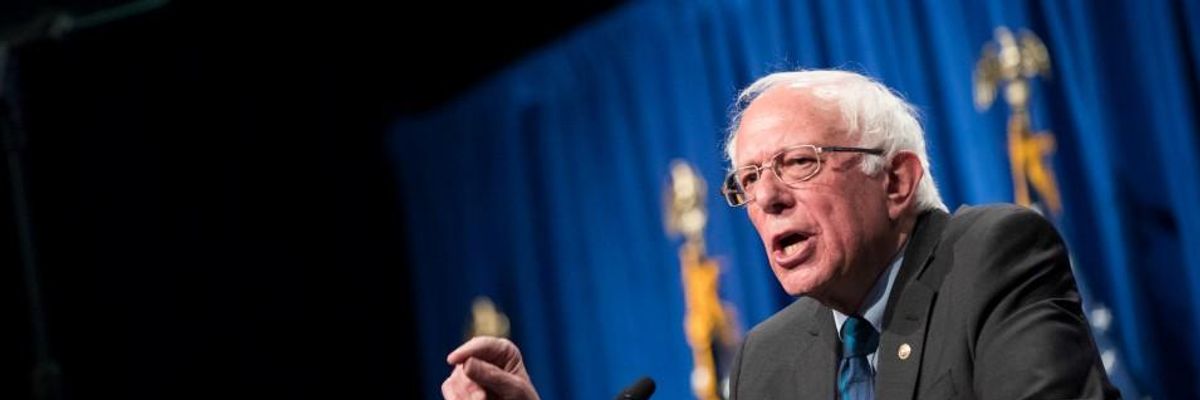
Supporters of Sen. Bernie Sanders (I-Vt.) defended his oft-cited statistic showing that the three richest billionaires in the U.S. own more wealth than the poorest 50 percent of the country, after Washington Post writer Glenn Kessler claimed the fact was "not especially meaningful." (Photo: Sarah Silbiger/Getty Images)
Critics of massive wealth inequality in the United States defended a statistic frequently cited by 2020 presidential candidate Sen. Bernie Sanders on Monday after Glenn Kessler, author of the Washington Post's "Fact Checker" column, claimed the fact that the bottom half of the country has zero or negative wealth was "not especially meaningful."
The statistic in question was brought up most recently by Sanders during the Democratic primary debate last week:
"We have three people in this country owning more wealth than the bottom half of America," Sanders said.
The statement, Kessler said, is factually true--but he rejected Sanders's suggestion that the inequality evidenced by the fact means that a major correction to the U.S. economy is required.
"This snappy talking point is based on numbers that add up, but it's also a question of comparing apples to oranges," Kessler wrote. "But people in the bottom half have essentially no wealth, as debts cancel out whatever assets they might have. So the comparison is not especially meaningful."
Critics denounced Kessler's suggestion that the notion of 50 percent of the population of the world's richest country carrying so much debt that any wealth they own is canceled out, could hold no meaning about the state of the nation's economic system.
The column, wrote Sanders's speechwriter, David Sirota, should be filed under "things you can't make up."
"Glenn Kessler's logic here--that it's 'not meaningful' that the bottom 50 percent of earners have no net worth because they have a bunch of debt that's obscuring all the assets they do have--is a completely nonsensical take," wrote journalist Matthew Chapman.
Kessler's dismissal of the plight of middle-income and lower-income Americans was indicative of the desire of many to ignore "perfectly correct data" which "point out ugly truths" about the United States, wrote Greg Greene, a blogger for Planned Parenthood Action.
This country and this world are at a monumental crossroads. US voters have an opportunity to beat back the forces of fascism and confront the billionaires who are rigging the economy, our media system, and our democracy, making it increasingly impossible for ordinary people to get by. We’re not just talking about the election. We’re talking about what must be done once these fascist elements are vanquished from power. We need a bolder set of solutions than what either major party has so far been willing to offer and a working-class movement ready to fight like hell for it. Trump didn't emerge from nowhere. The conditions that fueled MAGA authoritarianism were created by decades of radical neoliberal economic policies and a corrupt political system dominated by corporate interests. They slashed taxes on the super-rich, promising that the benefits would trickle down. They said giveaways to the corporate titans would make life more affordable for the rest of us. It was all bullshit. And when a bitter, betrayed populace searches for someone to blame, right-wing demagogues have little trouble finding scapegoats. People know when they're being lied to, but you won't hear any of this from the corporate media. Only independent journalism—powered and funded by people who believe in building a better world—can deliver truly trustworthy daily news. If you share our vision, please contribute whatever you can to sustain our work. |
Critics of massive wealth inequality in the United States defended a statistic frequently cited by 2020 presidential candidate Sen. Bernie Sanders on Monday after Glenn Kessler, author of the Washington Post's "Fact Checker" column, claimed the fact that the bottom half of the country has zero or negative wealth was "not especially meaningful."
The statistic in question was brought up most recently by Sanders during the Democratic primary debate last week:
"We have three people in this country owning more wealth than the bottom half of America," Sanders said.
The statement, Kessler said, is factually true--but he rejected Sanders's suggestion that the inequality evidenced by the fact means that a major correction to the U.S. economy is required.
"This snappy talking point is based on numbers that add up, but it's also a question of comparing apples to oranges," Kessler wrote. "But people in the bottom half have essentially no wealth, as debts cancel out whatever assets they might have. So the comparison is not especially meaningful."
Critics denounced Kessler's suggestion that the notion of 50 percent of the population of the world's richest country carrying so much debt that any wealth they own is canceled out, could hold no meaning about the state of the nation's economic system.
The column, wrote Sanders's speechwriter, David Sirota, should be filed under "things you can't make up."
"Glenn Kessler's logic here--that it's 'not meaningful' that the bottom 50 percent of earners have no net worth because they have a bunch of debt that's obscuring all the assets they do have--is a completely nonsensical take," wrote journalist Matthew Chapman.
Kessler's dismissal of the plight of middle-income and lower-income Americans was indicative of the desire of many to ignore "perfectly correct data" which "point out ugly truths" about the United States, wrote Greg Greene, a blogger for Planned Parenthood Action.

