SUBSCRIBE TO OUR FREE NEWSLETTER
Daily news & progressive opinion—funded by the people, not the corporations—delivered straight to your inbox.
5
#000000
#FFFFFF
To donate by check, phone, or other method, see our More Ways to Give page.
Daily news & progressive opinion—funded by the people, not the corporations—delivered straight to your inbox.
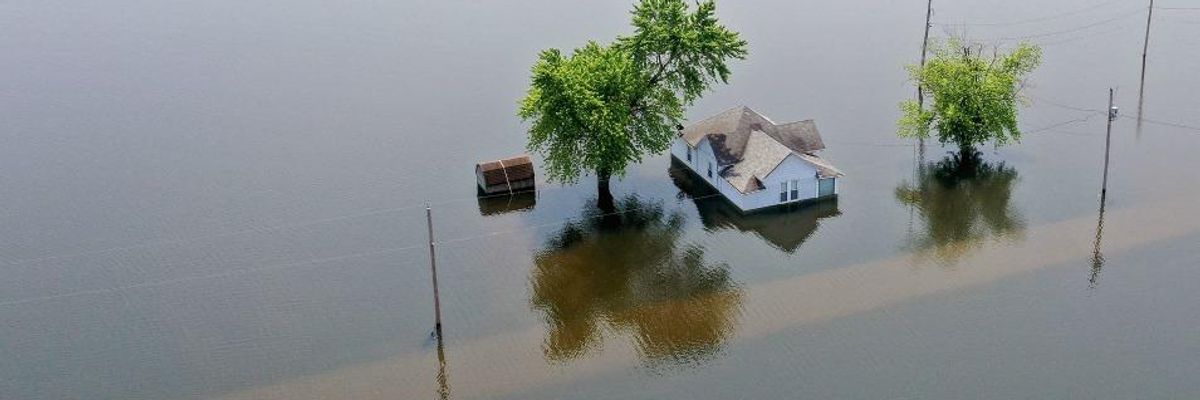
Floodwater from the Mississippi River rises around a home on June 1, 2019 in West Alton, Missouri. The Midwest has been experiencing major flooding since mid-March especially along the Missouri, Arkansas, and Mississippi Rivers. Towns along the Mississippi River have been experiencing the longest stretch of major flooding from the river in nearly a century. (Photo: Scott Olson/Getty Images)
Farmers and residents across the Midwest are currently "living climate change," according to experts and scientists who are observing catastrophic flooding from one of the rainiest springs on record.
Since March, heavy rains in Oklahoma, Arkansas, Missouri, and other states have led the Mississippi River and other waterways to overflow, with the Mississippi cresting at more than 21 feet in one Iowa city on Sunday--the second highest level since historic flooding in 1993 decimated farms, homes, and whole towns.
At least three people have been killed as a result of the floods so far, and tens of thousands have been displaced.
Drone footage from Sunday showed a levee on the Mississippi River breaking, forcing 250 people from their homes in the middle of the night in Winfield, Missouri.
While a rainy season is not necessarily indicative of the effects of the climate crisis, the nonprofit climate action group Earthjustice wrote that the relentlessness of the current flooding and its level of destruction "is not normal."
As Common Dreams reported last week, the especially rainy season has been linked to an unusually high number of tornadoes in the Midwest and all the way to the East Coast in recent weeks. About 270 tornadoes were recorded last month, including several that hit the region over 13 consecutive days.
As National Geographic reported Monday, the floods serve as some of the most tangible evidence that the changing climate is affecting farmers' livelihoods.
Increased water vapor in the atmosphere can result from a warmer climate, and "climate scientists say the devastating rains falling over the Midwest are exactly in line with what they've been predicting," Sarah Gibbons wrote.
"Overall, it's climate change," Donald Wuebbles, an atmospheric scientist at the University of Illinois at Urbana-Champaign, told National Geographic. "We expect an increase in total precipitation in the Midwest, especially in winter and spring, with more coming as larger events."
"We are living climate change right now," added Evan DeLucia, a plant biologist at the university.
For farmers, extreme flooding has meant they are able to plant far less corn and soybeans, as heavy rainfall can be just as damaging to crops as drought and extreme heat. Only 58 percent of the former and 29 percent of the former were planted by the end of May, as growing season was nearly over. Farmers shared the flood's effects on their crops with the hashtag #NoPlant2019.
As a result of the unusually rainy spring, National Geographic reported, farmers can expect to pay more for corn that they use to feed livestock while consumers will likely pay more for corn and soy products as well.
While many of the warnings about the effects of the climate crisis focus on coastal cities being washed away by rising sea levels, Megan Molteni wrote last month at Wired, "climate change will bring more moisture to the middle parts of the country too"--a shift for which the Midwest is poorly equipped.
"After decades of draining wetlands and clearing forests for agricultural use," wrote Molteni, "those changes to the timing, type, and amount of precipitation will fall on a system already profoundly altered in ways that make flooding much more likely."
Dear Common Dreams reader, It’s been nearly 30 years since I co-founded Common Dreams with my late wife, Lina Newhouser. We had the radical notion that journalism should serve the public good, not corporate profits. It was clear to us from the outset what it would take to build such a project. No paid advertisements. No corporate sponsors. No millionaire publisher telling us what to think or do. Many people said we wouldn't last a year, but we proved those doubters wrong. Together with a tremendous team of journalists and dedicated staff, we built an independent media outlet free from the constraints of profits and corporate control. Our mission has always been simple: To inform. To inspire. To ignite change for the common good. Building Common Dreams was not easy. Our survival was never guaranteed. When you take on the most powerful forces—Wall Street greed, fossil fuel industry destruction, Big Tech lobbyists, and uber-rich oligarchs who have spent billions upon billions rigging the economy and democracy in their favor—the only bulwark you have is supporters who believe in your work. But here’s the urgent message from me today. It's never been this bad out there. And it's never been this hard to keep us going. At the very moment Common Dreams is most needed, the threats we face are intensifying. We need your support now more than ever. We don't accept corporate advertising and never will. We don't have a paywall because we don't think people should be blocked from critical news based on their ability to pay. Everything we do is funded by the donations of readers like you. When everyone does the little they can afford, we are strong. But if that support retreats or dries up, so do we. Will you donate now to make sure Common Dreams not only survives but thrives? —Craig Brown, Co-founder |
Farmers and residents across the Midwest are currently "living climate change," according to experts and scientists who are observing catastrophic flooding from one of the rainiest springs on record.
Since March, heavy rains in Oklahoma, Arkansas, Missouri, and other states have led the Mississippi River and other waterways to overflow, with the Mississippi cresting at more than 21 feet in one Iowa city on Sunday--the second highest level since historic flooding in 1993 decimated farms, homes, and whole towns.
At least three people have been killed as a result of the floods so far, and tens of thousands have been displaced.
Drone footage from Sunday showed a levee on the Mississippi River breaking, forcing 250 people from their homes in the middle of the night in Winfield, Missouri.
While a rainy season is not necessarily indicative of the effects of the climate crisis, the nonprofit climate action group Earthjustice wrote that the relentlessness of the current flooding and its level of destruction "is not normal."
As Common Dreams reported last week, the especially rainy season has been linked to an unusually high number of tornadoes in the Midwest and all the way to the East Coast in recent weeks. About 270 tornadoes were recorded last month, including several that hit the region over 13 consecutive days.
As National Geographic reported Monday, the floods serve as some of the most tangible evidence that the changing climate is affecting farmers' livelihoods.
Increased water vapor in the atmosphere can result from a warmer climate, and "climate scientists say the devastating rains falling over the Midwest are exactly in line with what they've been predicting," Sarah Gibbons wrote.
"Overall, it's climate change," Donald Wuebbles, an atmospheric scientist at the University of Illinois at Urbana-Champaign, told National Geographic. "We expect an increase in total precipitation in the Midwest, especially in winter and spring, with more coming as larger events."
"We are living climate change right now," added Evan DeLucia, a plant biologist at the university.
For farmers, extreme flooding has meant they are able to plant far less corn and soybeans, as heavy rainfall can be just as damaging to crops as drought and extreme heat. Only 58 percent of the former and 29 percent of the former were planted by the end of May, as growing season was nearly over. Farmers shared the flood's effects on their crops with the hashtag #NoPlant2019.
As a result of the unusually rainy spring, National Geographic reported, farmers can expect to pay more for corn that they use to feed livestock while consumers will likely pay more for corn and soy products as well.
While many of the warnings about the effects of the climate crisis focus on coastal cities being washed away by rising sea levels, Megan Molteni wrote last month at Wired, "climate change will bring more moisture to the middle parts of the country too"--a shift for which the Midwest is poorly equipped.
"After decades of draining wetlands and clearing forests for agricultural use," wrote Molteni, "those changes to the timing, type, and amount of precipitation will fall on a system already profoundly altered in ways that make flooding much more likely."
Farmers and residents across the Midwest are currently "living climate change," according to experts and scientists who are observing catastrophic flooding from one of the rainiest springs on record.
Since March, heavy rains in Oklahoma, Arkansas, Missouri, and other states have led the Mississippi River and other waterways to overflow, with the Mississippi cresting at more than 21 feet in one Iowa city on Sunday--the second highest level since historic flooding in 1993 decimated farms, homes, and whole towns.
At least three people have been killed as a result of the floods so far, and tens of thousands have been displaced.
Drone footage from Sunday showed a levee on the Mississippi River breaking, forcing 250 people from their homes in the middle of the night in Winfield, Missouri.
While a rainy season is not necessarily indicative of the effects of the climate crisis, the nonprofit climate action group Earthjustice wrote that the relentlessness of the current flooding and its level of destruction "is not normal."
As Common Dreams reported last week, the especially rainy season has been linked to an unusually high number of tornadoes in the Midwest and all the way to the East Coast in recent weeks. About 270 tornadoes were recorded last month, including several that hit the region over 13 consecutive days.
As National Geographic reported Monday, the floods serve as some of the most tangible evidence that the changing climate is affecting farmers' livelihoods.
Increased water vapor in the atmosphere can result from a warmer climate, and "climate scientists say the devastating rains falling over the Midwest are exactly in line with what they've been predicting," Sarah Gibbons wrote.
"Overall, it's climate change," Donald Wuebbles, an atmospheric scientist at the University of Illinois at Urbana-Champaign, told National Geographic. "We expect an increase in total precipitation in the Midwest, especially in winter and spring, with more coming as larger events."
"We are living climate change right now," added Evan DeLucia, a plant biologist at the university.
For farmers, extreme flooding has meant they are able to plant far less corn and soybeans, as heavy rainfall can be just as damaging to crops as drought and extreme heat. Only 58 percent of the former and 29 percent of the former were planted by the end of May, as growing season was nearly over. Farmers shared the flood's effects on their crops with the hashtag #NoPlant2019.
As a result of the unusually rainy spring, National Geographic reported, farmers can expect to pay more for corn that they use to feed livestock while consumers will likely pay more for corn and soy products as well.
While many of the warnings about the effects of the climate crisis focus on coastal cities being washed away by rising sea levels, Megan Molteni wrote last month at Wired, "climate change will bring more moisture to the middle parts of the country too"--a shift for which the Midwest is poorly equipped.
"After decades of draining wetlands and clearing forests for agricultural use," wrote Molteni, "those changes to the timing, type, and amount of precipitation will fall on a system already profoundly altered in ways that make flooding much more likely."