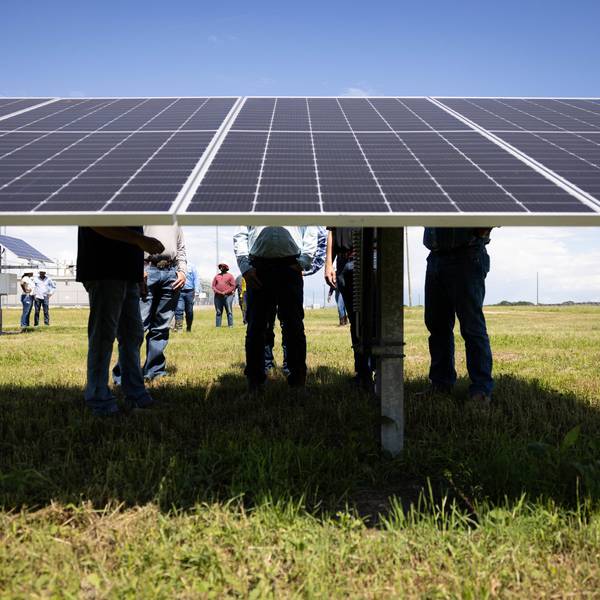

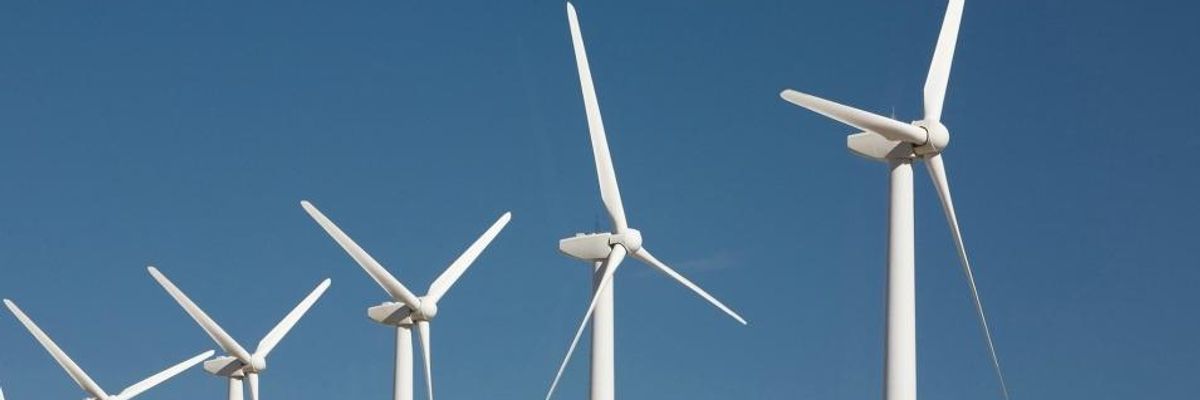
A new study based on data from the Energy Information Agency found that coal plants are now far more expensive to run than wind and solar power projects. (Photo: reynermedia/flickr/cc)
'Simple Laws of Economics' Doom Remaining US Coal Plants as Solar and Wind Are Now Cheaper for American Households
"America has officially entered the 'coal cost crossover.'"
In propping up the coal industry, the Trump administration is not only contributing to dangerous pollution, fossil fuel emissions, and the climate crisis, it is also now clinging to a far more expensive energy production model than renewable energy offers.
That's according to a new report from renewable energy analysis firm Energy Innovation, showing that about three-quarters of power produced by the nation's remaining coal plants is more expensive for American households than renewables including wind, solar, and hydro power.
Energy Innovation based its study on companies' financial filings data from the U.S. Energy Information Administration (EIA). It found that coal has become more expensive as maintenance and anti-pollution compliance costs have risen, while technological advances have made solar and wind power cheaper.
Those trends are expected to continue, and the group predicts that by 2025, 86 percent of coal plants will be producing electricity that is more expensive than renewable energy.
"America has officially entered the 'coal cost crossover'--where existing coal is increasingly more expensive than cleaner alternatives," reads the report.
Climate action advocates applauded the report's findings on social media.
Energy Innovation reported in January that half of all U.S. coal plants have shut down in the last decade, while renewable sources now account for 17 percent of energy production--twice the amount of electricity they provided in 2008.
Monday's study provides the latest evidence that coal production is becoming an increasingly unrealistic method for creating the energy that powers American homes.
"We've seen we are at the 'coal crossover' point in many parts of the country but this is actually more widespread than previously thought," Mike O'Boyle, co-author of the report and electricity policy director for Energy Innovation, told the Guardian. "There is a huge potential for wind and solar to replace coal, while saving people money."
The study calls for a complete drawdown of the use of coal plants in the U.S. But with President Donald Trump intent on putting his environmental policy in the hands of EPA administrator and former coal lobbyist Andrew Wheeler; deregulating the coal industry to allow plants to pollute nearby waterways and soil; and imposing tariffs on solar panels to stop the renewable sector from replacing the dying industry, states have been the ones leading the way in transitioning from fossil fuels.
California and Hawaii announced plans in recent years to shift to 100 percent renewable energy by 2045. New Mexico Gov. Michelle Lujan Grisham signed a bill Monday to move the state's utilities to sustainably-sourced energy by 2045, while Puerto Rican legislators are planning to vote on the issue this week and a number of cities and towns throughout the country have voted to end their dependence on fossil fuels.
"It would be better if we had a federal cohesive policy because not all states will take the initiative," O'Boyle told the Guardian. "In order to get an affordable, clean energy system we need both federal and state actors involved."
Energy Innovation asserted in its report that replacing failing coal plants with renewable energy projects could be an immediate boon for local economies.
We are at a crossroads
This country and this world are at a monumental crossroads. In a few short weeks, US voters will have an opportunity to beat back the forces of fascism and confront the billionaires who are rigging the economy, our media system, and our democracy, making it increasingly impossible for ordinary people to get by. We’re not just talking about the election. We’re talking about what must be done once these fascist elements are vanquished from power. We need a bolder set of solutions than what either major party has so far been willing to offer and a working-class movement ready to fight like hell for it. Trump didn't emerge from nowhere. The conditions that fueled MAGA authoritarianism were created by decades of radical neoliberal economic policies and a corrupt political system dominated by corporate interests. They slashed taxes on the super-rich, promising that the benefits would trickle down. They said giveaways to the corporate titans would make life more affordable for the rest of us. It was all bullshit. And when a bitter, betrayed populace searches for someone to blame, right-wing demagogues have little trouble finding scapegoats. People know when they're being lied to, but you won't hear any of this from the corporate media. Only independent journalism—powered and funded by people who believe in building a better world—can deliver truly trustworthy daily news. Our Fall Campaign is underway, and we need your help. To power our newsroom through the rest of the year, we need to raise $125,000 by midnight on October 31. So if you share our vision, please contribute whatever you can to sustain our work. |
In propping up the coal industry, the Trump administration is not only contributing to dangerous pollution, fossil fuel emissions, and the climate crisis, it is also now clinging to a far more expensive energy production model than renewable energy offers.
That's according to a new report from renewable energy analysis firm Energy Innovation, showing that about three-quarters of power produced by the nation's remaining coal plants is more expensive for American households than renewables including wind, solar, and hydro power.
Energy Innovation based its study on companies' financial filings data from the U.S. Energy Information Administration (EIA). It found that coal has become more expensive as maintenance and anti-pollution compliance costs have risen, while technological advances have made solar and wind power cheaper.
Those trends are expected to continue, and the group predicts that by 2025, 86 percent of coal plants will be producing electricity that is more expensive than renewable energy.
"America has officially entered the 'coal cost crossover'--where existing coal is increasingly more expensive than cleaner alternatives," reads the report.
Climate action advocates applauded the report's findings on social media.
Energy Innovation reported in January that half of all U.S. coal plants have shut down in the last decade, while renewable sources now account for 17 percent of energy production--twice the amount of electricity they provided in 2008.
Monday's study provides the latest evidence that coal production is becoming an increasingly unrealistic method for creating the energy that powers American homes.
"We've seen we are at the 'coal crossover' point in many parts of the country but this is actually more widespread than previously thought," Mike O'Boyle, co-author of the report and electricity policy director for Energy Innovation, told the Guardian. "There is a huge potential for wind and solar to replace coal, while saving people money."
The study calls for a complete drawdown of the use of coal plants in the U.S. But with President Donald Trump intent on putting his environmental policy in the hands of EPA administrator and former coal lobbyist Andrew Wheeler; deregulating the coal industry to allow plants to pollute nearby waterways and soil; and imposing tariffs on solar panels to stop the renewable sector from replacing the dying industry, states have been the ones leading the way in transitioning from fossil fuels.
California and Hawaii announced plans in recent years to shift to 100 percent renewable energy by 2045. New Mexico Gov. Michelle Lujan Grisham signed a bill Monday to move the state's utilities to sustainably-sourced energy by 2045, while Puerto Rican legislators are planning to vote on the issue this week and a number of cities and towns throughout the country have voted to end their dependence on fossil fuels.
"It would be better if we had a federal cohesive policy because not all states will take the initiative," O'Boyle told the Guardian. "In order to get an affordable, clean energy system we need both federal and state actors involved."
Energy Innovation asserted in its report that replacing failing coal plants with renewable energy projects could be an immediate boon for local economies.