
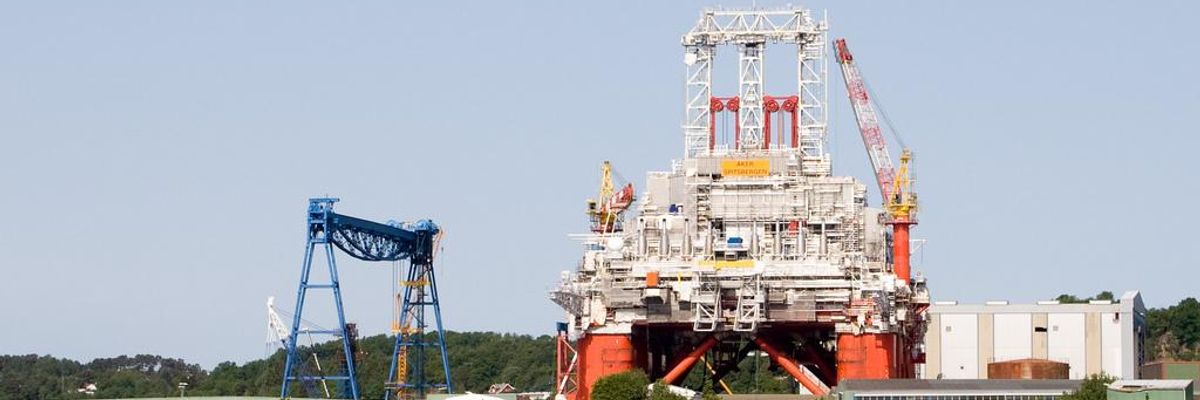
About six percent of Norway's sovereign wealth fund is invested in oil and gas companies--but the countries central bank advised that all those shares be dumped, amid falling oil prices and expectations of a dim future for fossil fuels. (Photo: Guy Beauchamp/Flickr/cc)
'Biggest Pile of Money on the Planet' To Dump Fossil Fuels Holdings
In 'astonishing' move, Norwegian government advised to divest its sovereign wealth fund of all its shares in oil and gas industry
Environmental advocates on Thursday applauded the latest organization to shift away from continued support of the fossil fuel industry--Norway's national bank.
In a move 350.org co-founder Bill McKibben called "astonishing," Norges Bank, which oversees the world's largest sovereign wealth fund, advised the Norwegian government to dump all of its shares in oil and gas companies, leaving those entities out of its $1 trillion fund.
The bank's decision comes two years after Norway's parliament approved a measure calling for the fund to begin divesting from coal companies.
Norges Bank made the new recommendation in light of falling oil prices. Oil and gas are seen as increasingly risky investments as more countries turn to cleaner energy sources in order to meet requirements under the Paris climate agreement, which aims to keep global warming under two degrees Celsius above pre-industrial levels.
While Norway has built much of its sovereign wealth through oil and gas development in the past--six percent of the fund is invested in fossil fuels--it's now home to a fast-growing solar power sector, with solar installations rising by 366 percent from 2015 to 2016.
"It is not surprising that we see the world's largest sovereign wealth fund managers no longer prepared to take the increasing risk associated with oil and gas assets, which do not have a long-term future," said Paul Fisher of the Cambridge Institute for Sustainability Leadership, in an interview with the Guardian.
McKibben compared the bank's recommendation to "the moment when the Rockefellers divested the world's oldest oil fortune" in 2014, when the heirs to Standard Oil said that if founder John D. Rockefeller were alive in the 21st century, "he would be moving out of fossil fuels and investing in clean, renewable energy."
"This is the biggest pile of money on the planet, most of it derived from oil--but that hasn't blinded its owners to the realities of the world we now inhabit," said McKibben.
Nicolo Wojewoda of 350.org Europe was also hopeful about the implications of Norges Bank's decision, calling it "yet another nail in the coffin of the coal, oil, and gas industry."
"To stop climate catastrophe, fossil fuels need to stay in the ground. Investing in them is no longer financially sound, nor morally acceptable, and this proposal is a clear recognition of that," Wojewoda added.
We are at a crossroads
This country and this world are at a monumental crossroads. In a few short weeks, US voters will have an opportunity to beat back the forces of fascism and confront the billionaires who are rigging the economy, our media system, and our democracy, making it increasingly impossible for ordinary people to get by. We’re not just talking about the election. We’re talking about what must be done once these fascist elements are vanquished from power. We need a bolder set of solutions than what either major party has so far been willing to offer and a working-class movement ready to fight like hell for it. Trump didn't emerge from nowhere. The conditions that fueled MAGA authoritarianism were created by decades of radical neoliberal economic policies and a corrupt political system dominated by corporate interests. They slashed taxes on the super-rich, promising that the benefits would trickle down. They said giveaways to the corporate titans would make life more affordable for the rest of us. It was all bullshit. And when a bitter, betrayed populace searches for someone to blame, right-wing demagogues have little trouble finding scapegoats. People know when they're being lied to, but you won't hear any of this from the corporate media. Only independent journalism—powered and funded by people who believe in building a better world—can deliver truly trustworthy daily news. Our Fall Campaign is underway, and we need your help. To power our newsroom through the rest of the year, we need to raise $125,000 by midnight on October 31. So if you share our vision, please contribute whatever you can to sustain our work. |
Environmental advocates on Thursday applauded the latest organization to shift away from continued support of the fossil fuel industry--Norway's national bank.
In a move 350.org co-founder Bill McKibben called "astonishing," Norges Bank, which oversees the world's largest sovereign wealth fund, advised the Norwegian government to dump all of its shares in oil and gas companies, leaving those entities out of its $1 trillion fund.
The bank's decision comes two years after Norway's parliament approved a measure calling for the fund to begin divesting from coal companies.
Norges Bank made the new recommendation in light of falling oil prices. Oil and gas are seen as increasingly risky investments as more countries turn to cleaner energy sources in order to meet requirements under the Paris climate agreement, which aims to keep global warming under two degrees Celsius above pre-industrial levels.
While Norway has built much of its sovereign wealth through oil and gas development in the past--six percent of the fund is invested in fossil fuels--it's now home to a fast-growing solar power sector, with solar installations rising by 366 percent from 2015 to 2016.
"It is not surprising that we see the world's largest sovereign wealth fund managers no longer prepared to take the increasing risk associated with oil and gas assets, which do not have a long-term future," said Paul Fisher of the Cambridge Institute for Sustainability Leadership, in an interview with the Guardian.
McKibben compared the bank's recommendation to "the moment when the Rockefellers divested the world's oldest oil fortune" in 2014, when the heirs to Standard Oil said that if founder John D. Rockefeller were alive in the 21st century, "he would be moving out of fossil fuels and investing in clean, renewable energy."
"This is the biggest pile of money on the planet, most of it derived from oil--but that hasn't blinded its owners to the realities of the world we now inhabit," said McKibben.
Nicolo Wojewoda of 350.org Europe was also hopeful about the implications of Norges Bank's decision, calling it "yet another nail in the coffin of the coal, oil, and gas industry."
"To stop climate catastrophe, fossil fuels need to stay in the ground. Investing in them is no longer financially sound, nor morally acceptable, and this proposal is a clear recognition of that," Wojewoda added.