

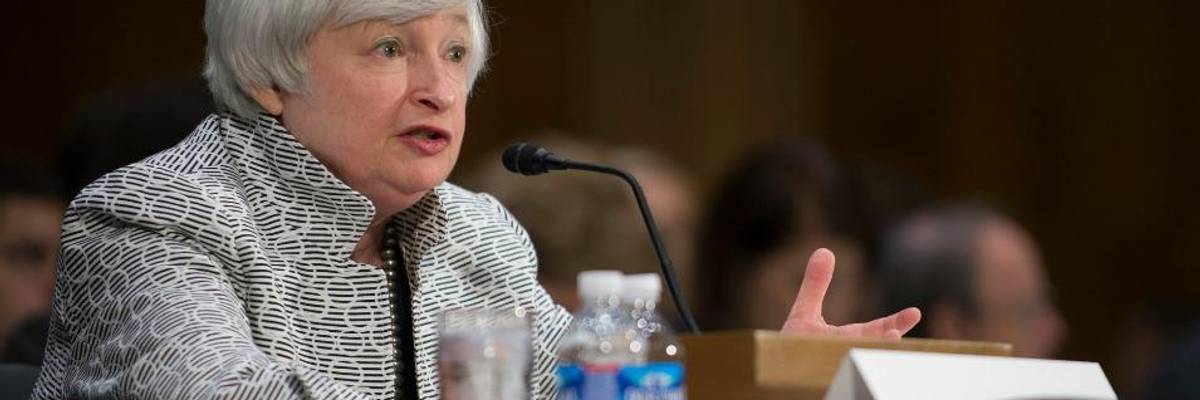
Federal Reserve Chair Janet Yellen speaks to Congress.
Broken US Democracy to Blame for Current Debt Ceiling Crisis
The Republicans must drop this wreck-the-economy threat. But we can't leave it there.
The debt ceiling is an artifact of pre-World War II fiscal policy. In the modern era, it makes no sense that Congress must separately authorize debt to cover spending it has already agreed upon.
Once, it was a quaint bit of Americana. Like the Electoral College, it's no longer charming.
Since the 2011 repeal of the Gephardt Rule—a sensible 1979 reform that allowed Congress to authorize spending and raise the debt limit in a single vote—the debt ceiling has become a cudgel. A party that seizes control of one branch of government—or even half a branch—refuses to raise the debt ceiling. The government is held hostage and a crisis ensues.
It has become a regular tool, unfortunately, for congressional Republicans.
Without genuine democratic reform, we'll be in the same place over, and over, and over again.
They brought the government within days of the "X date" (when the government cannot pay its bills) in 2011. The standoff led Standard & Poor's to downgrade the United States' credit rating. Then in 2012, the Treasury Department had to take "extraordinary measures" as it again approached the debt ceiling.
Indeed, Treasury Secretary Janet Yellen's extraordinary measures to keep the government open for a few more months aren't extraordinary at all—the Treasury has had to deploy them at least seven times since 2011.
Isn't this just political hardball? Yes, parties use whatever tools they have for an advantage. But it is nihilistic to constantly threaten to crash the economy as a negotiation ploy. As bad as all the standoffs of the last decade were, this one is likely to be worse. In 2011, Republicans had specific demands about budget cuts and strong party leaders empowered to make a deal on behalf of the caucus.
Today, the kooky fringe is in control. And, as Jonathan Chait writes in New York magazine, the right wing is "refusing to lift the debt ceiling unless Biden gives them... something. They have not decided what." Let's hope they decide before our government defaults on its debts, potentially triggering a global financial crisis.
As the Brennan Center noted in a day-long conference and series of writings a decade ago, all this reflects some fundamental flaws in our creaky governmental system. We have a Madisonian system of checks, balances, and veto points... and a polarized Western European party system. This new form of extreme obstructionism was relatively new, and we wondered what the consequences would be. In 2016, we found out: dysfunctional government produces populist passion and political strongmen. On this one, unfortunately, the United States was not even remotely exceptional.
Back then, numerous Republicans and conservatives joined our conference to discuss a way out. Now many of them have been drummed out of their own party. Once the debt ceiling threat was used to advance entitlement changes and tax cuts. Now it's a tool for insurrectionists and QAnoners.
How to address the polarization behind so much of this?
One answer is to bar partisan gerrymandering, as the Freedom to Vote: John R. Lewis Act did. Incumbents in hypersafe districts don't fear swing voters, they fear primary challengers. In the Republican Party, they especially fear challengers supported by dark money and billionaire-backed super PACs.
Counterintuitive steps can fortify our system against extortionist lawmakers. One is to bolster the role of political parties, as the Brennan Center has urged, by enabling them to raise more money than is currently allowed. Another is to strengthen the standing committees, which often are venues for bipartisanship (and substantive engagement). My colleague Maya Kornberg has an important new book on that very topic coming out in two weeks.
President Biden is right to stand firm. The Republicans must drop this wreck-the-economy threat. But we can't leave it there. Without genuine democratic reform, we'll be in the same place over, and over, and over again.
We are at a crossroads
This country and this world are at a monumental crossroads. In a few short weeks, US voters will have an opportunity to beat back the forces of fascism and confront the billionaires who are rigging the economy, our media system, and our democracy, making it increasingly impossible for ordinary people to get by. We’re not just talking about the election. We’re talking about what must be done once these fascist elements are vanquished from power. We need a bolder set of solutions than what either major party has so far been willing to offer and a working-class movement ready to fight like hell for it. Trump didn't emerge from nowhere. The conditions that fueled MAGA authoritarianism were created by decades of radical neoliberal economic policies and a corrupt political system dominated by corporate interests. They slashed taxes on the super-rich, promising that the benefits would trickle down. They said giveaways to the corporate titans would make life more affordable for the rest of us. It was all bullshit. And when a bitter, betrayed populace searches for someone to blame, right-wing demagogues have little trouble finding scapegoats. People know when they're being lied to, but you won't hear any of this from the corporate media. Only independent journalism—powered and funded by people who believe in building a better world—can deliver truly trustworthy daily news. Our Fall Campaign is underway, and we need your help. To power our newsroom through the rest of the year, we need to raise $125,000 by midnight on October 31. So if you share our vision, please contribute whatever you can to sustain our work. |
The debt ceiling is an artifact of pre-World War II fiscal policy. In the modern era, it makes no sense that Congress must separately authorize debt to cover spending it has already agreed upon.
Once, it was a quaint bit of Americana. Like the Electoral College, it's no longer charming.
Since the 2011 repeal of the Gephardt Rule—a sensible 1979 reform that allowed Congress to authorize spending and raise the debt limit in a single vote—the debt ceiling has become a cudgel. A party that seizes control of one branch of government—or even half a branch—refuses to raise the debt ceiling. The government is held hostage and a crisis ensues.
It has become a regular tool, unfortunately, for congressional Republicans.
Without genuine democratic reform, we'll be in the same place over, and over, and over again.
They brought the government within days of the "X date" (when the government cannot pay its bills) in 2011. The standoff led Standard & Poor's to downgrade the United States' credit rating. Then in 2012, the Treasury Department had to take "extraordinary measures" as it again approached the debt ceiling.
Indeed, Treasury Secretary Janet Yellen's extraordinary measures to keep the government open for a few more months aren't extraordinary at all—the Treasury has had to deploy them at least seven times since 2011.
Isn't this just political hardball? Yes, parties use whatever tools they have for an advantage. But it is nihilistic to constantly threaten to crash the economy as a negotiation ploy. As bad as all the standoffs of the last decade were, this one is likely to be worse. In 2011, Republicans had specific demands about budget cuts and strong party leaders empowered to make a deal on behalf of the caucus.
Today, the kooky fringe is in control. And, as Jonathan Chait writes in New York magazine, the right wing is "refusing to lift the debt ceiling unless Biden gives them... something. They have not decided what." Let's hope they decide before our government defaults on its debts, potentially triggering a global financial crisis.
As the Brennan Center noted in a day-long conference and series of writings a decade ago, all this reflects some fundamental flaws in our creaky governmental system. We have a Madisonian system of checks, balances, and veto points... and a polarized Western European party system. This new form of extreme obstructionism was relatively new, and we wondered what the consequences would be. In 2016, we found out: dysfunctional government produces populist passion and political strongmen. On this one, unfortunately, the United States was not even remotely exceptional.
Back then, numerous Republicans and conservatives joined our conference to discuss a way out. Now many of them have been drummed out of their own party. Once the debt ceiling threat was used to advance entitlement changes and tax cuts. Now it's a tool for insurrectionists and QAnoners.
How to address the polarization behind so much of this?
One answer is to bar partisan gerrymandering, as the Freedom to Vote: John R. Lewis Act did. Incumbents in hypersafe districts don't fear swing voters, they fear primary challengers. In the Republican Party, they especially fear challengers supported by dark money and billionaire-backed super PACs.
Counterintuitive steps can fortify our system against extortionist lawmakers. One is to bolster the role of political parties, as the Brennan Center has urged, by enabling them to raise more money than is currently allowed. Another is to strengthen the standing committees, which often are venues for bipartisanship (and substantive engagement). My colleague Maya Kornberg has an important new book on that very topic coming out in two weeks.
President Biden is right to stand firm. The Republicans must drop this wreck-the-economy threat. But we can't leave it there. Without genuine democratic reform, we'll be in the same place over, and over, and over again.
- Democrats Can Defeat GOP Extremism by 'Fighting for Working People': Warren ›
- Khanna Warns House GOP Wants to 'Hijack the Entire US Economy' to Cut Social Security ›
- This Is Absurd. The Debt Ceiling Must Be Abolished ›
- Abolish the Debt Ceiling. Do It Now ›
- GOP Members of Congress Threaten Debt Limit Default To Cut ... ›
- How GOP debt ceiling votes decline under Democratic presidents ... ›
- Democratic congressional leaders vow to address U.S. debt limit ... ›
- White House: GOP Plan over Debt Ceiling Is “Recipe for Economic ... ›
- Raise the debt ceiling. Then fix our democracy. | Brennan Center for ... ›
- Debt Ceiling Extortion Is an Attack on Democracy ›
The debt ceiling is an artifact of pre-World War II fiscal policy. In the modern era, it makes no sense that Congress must separately authorize debt to cover spending it has already agreed upon.
Once, it was a quaint bit of Americana. Like the Electoral College, it's no longer charming.
Since the 2011 repeal of the Gephardt Rule—a sensible 1979 reform that allowed Congress to authorize spending and raise the debt limit in a single vote—the debt ceiling has become a cudgel. A party that seizes control of one branch of government—or even half a branch—refuses to raise the debt ceiling. The government is held hostage and a crisis ensues.
It has become a regular tool, unfortunately, for congressional Republicans.
Without genuine democratic reform, we'll be in the same place over, and over, and over again.
They brought the government within days of the "X date" (when the government cannot pay its bills) in 2011. The standoff led Standard & Poor's to downgrade the United States' credit rating. Then in 2012, the Treasury Department had to take "extraordinary measures" as it again approached the debt ceiling.
Indeed, Treasury Secretary Janet Yellen's extraordinary measures to keep the government open for a few more months aren't extraordinary at all—the Treasury has had to deploy them at least seven times since 2011.
Isn't this just political hardball? Yes, parties use whatever tools they have for an advantage. But it is nihilistic to constantly threaten to crash the economy as a negotiation ploy. As bad as all the standoffs of the last decade were, this one is likely to be worse. In 2011, Republicans had specific demands about budget cuts and strong party leaders empowered to make a deal on behalf of the caucus.
Today, the kooky fringe is in control. And, as Jonathan Chait writes in New York magazine, the right wing is "refusing to lift the debt ceiling unless Biden gives them... something. They have not decided what." Let's hope they decide before our government defaults on its debts, potentially triggering a global financial crisis.
As the Brennan Center noted in a day-long conference and series of writings a decade ago, all this reflects some fundamental flaws in our creaky governmental system. We have a Madisonian system of checks, balances, and veto points... and a polarized Western European party system. This new form of extreme obstructionism was relatively new, and we wondered what the consequences would be. In 2016, we found out: dysfunctional government produces populist passion and political strongmen. On this one, unfortunately, the United States was not even remotely exceptional.
Back then, numerous Republicans and conservatives joined our conference to discuss a way out. Now many of them have been drummed out of their own party. Once the debt ceiling threat was used to advance entitlement changes and tax cuts. Now it's a tool for insurrectionists and QAnoners.
How to address the polarization behind so much of this?
One answer is to bar partisan gerrymandering, as the Freedom to Vote: John R. Lewis Act did. Incumbents in hypersafe districts don't fear swing voters, they fear primary challengers. In the Republican Party, they especially fear challengers supported by dark money and billionaire-backed super PACs.
Counterintuitive steps can fortify our system against extortionist lawmakers. One is to bolster the role of political parties, as the Brennan Center has urged, by enabling them to raise more money than is currently allowed. Another is to strengthen the standing committees, which often are venues for bipartisanship (and substantive engagement). My colleague Maya Kornberg has an important new book on that very topic coming out in two weeks.
President Biden is right to stand firm. The Republicans must drop this wreck-the-economy threat. But we can't leave it there. Without genuine democratic reform, we'll be in the same place over, and over, and over again.
- Democrats Can Defeat GOP Extremism by 'Fighting for Working People': Warren ›
- Khanna Warns House GOP Wants to 'Hijack the Entire US Economy' to Cut Social Security ›
- This Is Absurd. The Debt Ceiling Must Be Abolished ›
- Abolish the Debt Ceiling. Do It Now ›
- GOP Members of Congress Threaten Debt Limit Default To Cut ... ›
- How GOP debt ceiling votes decline under Democratic presidents ... ›
- Democratic congressional leaders vow to address U.S. debt limit ... ›
- White House: GOP Plan over Debt Ceiling Is “Recipe for Economic ... ›
- Raise the debt ceiling. Then fix our democracy. | Brennan Center for ... ›
- Debt Ceiling Extortion Is an Attack on Democracy ›