SUBSCRIBE TO OUR FREE NEWSLETTER
Daily news & progressive opinion—funded by the people, not the corporations—delivered straight to your inbox.
5
#000000
#FFFFFF
To donate by check, phone, or other method, see our More Ways to Give page.

Daily news & progressive opinion—funded by the people, not the corporations—delivered straight to your inbox.
"I can think of no good reason why political operators who have demonstrated a blatant disregard for the law would need access to these sensitive, mission-critical systems," Sen. Ron Wyden said.
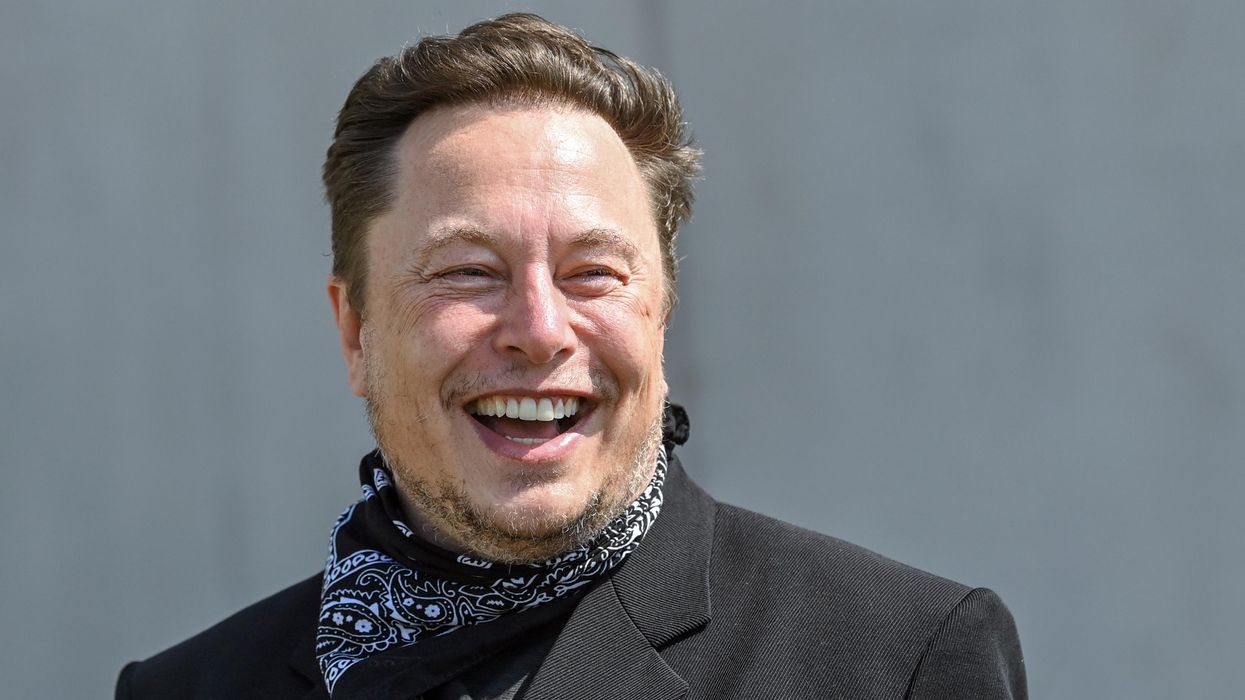
Elon Musk and his team at the Department of Government Efficiency—or DOGE—have been granted access to a sensitive Treasury Department payment system that contains the personal information of every American who receives tax refunds, Medicare, Social Security, and other payments from the government.
Newly approved Treasury Secretary Scott Bessent gave Musk surrogates access to the system late on Friday, five people familiar with the situation told The New York Times. Bessent's decision came the same day as news that David Lebryk, a career Treasury official who was acting secretary before Bessent's confirmation, would step down after arguing with DOGE members over access to the system run by the Bureau of Fiscal Service that pays out over $6 trillion a year.
"Sources tell my office that Treasury Secretary Bessent has granted DOGE *full* access to this system," Sen. Ron Wyden (D-Ore.) wrote on social media on Saturday. "Social Security and Medicare benefits, grants, payments to government contractors, including those that compete directly with Musk's own companies. All of it."
"Americans don't want an unelected and unaccountable billionaire dictating what working families can and cannot afford."
Former Labor Secretary Robert Reich also responded with shock to the news: "An unelected billionaire, with no actual congressional authority or governmentt experience, now has access to Treasury payment systems and sensitive information about millions of Americans who receive Social Security checks, tax refunds, and other payments. What could go wrong?"
The news heightens fears that Musk and the Trump administration are attempting to gain authoritarian control over the federal government by ousting or sidelining career civil servants and undermining Congress, which has the constitutional authority to decide how the government should spend its money.
DOGE gained access to the Treasury payment system on the same day that an official at the Office of Personnel Management said that Musk allies had locked career civil servants out of a computer system containing the personal information of federal employees. The news also capped a week in which the Trump administration attempted to freeze all federal grants and loans, a move that has been temporarily blocked by two judges.
Wyden, the ranking member on the Senate Finance Committee, sent a letter demanding answers from Bessent on Friday when reports first emerged that Musk's team had tried to gain access to the system.
"To put it bluntly, these payment systems simply cannot fail, and any politically motivated meddling in them risks severe damage to our country and the economy," Wyden wrote. "I am deeply concerned that following the federal grant and loan freeze earlier this week, these officials associated with Musk may have intended to access these payment systems to illegally withhold payments to any number of programs. I can think of no good reason why political operators who have demonstrated a blatant disregard for the law would need access to these sensitive, mission-critical systems."
Other Democratic lawmakers also voiced concerns on social media about the news.
"Elon Musk, the richest man on Earth, is rooting around in Social Security and Medicare payment systems. He's reaching his hands into our pockets and firing anyone who tries to stop him. This reeks of corruption—it must stop," Rep. Pramila Jayapal (D.-Wash.) wrote.
Sen. Elizabeth Warren (D-Mass.) called the news "alarming' and said that Congress must investigate.
People familiar with the situation told The New York Times that no payments had yet been blocked and that the stated mission of the DOGE team was to review payments, not to stop them. Musk suggested in a social media post on Friday that he was looking for inapropriate expenditures, but also that blocking funds might be appropriate.
"The DOGE team discovered, among other things, that payment approval officers at Treasury were instructed always to approve payments, even to known fraudulent or terrorist groups," he wrote on social media on Friday. "They literally never denied a payment in their entire career. Not even once."
Former Treasury officials told the Times that funds are dispersed by a comparatively small staff who rely on the agencies that earmark the funds to vet them. Don Hammond, who ran the system at the turn of the millennium, also told The Wall Street Journal that, while there were certain automatic safeguards in place, it was not the role of Treasury to approve or reject specific payments.
"Legally, if you want to stop a payment from taking place, the place to do that is at the agency level," Hammond said.
Responding to the article on social media on Sunday, Groundwork Collaborative executive director Lindsay Owens wrote: "The Treasury system makes the payments (cuts checks). It doesn't decide who to pay or how much. A little like an employer using a payroll processor. Musk has infiltrated the system to stop payments. It's a coup."
In an op-ed published by MSNBC on Saturday, Owens went into greater detail about her concerns, outlining three reasons why Musk might want access to the Treasury payment system.
Owens noted hat Musk wasn't "chasing these cuts for their own sake. He's helping congressional Republicans attempt to pay for a new round of tax breaks for corporations and the ultrawealthy—including Musk himself."
"It's nice to believe in a fantasy in which Musk and DOGE work alongside civil servants to improve technology and services for Americans and save a few bucks along the way. But all evidence points to the contrary," Owens continued. "The richest man in the world, whom no one elected to any government position, is seeking unprecedented access to confidential information, including information pertaining to his own business interests, and seems hell-bent on cutting off as much funding as possible for the programs that matter to the rest of us."
Owens pointed to a recent poll finding that only around one-third of Americans approve of DOGE, and that 52% disapprove of Musk.
"Americans don't want an unelected and unaccountable billionaire dictating what working families can and cannot afford," she concluded. "If Musk is going to continue running the government like one of his failed businesses, perhaps someone should force his 'resignation' too."
For taxing the rich, we currently rely on an income tax based on adjusted gross income as our primary vehicle. That isn’t working.
The Washington, D.C.-based Tax Foundation has long functioned as an apologist for America’s deepest pockets. Analysts at the foundation have spent years assuring us that our wealthiest are paying far more than their fair tax share—in the face of a reality that has our richest aggressively growing their share of the wealth all Americans are creating.
This past August, the Biden administration’s Treasury Department commissioned a new study that documented just how little of their wealth America’s richest are actually paying in taxes. Last month, the Tax Foundation responded with a predictable critique. Our super rich, insists this new Tax Foundation analysis, are still today paying “super amounts of taxes.”
But tax data, as the study Treasury officials released last summer shows, tell a far different story.
If Congress does not at some point soon raise what our ultra-rich pay in taxes as a percentage of their wealth, our grandchildren could well be living in a nation where our richest 0.01% hold half our nation’s wealth, quintuple their current share.
This Treasury study—led by an academic team that included the widely respected economists Emmanuel Saez and Gabriel Zucman—spotlighted a wide variety of stats on the incomes America’s 183.7 million taxpayer units reported and the taxes they paid in 2019.
The report devoted special attention to how much in taxes the nation’s most affluent that year paid, breaking these taxpayers down into wealth categories ranging from our richest 10% to our richest 0.001%. To drill down even deeper, the report tapped annual Forbes 400 data to calculate comparable stats for those households that sit at our nation’s even higher wealth summit.
And what did the Treasury report show? At that summit, the nation’s richest 0.0002%—a group that roughly corresponds in size to the Forbes 400—paid in 2019 federal and state taxes the equivalent of less than 1% of their wealth. The richest of America’s rich, the top 0.00005% of taxpayers, paid in federal and state taxes an amount that equaled just 0.75%.
All these rich did, to be sure, pay some foreign taxes as well. But the richest of America’s rich, even after taking these foreign taxes into account, still paid in taxes less than 1% of their wealth, as this charting of the Treasury Department stats shows.
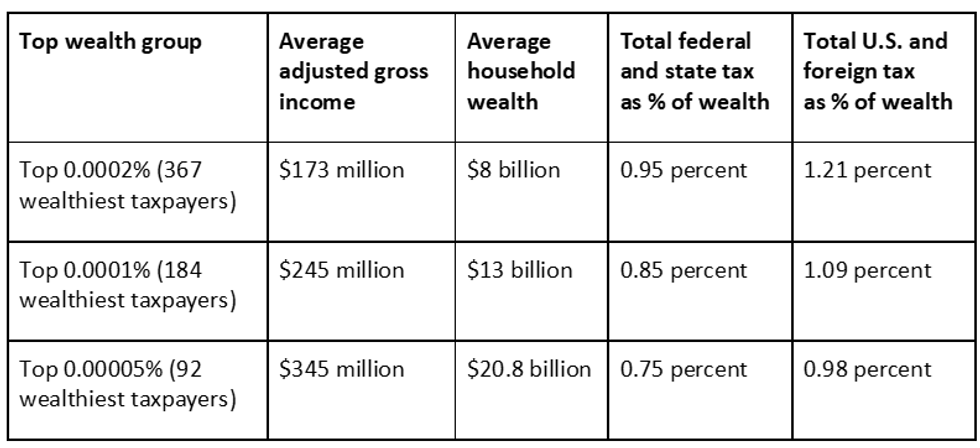
The Tax Foundation’s just-published response to the Treasury data doesn’t dispute the accuracy of any of these figures. The Tax Foundation claims instead that the Treasury report confirms that America’s rich “pay more than one-third of their annual income in federal taxes and more than 45% when state and local taxes are included.”
Indeed, the Tax Foundation adds, the total tax burden on the nation’s super wealthy can, with foreign taxes paid taken into account, run “upwards of 60% of their annual income.”
The key word here: income. The Treasury study, the Tax Foundation charges, “classifies taxpayers according to an estimate of their wealth rather than their income, with the intention of showing that the rich pay very little in taxes.” The rich, the foundation concludes, “are not undertaxed relative to their annual income.”
This Tax Foundation’s claim begs some obvious questions: What yardstick should we use to consider whether our wealthiest are paying an appropriate amount of tax? If our wealthiest, after paying their taxes, are still watching their personal wealth grow at a higher growth rate than the nation’s total wealth, are these wealthy paying their “fair tax share”?
The annual Forbes 400 may be the best place to start our answer to that question. Between 2014 and 2024, the wealth of the Forbes 400 increased from $2.29 trillion to $5.4 trillion. That translates to an annual growth rate of 8.96%, net of taxes and living expenses. Over the same period, America’s total household wealth grew 6.8% annually, increasing from $79.94 trillion to $154.39 trillion.
At those 2014-2024 rates of growth, the share of the nation’s wealth the Forbes 400 holds would double every 35 years. Over the past 42 years, the Forbes 400 share of the nation’s wealth has actually grown at an even faster rate, nearly quadrupling over that four-decade-plus span.
The wealth of our wealthiest has no natural limit. If Congress does not at some point soon raise what our ultra-rich pay in taxes as a percentage of their wealth, our grandchildren could well be living in a nation where our richest 0.01% hold half our nation’s wealth, quintuple their current share.
What level of taxation would be required to stop America’s wealth from concentrating so furiously? To close the gap between the growth rate for the wealth of the richest Americans and our nation’s overall growth in total wealth, current combined federal and state taxes on those at the top would have to rise substantially, at least tripling.
None of these figures should come as a surprise. We’ve known for decades now about the under-taxation of America’s billionaires, a reality that rests on what may be the single most glaring flaw in America’s tax system: “adjusted gross income.” The Internal Revenue Code uses this “AGI” as the starting point for calculating federal income tax due. But “adjusted gross income”—for America’s richest taxpayers—has become and continues to be an entirely meaningless figure.
Consider 2019, the year the Treasury study this past August most closely highlighted. The S&P 500 stock index that year rose 30% between the opening of trading in January and the last trading day in December. For Americans at our nation’s economic summit, that made for a wonderful year. These wealthy derive nearly all their income from their investments.
As we move up the economic scale, the wealth growth of the ultra-rich follows a clear pattern: The economic income—that is, the rate of wealth growth—of the topmost group increases as the size of the group shrinks.
Between 2014 and 2024, for example, the wealth of the 92 richest Americans increased from $1.4 trillion to $3.4 trillion, a jump that translates to an annual growth rate just over 9%. Over that same period, the wealth of remaining 308 in the Forbes 400 grew at a rate of 8.82%. By contrast, in 2019, the average adjusted gross incomes of the top 92 taxpayers and the next 275 taxpayers stood at 1.66% and 3.11% of their average wealth.
In other words, the higher up we go on the wealth ladder, the higher the rate of wealth growth, as we would expect. But adjusted gross income, expressed as a percentage of wealth, decreases. For America’s wealthiest, adjusted gross income bears no relationship to actual economic income. Any estimate of income that places, as the AGI does, the income of the 92 richest Americans at only 1.66% of their wealth rates as essentially useless.
To sharpen this picture even more, consider the increase in tax on America’s wealthiest 367 that would be needed to freeze the increase in their share of our nation’s wealth. Avoiding a further increase in the concentration of the nation’s wealth would require an overall increase in the rate of taxes our top 367 pay to more than 150% of their adjusted gross income. If we limited their overall tax rate to a mere 100% of their adjusted gross income, their share of the country’s wealth would continue to increase.
Where does that leave us? For taxing the rich, we currently rely on an income tax based on adjusted gross income as our primary vehicle. That isn’t working. If we’re going to achieve fair share taxation of the rich, we need to scrap AGI and develop a measure of income that accurately reflects their true economic income. Otherwise, we need to tax wealth directly.
"In their blind loyalty to their mega-donors, Republicans' fixation on giant tax cuts for billionaires has created a revenue problem that is driving up our national debt," said Sen. Sheldon Whitehouse in response to new Treasury Department figures.
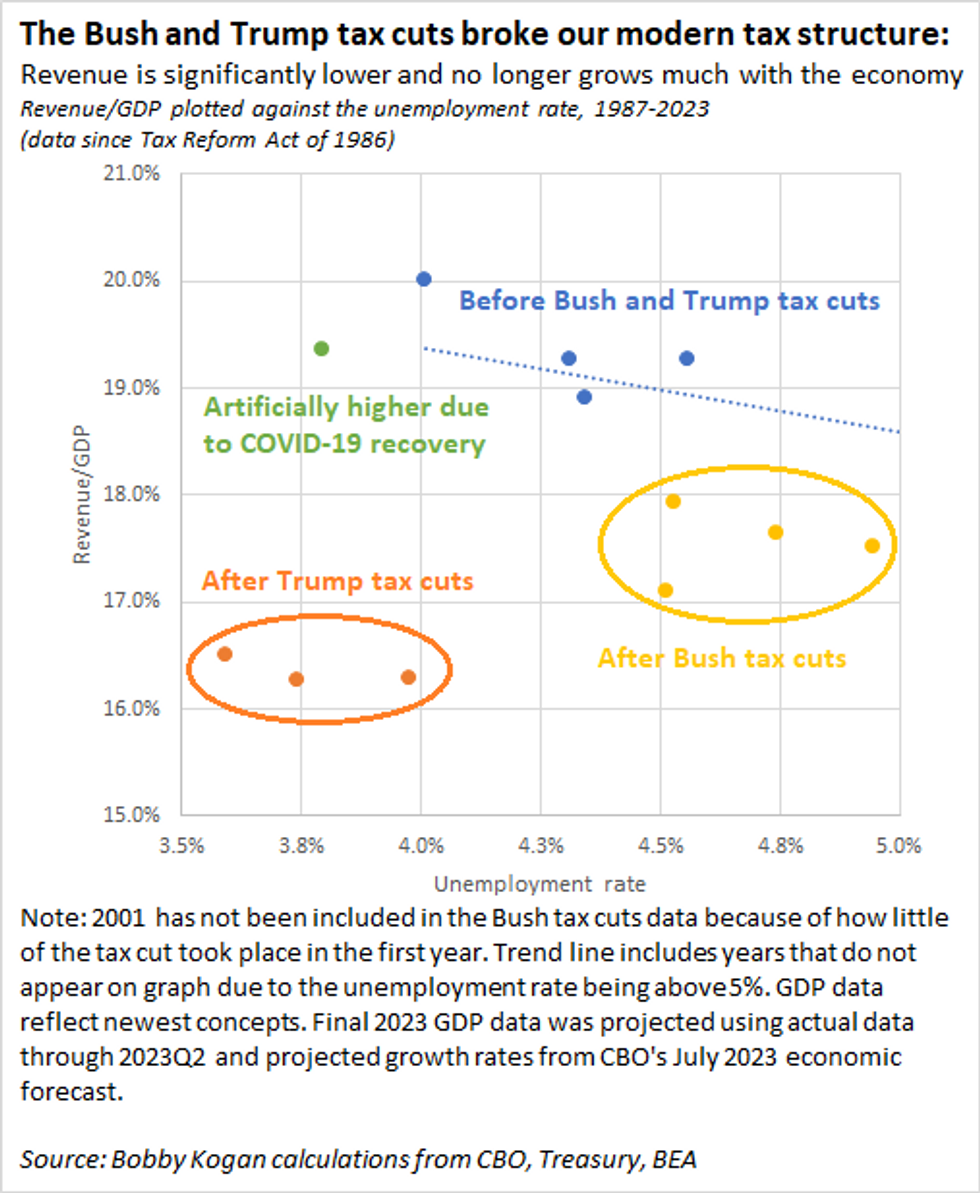
The U.S. Treasury Department on Friday released new figures related to the 2023 budget that showed a troubling drop in the nation's tax revenue compared to GDP—a measure which fell to 16.5% despite a growing economy—and an annual deficit increase that essentially doubled from the previous year.
"After record U.S. government spending in 2020 and 2021" due to programs related to the economic fallout from the Covid-19 crisis, the Washington Post reports, "the deficit dropped from close to $3 trillion to close to $1 trillion in 2022. But rather than continue to fall to its pre-pandemic levels, the deficit unexpectedly jumped this year to roughly $2 trillion."
While much of the reporting on the Treasury figures painted a picture of various and overlapping dynamics to explain the surge in the deficit—including higher payments on debt due to interest rates, tax filing waivers related to extreme weather events, the impact of a student loan forgiveness program that was later rescinded, or a dip in capital gains receipts—progressive tax experts say none of those complexities should act to shield what's at the heart of a budget that brings in less than it spends: tax giveaways to the rich.
Bobby Kogan, senior director for federal budget policy at the Center for American Progress, has argued repeatedly that growing deficits in recent years have a clear and singular chief cause: Republican tax cuts that benefit mostly the wealthy and profitable corporations.
In response to the Treasury figures released Friday, Kogan said that "roughly 75%" of the surge in the deficit and the debt ratio, the amount of federal debt relative to the overall size of the economy, was due to revenue decreases resulting from GOP-approved tax cuts over recent decades. "Of the remaining 25%," he said, "more than half" was higher interest payments on the debt related to Federal Reserve policy.
"We have a revenue problem, due to tax cuts," said Kogan, pointing to the major tax laws enacted under the administrations of George W. Bush and Donald Trump. "The Bush and Trump tax cuts broke our modern tax structure. Revenue is significantly lower and no longer grows much with the economy." And he offered this visualization about a growing debt ratio:
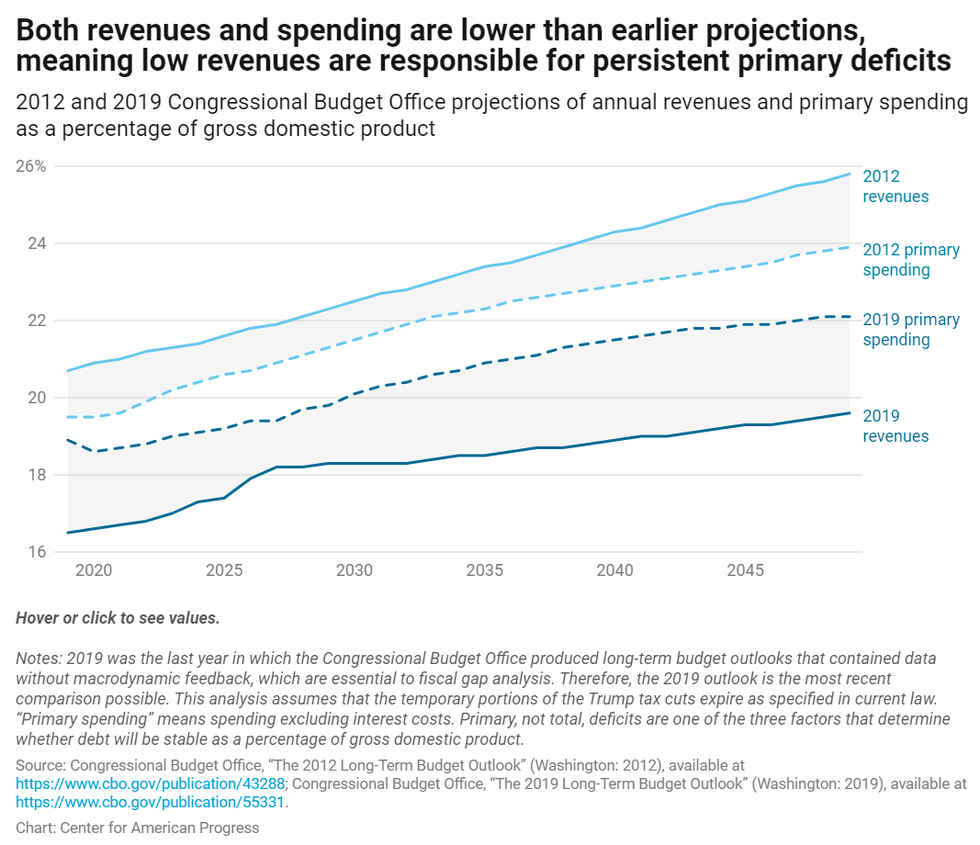
"The point I want to make again and again and again is that, relative to the last time CBO was projecting stable debt/GDP, spending is down, not up," Kogan said in a tweet Friday night. "It's lower revenue that's 100% responsible for the change in debt projections. If you take away nothing else, leave with this point."
In his tweet, Kogan offered the following chart to show recent and projected levels of both federal revenue and spending relative to gross domestic product (GDP):
In a detailed analysis produced in March, Kogan explained that, "If not for the Bush tax cuts and their extensions—as well as the Trump tax cuts—revenues would be on track to keep pace with spending indefinitely, and the debt ratio (debt as a percentage of the economy) would be declining. Instead, these tax cuts have added $10 trillion to the debt since their enactment and are responsible for 57 percent of the increase in the debt ratio since 2001, and more than 90 percent of the increase in the debt ratio if the one-time costs of bills responding to COVID-19 and the Great Recession are excluded."
On Friday, the office of Sen. Sheldon Whitehouse (D-R.I.) cited those same numbers in a press release responding to the Treasury's new report.
"Tax giveaways for the wealthy are continuing to starve the federal government of needed revenue: those passed by former Presidents Trump and Bush have added $10 trillion to the debt and account for 57 percent of the increase in the debt-to-GDP ratio since 2001," read the statement. "If not for those tax cuts, U.S. debt would be declining as a share of the economy."
Whitehouse, who chairs the Senate Budget Committee, said the dip in federal revenue and growth in the overall deficit both have the same primary cause: GOP fealty to the wealthy individuals and powerful corporations that bankroll their campaigns.
"In their blind loyalty to their mega-donors, Republicans' fixation on giant tax cuts for billionaires has created a revenue problem that is driving up our national debt," Whitehouse said Friday night. "Even as federal spending fell over the last year relative to the size of the economy, the deficit increased because Republicans have rigged the tax code so that big corporations and the wealthy can avoid paying their fair share."
Offering a solution, Whitehouse said, "Fixing our corrupted tax code and cracking down on wealthy tax cheats would help bring down the deficit. It would also ensure teachers and firefighters don't pay higher tax rates than billionaires, level the playing field for small businesses, and promote a stronger economy for all."
None of the latest figures—those showing that tax cuts have injured revenues and therefore spiked deficits and increased debt—should be a surprise.
In 2018, shortly after the Trump tax cuts were signed into law, a Congressional Budget Office (CBo) report predicted precisely this result: that revenues would plummet; annual deficits would grow; and not even the promise of economic growth made by Republicans to justify the giveaway would be enough to make up the difference in the budget.
"The CBO's latest report exposes the scam behind the rosy rhetoric from Republicans that their tax bill would pay for itself," Sen. Chuck Schumer (D-N.Y.), and now Senate Majority Leader, said at the time.
"Republicans racked up the national debt by giving tax breaks to their billionaire buddies, and now they want everyone else to pay for them."
In its 2018 report, the CBO predicted the deficit would rise to $804 billion by the end of that fiscal year. Now, for all the empty promises and howling from the GOP and their allied deficit hawks, the economic prescription they forced through Congress has resulted in an annual deficit of more than double that, all while demanding the nation's poorest and most vulnerable pay the price by demanding key social programs—including food aid, education budgets, unemployment benefits, and housing assistance—be slashed.
Meanwhile, the GOP majority in the U.S. House—with or without a Speaker currently holding the gavel—still has plans to extend the Trump tax cuts if given half a chance. In May, a CBO analysis of that pending legislation found that such an extension would add an additional $3.5 trillion to the national debt.
"Republicans racked up the national debt by giving tax breaks to their billionaire buddies, and now they want everyone else to pay for them," Sen. Whitehouse said at the time. "It is one of life's great enigmas that Republicans can keep a straight face while they simultaneously cite the deficit to extort massive spending cuts to critical programs and support a bill that would blow up deficits to extend trillions in tax cuts for the people who need them the least."
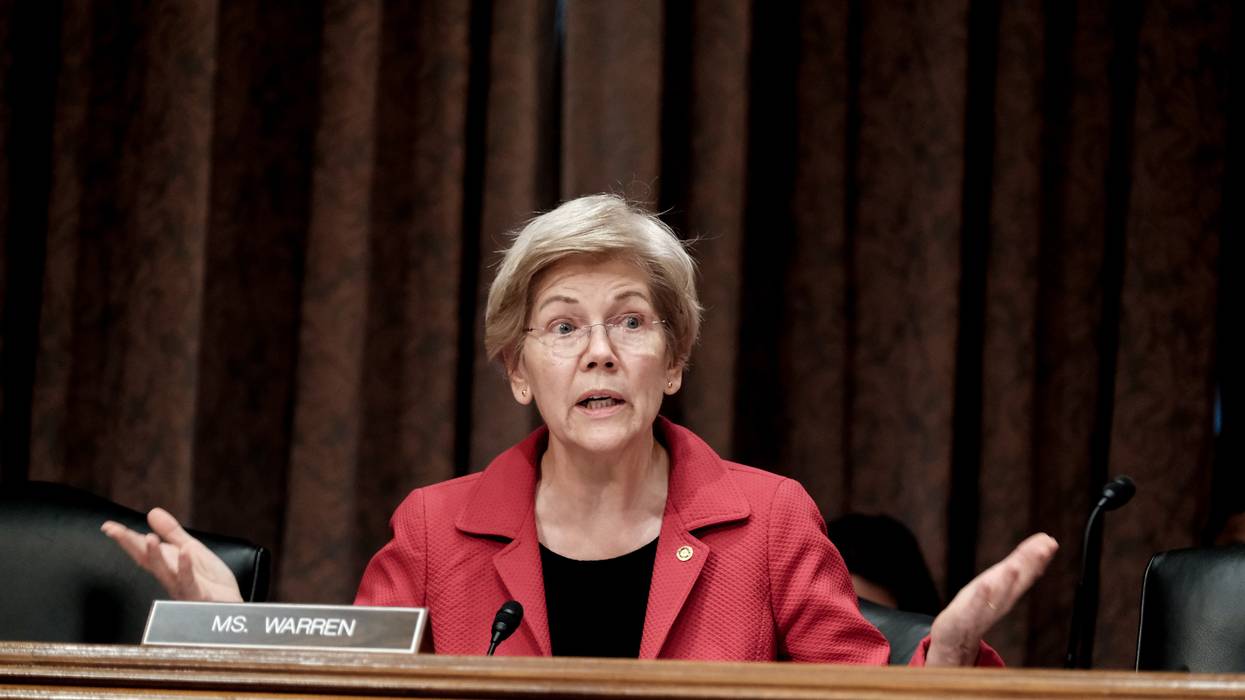
"The recent bank crisis underscores the urgency of strengthening the merger review process and reversing the dangerous trend of bank consolidation."
In the wake of three recent bank failures, U.S. Sen. Elizabeth Warren on Tuesday urged financial regulators to promote competition rather than further consolidation in the industry and improve merger guidelines.
The Massachusetts Democrat's call for action came in a letter to Assistant Attorney General Jonathan Kanter, Federal Deposit Investment Corporation (FDIC) Chairman Gruenberg, Acting Comptroller of the Currency Michael Hsu, Federal Reserve Vice Chair for Supervision Michael Barr, and Treasury Secretary Janet Yellen.
"Earlier this year, a series of fatal errors—poor risk management by bank executives, corporate greed, deregulation, and the lack of sufficient federal supervision—led to the implosion of Silicon Valley Bank, which was shortly followed by the collapses of Signature Bank, and First Republic," she wrote. "Unfortunately, Secretary Yellen and Acting Comptroller Hsu have recently indicated that they appear to be taking the wrong lessons from these bank failures, suggesting that they would like to see more bank consolidation."
"The number of commercial banks in the U.S. has fallen by 70% over the past two decades, and the trend is accelerating."
The letter references reporting from Politico's "Morning Money" (MM) earlier this month. As the outlet detailed:
A top lobbyist for big U.S. banks is hearing more openness from government officials on the topic of mergers for midsize lenders in the wake of banking stress earlier this year. But the industry wants more than just talk.
"There's been something of a sea change in Washington over the last two months," Bank Policy Institute CEO Greg Baer told MM in an interview this week. "I do think, at the highest level, and at the highest levels, there is a recognition that midsize banks need to be allowed to merge and be acquired potentially by larger banks."
"The problem, though, is that's easy to say," he added. "But you have to convince banks that in fact, you mean what you say."
Warren argued to Yellen and the letter's other recipients that "while your agencies are working to update the guidelines under which you evaluate bank mergers, which were last published in 1995, the recent bank crisis underscores the urgency of strengthening the merger review process and reversing the dangerous trend of bank consolidation."
"I have long been concerned with bank concentration and your agencies' failures to curb the proliferation of banks that are 'too big to fail,'" the senator acknowledged, noting that none of the federal banking agencies have formally denied a bank merger application in over 15 years, and the U.S. Department of Justice has not challenged one in more than 35 years.
"Meanwhile, the number of commercial banks in the U.S. has fallen by 70% over the past two decades, and the trend is accelerating with $77 billion in bank mergers and acquisitions in 2021 alone—the 'highest yearly deal volume since the 2008 financial crisis,'" she continued. Such consolidation not only harms consumers and small businesses but also heightens "systemic risk in the financial system, reducing the number of smaller banks and creating even more too-big-to-fail banks."
After highlighting President Joe Biden's 2021 executive order directing financial regulators and the attorney general to review and strengthen bank merger oversight, the senator asserted that allowing additional industry consolidation "would be a dereliction of your responsibilities" as well as a betrayal of the White House's "commitment to promoting competition in the economy."
"Shoring up our banking system will require stronger regulation and more vigorous oversight of big banks to keep them from failing in the first place," Warren contended, "and stronger merger guidelines and rules that significantly check consolidation and limit the size and number of too-big-to-fail banks that put taxpayers at risk."
One of the senator's proposed solutions is the Bank Merger Review Modernization Act, which would limit consolidation in the sector with various policies, including a requirement that mergers are in the public interest.
Her new letter concludes with a series of questions about ongoing work to update bank merger review guidelines—including when those guidelines will be released. She requested responses by July 10.
Warren has recently pressed financial regulators not only via letters but also at congressional hearings—including in May, when she grilled Hsu about the sale of First Republic to JPMorgan Chase, which made the nation's biggest bank even bigger. During that event, the senator declared that "the single biggest threat to the U.S. banking system is concentration."
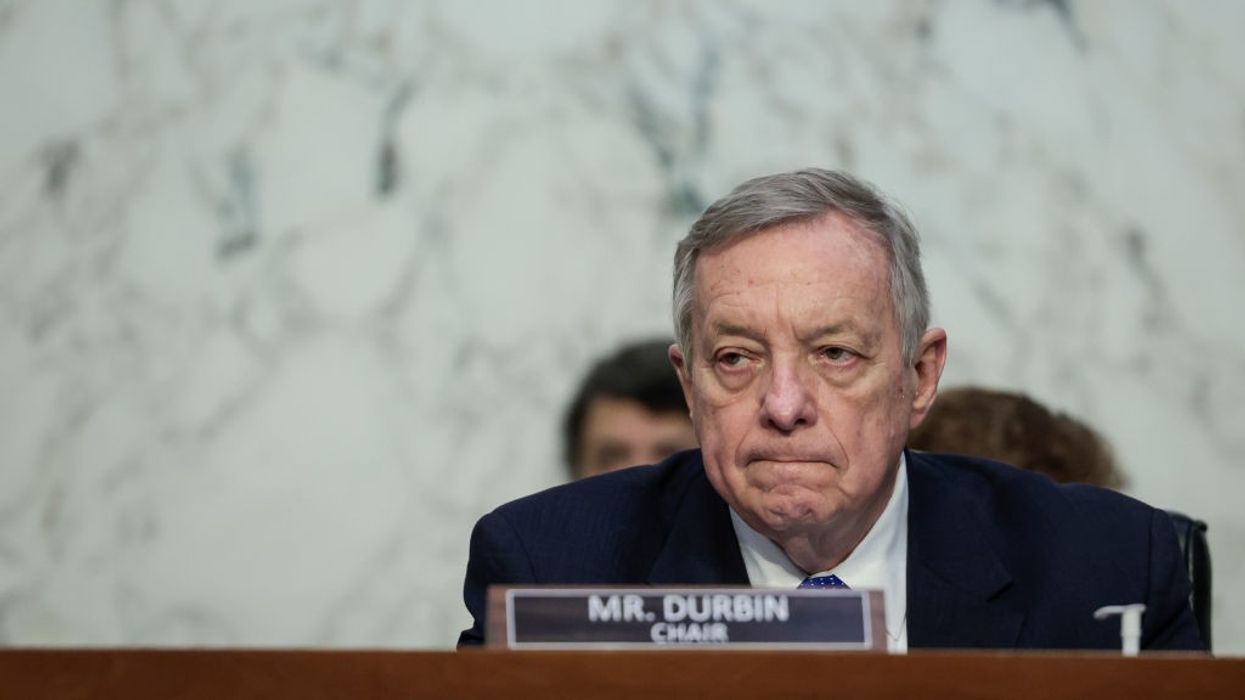
"After a near-catastrophic default thanks to political games by our Republican colleagues, it's time to put the debt ceiling in the hands of the Treasury secretary," said Sen. Dick Durbin.
In the wake of President Joe Biden and Congress just barely averting an economically catastrophic U.S. default, a pair of Democratic leaders on Friday introduced a bill intended to stop Republican lawmakers from holding the economy hostage again.
Contending that the recent crisis proves the current process "is broken and unsustainable," House Budget Committee Ranking Member Brendan Boyle (D-Pa.) and Senate Majority Whip Dick Durbin (D-Ill.) introduced the Debt Ceiling Reform Act.
Boyle and Durbin's move comes after Biden on Saturday signed the so-called Fiscal Responsibility Act—the debt ceiling compromise he negotiated with House Speaker Kevin McCarthy (R-Calif.)—just two days before the default deadline. The deal suspends the borrowing limit until 2025, after the next election cycle, but includes devstating concessions to the GOP.
"A definition of insanity is doing the same thing over and over while expecting a different result. If we do not significantly change the debt ceiling process, Republicans will keep taking our economy hostage and provoking default," Boyle warned. "The Debt Ceiling Reform Act will end Republicans' perennial weaponization of the debt ceiling once and for all by making it harder for extremists to take the debt ceiling hostage."
"This legislation is a sensible response to Republicans' repeated hostage-taking, manufactured default crises, and toxic brinkmanship," he said. "I am proud to join Sen. Durbin in introducing this much-needed legislation to permanently take default off the table and provide the economic stability the American people deserve from their government."
Although the proposal would not fully abolish the arbitrary and arguably unconstitutional debt limit—as some economists, legislators, scholars, and others have called for in response to recent GOP conduct—Boyle and Durbin's legislation would authorize the U.S. Treasury Department to continue paying the nation's bills unless, within 30 days, both chambers pass a veto-proof resolution of disapproval.
The sponsors highlighted that it is similar to what Senate Minority Leader Mitch McConnell (R-Ky.) proposed in 2011, when the Obama administration—for which Biden was vice president—was working with a divided Congress to prevent a historic default.
According to The Wall Street Journal, which exclusively reported on the bill's introduction:
Boyle concedes that the bill's prospects in the Republican-led House are dim, but he said he is hopeful that some GOP lawmakers might be convinced that debt ceiling fights are more trouble than they are worth, particularly after a rebellion from some conservative lawmakers over the latest debt ceiling deal paralyzed the House this week.
"I am hoping that there will be Republican members who are interested in this specific reform," he said.
A similar bill introduced by Boyle and Durbin last Congress had 22 House co-sponsors, all of them Democrats. The new bill has at least 48 House co-sponsors, including former Speaker Nancy Pelosi (D-Calif.). Durbin is the sole Senate sponsor.
"After a near-catastrophic default thanks to political games by our Republican colleagues, it's time to put the debt ceiling in the hands of the Treasury secretary," Durbin declared Friday. "For the sake of the American people and for the good of our economy, we need legislation to reform the way we address the debt ceiling."
"The Debt Ceiling Reform Act is responsible, commonsense legislation that will give the Treasury the authority to raise the debt ceiling," he continued. "If Republicans are truly concerned about the economic well-being of America, they will work with us on this sensible solution."
Meanwhile, calls for Democratic leadership to work toward abolishing the debt limit—whether through the courts or legislation—continue to mount, especially given concerns about a fight over the next hike.
"This round of negotiations was fought to a draw, but the White House backed itself into a corner before the next one even started. The White House may have won a reprieve from fiscal policy fights, but there's a fiscal policy hurricane brewing," Dylan Gyauch-Lewis, a researcher at the Revolving Door Project, wrote Friday for The American Prospect.
If Biden wins reelection next year but the GOP secures a majority in one or both chambers of Congress, Gyauch-Lewis warned, "Republicans will likely be able to again hold the entire global economy hostage. The ransom this time around may well be even more drastic. The GOP, emboldened by their victory, could try to win extensions of spending and tax cuts along with kneecapping the Democratic agenda."
"Arguably, Biden would still find himself embroiled in these negotiations even if Democrats flip the House and hold the Senate; it's entirely plausible that he could need to court moderate votes," he added. "Or Biden may not be able to get everything into a package that can make it through the Senate's reconciliation process, in which case he would need 60 votes, something Democrats almost certainly won't have on their own."
In an OtherWords column this week, Karen Dolan, who directs the Criminalization of Race and Poverty Project at the Institute for Policy Studies, stressed that while this time around, "Biden was able to hold off the worst harm, this deal still causes significant harm to ordinary people and sets a terrible precedent for more hostage-taking."
"Congress should abolish the debt ceiling," she said. "If Congress won't act, the president should intervene with his considerable executive power and invoke Section 4 of the 14th Amendment, which says that the validity of the public debt of the United States 'shall not be questioned.' He could even mint enough money to ensure there would be no default and no harm to families."
While a DOJ attorney declined to disclose the government's position, one observer said it seems to be: "Stop trying to make us... get rid of the debt ceiling. That sort of thing is for high-level insiders only, not pesky labor unions that are going about it all wrong."
With a "significant gap" remaining between what House Republicans and White House negotiators want to resolve the debt limit fight, a federal judge on Tuesday scheduled a hearing next week for a related lawsuit brought by a union for government workers.
Attorneys for the National Association of Government Employees (NAGE)—which represents about 75,000 workers across federal agencies—sued President Joe Biden and Treasury Secretary Yellen in the U.S. District Court for the District of Massachusetts earlier this month. The union's legal team requested emergency action by the court in a filing on Friday.
During a Tuesday videoconference, Judge Richard Stearns gave the U.S. Department of Justice (DOJ) until May 30 to file a response detailing the department's position on presidential authority relating to the public debt and scheduled a hearing for May 31—the eve of the so-called X-date, or when Yellen warns the government could run out of money.
While NAGE wants a decision from the court before the X-date, Stearns, an appointee of former President Bill Clinton, "sounded skeptical of arguments from the union's lawyers that disaster for the nation is impending if he did not put the case on an even faster track," according to Politico.
"If the emergency is as dire as you think it is, I would think that it's within the power of the president to address it using executive branch authority," the judge said. He added that "I understand there are time constraints, given that events are developing probably even as we're meeting, that probably make a decision prior to June 1st impossible."
Politico also noted that during the conference, DOJ lawyer Alexander Ely declined to disclose the department's position on whether the 14th Amendment's declaration that "the validity of the public debt of the United States... shall not be questioned" means the president can disregard the debt limit on constitutional grounds.
Thomas Geoghegan, an attorney for NAGE, said that "what we're faced with, I fear, is that the government doesn't really have a position on this, but there is no time to prevent irreparable injury."
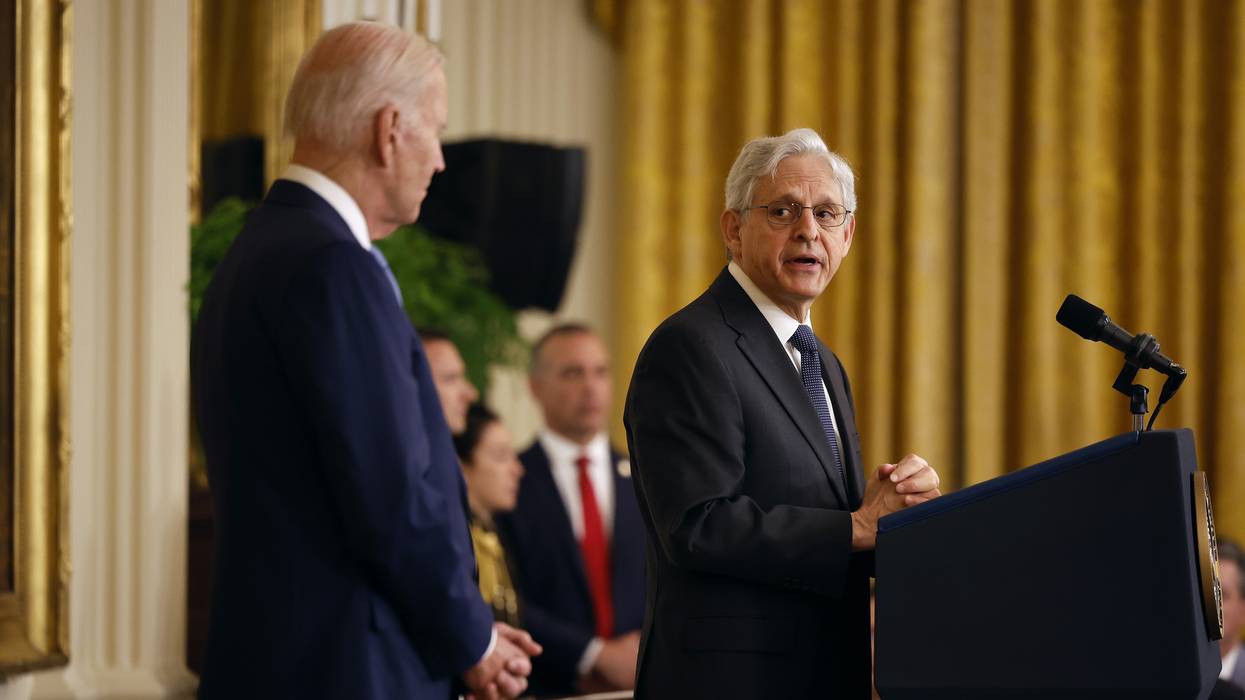
As Common Dreams reported Monday, Revolving Door Project executive director Jeff Hauser argued that not only should U.S. Attorney General Merrick Garland "refuse to defend the unconstitutional legal incoherence that is the debt ceiling," but also the DOJ should "file papers supporting the National Association of Government Employees' request, and should do so as soon as possible."
"NAGE's argument is sound," Hauser said. "While President Biden may be willing to keep channels open until the very last minute with nihilistic, bad-faith Republican lawmakers, the Justice Department's obligation is to the Constitution, which is unequivocal."
The American Prospect executive editor David Dayen—who has been closely following the case—noted on Twitter that the DOJ and NAGE's formal request for the Tuesday conference states that "defendants intend to file an opposition to plaintiff's emergency motion for preliminary injunction."
Law Dork's Chris Geidner responded that "it's not necessarily opposition to the underlying arguments. It's possible that their opposition is either to a court ordering this or employees, through litigation, ordering them to do so. I'd think it would be unusual for any executive to argue otherwise."
The Tuesday conference came as the head of another union representing federal workers sent a letter to the White House.
"Many federal agencies that deliver services directly to the public, like the Social Security Administration, are already at the breaking point from years of inadequate funding," American Federation of Government Employees national president Everett Kelley wrote to Biden, warning the House GOP's proposed spending cuts "would be an economic and humanitarian calamity."
"I urge you not to yield to threats but instead to heed the advice of many legal scholars who have concluded that you have the inherent power, and indeed the duty, to avoid a default under the Constitution's 14th Amendment," Kelley added. "You have additional authorities to mint platinum coins under 31 USC § 5112. Please use these authorities now before it is too late."
As Matt Bruenig, president of the think tank People's Policy Project, highlighted in a blog post Tuesday, minting the coin isn't Biden's only option—he could also have the Treasury "issue bonds with a face value of $0 that only paid its holders a set amount of interest each year for a certain number of years. In this scenario, people would still buy the bonds in order to receive the interest, but there would be no principal and thus no face value."
"My current thinking on the best way for Biden to deal with the debt limit is to sell zero-principal bonds," Bruenig wrote. "These would not count as debt under the wording of the debt limit statute because they have a $0 face value. If this was challenged, then the administration has three different defenses to the challenge: that zero-principal bonds do not contribute to the debt limit, that the debt limit is unconstitutional, and that illegally selling bonds is no more unconstitutional than illegally raising taxes, selling assets, or cutting spending.
"But whichever course of action Biden chooses," he concluded, "we should be clear that he has other options than agreeing to crack the whip against America's poor."
Members of Congress, legal scholars, and even the union representing federal workers are calling on the White House to answer the GOP's economic hostage-taking with unilateral action to prevent a default.
As congressional leaders prepare for a Tuesday meeting at the White House, Congressman Jamie Raskin, a constitutional scholar, affirmed Sunday that if GOP lawmakers won't raise the debt ceiling without major spending cuts, President Joe Biden can invoke the 14th Amendment to keep borrowing and avert a catastrophic first-ever U.S. default.
Section 4 of the 14th Amendment to the U.S. Constitution says in part, "The validity of the public debt of the United States, authorized by law... shall not be questioned."
Asked whether the president could and should use that part of the amendment to combat Republican efforts to hold the global economy hostage, Raskin (D-Md.) told MSNBC's Jen Pskai—Biden's former press secretary—that "I think he has that authority under these circumstances, absolutely, because the Congress has put him in a constitutionally untenable position."
"If he decides to default for the country, he's... violating the Constitution, because the 14th Amendment says you can't do that," Raskin said of Biden, pointing to a New York Times opinion piece by Harvard University professor emeritus Laurence Tribe.
Tribe—whose previous students include Raskin along with former President Barack Obama, U.S. Attorney General Merrick Garland, and Supreme Court Justices John Roberts and Elena Kagan—detailed why he has changed his mind on the debt limit argument.
"The question isn't whether the president can tear up the debt limit statute to ensure that the Treasury Department can continue paying bills submitted by veterans' hospitals or military contractors or even pension funds that purchased government bonds," he wrote Sunday. "The question isn't whether the president can in effect become a one-person Supreme Court, striking down laws passed by Congress."
Tribe continued:
The right question is whether Congress—after passing the spending bills that created these debts in the first place—can invoke an arbitrary dollar limit to force the president and his administration to do its bidding.
There is only one right answer to that question, and it is no.
And there is only one person with the power to give Congress that answer: the president of the United States. As a practical matter, what that means is this: Mr. Biden must tell Congress in no uncertain terms—and as soon as possible, before it's too late to avert a financial crisis—that the United States will pay all its bills as they come due, even if the Treasury Department must borrow more than Congress has said it can.
Praising Tribe's piece for the Times, Rep. Ro Khanna (D-Calif.) tweeted early Monday: "The Treasury has the [constitutional] obligation to pay our debts and spend the money Congress has already directed it to do. It really is that straightforward."
Treasury Secretary Janet Yellen warned in a letter to House Speaker Kevin McCarthy (R-Calif.) last week that "our best estimate is that we will be unable to continue to satisfy all of the government's obligations by early June, and potentially as early as June 1."
Appearing on ABC's "The Week" Sunday, Yellen confirmed the timeline she laid out for the speaker is "still our current thinking" and explained that "we've been using extraordinary measures for several months now, and our ability to do that is running out."
While acknowledging that Biden said Friday he was not yet ready to invoke the 14th Amendment, ABC's George Stephanopoulos asked Yellen if it was still a possibility. She would not explicitly address whether the White House is considering the move, instead stressing that "our priority is to make sure that Congress does its job."
"There is no way to protect our financial system and our economy other than Congress doing its job and raising the debt ceiling and enabling us to pay our bills," Yellen said. "And we should not get to the point where we need to consider whether the president can go on issuing debt. This would be a constitutional crisis."
Led by McCarthy, House Republicans last month passed their so-called Limit, Save, Grow Act, which would raise the debt ceiling by $1.5 trillion or until March 31, 2024—whichever comes first—but also impose dramatic cuts that would notably impact lower-income households. Senate Majority Leader Chuck Schumer (D-N.Y.) has repeatedly called the bill "dead on arrival."
House Minority Leader Hakeem Jeffries (D-N.Y.) and fellow Democrats are working on a "discharge petition" effort to force a vote on a clean bill raising the debt limit, but doing so would require support from at least five Republicans, which is unlikely.
In a Monday letter to Schumer, 43 GOP senators made clear that they are "united behind the House Republican conference in support of spending cuts and structural budget reform as a starting point for negotiations on the debt ceiling."
Meanwhile, Schumer, Jeffries, and other Democratic leaders on Monday released an updated version of their recent report warning that Republicans forcing a default would be catastrophic, "but even the threat of breaching the debt ceiling can have serious economic consequences for families."
Biden is set to meet with McCarthy, Jeffries, Schumer, and Senate Minority Leader Mitch McConnell (R-Ky.) Tuesday "for what he called a separate negotiation on fiscal policy—even though it is effectively linked to the debt limit drama," the Times noted Monday.
The newspaper added:
White House officials said this weekend that Mr. Biden has been publicly and privately adamant that he will not bargain with Republicans over raising the limit. "Let's get it straight: They're trying to hold the debt hostage to get us to agree to some draconian cuts, magnificently difficult and damaging cuts," Mr. Biden told a meeting of cabinet members and other economic officials on Friday.
Citing three unnamed sources with knowledge of internal conversations, The Washington Post reported Monday that White House officials see unilateral actions—from invoking the 14th Amendment to minting a platinum coin worth $1 trillion—as "risky choices that could cause lasting economic damage" but also "do not want to take the proposals completely off the table."
The National Association of Government Employees (NAGE), which represents about 75,000 federal employees, cited the 14th Amendment in a federal lawsuit filed Monday that seeks to have the debt limit law declared unconstitutional.
NAGE's complaint, which names Biden and Yellen as defendants, argues the debt limit statute "is unconstitutional because it puts the president in a quandary to exercise discretion to continue borrowing to pay for the programs which Congress has heretofore duly authorized and for which Congress has appropriated funds or to stop borrowing and to determine which of these programs the president, and not the Congress, will suspend, curtail, or cancel altogether."
The filing adds that NAGE "seeks to protect all its members from additional extraordinary measures as well as major spending-related actions that will necessarily be taken without approval of Congress and that result in layoffs, furloughs, requirements for unpaid work, and loss of funding of the pensions and retirement plans of its members."
"House Democrats are taking action to bring a clean bill raising the debt ceiling to the floor and end this game of high-stakes political chicken," said Democratic Rep. Jasmine Crockett.
House Democrats on Tuesday unveiled their closely held plan to force a vote on a debt ceiling hike "without extreme conditions," a remote bid to prevent the chamber's GOP majority from unleashing an unprecedented and severely damaging U.S. default.
Less than 24 hours after Treasury Secretary Janet Yellen warned that the federal government may not be able to meet its financial obligations beyond June 1 unless Congress raises or suspends the nation's arbitrary borrowing limit before then, House Minority Leader Hakeem Jeffries (D-N.Y.) announced a so-called "discharge petition" effort to "avert the Republican-manufactured default crisis."
The rarely used gambit compels floor action on legislation backed by a majority of House lawmakers. Democrats are seeking to force a vote on a fresh bill to increase the debt ceiling over the objections of Speaker Kevin McCarthy (R-Calif.), who controls the floor and has demanded trillions of dollars in devastating spending cuts in exchange for the GOP votes needed to avoid a worldwide economic disaster.
As The Hill reported:
The discharge petition—an obscure mechanism empowering 218 lawmakers to pass bills the speaker refuses to consider—is almost never successful, because it requires members of the ruling party to defy their own leadership.
Democrats, with 213 members, would need to find five Republicans willing to sign on. And some Republicans are already warning that it'll never happen, especially after GOP leaders last week were successful in passing a debt ceiling package through the lower chamber.
"They're not going to get any Republicans," Rep. Scott Perry (R-Pa.), head of the far-right Freedom Caucus, told the outlet. "We already passed our bill."
The so-called Limit, Save, Grow Act passed last week by House Republicans would raise the debt ceiling, but only in conjunction with measures to slash the nation's already tattered social safety net, weaken efforts to crack down on wealthy tax cheats, repeal clean energy investments, and more.
Senate Majority Leader Chuck Schumer (D-N.Y.) has said the bill is "dead on arrival" in the upper chamber. President Joe Biden—who was vice president in 2011 when GOP lawmakers weaponized the debt ceiling to impose austerity and hurt the nation's credit score in the process—has also refused to entertain Republicans' plot to treat the global economy as a bargaining chip to advance attacks on programs that benefit working-class households.
According to The Hill: "Some moderate Republicans have already floated a willingness to join Democrats on a discharge petition if Congress inches too close to a federal default with no resolution in sight. Rep. Brian Fitzpatrick (R-Pa.), a co-chair of the centrist Problem Solvers Caucus, said earlier in the year that he might do so—'if that's necessary.'"
The challenge before House Democrats, in the words of Steven Harper, is to find "five rational Republicans willing to save the U.S. economy."
In a "Dear Colleague" letter sent to House Democrats on Tuesday, Jeffries wrote:
A dangerous default is not an option. Making sure that America pays its bills—and not the extreme ransom note demanded by Republicans—is the only responsible course of action. Since 1960, the debt ceiling has been extended or revised 78 separate times—49 under Republican administrations and 29 under Democratic presidents.
Most recently, under former President [Donald] Trump, Democrats voted three times to raise the debt ceiling without gamesmanship, brinksmanship, or partisanship. For the good of the country, extreme MAGA Republicans must do the same.
"House Democrats are working to make sure we have all options at our disposal to avoid a default," Jeffries added.
The newly revealed strategy was quietly hatched in January when Rep. Mark DeSaulnier (D-Calif.) introduced "The Breaking the Gridlock Act" and kept confidential until now.
In the wake of Yellen's warning, Rep. Jim McGovern (D-Mass.), the top-ranked Democrat on the House Rules Committee, introduced a "special rule" on Tuesday, during a pro forma session held while the House was in recess.
"The next step in the process is filing a discharge petition, which will start the signature-gathering process," The Hill explained. "The petition, however, cannot be filed for seven legislative days after the special rule is introduced, meaning the earliest signatures can begin to be collected is on May 16."
According to The New York Times, McGovern's "open-ended rule would provide a vehicle to bring Mr. DeSaulnier’s bill to the floor and amend it with a Democratic proposal—which has yet to be written—to resolve the debt limit crisis."
As the newspaper reported:
The strategy is no silver bullet, and Democrats concede it is a long shot. Gathering enough signatures to force a bill to the floor would take at least five Republicans willing to cross party lines if all Democrats signed on, a threshold that Democrats concede will be difficult to reach. They have yet to settle on the debt ceiling proposal itself, and for the strategy to succeed, Democrats would likely need to negotiate with a handful of mainstream Republicans to settle on a measure they could accept.
Still, Democrats argue that the prospect of a successful effort could force House Republicans into a more acceptable deal.
Rep. Jasmine Crockett (D-Texas) described the discharge petition as "an extraordinary action to address the extraordinarily disastrous position Speaker McCarthy has put our country in."
"By using the debt ceiling as a ticking time bomb hanging over the heads of the American people," Crockett continued, "Republicans are threatening to send our country into a full recession if they don't get to check off every box on their extreme conservative wishlist."
"Republicans are treating this debt ceiling negotiation as a hostage situation—with the American people as the hostages," she added. "In response, House Democrats are taking action to bring a clean bill raising the debt ceiling to the floor and end this game of high-stakes political chicken."
According to the Times:
House Democratic leaders have for months played down the possibility of initiating a discharge petition as a way out of the stalemate. They are hesitant to budge from the party position, which Mr. Biden has articulated repeatedly, that Republicans should agree to raise the debt limit with no conditions or concessions on spending cuts.
But behind the scenes, they were simultaneously taking steps to make sure a vehicle was available if needed.
The discharge petition process can be time-consuming and complicated, so Democrats who devised the strategy started early and carefully crafted their legislative vehicle. Insiders privately refer to the measure as a "Swiss Army knife" bill—one that was intended to be referred to every single House committee in order to keep open as many opportunities as possible for forcing it to the floor.
The American Prospect's executive editor, David Dayen, warned on social media that "the timing of a discharge petition is such that this needed to start at the beginning of the Congressional session; probably too late now."
In the absence of congressional action, Yellen—who has supported proposals to permanently eliminate the federal government's borrowing cap as most countries around the world have done—still has the authority to avert an economic calamity by minting a trillion-dollar platinum coin.
On Monday, former Labor Secretary Robert Reich urged Biden to "play hardball by ignoring" the GOP. As legal experts have argued, the 14th Amendment to the U.S. Constitution prohibits "fiscal obstructionism," and even the right-wing-controlled U.S. Supreme Court, some observers predict, would likely support the Biden administration.
"If Congress fails to increase the debt limit, it would cause severe hardship to American families, harm our global leadership position, and raise questions about our ability to defend our national security interests."
After months of taking "extraordinary measures" to prevent a first-ever U.S. default, Treasury Secretary Janet Yellen on Monday warned that "our best estimate is that we will be unable to continue to satisfy all of the government's obligations by early June, and potentially as early as June 1, if Congress does not raise or suspend the debt limit before that time."
Amid calls for a clean bill to raise the nation's arbitrary borrowing limit to avert a default that economists say could be catastrophic for the U.S. and global economies, House Speaker Kevin McCarthy (R-Calif.) and 216 other Republicans last week passed what critics called a "debt ceiling scam" containing "extreme, harmful cuts against average Americans to protect billionaire tax breaks."
McCarthy went ahead with the vote despite Senate Majority Leader Chuck Schumer (D-N.Y.) warning that the House GOP's so-called Limit, Save, Grow Act is "dead on arrival" in the upper chamber, elevating concerns that congressional Republicans will continue risking a global economic crisis in hopes of forcing Democrats to agree to massive spending cuts.
"Given the current projections, it is imperative that Congress act as soon as possible to increase or suspend the debt limit in a way that provides longer-term certainty that the government will continue to make its payments," Yellen wrote to McCarthy on Monday, noting that "it is impossible to predict with certainty the exact date when Treasury will be unable to pay the government's bills."
"We have learned from past debt limit impasses that waiting until the last minute to suspend or increase the debt limit can cause serious harm to business and consumer confidence, raise short-term borrowing costs for taxpayers, and negatively impact the credit rating of the United States," she added. "If Congress fails to increase the debt limit, it would cause severe hardship to American families, harm our global leadership position, and raise questions about our ability to defend our national security interests."
As Yellen sent her notice to McCarthy, Schumer circulated a dear colleague letter declaring that with the vote last week on what Democrats have rebranded the Default on America (DOA) Act, "House Republicans sent a hard-right ransom note to the American people."
Pledging that "the Senate will show the public what this bill truly is" with "hearings to expose the true impact of this reckless legislation on everyday Americans," Schumer added:
Speaker McCarthy has surrendered to the far-right extremist members of his caucus and the DOA is their crown jewel. In backrooms, they pulled together a slew of unpatriotic and harmful policies that would take the country backwards. The DOA would cut critical funding to nearly all sectors of American life meaning fewer jobs, higher costs, and leaving policemen, first responders, border patrol, and our brave veterans all hanging out to dry. The DOA would repeal the historic green energy tax credits from the Inflation Reduction Act, threatening over $150 billion in investments and 18,000 jobs that have been announced since Democrats passed that bill. The DOA would hamper our international standing by gutting funding for critical State Department programs and cutting-edge research facilities and sending jobs overseas.
Let's be perfectly clear: The Republican Default on America Act does nothing to actually resolve the looming debt crisis, and it has no hope of ever becoming law. If anything, the MAGA House Republicans' actions have increased the likelihood of default. It locks the House into an unacceptable and extreme position that pulls us even further apart. If Speaker McCarthy was a serious good-faith negotiator, he would not have let extremists take him hostage and move this debate in the wrong direction.
After reiterating that "the real solution is bipartisan support for a clean bill to increase the debt limit," Schumer concluded that "a reckless Republican-forced default could plunge the country into a deep and painful recession and destabilize the global economy. We will do everything we can to protect the American people and prevent a default."
Meanwhile, President Joe Biden also called out GOP leadership on Monday, saying during a National Small Business Week event that "we pay our bills, and we should do so without reckless hostage-taking from some of the MAGA Republicans in Congress."
Citing two unnamed sources, Politico reported Monday evening that Biden has invited McCarthy, House Minority Leader Hakeem Jeffries (D-N.Y.), Schumer, and Senate Minority Leader Mitch McConnell (R-Ky.)—who has said the speaker and president need to reach an agreement—to "meet at the White House on May 9 to discuss the impending breach of the U.S. debt limit."
In a joint statement Monday, Schumer and Jeffries urged Republicans to "put aside partisan interests and do what is right and necessary for the American people," emphasizing that "we do not have the luxury of waiting until June 1 to come together, pass a clean bill to avoid a default, and prevent catastrophic consequences for our economy and millions of American families."
Earlier Monday, former Labor Secretary Robert Reichnoted that Biden "rightfully says that raising the so-called debt ceiling should not be negotiable" and offered the president some advice: "Ignore McCarthy and the Republican radicals."
"Mr. President, your oath to uphold the Constitution takes precedence. As the supreme law of the land, the Constitution has greater weight than the debt ceiling," Reich wrote. "If House Republicans refuse to raise the debt ceiling, you are obligated by the U.S. Constitution and your oath of office to ignore the debt ceiling and continue to pay the debts of the United States."
"The Republicans want to lure you into a cynical game, Mr. President," he added. "The nation needs you to play hardball by ignoring them."
This post has been updated with a joint statement from Senate Majority Leader Chuck Schumer and House Minority Leader Hakeem Jeffries.
"If management at a wide swath of banks failed to properly address a well-understood risk, they cannot be trusted to independently address other complex emerging risks," argued 50 green groups.
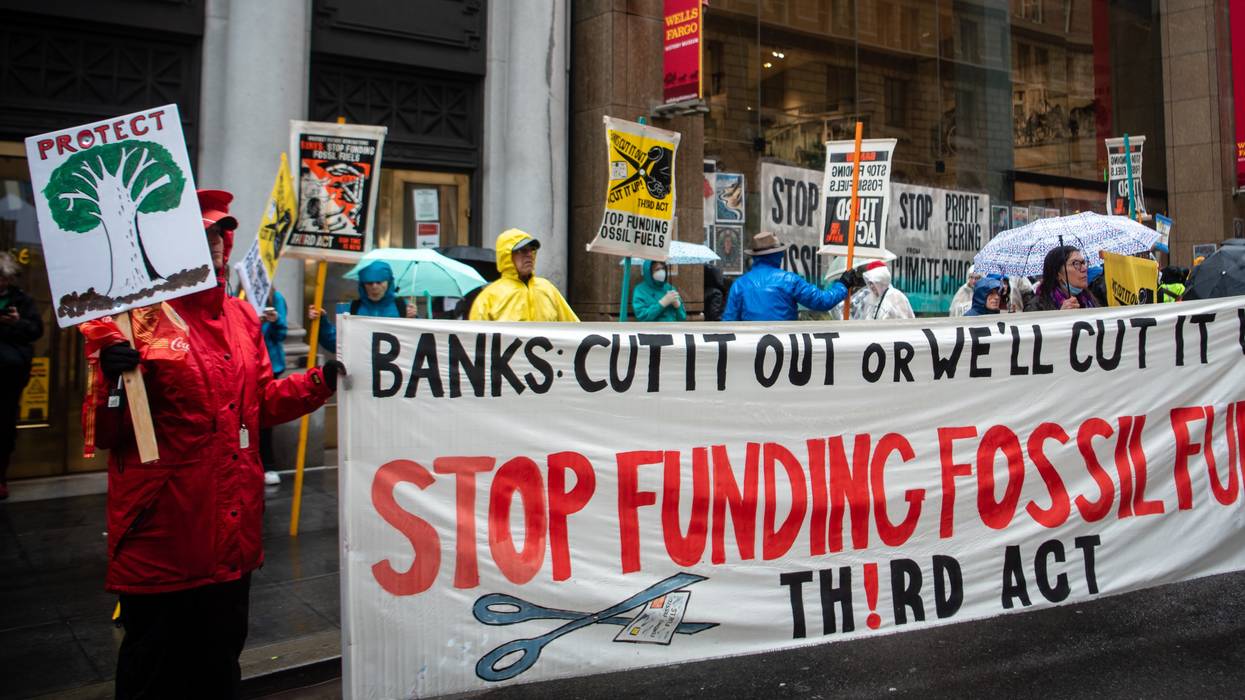
In the wake of recent bank collapses and protests across the United States demanding financial institutions end fossil fuel financing, 50 climate, environmental justice, and Indigenous rights groups on Tuesday advocated for new regulations.
"We the undersigned strongly urge financial regulators and Congress to learn from the collapse and bailout of Silicon Valley Bank (SVB) and rapidly implement new regulations to mitigate against climate-related financial risk," the coalition wrote.
"Climate-related risks are moving us toward a financial crisis. But regulators have not taken adequate steps to actually mitigate those risks."
The groups' letter was sent to key leaders at the U.S. Treasury Department, Federal Reserve, Federal Deposit Insurance Corporation (FDIC), National Economic Council, and relevant U.S. House and Senate committees.
After explaining how the SVB collapse is partly the result of poor management enabled by regulatory rollbacks under the Trump administration, the letter states that "this is only the latest example of a bank being wholly unprepared for a large and obvious financial risk."
The letter continues:
It is a stark reminder of the chaos that can unfold when a financial institution has high exposure to a risky industry, and of the fact that the leaders of major financial institutions are frequently far more concerned with their short-term gains than with robust risk management measures that ensure their safety and the safety and soundness of the financial system. As a reminder of the latter, senior managers at SVB paid themselves millions in bonuses hours before their bank failed and the federal government financially backstopped it. Here again, stronger rules—including the Dodd-Frank executive compensation rules that remain unfinished—could have incentivized greater bank attention to risks.
To prevent any potential for a cascade of bank runs after SVB's collapse, federal regulators have now effectively set a precedent of guaranteeing all bank deposits in all banking institutions nationwide, to be backstopped by the Federal Deposit Insurance Fund and then taxpayer dollars. Moreover, the Federal Reserve has begun lending at extraordinarily generous terms to any other banks with assets whose real value has been curbed by interest rate hikes—in effect, the Fed is offering a first-of-its-kind, get-out-of-bank-failure-free card to any firms that made the same foreseeable mistake as SVB. Regulators justified this extraordinary shift in the structures of American finance by relying on emergency rules in place to prevent systemic risk to the financial system. In effect, regulators argued that SVB's inability to mitigate one of the most obvious forms of financial risk—the potential for rising interest rates amid high inflation—constituted a grave risk to the whole financial system, and, thereby, the whole economy.
"If management at a wide swath of banks failed to properly address a well-understood risk, they cannot be trusted to independently address other complex emerging risks," the groups argued. "Regulators must intervene to protect the financial system from risks associated with climate change and the ongoing transition to a green economy."
The letter notes recent remarks from Treasury Secretary Janet Yellen about the economic and financial impact of the climate emergency as well as how, as it worsens, "banks of all sizes holding mortgage-backed bonds will see their assets drop in value" while "banks invested in the fossil fuel industry will eventually be saddled with stranded assets."
"Climate-related risks are moving us toward a financial crisis. But regulators have not taken adequate steps to actually mitigate those risks," the coalition warned, calling on U.S. policymakers to:
"Banks cannot be trusted to independently evaluate and protect against the systemic risks of the climate crisis in real-time. They also cannot be trusted to avoid creating risks for other institutions and the financial system through their support for fossil assets and greenhouse gas emissions," the letter says. "This process requires regulators to set clear rules and ensure banks and financial institutions do not engage in unsafe behavior and do not create undue risks and costs for the financial system and the economy."
Signatories include Greenpeace USA, Lakota People's Law Project, Sierra Club, and Third Act—who came together earlier this month for a "Stop Dirty Banks" national day of action, the first elderly-led mass climate demonstration in U.S. history.
"Today is a major drive to take the cash out of carbon," declared Third Act's Bill McKibben. "We want JPMorgan Chase, Citi, Wells Fargo, and Bank of America to hear the voices of the older generation which has the money and structural power to face down their empty, weasel words on climate. We will not go to our graves quietly knowing that the financial institutions in our own communities continue to fund the climate crisis."