
The first marathon, legend has it, occurred in ancient Greece in 490 B.C. The Athenians had repelled an invasion by the Persians, and a messenger was dispatched to run from the scene of the battle, the city of Marathon, to the capital at Athens, with news of the victory. He ran the distance, about 26 miles, delivered his message and collapsed, dying on the spot. Scholars question the accuracy of the legend, but it persists as a founding myth of the popular event. The future of the marathon, and of the Summer Olympics in general, may be at risk. A report just published in the British medical journal The Lancet suggests that by the year 2085, almost all of the cities that could host the Summer Games will be too hot for outdoor events.
"The marathon is the most demanding endurance event, and thus provides a fair indication of whether conditions are likely to be safe for any other Olympic event," wrote the scientists, led by Kirk Smith, professor of global environmental health at the University of California, Berkeley. They noted that extreme high temperatures have already caused marathons to be canceled, like the 2007 Chicago Marathon. At the U.S. Olympic marathon trials held in Los Angeles to choose the team for the Rio Olympic Games this year, 30 percent of the runners dropped out of the race due to the heat. "By 2085, only eight (1.5 percent) of 543 cities outside of western Europe would meet the low-risk category," they wrote.
The Lancet researchers made use of the global attention being paid to the Olympics to make a bigger point: "The world beyond 2050 poses increasingly difficult challenges ... because the extent and speed of change might exceed society's ability to adapt." Half the world's workers work outdoors, they note, and, increasingly, the outdoors, and indoor spaces without cooling, are becoming unsafe. They warn that "exertional heat stroke and its negative outcomes, including mortality, will become a large part of outdoor work around the world." Drawing from another sports example, thousands of workers are toiling in extreme heat in Qatar, building the stadiums for the 2022 World Cup soccer championships. The International Trade Union Confederation estimates that "more than 7,000 workers will die before a ball is kicked in the 2022 World Cup."

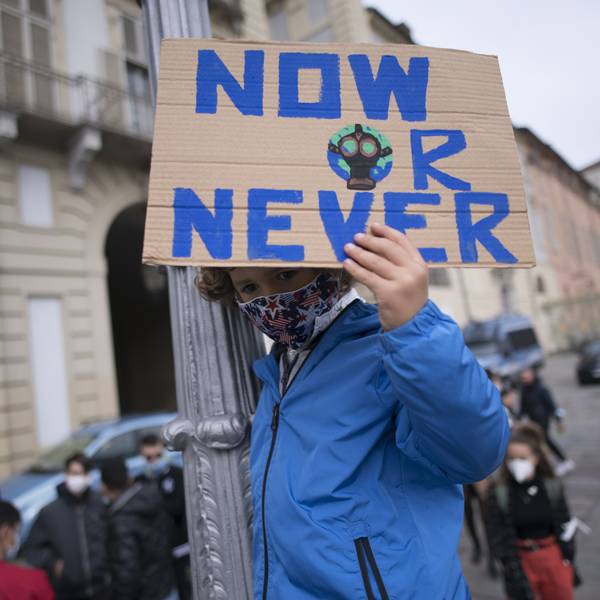
These dire conditions stress the urgent need to address the threat of climate disruption. The Paris Agreement reached last December aspires to limit the global average temperature rise to 1.5 degrees Celsius, at the most 2 degrees C (2.7-3.6 degrees Fahrenheit). The science increasingly suggests that the climate is changing faster than predicted, and that urgent action is needed now. With each passing day of debate and half-measures, the problem gets harder--if not impossible--to solve.
Historically, the world's greatest emitter of greenhouse gases has been the United States. We have been burning fossil fuels with abandon for centuries. According to the U.S. Energy Information Administration, "Three fossil fuels--petroleum, natural gas, and coal--have provided more than 80 percent of total U.S. energy consumption for more than 100 years." While renewable sources, primarily wind and solar, are increasing, these are still a fraction of where they need to be in order to meet the pledges made in Paris at the "COP 21" climate summit.
President Barack Obama just announced what will likely be his final order on vehicle fuel-efficiency standards. His climate legacy is now set, and is remarkably limited (noting, of course, the staunch opposition of the climate-change deniers in the Republican Party leadership). What of Obama's two most likely successors, though? Hillary Clinton acknowledges that climate change is an urgent issue, but signaled otherwise when, this week, she announced that her transition team will be led by Ken Salazar, former interior secretary and former U.S. senator from Colorado. Salazar has enthusiastically pushed fracking and is a proponent of both the Keystone XL pipeline and the Trans-Pacific Partnership.
Donald Trump, meanwhile, has described climate change as a "hoax." As Trump received his first classified U.S. national-security briefing this week, the Gulf Coast is suffering from sustained rain and flooding, with at least 11 people killed and more than 20,000 people evacuated from their homes in and around Baton Rouge. In Southern California, wildfires rage, spurred by severe, climate-change-induced drought, forcing more than 82,000 people from their homes. July was also the hottest month in recorded history. As part of his classified briefing, Trump should be shown the Pentagon's findings, which for years now have identified climate change as one of the most serious threats to our national security.
The first marathon, legend has it, occurred in ancient Greece in 490 B.C. The Athenians had repelled an invasion by the Persians, and a messenger was dispatched to run from the scene of the battle, the city of Marathon, to the capital at Athens, with news of the victory. He ran the distance, about 26 miles, delivered his message and collapsed, dying on the spot. Scholars question the accuracy of the legend, but it persists as a founding myth of the popular event. The future of the marathon, and of the Summer Olympics in general, may be at risk. A report just published in the British medical journal The Lancet suggests that by the year 2085, almost all of the cities that could host the Summer Games will be too hot for outdoor events.
"The marathon is the most demanding endurance event, and thus provides a fair indication of whether conditions are likely to be safe for any other Olympic event," wrote the scientists, led by Kirk Smith, professor of global environmental health at the University of California, Berkeley. They noted that extreme high temperatures have already caused marathons to be canceled, like the 2007 Chicago Marathon. At the U.S. Olympic marathon trials held in Los Angeles to choose the team for the Rio Olympic Games this year, 30 percent of the runners dropped out of the race due to the heat. "By 2085, only eight (1.5 percent) of 543 cities outside of western Europe would meet the low-risk category," they wrote.
The Lancet researchers made use of the global attention being paid to the Olympics to make a bigger point: "The world beyond 2050 poses increasingly difficult challenges ... because the extent and speed of change might exceed society's ability to adapt." Half the world's workers work outdoors, they note, and, increasingly, the outdoors, and indoor spaces without cooling, are becoming unsafe. They warn that "exertional heat stroke and its negative outcomes, including mortality, will become a large part of outdoor work around the world." Drawing from another sports example, thousands of workers are toiling in extreme heat in Qatar, building the stadiums for the 2022 World Cup soccer championships. The International Trade Union Confederation estimates that "more than 7,000 workers will die before a ball is kicked in the 2022 World Cup."
These dire conditions stress the urgent need to address the threat of climate disruption. The Paris Agreement reached last December aspires to limit the global average temperature rise to 1.5 degrees Celsius, at the most 2 degrees C (2.7-3.6 degrees Fahrenheit). The science increasingly suggests that the climate is changing faster than predicted, and that urgent action is needed now. With each passing day of debate and half-measures, the problem gets harder--if not impossible--to solve.
Historically, the world's greatest emitter of greenhouse gases has been the United States. We have been burning fossil fuels with abandon for centuries. According to the U.S. Energy Information Administration, "Three fossil fuels--petroleum, natural gas, and coal--have provided more than 80 percent of total U.S. energy consumption for more than 100 years." While renewable sources, primarily wind and solar, are increasing, these are still a fraction of where they need to be in order to meet the pledges made in Paris at the "COP 21" climate summit.
President Barack Obama just announced what will likely be his final order on vehicle fuel-efficiency standards. His climate legacy is now set, and is remarkably limited (noting, of course, the staunch opposition of the climate-change deniers in the Republican Party leadership). What of Obama's two most likely successors, though? Hillary Clinton acknowledges that climate change is an urgent issue, but signaled otherwise when, this week, she announced that her transition team will be led by Ken Salazar, former interior secretary and former U.S. senator from Colorado. Salazar has enthusiastically pushed fracking and is a proponent of both the Keystone XL pipeline and the Trans-Pacific Partnership.
Donald Trump, meanwhile, has described climate change as a "hoax." As Trump received his first classified U.S. national-security briefing this week, the Gulf Coast is suffering from sustained rain and flooding, with at least 11 people killed and more than 20,000 people evacuated from their homes in and around Baton Rouge. In Southern California, wildfires rage, spurred by severe, climate-change-induced drought, forcing more than 82,000 people from their homes. July was also the hottest month in recorded history. As part of his classified briefing, Trump should be shown the Pentagon's findings, which for years now have identified climate change as one of the most serious threats to our national security.
The first marathon, legend has it, occurred in ancient Greece in 490 B.C. The Athenians had repelled an invasion by the Persians, and a messenger was dispatched to run from the scene of the battle, the city of Marathon, to the capital at Athens, with news of the victory. He ran the distance, about 26 miles, delivered his message and collapsed, dying on the spot. Scholars question the accuracy of the legend, but it persists as a founding myth of the popular event. The future of the marathon, and of the Summer Olympics in general, may be at risk. A report just published in the British medical journal The Lancet suggests that by the year 2085, almost all of the cities that could host the Summer Games will be too hot for outdoor events.
"The marathon is the most demanding endurance event, and thus provides a fair indication of whether conditions are likely to be safe for any other Olympic event," wrote the scientists, led by Kirk Smith, professor of global environmental health at the University of California, Berkeley. They noted that extreme high temperatures have already caused marathons to be canceled, like the 2007 Chicago Marathon. At the U.S. Olympic marathon trials held in Los Angeles to choose the team for the Rio Olympic Games this year, 30 percent of the runners dropped out of the race due to the heat. "By 2085, only eight (1.5 percent) of 543 cities outside of western Europe would meet the low-risk category," they wrote.
The Lancet researchers made use of the global attention being paid to the Olympics to make a bigger point: "The world beyond 2050 poses increasingly difficult challenges ... because the extent and speed of change might exceed society's ability to adapt." Half the world's workers work outdoors, they note, and, increasingly, the outdoors, and indoor spaces without cooling, are becoming unsafe. They warn that "exertional heat stroke and its negative outcomes, including mortality, will become a large part of outdoor work around the world." Drawing from another sports example, thousands of workers are toiling in extreme heat in Qatar, building the stadiums for the 2022 World Cup soccer championships. The International Trade Union Confederation estimates that "more than 7,000 workers will die before a ball is kicked in the 2022 World Cup."
These dire conditions stress the urgent need to address the threat of climate disruption. The Paris Agreement reached last December aspires to limit the global average temperature rise to 1.5 degrees Celsius, at the most 2 degrees C (2.7-3.6 degrees Fahrenheit). The science increasingly suggests that the climate is changing faster than predicted, and that urgent action is needed now. With each passing day of debate and half-measures, the problem gets harder--if not impossible--to solve.
Historically, the world's greatest emitter of greenhouse gases has been the United States. We have been burning fossil fuels with abandon for centuries. According to the U.S. Energy Information Administration, "Three fossil fuels--petroleum, natural gas, and coal--have provided more than 80 percent of total U.S. energy consumption for more than 100 years." While renewable sources, primarily wind and solar, are increasing, these are still a fraction of where they need to be in order to meet the pledges made in Paris at the "COP 21" climate summit.
President Barack Obama just announced what will likely be his final order on vehicle fuel-efficiency standards. His climate legacy is now set, and is remarkably limited (noting, of course, the staunch opposition of the climate-change deniers in the Republican Party leadership). What of Obama's two most likely successors, though? Hillary Clinton acknowledges that climate change is an urgent issue, but signaled otherwise when, this week, she announced that her transition team will be led by Ken Salazar, former interior secretary and former U.S. senator from Colorado. Salazar has enthusiastically pushed fracking and is a proponent of both the Keystone XL pipeline and the Trans-Pacific Partnership.
Donald Trump, meanwhile, has described climate change as a "hoax." As Trump received his first classified U.S. national-security briefing this week, the Gulf Coast is suffering from sustained rain and flooding, with at least 11 people killed and more than 20,000 people evacuated from their homes in and around Baton Rouge. In Southern California, wildfires rage, spurred by severe, climate-change-induced drought, forcing more than 82,000 people from their homes. July was also the hottest month in recorded history. As part of his classified briefing, Trump should be shown the Pentagon's findings, which for years now have identified climate change as one of the most serious threats to our national security.