

SUBSCRIBE TO OUR FREE NEWSLETTER
Daily news & progressive opinion—funded by the people, not the corporations—delivered straight to your inbox.
5
#000000
#FFFFFF
To donate by check, phone, or other method, see our More Ways to Give page.
Daily news & progressive opinion—funded by the people, not the corporations—delivered straight to your inbox.
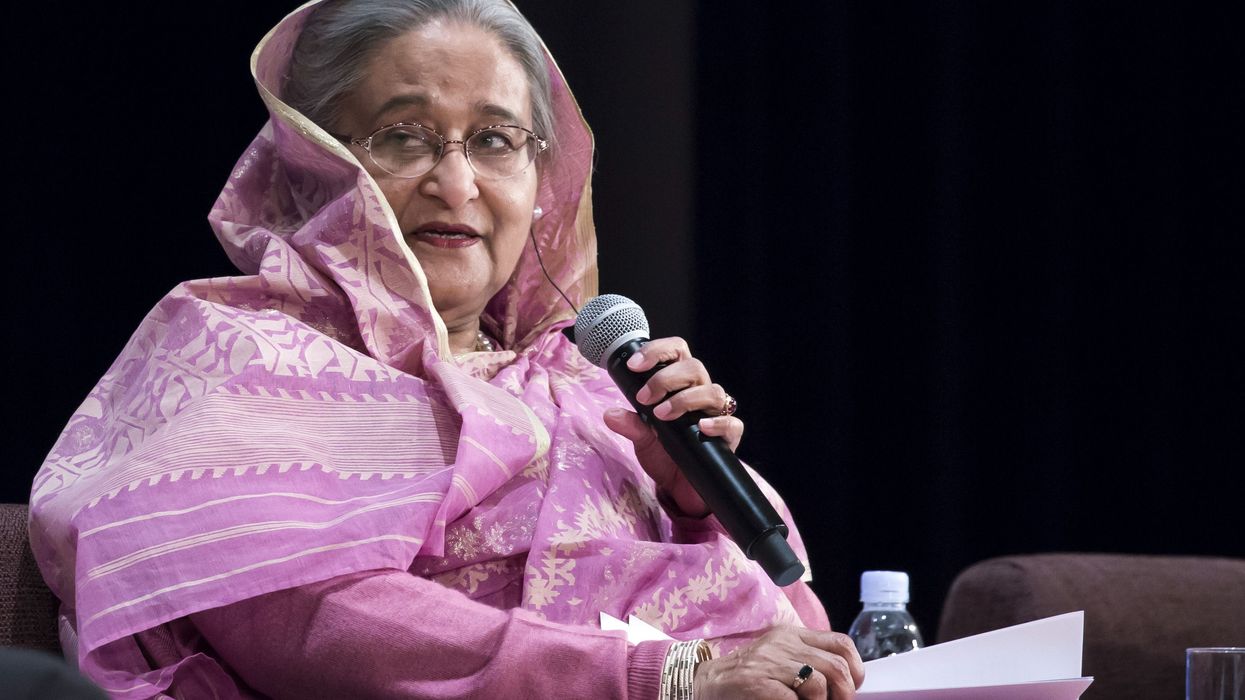
Human rights defenders voiced concerns over the fairness of the in-absentia trial and death sentences for Sheikh Hasina and her former home minister.
Human rights groups and capital punishment abolitionists expressed alarm Monday after exiled former Bangladeshi Prime Minister Sheikh Hasina and her home minister were sentenced to death by a special tribunal for crimes against humanity for ordering last year's crackdown on student protests that left thousands of people dead and wounded.
Amnesty International secretary general Agnès Callamard asserted in a statement that "this trial and sentence is neither fair nor just."
"Victims need justice and accountability, yet the death penalty simply compounds human rights violations," she said. "It’s the ultimate cruel, degrading, and inhuman punishment and has no place in any justice process."
According to Callamard:
Justice for survivors and victims demands that fiercely independent and impartial proceedings, which meet international human rights standards are conducted. Instead, this trial has been conducted before a court that Amnesty International has long criticized for its lack of independence and history of unfair proceedings. Further, the unprecedented speed of this trial in absentia and verdict raises significant fair trial concerns for a case of this scale and complexity. Although Sheikh Hasina was represented by a court-appointed lawyer, the time to prepare a defense was manifestly inadequate. Such unfair trial indicators are compounded by reports that defense cross examination of evidence deemed to be contradictory was not allowed.
The International Crimes Tribunal (ICT) sentenced Hasina and former Home Minister Asaduzzaman Khan Kamal to death by hanging over their command responsibility for the killings, torture, and the use of lethal force against participants in what became known as the July Uprising.
Former Inspector General of Police Chowdhury Abdullah Al-Mamun was sentenced to five years in prison after he confessed his guilt and turned government witness against Hasina and Khan, both of whom fled to India in August 2024.
Ironically, the ICT was established by Hasina's Awami League government to prosecute the perpetrators of crimes against humanity and war crimes committed during the 1971 US-backed genocide committed by Pakistani forces in their unsuccessful bid to prevent what was then East Pakistan from becoming the independent nation of Bangladesh.
Last year's protests began as opposition to job quota reforms but escalated into a nationwide uprising against government corruption and human rights violations. The demonstrations forced Hasina—who had led Bangladesh for 15 years—to resign and flee the country on August 5, 2024.
According to the United Nations Office for the High Commissioner of Human Rights (OHCHR), members of Hasina's government and ruling Awami League "systematically engaged in a range of serious human rights violations" during the uprising.
"As many as 1,400 people may have been killed between July 15 and August 5, and thousands were injured, the vast majority of whom were shot by Bangladesh’s security forces," OHCHR found. "Of these, the report indicates that as many as 12-13% of those killed were children. Bangladesh Police reported that 44 of its officers were killed."
According to the ICT's 453-page judgment, Hasina told Sheikh Fazle Noor Taposh, then mayor of Dhaka South, that “police have been ordered to shoot protestors anywhere they can."
The ICT also found that Hasina incited violence with statements including asking if “Razakars’ grandchildren [will] get jobs rather than the grandchildren of the freedom fighters?”
Razakars were paramilitary fighters—mostly pro-Pakistan Bengalis and Biharis—armed and trained by Pakistan who committed some of the worst atrocities of the 1971 genocide. The "freedom fighters" to whom Hasina referred included members of the Awami League, which led the fight for Bangladeshi independence from Pakistan.
Hasina is the daughter of Awami League co-founder Sheikh Mujibur Rahman, who is considered the "Father of the Nation" for leading the struggle culminating in the 1971 genocide, Indian invasion, and, ultimately, independence for Bangladesh. He was assassinated along with numerous relatives and staff in 1975.
Hasina condemned the verdict and sentence as "biased and politically motivated."
"We lost control of the situation, but to characterize what happened as a premeditated assault on citizens is simply to misread the facts," she said in a statement, adding that "I am not afraid to face my accusers in a proper tribunal where evidence can be weighed and tested fairly."
Both Hasina and ousted and imprisoned former Pakistani Prime Minister Imran Khan have accused the United States of conducting covert operations to topple their respective governments. Former Bangladeshi ministers allege that the US Agency for International Development and the Central Intelligence Agency—both of which have long histories of subversion, torture, and regime change operations—had hands in the July Uprising. The Biden administration denied any involvement in ousting Hasina.
The condemned defendants may now appeal to the Supreme Court.
Muhammad Yunus, the Nobel Peace laureate who leads Bangladesh's interim government ahead of parliamentary elections expected to be held next February, called the verdicts and death sentences "important, though limited, justice."
"Today, the courts of Bangladesh have spoken with a clarity that resonates across the nation and beyond," he said. "The conviction and sentencing affirm a fundamental principle: no one, regardless of power, is above the law."
UN Human Rights Spokesperson Ravina Shamdasani called the verdicts "an important moment for victims of the grave violations committed during the suppression of protests last year."
However, Shamdasani added that "we also regret the imposition of the death penalty, which we oppose in all circumstances."
Human Rights Watch deputy Asia director Meenakshi Ganguly wrote on X that "Bangladesh should ensure a credible justice system" and "abolish capital punishment."
India's Ministry of External Affairs declined to say whether it would honor Bangladesh's request to extradite Hasina and Khan.
"As a close neighbor, India remains committed to the best interests of people of Bangladesh, including in peace, democracy, inclusion, and stability in that country," the ministry ambiguously stated. "We will always engage constructively with all stakeholders to that end."
Experts say extradition is highly unlikely.
The days leading up to the verdicts saw widespread protests and unrest, including dozens of arson and crude bomb attacks resulting in the deaths of two people.

Extreme weather events are displacing millions, creating new tensions between neighbors, and demanding coordinated military responses. Will world leaders do what is needed to meet the challenge?
Bangladesh was still reeling from political turmoil, which felled Prime Minister Sheikh Hasina’s government on August 5, when a flood disaster struck out of the blue, upending the lives of 6 million Bangladeshis. Half a million people were left to their own devices, beyond the reach of first responders. Worst of all, 2 million children were exposed to the aftermath of flooding. Dhaka had not seen a deluge like this in the past three decades. Yet the country is no stranger to disasters. Just in May this year, it was battered by Storm Remal, devastating millions. In 2023, it was Cyclone Mocha that visited its wrath on two neighboring states: Bangladesh and Myanmar.
The speed and severity of flash floods is equally quick to inflame geopolitical tensions, as Dhaka accused neighboring India aggravating the situation by opening the floodgates of a dam in a neighboring state. India denied the charge and blamed erratic monsoons for swelling the transboundary Gomati River that overflowed its banks. Bangladesh and India share 54 transboundary rivers, including the Ganges and Yamuna. As an upstream country, India is viewed with suspicion by downstream Bangladesh. All downstream nations suspect their upstream neighbors in the event of such calamities. For its part, India blames upstream China for major diversions on transboundary rivers. Similar accusations are heard among 11 riparian nations on the Nile. All this shows how climate change shapes geopolitics.
Each time a developing nation is struck by an epic calamity, it takes 10-20 years to fully recover from the impact. Disasters worsen the preexisting vulnerabilities of those affected, hindering their recovery. Viewing these impacts, Bangladesh estimates that 20 million of its citizens will become “climate refugees” in the next 25 years, while 30 million are set to lose everything from climate change. It wants Western nations to recognize climate refugees as they do victims of “political repression.” Rajendra Pachauri, a former chairperson of the United Nations Intergovernmental Panel on Climate Change (IPCC), echoes Dhaka’s call for what he describes as “managed migration.” Unmanaged migration, however, continues. There are already 13 million Bangladeshis settled in Europe, North America, and the Middle East.
How ironic it is that 200 world leaders at the climate summit (COP29) in Baku, Azerbaijan this November, will be fighting tooth and nail to commit the least possible amount to the $100 billion global climate fund, which is basically a cleanup cost of climate change.
The ferocity of monsoons is forcing millions from their native habitats. Monsoons smash riverbanks, deluging countries on a monumental scale. Although shorter in duration, monsoons pack crushing punches. In 2022, southeastern Pakistan had received triple the amount of monthly rain in just one day. Monsoons are being fueled by the ever-warmer oceans that burst “atmospheric rivers.” The Bay of Bengal, where monsoons rise, and the Indian Ocean, which is the world’s fastest-warming ocean, are literally blazing. Asia’s sea surface temperature is warming more than three times faster than the global average. The continent’s land surface temperature has already surpassed the maximum threshold of 1.5°C to which the world agreed in Paris in 2015. Asia’s highest surface temperature in 2023 was recorded as 1.92°C above the 1961-1990 level (not the preindustrial level).
Asian countries such as Bangladesh, which have made the least contribution to carbonizing the atmosphere, are the most affected. In 2013, IPCC, in its fifth assessment report, predicted “less frequent but more intense” extreme weather events around the globe. Mother Nature, somehow, seems far ahead of the United Nations. As the case of Bangladesh shows, storms that are making landfalls around the world, are as frequent as they are intense. Weeks after the U.N.’s fifth assessment report came out, the Philippines endured typhoon Haiyan that killed 10,000 Filipinos, unleashing its fury on 13 million, 5 million of them children. Economic losses were valued at $15 billion (5% of the Philippine economy in 2013). Haiyan was then declared the strongest-ever superstorm in meteorological annals. Now scientists are thinking about adding a sixth hurricane category as Category 5 hurricanes are becoming passe.
Yet the world is far from equipped to tame climatic disasters. Haiyan, for instance, packed wind gusts of up to 235 miles per hour, a wind velocity that is almost twice the speed of the yet-to-be-invented Category 6 hurricane. Manila deployed 18,177 military troops, 844 vehicles, 44 seagoing vessels, and 31 aircraft to deal with the problem, and it still wasn’t enough. It had to call in military reinforcements from Australia, Britain, China, Japan, and the United States. The Philippines never faced a national adversary with a fraction of Haiyan’s lethality.
The United States committed the largest of all military resources to support the Philippines. It commissioned the nuclear-powered aircraft carrier USS George Washington with 80 aircraft and 5,000 troops aboard, in addition to four additional naval ships. Britain sent the Illustrious aircraft carrier stocked with transport planes and medical personnel. Japan sent a naval force of 1,000 troops, which was Tokyo’s largest-ever disaster-relief deployment, with three navy ships led by the Ise, Japan’s largest warship. Yet Haiyan kept all these naval deployments from entering the “disaster zone” for three days until November 11. By then, it had already made history as the Philippine deadliest storm.
Seven years later, in 2020, Australia had the lengthiest season of climate-driven wildfires, the intensity of which the The New York Times described in a breathtaking headline as “an atomic bomb.” For the first time in its history, Australia issued a “compulsory call-out” of its Defense Force Reserve Brigades, and deployed thousands of soldiers, sailors, and airmen to battle the raging fires and help evacuations. Yet the Australian military alone was no match for the blazes. Seventy countries, including Canada, New Zealand, Singapore, and the United States, offered assistance. The economic cost of fires was put at $103 billion. Worst of all, 1 billion animals were burned to death in this climate-fueled inferno.
The Asia-Pacific is set to see the economic tab of climatic disasters double to $1.4 trillion a year (which is 4.2% of regional GDP). By the middle of the 21st century, the global toll of climate-driven calamities will reach $38 trillion a year. How ironic it is that 200 world leaders at the climate summit (COP29) in Baku, Azerbaijan this November, will be fighting tooth and nail to commit the least possible amount to the $100 billion global climate fund, which is basically a cleanup cost of climate change. Yet they have no remorse in having future generations pay $38 trillion a year as a penalty for climate breakdown. The cost of all wars, including world wars, fought in the 20th century is not nearly as much as this amount.
It is, however, heartening that the climate envoy John Podesta has announced U.S. support for Azerbaijan’s initiative of the New Collective Quantified Goal on climate finance. In a U.S.-China Working Group meeting in Beijing in September, Podesta urged China to support this initiative. Both will cohost a summit of world leaders assembled at COP29 to urge more aggressive cuts in greenhouse gas emissions. In all of this, climate change is defining itself in geopolitics.
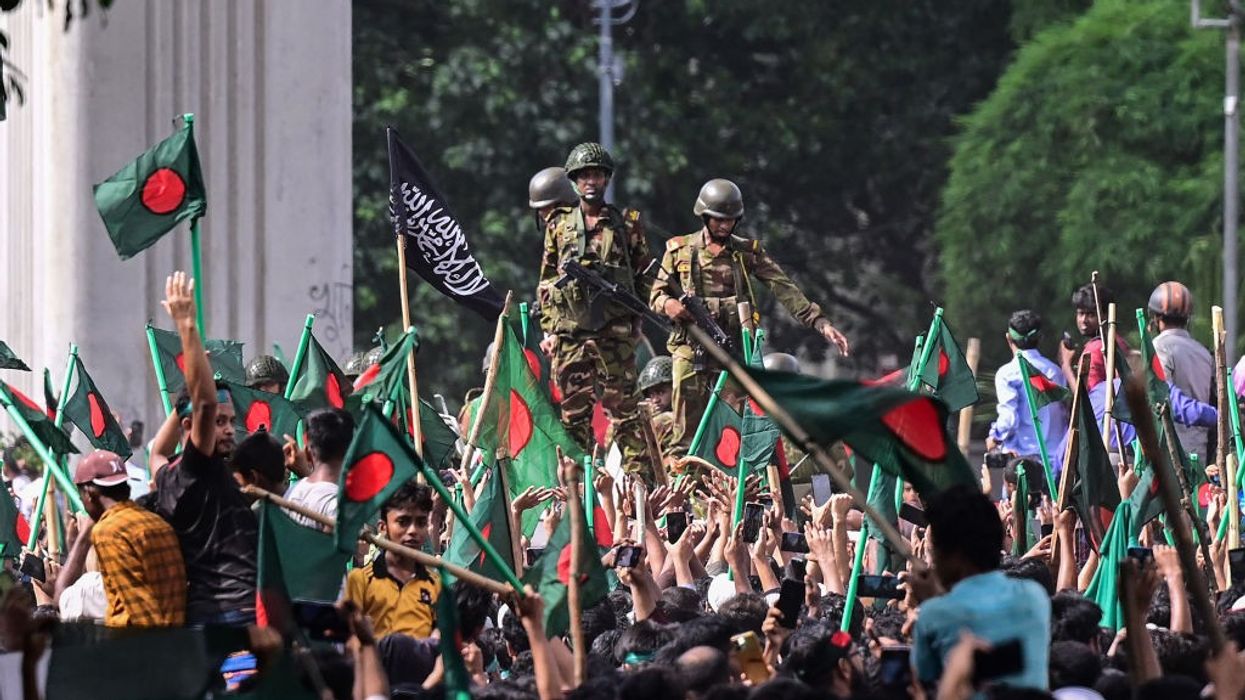
The very strong evidence of the U.S. role in toppling the government of Imran Khan in Pakistan raises the likelihood that something similar may have occurred in Bangladesh.
Two former leaders of major South Asian countries have reportedly accused the United States of covert regime change operations to topple their governments. One of the leaders, former Pakistan Prime Minister Imran Khan, languishes in prison, on a perverse conviction that proves Khan’s assertion. The other leader, former Bangladesh Prime Minister Sheik Hasina, fled to India following a violent coup in her country. Their grave accusations against the U.S., as reported in the world media, should be investigated by the UN, since if true, the U.S. actions would constitute a fundamental threat to world peace and to regional stability in South Asia.
The two cases seem to be very similar. The very strong evidence of the U.S. role in toppling the government of Imran Khan raises the likelihood that something similar may have occurred in Bangladesh.
In the case of Pakistan, Donald Lu, Assistant Secretary of State for South Asia and Central Asia, met with Asad Majeed Khan, Pakistan’s Ambassador to the U.S., on March 7, 2022. Ambassador Khan immediately wrote back to his capital, conveying Lu’s warning that PM Khan threatened U.S.-Pakistan relations because of Khan’s “aggressively neutral position” regarding Russia and Ukraine.
The Ambassador’s March 7 note (technically a diplomatic cypher) quoted Assistant Secretary Lu as follows: “I think if the no-confidence vote against the Prime Minister succeeds, all will be forgiven in Washington because the Russia visit is being looked at as a decision by the Prime Minister. Otherwise, I think it will be tough going ahead.” The very next day, members of the parliament took procedural steps to oust PM Khan.
On March 27, PM Khan brandished the cypher, and told his followers and the public that the U.S. was out to bring him down. On April 10, PM Khan was thrown out of office as the parliament acceded to the U.S. threat.
We know this in detail because of Ambassador Khan’s cypher, exposed by PM Khan and brilliantly documented by Ryan Grim of The Intercept, including the text of the cypher. Absurdly and tragically, PM Khan languishes in prison in part over espionage charges, linked to his revealing the cypher.
The U.S. appears to have played a similar role in the recent violent coup in Bangladesh. PM Hasina was ostensibly toppled by student unrest, and fled to India when the Bangladeshi military refused to prevent the protestors from storming the government offices. Yet there may well be much more to the story than meets the eye.
According to press reports in India, PM Hasina is claiming that the U.S. brought her down. Specifically, she says that the U.S. removed her from power because she refused to grant the U.S. military facilities in a region that is considered strategic for the U.S. in its “Indo-Pacific Strategy” to contain China. While these are second-hand accounts by the Indian media, they track closely several speeches and statements that Hasina has made over the past two years.
On May 17, 2024, the same Assistant Secretary Liu who played a lead role in toppling PM Khan, visited Dhaka to discuss the US Indo-Pacific Strategy among other topics. Days later, Sheikh Hasina reportedly summoned the leaders of the 14 parties of her alliance to make the startling claim that a “country of white-skinned people” was trying to bring her down, ostensibly telling the leaders that she refused to compromise her nation’s sovereignty. Like Imran Khan, PM Hasina had been pursuing a foreign policy of neutrality, including constructive relations not only with the U.S. but also with China and Russia, much to the deep consternation of the U.S. government.
To add credence to Hasina’s charges, Bangladesh had delayed signing two military agreements that the U.S. had pushed very hard since 2022, indeed by none other than the former Under-Secretary of State Victoria Nuland, the neocon hardliner with her own storied history of U.S. regime-change operations. One of the draft agreements, the General Security of Military Information Agreement (GSOMIA), would bind Bangladesh to closer military-to-military cooperation with Washington. The Government of PM Hasina was clearly not enthusiastic to sign it.
The U.S. is by far the world’s leading practitioner of regime-change operations, yet the U.S. flatly denies its role in covert regime change operations even when caught red-handed, as with Nuland’s infamous intercepted phone call in late January 2014 planning the U.S.-led regime change operation in Ukraine. It is useless to appeal to the U.S. Congress, and still less the executive branch, to investigate the claims by PM Khan and PM Hasina. Whatever the truth of the matter, they will deny and lie as necessary.
This is where the UN should step in. Covert regime change operations are blatantly illegal under international law (notably the Doctrine of Non-Intervention, as expressed for example in UN General Assembly Resolution 2625, 1970), and constitute perhaps the greatest threat to world peace, as they profoundly destabilize nations, and often lead to wars and other civil disorders. The UN should investigate and expose covert regime change operations, both in the interests of reversing them, and preventing them in the future.
The UN Security Council is of course specifically charged under Article 24 of the UN Charter with “primary responsibility for the maintenance of international peace and security.” When evidence arises that a government has been toppled through the intervention or complicity of a foreign government, the UN Security Council should investigate the claims.
In the cases of Pakistan and Bangladesh, the UN Security Council should seek the direct testimony of PM Khan and PM Hasina in order to evaluate the evidence that the U.S. played a role in the overthrow of the governments of these two leaders. Each, of course, should be protected by the UN for giving their testimony, so as to protect them from any retribution that could follow their honest presentation of the facts. Their testimony can be taken by video conference, if necessary, given the tragic ongoing incarceration of PM Khan.
The U.S. might well exercise its veto in the UN Security Council to prevent such a investigation. In that case, the UN General Assembly can take up the matter, under UN Resolution A/RES/76/, which allows the UN General Assembly to consider an issue blocked by veto in the UN Security Council. The issues at stake could then be assessed by the entire membership of the UN. The veracity of the U.S. involvement in the recent regime changes in Pakistan and Bangladesh could then be objectively analyzed and judged on the evidence, rather than on mere assertions and denials.
The U.S. engaged in at least 64 covert regime change operations during 1947-1989, according to documented research by Lindsey O’Rourke, political science professor at Boston Collage, and several more that were overt (e.g. by U.S.-led war). It continues to engage in regime-change operations with shocking frequency to this day, toppling governments in all parts of the world. It is wishful thinking that the U.S. will abide by international law on its own, but it is not wishful thinking for the world community, long suffering from U.S. regime change operations, to demand their end at the United Nations.