SUBSCRIBE TO OUR FREE NEWSLETTER
Daily news & progressive opinion—funded by the people, not the corporations—delivered straight to your inbox.
5
#000000
#FFFFFF
To donate by check, phone, or other method, see our More Ways to Give page.
Daily news & progressive opinion—funded by the people, not the corporations—delivered straight to your inbox.
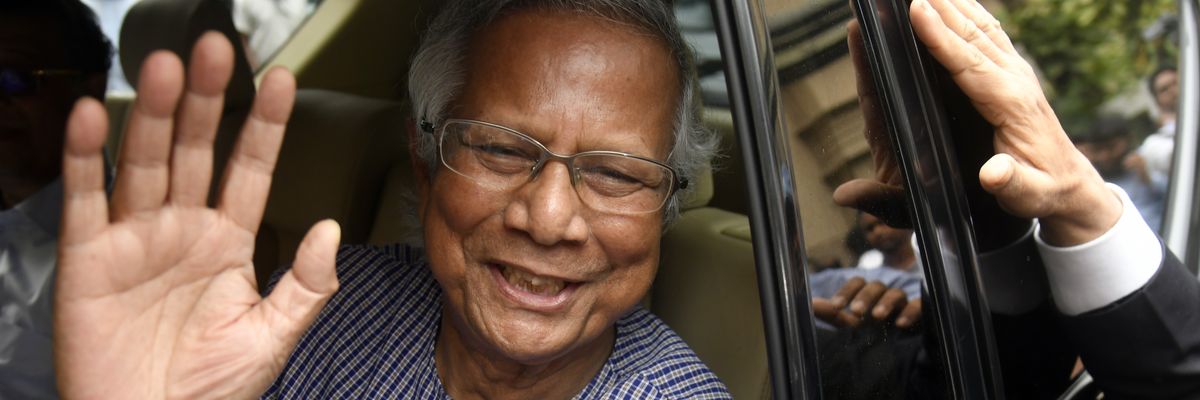
Nobel laureate Muhammad Yunus is seen in Dhaka, Bangladesh, on October 5, 2023.
"The courage of this youth is boundless," said the microcredit pioneer known as the banker to the poor. "They have made Bangladesh proud and shown the world our nation's determination against injustice."
The leader of student protests over jobs and economic injustice in Bangladesh in recent weeks said Tuesday that Nobel Peace Prize laureate Muhammad Yunus had accepted the students' call for him to take over the country's interim government, following the resignation of Prime Minister Sheikh Hasina.
A spokesperson for the country's president, Mohammed Shahabuddin, told the Associated Press that Yunus would lead the interim government and that other political leaders would be decided soon.
Yunus, an economist who won the Nobel prize in 2006 for establishing the microcredit institution Grameen Bank, has been called the "banker to the poor" for helping to lift millions of people in Bangladesh out of poverty through small loans.
Nahid Islam, who led the protest movement last month over quotas in government jobs and unemployment, said Tuesday that the movement would not accept a government led by General Waker-uz-Zaman, the chief of army staff who announced on Monday that Hasina had fled the country and stepped down, and who took temporary control of the country.
"We have given our blood, been martyred, and we have to fulfill our pledge to build a new Bangladesh," Islam said. "No government other than the one proposed by the students will be accepted. As we have said, no military government, or one backed by the military, or a government of fascists, will be accepted."
"No government other than the one proposed by the students will be accepted. As we have said, no military government, or one backed by the military, or a government of fascists, will be accepted."
Yunus said he was "honored by the trust of the protesters who wish for me to lead the interim government."
"If action is needed in Bangladesh, for my country and for the courage of my people, then I will take it. The interim government is only the beginning. Lasting peace will only come with free elections. Without elections, there will be no change," said Yunus.
Shahabuddin announced on Tuesday that Parliament had been dissolved and said new elections would soon be held.
The protests began in July in Dhaka, with students outraged over the reinstatement of a job quota policy that reserved 30% of government jobs for descendants of military veterans of Bangladesh's 1971 war for independence from Pakistan—most of whom had ties to Hasina's Awami League party.
About a quarter of jobs were reserved for women, people with disabilities, and ethic minorities, leaving about 3,000 jobs open for 400,000 graduates to compete over.
Bangladesh has a high unemployment rate, with about a fifth of the population of 170 million people out of work, exacerbating anger over the job scheme and economic distress.
Hasina was elected to her fourth term as prime minister in January, but was accused of rigging the election, clamping down on opposition politicians and dissent, and arranging extrajudicial killings. She denied the accusations.
Student protesters took to the streets, chanting, "One, two, three, four, Sheikh Hasina is a dictator."
Police responded by cracking down violently, with more than 180 people killed and hundreds of people hit in the eyes by pellets that security forces deployed—potentially blinding them permanently.
The country's Supreme Court rescinded the job quota policy on July 21, opening jobs to 93% of applicants, but students continued to rally, demanding that Hasina step down.
Yunus expressed pride in the student protesters who led the movement.
"Youth have voiced their need for change in our country," the 84-year-old banker said. "The prime minister heard them by leaving the country. This was a very important first step taken yesterday. The courage of this youth is boundless. They have made Bangladesh proud and shown the world our nation's determination against injustice."
Dear Common Dreams reader, It’s been nearly 30 years since I co-founded Common Dreams with my late wife, Lina Newhouser. We had the radical notion that journalism should serve the public good, not corporate profits. It was clear to us from the outset what it would take to build such a project. No paid advertisements. No corporate sponsors. No millionaire publisher telling us what to think or do. Many people said we wouldn't last a year, but we proved those doubters wrong. Together with a tremendous team of journalists and dedicated staff, we built an independent media outlet free from the constraints of profits and corporate control. Our mission has always been simple: To inform. To inspire. To ignite change for the common good. Building Common Dreams was not easy. Our survival was never guaranteed. When you take on the most powerful forces—Wall Street greed, fossil fuel industry destruction, Big Tech lobbyists, and uber-rich oligarchs who have spent billions upon billions rigging the economy and democracy in their favor—the only bulwark you have is supporters who believe in your work. But here’s the urgent message from me today. It's never been this bad out there. And it's never been this hard to keep us going. At the very moment Common Dreams is most needed, the threats we face are intensifying. We need your support now more than ever. We don't accept corporate advertising and never will. We don't have a paywall because we don't think people should be blocked from critical news based on their ability to pay. Everything we do is funded by the donations of readers like you. When everyone does the little they can afford, we are strong. But if that support retreats or dries up, so do we. Will you donate now to make sure Common Dreams not only survives but thrives? —Craig Brown, Co-founder |
The leader of student protests over jobs and economic injustice in Bangladesh in recent weeks said Tuesday that Nobel Peace Prize laureate Muhammad Yunus had accepted the students' call for him to take over the country's interim government, following the resignation of Prime Minister Sheikh Hasina.
A spokesperson for the country's president, Mohammed Shahabuddin, told the Associated Press that Yunus would lead the interim government and that other political leaders would be decided soon.
Yunus, an economist who won the Nobel prize in 2006 for establishing the microcredit institution Grameen Bank, has been called the "banker to the poor" for helping to lift millions of people in Bangladesh out of poverty through small loans.
Nahid Islam, who led the protest movement last month over quotas in government jobs and unemployment, said Tuesday that the movement would not accept a government led by General Waker-uz-Zaman, the chief of army staff who announced on Monday that Hasina had fled the country and stepped down, and who took temporary control of the country.
"We have given our blood, been martyred, and we have to fulfill our pledge to build a new Bangladesh," Islam said. "No government other than the one proposed by the students will be accepted. As we have said, no military government, or one backed by the military, or a government of fascists, will be accepted."
"No government other than the one proposed by the students will be accepted. As we have said, no military government, or one backed by the military, or a government of fascists, will be accepted."
Yunus said he was "honored by the trust of the protesters who wish for me to lead the interim government."
"If action is needed in Bangladesh, for my country and for the courage of my people, then I will take it. The interim government is only the beginning. Lasting peace will only come with free elections. Without elections, there will be no change," said Yunus.
Shahabuddin announced on Tuesday that Parliament had been dissolved and said new elections would soon be held.
The protests began in July in Dhaka, with students outraged over the reinstatement of a job quota policy that reserved 30% of government jobs for descendants of military veterans of Bangladesh's 1971 war for independence from Pakistan—most of whom had ties to Hasina's Awami League party.
About a quarter of jobs were reserved for women, people with disabilities, and ethic minorities, leaving about 3,000 jobs open for 400,000 graduates to compete over.
Bangladesh has a high unemployment rate, with about a fifth of the population of 170 million people out of work, exacerbating anger over the job scheme and economic distress.
Hasina was elected to her fourth term as prime minister in January, but was accused of rigging the election, clamping down on opposition politicians and dissent, and arranging extrajudicial killings. She denied the accusations.
Student protesters took to the streets, chanting, "One, two, three, four, Sheikh Hasina is a dictator."
Police responded by cracking down violently, with more than 180 people killed and hundreds of people hit in the eyes by pellets that security forces deployed—potentially blinding them permanently.
The country's Supreme Court rescinded the job quota policy on July 21, opening jobs to 93% of applicants, but students continued to rally, demanding that Hasina step down.
Yunus expressed pride in the student protesters who led the movement.
"Youth have voiced their need for change in our country," the 84-year-old banker said. "The prime minister heard them by leaving the country. This was a very important first step taken yesterday. The courage of this youth is boundless. They have made Bangladesh proud and shown the world our nation's determination against injustice."
The leader of student protests over jobs and economic injustice in Bangladesh in recent weeks said Tuesday that Nobel Peace Prize laureate Muhammad Yunus had accepted the students' call for him to take over the country's interim government, following the resignation of Prime Minister Sheikh Hasina.
A spokesperson for the country's president, Mohammed Shahabuddin, told the Associated Press that Yunus would lead the interim government and that other political leaders would be decided soon.
Yunus, an economist who won the Nobel prize in 2006 for establishing the microcredit institution Grameen Bank, has been called the "banker to the poor" for helping to lift millions of people in Bangladesh out of poverty through small loans.
Nahid Islam, who led the protest movement last month over quotas in government jobs and unemployment, said Tuesday that the movement would not accept a government led by General Waker-uz-Zaman, the chief of army staff who announced on Monday that Hasina had fled the country and stepped down, and who took temporary control of the country.
"We have given our blood, been martyred, and we have to fulfill our pledge to build a new Bangladesh," Islam said. "No government other than the one proposed by the students will be accepted. As we have said, no military government, or one backed by the military, or a government of fascists, will be accepted."
"No government other than the one proposed by the students will be accepted. As we have said, no military government, or one backed by the military, or a government of fascists, will be accepted."
Yunus said he was "honored by the trust of the protesters who wish for me to lead the interim government."
"If action is needed in Bangladesh, for my country and for the courage of my people, then I will take it. The interim government is only the beginning. Lasting peace will only come with free elections. Without elections, there will be no change," said Yunus.
Shahabuddin announced on Tuesday that Parliament had been dissolved and said new elections would soon be held.
The protests began in July in Dhaka, with students outraged over the reinstatement of a job quota policy that reserved 30% of government jobs for descendants of military veterans of Bangladesh's 1971 war for independence from Pakistan—most of whom had ties to Hasina's Awami League party.
About a quarter of jobs were reserved for women, people with disabilities, and ethic minorities, leaving about 3,000 jobs open for 400,000 graduates to compete over.
Bangladesh has a high unemployment rate, with about a fifth of the population of 170 million people out of work, exacerbating anger over the job scheme and economic distress.
Hasina was elected to her fourth term as prime minister in January, but was accused of rigging the election, clamping down on opposition politicians and dissent, and arranging extrajudicial killings. She denied the accusations.
Student protesters took to the streets, chanting, "One, two, three, four, Sheikh Hasina is a dictator."
Police responded by cracking down violently, with more than 180 people killed and hundreds of people hit in the eyes by pellets that security forces deployed—potentially blinding them permanently.
The country's Supreme Court rescinded the job quota policy on July 21, opening jobs to 93% of applicants, but students continued to rally, demanding that Hasina step down.
Yunus expressed pride in the student protesters who led the movement.
"Youth have voiced their need for change in our country," the 84-year-old banker said. "The prime minister heard them by leaving the country. This was a very important first step taken yesterday. The courage of this youth is boundless. They have made Bangladesh proud and shown the world our nation's determination against injustice."