

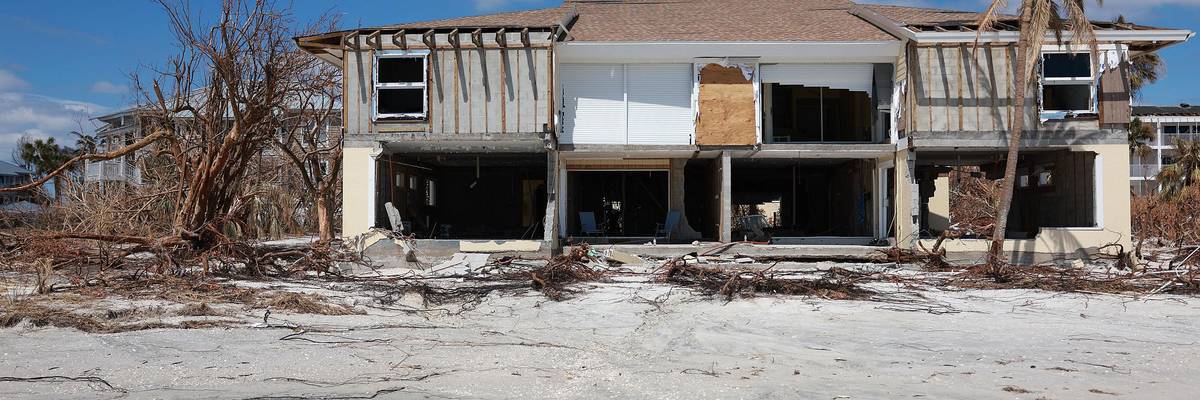
A destroyed building sits among debris after Hurricane Ian passed through the area on October 8, 2022 in Sanibel, Florida. Residents are hopeful that the causeway onto the island will be repaired soon so they can start the process of rebuilding. (Photo: Joe Raedle/Getty Images)
The Wealthy: A Greater Threat to Florida Than Hurricanes
Don't expect any substantial change anytime soon in the state's continuing rush to keep average families buying homes—and paying property taxes—in the most at-risk coastal zones.
Last month's Hurricane Ian has already faded from the headlines, but local officials and insurers are still tallying up the total damage. The storm may well end up America's second-costliest hurricane ever.
"The state of Florida--with all these insurance subsidies--is essentially doing everything within its power to keep people buying property in the state's most climate change-threatened coastal areas."
Florida's total damage bill, the global property analyst CoreLogic now estimates, could hit $70 billion. The good news? Without the federal program that discourages development in Florida's flood-prone inland area south of Tampa, CoreLogic's Tom Larsen points out, Hurricane Ian's toll would be running far higher.
Florida's coasts--by far the state's most vulnerable real estate--have no comparable federal protection. On these coasts, Florida's state government calls the shots. Actually, we need to get a bit more precise here. Florida's state government doesn't call the shots. Florida's rich do, and the continuing immensity of their after-tax incomes has turned out to matter far more to state policy than the well-being of Floridian families of modest means.
How so? Let's start with CoreLogic's analysis of Hurricane Ian's damage. The "key reason" why Hurricane Ian has been "so economically destructive," notes CoreLogic's Larsen, has been Florida's "massive growth in coastal real estate." That coastal growth has accounted for a disproportionate share of Florida's 50% population jump since 1992, the year "when Hurricane Andrew hit Miami."
Florida authorities have been doing everything possible ever since then to keep people flowing into the state's coastal communities most vulnerable to climate-change storm surges. And that hasn't been easy, because the danger from giant windstorms has the private insurance market freaking out. Annual property-insurance premiums in Florida, reports an Economist analysis, now run "triple the national average."
Florida officials have not stood idly by. Twenty years ago, state lawmakers created the Citizens Property Insurance Corporation, a government-owned nonprofit insurer of last resort. Citizens currently charges premiums that average up to 40% less than commercial property-insurance policies, and this taxpayer-subsidized insurer now covers more Floridian property-owners than any private insurer.
What happens when Citizens Property Insurance can't cover one of its climate-disaster liabilities? The agency has the authority, The Economist notes, to "levy a surcharge on almost all other property- and casualty-insurance policyholders in the state."
The state of Florida--with all these insurance subsidies--is essentially doing everything within its power to keep people buying property in the state's most climate change-threatened coastal areas. Why does the state want as many people as possible living in harm's way? The state needs property owners. Taxes on property keep the state of Florida running. The state has no tax on income.
High-income people in Florida--the state's rich--like things that way.
State and local governments, observes the Washington, D.C.-based Institute on Taxation and Economic Policy, "have historically relied on three broad types of taxes": levies on personal income, property, and--through sales and excises taxes--consumption.
State income taxes, ITEP calculates, rate as by far the most progressive of these three tax categories. On average, low-income families in the United States pay just 0.04% of their incomes in state income tax. Top 1% families pay 4.6%, an income share over 100 times greater.
Those numbers reverse when we look at state and local property taxes, with low-income families paying an average 4.2% of their incomes in taxes on property and top 1-percenters paying just 1.7%. And low-income renters, ITEP reminds us, "do not escape property taxes" since their landlords pass on the tax "in the form of higher rent."
Just how regressive do taxes in Florida turn out to be? Families in the state's richest 1% pay just 2.3 of their incomes in total state and local taxes. Families in Florida's middle-income fifth pay state and local taxes at almost quadruple that rate, 8.1% of family income, and the state's poorest fifth of families pay 12.7% of their incomes in state and local taxes.
An even more striking stat: Only one state in the nation--the gambling-dependent Nevada--has a tax system friendlier to its top 1% than Florida.
This Florida tax friendliness--to the wealthy--has turned out to be quite the rich people-magnet. Florida now rates as the home to 10% of the nation's households worth at least $30 million, as a just-published ITEP report on America's "geographic distribution of extreme wealth" documents. The state, Fortune noted this past August, is attracting "nearly four times the number of high-rollers" as Texas, the nation's second-most popular state destination for wealthy households on the move.
Florida's well-endowed households, in return, have been quite generous to the pols who keep the Sunshine State so inviting to the superrich. The two fundraising committees supporting the reelection bid of Florida's current rich people-friendly governor, the Tampa Bay Times reports, are now sitting on "more than $115 million." The Democratic Party challenger to Republican incumbent Ron DeSantis has $5 million in the bank.
Don't expect, in other words, any substantial change anytime soon in Florida's continuing rush to keep average families buying homes--and paying property taxes--in the state's most at-risk coastal zones. Those homes may flood in the next big hurricane. Or even get blown away. A small price to pay to keep rich people happy.
An Urgent Message From Our Co-Founder
Dear Common Dreams reader, It’s been nearly 30 years since I co-founded Common Dreams with my late wife, Lina Newhouser. We had the radical notion that journalism should serve the public good, not corporate profits. It was clear to us from the outset what it would take to build such a project. No paid advertisements. No corporate sponsors. No millionaire publisher telling us what to think or do. Many people said we wouldn't last a year, but we proved those doubters wrong. Together with a tremendous team of journalists and dedicated staff, we built an independent media outlet free from the constraints of profits and corporate control. Our mission has always been simple: To inform. To inspire. To ignite change for the common good. Building Common Dreams was not easy. Our survival was never guaranteed. When you take on the most powerful forces—Wall Street greed, fossil fuel industry destruction, Big Tech lobbyists, and uber-rich oligarchs who have spent billions upon billions rigging the economy and democracy in their favor—the only bulwark you have is supporters who believe in your work. But here’s the urgent message from me today. It's never been this bad out there. And it's never been this hard to keep us going. At the very moment Common Dreams is most needed, the threats we face are intensifying. We need your support now more than ever. We don't accept corporate advertising and never will. We don't have a paywall because we don't think people should be blocked from critical news based on their ability to pay. Everything we do is funded by the donations of readers like you. When everyone does the little they can afford, we are strong. But if that support retreats or dries up, so do we. Will you donate now to make sure Common Dreams not only survives but thrives? —Craig Brown, Co-founder |
Last month's Hurricane Ian has already faded from the headlines, but local officials and insurers are still tallying up the total damage. The storm may well end up America's second-costliest hurricane ever.
"The state of Florida--with all these insurance subsidies--is essentially doing everything within its power to keep people buying property in the state's most climate change-threatened coastal areas."
Florida's total damage bill, the global property analyst CoreLogic now estimates, could hit $70 billion. The good news? Without the federal program that discourages development in Florida's flood-prone inland area south of Tampa, CoreLogic's Tom Larsen points out, Hurricane Ian's toll would be running far higher.
Florida's coasts--by far the state's most vulnerable real estate--have no comparable federal protection. On these coasts, Florida's state government calls the shots. Actually, we need to get a bit more precise here. Florida's state government doesn't call the shots. Florida's rich do, and the continuing immensity of their after-tax incomes has turned out to matter far more to state policy than the well-being of Floridian families of modest means.
How so? Let's start with CoreLogic's analysis of Hurricane Ian's damage. The "key reason" why Hurricane Ian has been "so economically destructive," notes CoreLogic's Larsen, has been Florida's "massive growth in coastal real estate." That coastal growth has accounted for a disproportionate share of Florida's 50% population jump since 1992, the year "when Hurricane Andrew hit Miami."
Florida authorities have been doing everything possible ever since then to keep people flowing into the state's coastal communities most vulnerable to climate-change storm surges. And that hasn't been easy, because the danger from giant windstorms has the private insurance market freaking out. Annual property-insurance premiums in Florida, reports an Economist analysis, now run "triple the national average."
Florida officials have not stood idly by. Twenty years ago, state lawmakers created the Citizens Property Insurance Corporation, a government-owned nonprofit insurer of last resort. Citizens currently charges premiums that average up to 40% less than commercial property-insurance policies, and this taxpayer-subsidized insurer now covers more Floridian property-owners than any private insurer.
What happens when Citizens Property Insurance can't cover one of its climate-disaster liabilities? The agency has the authority, The Economist notes, to "levy a surcharge on almost all other property- and casualty-insurance policyholders in the state."
The state of Florida--with all these insurance subsidies--is essentially doing everything within its power to keep people buying property in the state's most climate change-threatened coastal areas. Why does the state want as many people as possible living in harm's way? The state needs property owners. Taxes on property keep the state of Florida running. The state has no tax on income.
High-income people in Florida--the state's rich--like things that way.
State and local governments, observes the Washington, D.C.-based Institute on Taxation and Economic Policy, "have historically relied on three broad types of taxes": levies on personal income, property, and--through sales and excises taxes--consumption.
State income taxes, ITEP calculates, rate as by far the most progressive of these three tax categories. On average, low-income families in the United States pay just 0.04% of their incomes in state income tax. Top 1% families pay 4.6%, an income share over 100 times greater.
Those numbers reverse when we look at state and local property taxes, with low-income families paying an average 4.2% of their incomes in taxes on property and top 1-percenters paying just 1.7%. And low-income renters, ITEP reminds us, "do not escape property taxes" since their landlords pass on the tax "in the form of higher rent."
Just how regressive do taxes in Florida turn out to be? Families in the state's richest 1% pay just 2.3 of their incomes in total state and local taxes. Families in Florida's middle-income fifth pay state and local taxes at almost quadruple that rate, 8.1% of family income, and the state's poorest fifth of families pay 12.7% of their incomes in state and local taxes.
An even more striking stat: Only one state in the nation--the gambling-dependent Nevada--has a tax system friendlier to its top 1% than Florida.
This Florida tax friendliness--to the wealthy--has turned out to be quite the rich people-magnet. Florida now rates as the home to 10% of the nation's households worth at least $30 million, as a just-published ITEP report on America's "geographic distribution of extreme wealth" documents. The state, Fortune noted this past August, is attracting "nearly four times the number of high-rollers" as Texas, the nation's second-most popular state destination for wealthy households on the move.
Florida's well-endowed households, in return, have been quite generous to the pols who keep the Sunshine State so inviting to the superrich. The two fundraising committees supporting the reelection bid of Florida's current rich people-friendly governor, the Tampa Bay Times reports, are now sitting on "more than $115 million." The Democratic Party challenger to Republican incumbent Ron DeSantis has $5 million in the bank.
Don't expect, in other words, any substantial change anytime soon in Florida's continuing rush to keep average families buying homes--and paying property taxes--in the state's most at-risk coastal zones. Those homes may flood in the next big hurricane. Or even get blown away. A small price to pay to keep rich people happy.
Last month's Hurricane Ian has already faded from the headlines, but local officials and insurers are still tallying up the total damage. The storm may well end up America's second-costliest hurricane ever.
"The state of Florida--with all these insurance subsidies--is essentially doing everything within its power to keep people buying property in the state's most climate change-threatened coastal areas."
Florida's total damage bill, the global property analyst CoreLogic now estimates, could hit $70 billion. The good news? Without the federal program that discourages development in Florida's flood-prone inland area south of Tampa, CoreLogic's Tom Larsen points out, Hurricane Ian's toll would be running far higher.
Florida's coasts--by far the state's most vulnerable real estate--have no comparable federal protection. On these coasts, Florida's state government calls the shots. Actually, we need to get a bit more precise here. Florida's state government doesn't call the shots. Florida's rich do, and the continuing immensity of their after-tax incomes has turned out to matter far more to state policy than the well-being of Floridian families of modest means.
How so? Let's start with CoreLogic's analysis of Hurricane Ian's damage. The "key reason" why Hurricane Ian has been "so economically destructive," notes CoreLogic's Larsen, has been Florida's "massive growth in coastal real estate." That coastal growth has accounted for a disproportionate share of Florida's 50% population jump since 1992, the year "when Hurricane Andrew hit Miami."
Florida authorities have been doing everything possible ever since then to keep people flowing into the state's coastal communities most vulnerable to climate-change storm surges. And that hasn't been easy, because the danger from giant windstorms has the private insurance market freaking out. Annual property-insurance premiums in Florida, reports an Economist analysis, now run "triple the national average."
Florida officials have not stood idly by. Twenty years ago, state lawmakers created the Citizens Property Insurance Corporation, a government-owned nonprofit insurer of last resort. Citizens currently charges premiums that average up to 40% less than commercial property-insurance policies, and this taxpayer-subsidized insurer now covers more Floridian property-owners than any private insurer.
What happens when Citizens Property Insurance can't cover one of its climate-disaster liabilities? The agency has the authority, The Economist notes, to "levy a surcharge on almost all other property- and casualty-insurance policyholders in the state."
The state of Florida--with all these insurance subsidies--is essentially doing everything within its power to keep people buying property in the state's most climate change-threatened coastal areas. Why does the state want as many people as possible living in harm's way? The state needs property owners. Taxes on property keep the state of Florida running. The state has no tax on income.
High-income people in Florida--the state's rich--like things that way.
State and local governments, observes the Washington, D.C.-based Institute on Taxation and Economic Policy, "have historically relied on three broad types of taxes": levies on personal income, property, and--through sales and excises taxes--consumption.
State income taxes, ITEP calculates, rate as by far the most progressive of these three tax categories. On average, low-income families in the United States pay just 0.04% of their incomes in state income tax. Top 1% families pay 4.6%, an income share over 100 times greater.
Those numbers reverse when we look at state and local property taxes, with low-income families paying an average 4.2% of their incomes in taxes on property and top 1-percenters paying just 1.7%. And low-income renters, ITEP reminds us, "do not escape property taxes" since their landlords pass on the tax "in the form of higher rent."
Just how regressive do taxes in Florida turn out to be? Families in the state's richest 1% pay just 2.3 of their incomes in total state and local taxes. Families in Florida's middle-income fifth pay state and local taxes at almost quadruple that rate, 8.1% of family income, and the state's poorest fifth of families pay 12.7% of their incomes in state and local taxes.
An even more striking stat: Only one state in the nation--the gambling-dependent Nevada--has a tax system friendlier to its top 1% than Florida.
This Florida tax friendliness--to the wealthy--has turned out to be quite the rich people-magnet. Florida now rates as the home to 10% of the nation's households worth at least $30 million, as a just-published ITEP report on America's "geographic distribution of extreme wealth" documents. The state, Fortune noted this past August, is attracting "nearly four times the number of high-rollers" as Texas, the nation's second-most popular state destination for wealthy households on the move.
Florida's well-endowed households, in return, have been quite generous to the pols who keep the Sunshine State so inviting to the superrich. The two fundraising committees supporting the reelection bid of Florida's current rich people-friendly governor, the Tampa Bay Times reports, are now sitting on "more than $115 million." The Democratic Party challenger to Republican incumbent Ron DeSantis has $5 million in the bank.
Don't expect, in other words, any substantial change anytime soon in Florida's continuing rush to keep average families buying homes--and paying property taxes--in the state's most at-risk coastal zones. Those homes may flood in the next big hurricane. Or even get blown away. A small price to pay to keep rich people happy.