SUBSCRIBE TO OUR FREE NEWSLETTER
Daily news & progressive opinion—funded by the people, not the corporations—delivered straight to your inbox.
5
#000000
#FFFFFF
To donate by check, phone, or other method, see our More Ways to Give page.
Daily news & progressive opinion—funded by the people, not the corporations—delivered straight to your inbox.
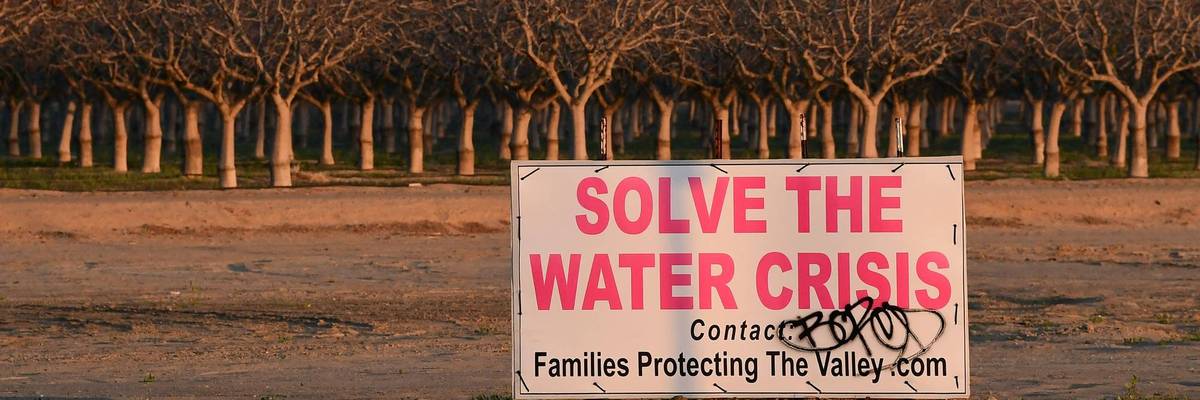
A sign calls for solving California's water crisis on the outskirts of Buttonwillow in California's Kern County on April 2, 2021, one of the top agriculture producing counties in the San Joaquin Valley where dairy, grapes, almonds, strawberries, and pistachios contribute billions to the economy each year.
Farmers in California's San Joaquin Valley need enough support to turn a forced transition into a livable one, where they can afford to retire acres while still keeping a foothold in agriculture and in their communities.
Until three years ago, AW, who requested that only his initials be used for identification purposes, was an almond farmer. Now, he’s a grass farmer. AW farms in Tulare County, California, the heart of the San Joaquin Valley and California’s most productive agricultural region, the source of more than half of the produce the nation consumes. Five years ago, he was growing almonds across his 300 acres, a profitable crop that sold at a high value on the market. Now, he’s growing cover crop, a mix of various grasses intended to keep the soil on his land healthy, but that doesn’t bring in income anywhere close to what AW was making when he was growing almonds.
Why did AW make this switch? Not out of choice, but out of necessity. California agriculture is tied to the Sustainable Groundwater Management Act (SGMA), a bill passed in 2014 with the goal of reducing groundwater overdraft throughout the state, an agriculture-driven environmental hazard that is depleting aquifers and causing subsidence. The main tension behind SGMA is that the act is expected to cause between 500,000 to 1 million acres of San Joaquin Valley agricultural land to come out of production before 2040, and the act does not come with a built-in support system to help farmers figure out what to do with their land when agriculture is no longer an option. Neither SGMA nor the Valley farmers who it’s hurting the most are at fault—farmers are simply employing decades old agricultural practices to meet national food demand and SGMA is simply trying to preserve the state’s water resources.
AW is one of the first farmers to feel the impacts of SGMA fully realized on his land. SGMA, although passed more than a decade ago, is just now taking hold across the state, and farmers are now faced with the difficult choice of farming under restrictions and the potential of facing fines, or not farming at all. The state’s agricultural economy is at a major influx point—how farmers, communities, organizations, and the government react to the challenges that are about to descend onto this region will influence how the agricultural industry survives and takes shape for the coming decades.
In the media and in public conversation, farmers are often portrayed as anti-environmental, shortsighted, and profit driven. But through interviews I conducted with over 30 San Joaquin Valley farmers about their experiences with SGMA, I found something different: people confronting extreme change, often alone, trying to make difficult decisions for the good of their families, their business, land, and their futures. Almost every farmer I spoke to described feelings of isolation as neighbors compete for water and limited state funding, and as collaboration and trust erode. Outside of a handful of small pools of money and technical assistance that have been rolled out by the California state government, there has been lacking wide-scale institutional support for farmers seeking to change land uses.
If we give people like AW the tools and backing to make this shift, the San Joaquin Valley can move from a story of loss to a blueprint for how rural communities across the country can adapt to a hotter, drier future.
To fill this void, California requires the scaling up of solutions that will help farmers remain in the agricultural industry while taking advantage of this wide-scale shift in the agricultural landscape to increase sustainability and prioritize the environment in their decisions and actions. Organizations based in the region, such as The Nature Conservancy, River Partners, and Sequoia Riverlands Trust, are working on a small scale to do just that.
These organizations aim to protect and preserve both habitat and agriculture in the San Joaquin Valley region while helping farmers navigate the landscape of SGMA. They work on habitat restoration projects, assisting farmers with conservation easements, and are constantly innovating on how to make certain solutions more economically viable for farmers. Alongside academic research partners, these research organizations are also exploring how to make certain aspects of agriculture more viable, such as an expansion of regenerative agriculture in the region, which would offer a path forward that ties farmers’ livelihoods to rebuilding soil, recharging groundwater, and restoring habitat and turning today’s crisis into a long-term investment in a healthier, more resilient food system. This work serves as a model of the support systems that need to be wheeled out at a much larger scale in order for farmers, the economy, and the environment to thrive under this set of new regulations. Its spirit of collective undertaking is exactly what the San Joaquin Valley needs now as it navigates the upheaval of SGMA.
What AW needs to help him navigate his transition from farming almonds is what the Valley needs: enough support to turn a forced transition into a livable one, where farmers can afford to retire acres while still keeping a foothold in agriculture and in their communities. That will require sustained investment in on-the-ground organizations, dedicated funding for land transition and habitat restoration, and policies that treat farmers not as villains, but as partners in reshaping one of America’s most important food-producing regions. If we give people like AW the tools and backing to make this shift, the San Joaquin Valley can move from a story of loss to a blueprint for how rural communities across the country can adapt to a hotter, drier future, bringing with them the promise of sustainability.
Dear Common Dreams reader, It’s been nearly 30 years since I co-founded Common Dreams with my late wife, Lina Newhouser. We had the radical notion that journalism should serve the public good, not corporate profits. It was clear to us from the outset what it would take to build such a project. No paid advertisements. No corporate sponsors. No millionaire publisher telling us what to think or do. Many people said we wouldn't last a year, but we proved those doubters wrong. Together with a tremendous team of journalists and dedicated staff, we built an independent media outlet free from the constraints of profits and corporate control. Our mission has always been simple: To inform. To inspire. To ignite change for the common good. Building Common Dreams was not easy. Our survival was never guaranteed. When you take on the most powerful forces—Wall Street greed, fossil fuel industry destruction, Big Tech lobbyists, and uber-rich oligarchs who have spent billions upon billions rigging the economy and democracy in their favor—the only bulwark you have is supporters who believe in your work. But here’s the urgent message from me today. It's never been this bad out there. And it's never been this hard to keep us going. At the very moment Common Dreams is most needed, the threats we face are intensifying. We need your support now more than ever. We don't accept corporate advertising and never will. We don't have a paywall because we don't think people should be blocked from critical news based on their ability to pay. Everything we do is funded by the donations of readers like you. When everyone does the little they can afford, we are strong. But if that support retreats or dries up, so do we. Will you donate now to make sure Common Dreams not only survives but thrives? —Craig Brown, Co-founder |
Until three years ago, AW, who requested that only his initials be used for identification purposes, was an almond farmer. Now, he’s a grass farmer. AW farms in Tulare County, California, the heart of the San Joaquin Valley and California’s most productive agricultural region, the source of more than half of the produce the nation consumes. Five years ago, he was growing almonds across his 300 acres, a profitable crop that sold at a high value on the market. Now, he’s growing cover crop, a mix of various grasses intended to keep the soil on his land healthy, but that doesn’t bring in income anywhere close to what AW was making when he was growing almonds.
Why did AW make this switch? Not out of choice, but out of necessity. California agriculture is tied to the Sustainable Groundwater Management Act (SGMA), a bill passed in 2014 with the goal of reducing groundwater overdraft throughout the state, an agriculture-driven environmental hazard that is depleting aquifers and causing subsidence. The main tension behind SGMA is that the act is expected to cause between 500,000 to 1 million acres of San Joaquin Valley agricultural land to come out of production before 2040, and the act does not come with a built-in support system to help farmers figure out what to do with their land when agriculture is no longer an option. Neither SGMA nor the Valley farmers who it’s hurting the most are at fault—farmers are simply employing decades old agricultural practices to meet national food demand and SGMA is simply trying to preserve the state’s water resources.
AW is one of the first farmers to feel the impacts of SGMA fully realized on his land. SGMA, although passed more than a decade ago, is just now taking hold across the state, and farmers are now faced with the difficult choice of farming under restrictions and the potential of facing fines, or not farming at all. The state’s agricultural economy is at a major influx point—how farmers, communities, organizations, and the government react to the challenges that are about to descend onto this region will influence how the agricultural industry survives and takes shape for the coming decades.
In the media and in public conversation, farmers are often portrayed as anti-environmental, shortsighted, and profit driven. But through interviews I conducted with over 30 San Joaquin Valley farmers about their experiences with SGMA, I found something different: people confronting extreme change, often alone, trying to make difficult decisions for the good of their families, their business, land, and their futures. Almost every farmer I spoke to described feelings of isolation as neighbors compete for water and limited state funding, and as collaboration and trust erode. Outside of a handful of small pools of money and technical assistance that have been rolled out by the California state government, there has been lacking wide-scale institutional support for farmers seeking to change land uses.
If we give people like AW the tools and backing to make this shift, the San Joaquin Valley can move from a story of loss to a blueprint for how rural communities across the country can adapt to a hotter, drier future.
To fill this void, California requires the scaling up of solutions that will help farmers remain in the agricultural industry while taking advantage of this wide-scale shift in the agricultural landscape to increase sustainability and prioritize the environment in their decisions and actions. Organizations based in the region, such as The Nature Conservancy, River Partners, and Sequoia Riverlands Trust, are working on a small scale to do just that.
These organizations aim to protect and preserve both habitat and agriculture in the San Joaquin Valley region while helping farmers navigate the landscape of SGMA. They work on habitat restoration projects, assisting farmers with conservation easements, and are constantly innovating on how to make certain solutions more economically viable for farmers. Alongside academic research partners, these research organizations are also exploring how to make certain aspects of agriculture more viable, such as an expansion of regenerative agriculture in the region, which would offer a path forward that ties farmers’ livelihoods to rebuilding soil, recharging groundwater, and restoring habitat and turning today’s crisis into a long-term investment in a healthier, more resilient food system. This work serves as a model of the support systems that need to be wheeled out at a much larger scale in order for farmers, the economy, and the environment to thrive under this set of new regulations. Its spirit of collective undertaking is exactly what the San Joaquin Valley needs now as it navigates the upheaval of SGMA.
What AW needs to help him navigate his transition from farming almonds is what the Valley needs: enough support to turn a forced transition into a livable one, where farmers can afford to retire acres while still keeping a foothold in agriculture and in their communities. That will require sustained investment in on-the-ground organizations, dedicated funding for land transition and habitat restoration, and policies that treat farmers not as villains, but as partners in reshaping one of America’s most important food-producing regions. If we give people like AW the tools and backing to make this shift, the San Joaquin Valley can move from a story of loss to a blueprint for how rural communities across the country can adapt to a hotter, drier future, bringing with them the promise of sustainability.
Until three years ago, AW, who requested that only his initials be used for identification purposes, was an almond farmer. Now, he’s a grass farmer. AW farms in Tulare County, California, the heart of the San Joaquin Valley and California’s most productive agricultural region, the source of more than half of the produce the nation consumes. Five years ago, he was growing almonds across his 300 acres, a profitable crop that sold at a high value on the market. Now, he’s growing cover crop, a mix of various grasses intended to keep the soil on his land healthy, but that doesn’t bring in income anywhere close to what AW was making when he was growing almonds.
Why did AW make this switch? Not out of choice, but out of necessity. California agriculture is tied to the Sustainable Groundwater Management Act (SGMA), a bill passed in 2014 with the goal of reducing groundwater overdraft throughout the state, an agriculture-driven environmental hazard that is depleting aquifers and causing subsidence. The main tension behind SGMA is that the act is expected to cause between 500,000 to 1 million acres of San Joaquin Valley agricultural land to come out of production before 2040, and the act does not come with a built-in support system to help farmers figure out what to do with their land when agriculture is no longer an option. Neither SGMA nor the Valley farmers who it’s hurting the most are at fault—farmers are simply employing decades old agricultural practices to meet national food demand and SGMA is simply trying to preserve the state’s water resources.
AW is one of the first farmers to feel the impacts of SGMA fully realized on his land. SGMA, although passed more than a decade ago, is just now taking hold across the state, and farmers are now faced with the difficult choice of farming under restrictions and the potential of facing fines, or not farming at all. The state’s agricultural economy is at a major influx point—how farmers, communities, organizations, and the government react to the challenges that are about to descend onto this region will influence how the agricultural industry survives and takes shape for the coming decades.
In the media and in public conversation, farmers are often portrayed as anti-environmental, shortsighted, and profit driven. But through interviews I conducted with over 30 San Joaquin Valley farmers about their experiences with SGMA, I found something different: people confronting extreme change, often alone, trying to make difficult decisions for the good of their families, their business, land, and their futures. Almost every farmer I spoke to described feelings of isolation as neighbors compete for water and limited state funding, and as collaboration and trust erode. Outside of a handful of small pools of money and technical assistance that have been rolled out by the California state government, there has been lacking wide-scale institutional support for farmers seeking to change land uses.
If we give people like AW the tools and backing to make this shift, the San Joaquin Valley can move from a story of loss to a blueprint for how rural communities across the country can adapt to a hotter, drier future.
To fill this void, California requires the scaling up of solutions that will help farmers remain in the agricultural industry while taking advantage of this wide-scale shift in the agricultural landscape to increase sustainability and prioritize the environment in their decisions and actions. Organizations based in the region, such as The Nature Conservancy, River Partners, and Sequoia Riverlands Trust, are working on a small scale to do just that.
These organizations aim to protect and preserve both habitat and agriculture in the San Joaquin Valley region while helping farmers navigate the landscape of SGMA. They work on habitat restoration projects, assisting farmers with conservation easements, and are constantly innovating on how to make certain solutions more economically viable for farmers. Alongside academic research partners, these research organizations are also exploring how to make certain aspects of agriculture more viable, such as an expansion of regenerative agriculture in the region, which would offer a path forward that ties farmers’ livelihoods to rebuilding soil, recharging groundwater, and restoring habitat and turning today’s crisis into a long-term investment in a healthier, more resilient food system. This work serves as a model of the support systems that need to be wheeled out at a much larger scale in order for farmers, the economy, and the environment to thrive under this set of new regulations. Its spirit of collective undertaking is exactly what the San Joaquin Valley needs now as it navigates the upheaval of SGMA.
What AW needs to help him navigate his transition from farming almonds is what the Valley needs: enough support to turn a forced transition into a livable one, where farmers can afford to retire acres while still keeping a foothold in agriculture and in their communities. That will require sustained investment in on-the-ground organizations, dedicated funding for land transition and habitat restoration, and policies that treat farmers not as villains, but as partners in reshaping one of America’s most important food-producing regions. If we give people like AW the tools and backing to make this shift, the San Joaquin Valley can move from a story of loss to a blueprint for how rural communities across the country can adapt to a hotter, drier future, bringing with them the promise of sustainability.