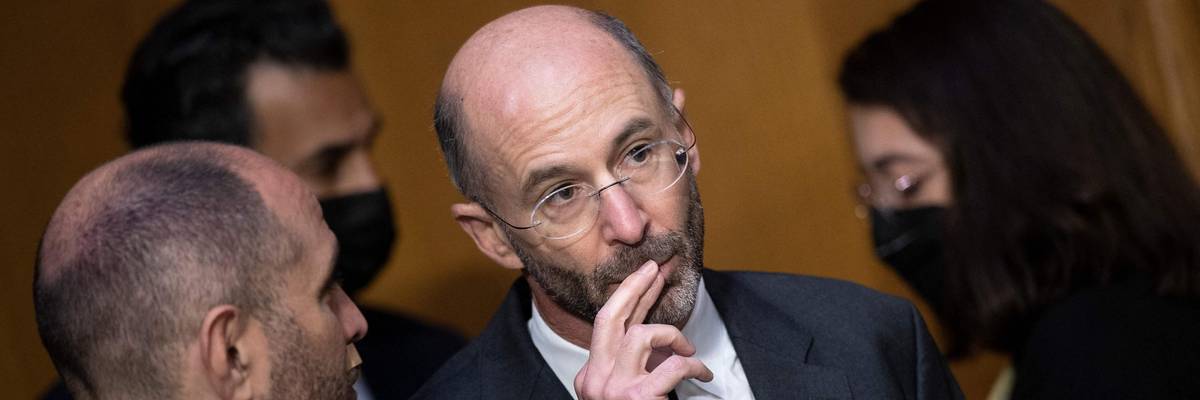
Robert Malley, Biden administration special envoy for Iran, waits to testify about the JCPOA (Joint Comprehensive Plan of Action) during a hearing of the Senate Foreign Relations on Capitol Hill May 25, 2022, in Washington, DC. (Photo: Brendan Smialowski/AFP via Getty Images)
A Renewed Iran Deal Provides a Way to Avoid the Threat of War
There's still time to undo Trump's reckless abandonment of diplomacy. The last thing the world needs is another regional arms race, or another war.
It could be make or break time for the Iran nuclear deal.
The Joint Comprehensive Plan of Action (JCPOA) was the Obama administration's top foreign policy achievement. It led to dramatic reductions in Iran's ability to enrich uranium in return for the U.S. and its allies lifting nuclear-related sanctions that were crippling Iran's economy.
Under Trump, the U.S. designated an elite Iranian military unit as a foreign terrorist organization. That led to extreme sanctions against individuals and agencies connected to this group.
Former President Donald Trump abrogated the agreement just over four years ago. The Biden administration's talks with Iran to revive the deal have since progressed impressively, but now they have stalled again.
The problem lies with one of the many new sanctions Trump imposed against Iran during his last days in office that have nothing to do with Iran's nuclear program or the JCPOA.
Under Trump, the U.S. designated an elite Iranian military unit, the Islamic Revolutionary Guard Corps, as a foreign terrorist organization. That led to extreme sanctions against individuals and agencies connected to this group.
The designation was explicitly designed by Trump to serve as a "poison pill" that would make it politically much harder for the U.S. to rejoin the deal, since it would require lifting sanctions against a so-called "terrorist" organization.
Unfortunately, the ploy seems to have worked.
The Senate recently approved a nonbinding GOP-backed measure pressuring the Biden administration not to de-list the Revolutionary Guard, even though getting back to the agreement will be almost impossible without delisting. Diplomats on all sides are working to overcome this obstacle, but time is running short.
Trump's blatantly political move has made the United States, the region and the world less safe.
During the period that the JCPOA was in effect, all sides agreed that Iran was in full compliance with its requirements. But still it faced devastating new sanctions from the Trump administration.
While Iran has gradually enriched uranium to higher levels since Trump abrogated the deal, it has made no attempt to acquire nuclear weapons. Returning to the JCPOA is the best way to prevent this from happening.
Israel is the region's only current nuclear weapons state. But others--including Saudi Arabia, the United Arab Emirates, Egypt and Turkey (which already has U.S. nuclear weapons on its soil as part of NATO's nuclear sharing)--could end up joining the nuclear club if Iran does.
To repeat, Iran has, to date, not moved toward acquiring nuclear weapons. But its people continue to endure punishing economic sanctions, with the poorest and most vulnerable always the hardest hit.
A renewed JCPOA provides a way to avoid the threat of war--initiated by one of Iran's regional rivals, or even the United States--that would arise should Iran at some point move toward nuclear capability. It might also serve as the basis for future negotiations with Iran on broader military and regional issues, and even set the stage for beginning negotiations towards global nuclear disarmament.
Negotiations over restoring the JCPOA are ongoing, and a resolution could come soon. A separate agreement between Iran and the UN''s nuclear watchdog agency, allowing UN inspection of Iran's nuclear sites, is scheduled to expire around June 6. That gives sharp urgency to getting the U.S. team to the table.
There's still time to undo Trump's reckless abandonment of diplomacy. The last thing the world needs is another regional arms race, or another war.
We are at a crossroads
This country and this world are at a monumental crossroads. In a few short weeks, US voters will have an opportunity to beat back the forces of fascism and confront the billionaires who are rigging the economy, our media system, and our democracy, making it increasingly impossible for ordinary people to get by. We’re not just talking about the election. We’re talking about what must be done once these fascist elements are vanquished from power. We need a bolder set of solutions than what either major party has so far been willing to offer and a working-class movement ready to fight like hell for it. Trump didn't emerge from nowhere. The conditions that fueled MAGA authoritarianism were created by decades of radical neoliberal economic policies and a corrupt political system dominated by corporate interests. They slashed taxes on the super-rich, promising that the benefits would trickle down. They said giveaways to the corporate titans would make life more affordable for the rest of us. It was all bullshit. And when a bitter, betrayed populace searches for someone to blame, right-wing demagogues have little trouble finding scapegoats. People know when they're being lied to, but you won't hear any of this from the corporate media. Only independent journalism—powered and funded by people who believe in building a better world—can deliver truly trustworthy daily news. Our Fall Campaign is underway, and we need your help. To power our newsroom through the rest of the year, we need to raise $125,000 by midnight on October 31. So if you share our vision, please contribute whatever you can to sustain our work. |
It could be make or break time for the Iran nuclear deal.
The Joint Comprehensive Plan of Action (JCPOA) was the Obama administration's top foreign policy achievement. It led to dramatic reductions in Iran's ability to enrich uranium in return for the U.S. and its allies lifting nuclear-related sanctions that were crippling Iran's economy.
Under Trump, the U.S. designated an elite Iranian military unit as a foreign terrorist organization. That led to extreme sanctions against individuals and agencies connected to this group.
Former President Donald Trump abrogated the agreement just over four years ago. The Biden administration's talks with Iran to revive the deal have since progressed impressively, but now they have stalled again.
The problem lies with one of the many new sanctions Trump imposed against Iran during his last days in office that have nothing to do with Iran's nuclear program or the JCPOA.
Under Trump, the U.S. designated an elite Iranian military unit, the Islamic Revolutionary Guard Corps, as a foreign terrorist organization. That led to extreme sanctions against individuals and agencies connected to this group.
The designation was explicitly designed by Trump to serve as a "poison pill" that would make it politically much harder for the U.S. to rejoin the deal, since it would require lifting sanctions against a so-called "terrorist" organization.
Unfortunately, the ploy seems to have worked.
The Senate recently approved a nonbinding GOP-backed measure pressuring the Biden administration not to de-list the Revolutionary Guard, even though getting back to the agreement will be almost impossible without delisting. Diplomats on all sides are working to overcome this obstacle, but time is running short.
Trump's blatantly political move has made the United States, the region and the world less safe.
During the period that the JCPOA was in effect, all sides agreed that Iran was in full compliance with its requirements. But still it faced devastating new sanctions from the Trump administration.
While Iran has gradually enriched uranium to higher levels since Trump abrogated the deal, it has made no attempt to acquire nuclear weapons. Returning to the JCPOA is the best way to prevent this from happening.
Israel is the region's only current nuclear weapons state. But others--including Saudi Arabia, the United Arab Emirates, Egypt and Turkey (which already has U.S. nuclear weapons on its soil as part of NATO's nuclear sharing)--could end up joining the nuclear club if Iran does.
To repeat, Iran has, to date, not moved toward acquiring nuclear weapons. But its people continue to endure punishing economic sanctions, with the poorest and most vulnerable always the hardest hit.
A renewed JCPOA provides a way to avoid the threat of war--initiated by one of Iran's regional rivals, or even the United States--that would arise should Iran at some point move toward nuclear capability. It might also serve as the basis for future negotiations with Iran on broader military and regional issues, and even set the stage for beginning negotiations towards global nuclear disarmament.
Negotiations over restoring the JCPOA are ongoing, and a resolution could come soon. A separate agreement between Iran and the UN''s nuclear watchdog agency, allowing UN inspection of Iran's nuclear sites, is scheduled to expire around June 6. That gives sharp urgency to getting the U.S. team to the table.
There's still time to undo Trump's reckless abandonment of diplomacy. The last thing the world needs is another regional arms race, or another war.
It could be make or break time for the Iran nuclear deal.
The Joint Comprehensive Plan of Action (JCPOA) was the Obama administration's top foreign policy achievement. It led to dramatic reductions in Iran's ability to enrich uranium in return for the U.S. and its allies lifting nuclear-related sanctions that were crippling Iran's economy.
Under Trump, the U.S. designated an elite Iranian military unit as a foreign terrorist organization. That led to extreme sanctions against individuals and agencies connected to this group.
Former President Donald Trump abrogated the agreement just over four years ago. The Biden administration's talks with Iran to revive the deal have since progressed impressively, but now they have stalled again.
The problem lies with one of the many new sanctions Trump imposed against Iran during his last days in office that have nothing to do with Iran's nuclear program or the JCPOA.
Under Trump, the U.S. designated an elite Iranian military unit, the Islamic Revolutionary Guard Corps, as a foreign terrorist organization. That led to extreme sanctions against individuals and agencies connected to this group.
The designation was explicitly designed by Trump to serve as a "poison pill" that would make it politically much harder for the U.S. to rejoin the deal, since it would require lifting sanctions against a so-called "terrorist" organization.
Unfortunately, the ploy seems to have worked.
The Senate recently approved a nonbinding GOP-backed measure pressuring the Biden administration not to de-list the Revolutionary Guard, even though getting back to the agreement will be almost impossible without delisting. Diplomats on all sides are working to overcome this obstacle, but time is running short.
Trump's blatantly political move has made the United States, the region and the world less safe.
During the period that the JCPOA was in effect, all sides agreed that Iran was in full compliance with its requirements. But still it faced devastating new sanctions from the Trump administration.
While Iran has gradually enriched uranium to higher levels since Trump abrogated the deal, it has made no attempt to acquire nuclear weapons. Returning to the JCPOA is the best way to prevent this from happening.
Israel is the region's only current nuclear weapons state. But others--including Saudi Arabia, the United Arab Emirates, Egypt and Turkey (which already has U.S. nuclear weapons on its soil as part of NATO's nuclear sharing)--could end up joining the nuclear club if Iran does.
To repeat, Iran has, to date, not moved toward acquiring nuclear weapons. But its people continue to endure punishing economic sanctions, with the poorest and most vulnerable always the hardest hit.
A renewed JCPOA provides a way to avoid the threat of war--initiated by one of Iran's regional rivals, or even the United States--that would arise should Iran at some point move toward nuclear capability. It might also serve as the basis for future negotiations with Iran on broader military and regional issues, and even set the stage for beginning negotiations towards global nuclear disarmament.
Negotiations over restoring the JCPOA are ongoing, and a resolution could come soon. A separate agreement between Iran and the UN''s nuclear watchdog agency, allowing UN inspection of Iran's nuclear sites, is scheduled to expire around June 6. That gives sharp urgency to getting the U.S. team to the table.
There's still time to undo Trump's reckless abandonment of diplomacy. The last thing the world needs is another regional arms race, or another war.